Homer: The Iliad
Book XXIV
Translated by A. S. Kline © Copyright 2009 All Rights Reserved
This work may be freely reproduced, stored and transmitted, electronically or otherwise, for any non-commercial purpose. Conditions and Exceptions apply.
Contents
- Bk XXIV:1-76 The gods argue over the treatment of Hector’s body
- Bk XXIV:77-140 Thetis persuades Achilles to ransom the corpse
- Bk XXIV:141-199 Iris carries the message to Priam
- Bk XXIV:200-280 Priam prepares to visit the Greek camp
- Bk XXIV:281-348 Priam prays to Zeus
- Bk XXIV:349-467 Hermes guides Priam to Achilles hut
- Bk XXIV:468-551 Priam moves Achilles’ heart
- Bk XXIV:552-620 Achilles releases Hector’s corpse to Priam
- Bk XXIV:621-676 Achilles agrees a truce for Hector’s funeral
- Bk XXIV:677-717 Priam returns to Troy with the body
- Bk XXIV:718-775 The lament for Hector
- Bk XXIV:776-804 Hector’s funeral
BkXXIV:1-76 The gods argue over the treatment of Hector’s body
After the funeral games, the men left the assembly and scattered each to their own ship, ready for supper and then their fill of sweet sleep. But Achilles wept in remembrance of his friend, and sleep that conquers all refused to come. He tossed this way and that, regretting Patroclus’ bravery and strength, remembering all they had done together and the hardships they had shared, embroiled in war or on the cruel sea. He shed great tears, thinking of these things, lying now on his side, his back, or on his face. Each night he would stagger to his feet, at last, and wander grieving along the sand.
Dawn would find him there, as she lit the sea and shore. Then he would harness his swift team to his chariot, and rope Hector’s corpse to the rear, and when he had dragged him three times round Patroclus’ mound, return to rest in his hut, leaving Hector’s body stretched out on its face in the dust. Yet Apollo kept the flesh from being spoiled, pitying the warrior even in death, and he covered the body with his golden aegis so that Achilles could not damage the skin as he dragged the corpse along.
Though Achilles in his anger tried to disfigure Hector, the blessed immortals felt pity as they watched, and urged the sharp-eyed Hermes to steal the corpse. Though this thought pleased most of them, Hera, Poseidon and bright-eyed Athene were opposed. They still hated sacred Ilium, Priam and his whole race, because of Paris and his foolish error, in humiliating the two goddesses, at the parade by his shepherd’s hut, when he showed his preference for Aphrodite, praising her for furthering his sad lust.
After eleven days of this, on the twelfth dawn Phoebus Apollo addressed them all: ‘Harsh and cruel you are, you immortals! Did Hector not burn the thighs of unblemished bulls and goats for you, and yet you have not the decency, now he is dead, to rescue his corpse for his wife, his mother, his child to watch over, nor for his father Priam and his friends, who might then swiftly give him to the fires, and enact his funeral rites. You would rather help this brute, Achilles, whose mind is warped, his will of adamant. The man’s heart is like a lion’s, wild and powerful is that creature’s in its urge to slaughter the shepherds’ flocks for meat. Achilles is as devoid of pity, and of the shame that benefits men, urging restraint. Many a man loses someone closer to him than this, a brother born of the one mother, or a son, yet when he has finished weeping and wailing he has done, since the Fates grant men patient endurance. But this man, having robbed Hector of life, ties him to his chariot and drags him round his dead friend’s mound, as if that brought him honour or profit. Great as he is, let him be wary of our wrath; not disfigure the mute clay in his fury.’
But white-armed Hera took exception to all this: ‘That might make sense, Lord of the Silver Bow, if the gods valued Hector as highly as Achilles. But Hector was a mere mortal, suckled at a woman’s breast, while Achilles is child to a goddess. I nurtured her and reared her myself, and gave her in marriage to Peleus, a warrior dear to us immortals. All of you, all you gods, came to the wedding, and you Apollo were there yourself, sitting down to feast, lyre in hand, you faithless friend of wrongdoers.’
Zeus, the Cloud-Gatherer now replied: ‘Hera, curb your anger against us. These men will not be honoured equally. Yet of all the mortals in Ilium, Hector was dearest to the gods. At least he was so to me, never failing in his gifts towards me. My altar never lacked for sacrifice, for a share of all his meat and drink, the offerings that are our privilege. But, no talk now of stealing brave Hector’s corpse, for Achilles would hear of it from his mother who visits him night and day. Better for one of you to summon Thetis to me, so I may advise her wisely, to have Achilles accept a ransom, and give Hector’s body back to Priam.
BkXXIV:77-140 Thetis persuades Achilles to ransom the corpse
Iris it was, swift as the storm-wind, who sped off to carry the message, and half-way between Samothrace and rugged Imbros plunged into the dark echoing waters. Down she sank like the fisherman’s lead weight set in a piece of ox-horn that lures the greedy fish to their death. In a hollow cave she found Thetis, surrounded by the nymphs of the sea, bemoaning the destiny of her peerless son, doomed to die in the fertile land of Troy, far from his native soil. Fleet-footed Iris approached and spoke: ‘Come, Thetis, Zeus of deathless wisdom summons you.’ ‘Why does the great god ask for me?’ the silver-footed goddess replied, ‘I’m possessed by such deep sorrow, I’d be ashamed to join the immortals, yet I will go, for anything he says must carry weight.’
With that, the lovely goddess donned a dark veil, blacker than black, and followed Iris, swift as the wind. The deep sea parted for them, and when they reached the shore they soared to the heavens, and found far-echoing Zeus surrounded by all the blessed immortals. Athene gave up her place next to the son of Cronos, and Hera handed her a fine golden cup, and welcomed her sweetly, and Thetis drank and gave her back the cup. Then the Father of gods and men addressed her: ‘Lady Thetis you come, I know, bearing the burden of sorrowful thought, yet I must tell you why I summoned you. The immortals have been quarrelling these nine days about how Hector’s corpse is treated by Achilles, sacker of cities. They would like Hermes to spirit the body away, but I would rather honour Achilles, and keep your love and respect in time to come. So dart down to his camp and tell him what I say, that he has angered the gods, and I above all am filled with wrath, because he holds Hector’s corpse by the beaked ships, instead of restoring it to Troy. Hopefully, in fear of me, he will return the body, but I will send Iris to brave Priam, and tell him to go to the Greek ships and offer a ransom for his son, gifts that will thaw the heart of Achilles.’
The goddess, silver-footed Thetis, instantly obeyed, darting down from the heights of Olympus to her son’s hut. There she found him still grieving, while his friends prepared their morning meal. The carcase of a great shaggy ram lay there, awaiting their attention, in the hut. His regal mother sat down beside him and stroking him with her hand said: ‘Child, how long must you consume your heart with tears and sorrow, forgetting your food and bed? Why not find comfort with some woman, since you have but a brief time left to live, and the shadows of Death and remorseless Fate are already close upon you. Obey me swiftly now.’ And she gave him Zeus’ message, to release Hector’s corpse and take a ransom in exchange.
Fleet-footed Achilles gazed at her and answered: ‘If such be the Olympian’s firm wish, then let it be so. Let whoever brings fit ransom take away the dead.’
BkXXIV:141-199 Iris carries the message to Priam
While mother and son were exchanging winged words there by the ships, Zeus sent Iris to sacred Ilium: ‘Down from Olympus, Iris, fast as you can, and tell brave Priam in Troy to go to the Greek ships and ransom his dear son’s body, carrying gifts to Achilles that will thaw his heart. Tell him to go alone, not to take anyone else from Troy except one of the older heralds, to drive the light mule-cart that will carry Achilles’ victim back to the city. Tell him not to fear death or anything else, for we will grant him the best of guides, Hermes, who will escort him to Achilles. Once in Achilles’ hut, no one will harm him, for he will not find Achilles witless, mindless, vicious, but one who will in kindness spare the suppliant.’
Those were his words, and Iris, swift as the storm-wind, sped away with the message. She came to Priam’s palace and found it filled with grief and lamentation. Around their father his sons sat, their garments drenched with tears. There in the middle of the courtyard was the aged king wrapped in a cloak, his head and neck soiled by the earth from his hands as he grovelled on the ground. Throughout the palace his daughters and daughters-in-law were bemoaning the host of noble warriors who had lost their lives at Greek hands.
Iris, Zeus’ messenger, came to Priam and said: ‘Take heart, Dardanian Priam, forgo all fear. I am here not as a herald of evil but with the best of intent. I come with a message from Zeus, who far off though he may be still cares about you and has pity.’ Then she repeated Zeus’ wishes, and departed.
Then Priam ordered his sons to harness the light mule-cart, with a wicker frame on top. He himself went down to his vaulted treasure chamber, high-roofed and fragrant with cedar-wood, which was full of precious things. He summoned his wife Hecabe, and said: ‘Lady, a message from Zeus has come to me, telling me to go to the Greek ships and ransom our dear son’s body, with gifts that will thaw Achilles’ heart. I feel compelled to go to the Greek camp, to their ships, but tell me what you think.’
BkXXIV:200-280 Priam prepares to visit the Greek camp
Hecabe cried out at his words, and said: ‘Alas, where is that wisdom now for which you are famous here and abroad? How can you go to the Greek ships and face the man who has slaughtered so many of your fine sons? Your heart must be made of iron. Once you are in his power, from the moment he sets eyes on you, that savage treacherous brute will show you neither mercy nor respect. Let us grieve for our son here, in the hall. This is the thread Fate spun for that child of mine at his birth, to sate the running dogs far from us, his corpse held captive by that man of violence. I wish I could fix my teeth in Achilles’ heart and devour it. That would requite him for what he has done to my son, who showed he was no coward when he was killed, fighting to defend the men and the full-breasted women of Troy, without thought of flight or safety.’
Priam, that godlike old man, answered her: ‘Don’t try to prevent me going, I will not be persuaded, and don’t you prove a bird of ill-omen here. If any man on earth had spoken to me of this, even a priest, or some diviner who reads the sacrificial entrails, I would have thought it false, and rejected it the more. But I heard the voice of a goddess, and saw her face to face, so I must go, and fulfil her command. If I am doomed to die by the ships of the bronze-clad Greeks, then so be it. When I have clasped my son in my arms and wept my fill, then let Achilles slay me on the spot.’
So saying, he lifted the ornate lids of several chests from which he took twelve fine robes, and twelve single-sided cloaks, with as many coverlets, white mantles and tunics also. He weighed out ten talents of gold and had them taken outside, with two bright tripods, and four cauldrons. And he even added a great treasure, a beautiful cup, a gift from the men of Thrace when he went on an embassy there, so eager was he to ransom his dear son fittingly. Then he drove out the Trojans cluttering the portico, rebuking them with harsh words: ‘Out you shameful wretches! Have you nothing to grieve for at home that you come to trouble me? Is it not enough that Zeus has brought me sorrow; taking from me the best of sons? You will soon know it too. You’ll be easy meat for the Greeks now Hector is dead. As for me, I only hope I go to the House of Hades before I have to see this city plundered and laid waste.’
With this, he chased after them with his staff, and they fled from the angry old man. He shouted reproaches at his sons as well, Helenus, Paris, noble Agathon, Pammon, Antiphonus, Polites of the loud war-cry, Deiphobus, Hippothous, and lordly Dius. He ordered all nine around at the top of his voice: ‘Quick, you useless tribe, my disgrace: would that instead of Hector you were the ones who had died by the swift ships! Alas, my wretched fate! I had the best sons in all the wide land of Troy, yet they are gone, every one; godlike Mestor, Troilus the fierce charioteer, and now Hector, a god among men, who seemed the son of a divine being, not of this mere mortal. War has taken them all, while you shameful creatures remain, liars and wastrels, better at treading the dust in dance, or stealing lambs and kids from the fields. Make ready the cart, now, and pile these things inside, so I can be on my way.’
So he ranted, and they, fearful of their father’s anger, brought out the light mule cart, new and carefully-made, and added the wicker frame on top. They took the boxwood yoke with its central boss and fine guide rings from its peg, and carried it out with its twelve foot yoke-band. They set the yoke carefully on the polished shaft, in the notch at the end, and slipped the ring over the pin. Then they bound it fast to the boss with three turns either way, then wound it round the shaft and tucked the loose end in. They carried the princely ransom for Hector’s corpse from the treasure chamber, and heaped the items on the wooden cart. Then they yoked the sturdy mules, trained to work in harness, a glorious gift to Priam from the Mysians. Last of all they brought, and yoked to his chariot, horses kept by the king himself and fed at the gleaming manger.
BkXXIV:281-348 Priam prays to Zeus
Priam and the herald were waiting, lost in thought, in the lofty palace, for their teams to be harnessed, when Hecabe came to them, full of anxiety, carrying a golden cup of honeyed wine in her right hand, so they might make libation before they set out. She approached the chariot saying: ‘There, pour a libation to Father Zeus and pray for your safe return from the enemy camp, since your heart persuades you to go despite my misgivings. Pray to the son of Cronus, Lord of the Storm-Clouds, God of Ida, who gazes down on our whole land of Troy, and ask him to send a bird of omen, and make it that swift messenger, dearest to him of all the birds, and mightiest. Let it appear on your right hand, so you can note it and feel safe in going among the horse-loving Danaans. If Zeus does not grant you a sight of his swift messenger, then I’d not advise you to visit the Argive ships, no matter how you feel.’
‘Wife,’ Priam replied, ‘I will do as you suggest, for it is good to pray to Zeus, and ask him for mercy.’
So saying the old man asked a maid to pour fresh water over his hands. She brought a pitcher of water and a basin, and when he had washed his hands, he took the cup from his wife and standing in the centre of the courtyard, he poured the wine, then gazed towards heaven and prayed aloud: ‘Glorious and almighty Father Zeus, who rules from Ida, let me be welcome in Achilles’ hut and may he show mercy. Send me a bird of omen, that swift messenger, dearest to you of all the birds, and mightiest. Let it appear on my right hand, so I can note it and feel safe in going among the horse-loving Danaans.’
Zeus, the Counsellor, heard his prayer, and sent the greatest of winged omens: the dark raptor men call the black eagle. Its wingspan was as wide as the double doors, strong and secure, of a rich man’s lofty treasure chamber, and it soared on the right, high over the city. They were overjoyed at a sight that warmed the hearts of all.
The old man quickly mounted the chariot, and drove from the echoing portico out through the palace gate. The mules in front pulled the cart driven by wise Idaeus, while the old man’s team followed. He cracked his whip as they sped through the city, while his folk followed after, wailing as if he went to his death. But when they had left the city and entered the plain, his sons and sons-in-law turned back to Ilium.
The pair did not escape Zeus, the Far-Echoer’s, notice, as they forged across the plain, and pitying the old man he spoke at once to his dear son Hermes: ‘You love to guide travellers, and give ear to whomever you wish, so go and escort Priam to the hollow ships of the Greeks, so that no one knows him till he reaches Achilles.’
At this, the Messenger God, the Slayer of Argus, quick to obey, bound his beautiful sandals on his feet, the sandals of imperishable gold that carry him swift as the gale over the ocean waves and the boundless earth. He took with him that wand with which he lulls to sleep or rouses from slumber whomsoever he will. He flew with it in his hand, and soon came to the Hellespont and Troy. There he appeared in the likeness of a young prince at that age when a beard first starts to grow, and youth’s charms are at their greatest.
BkXXIV:349-467 Hermes guides Priam to Achilles hut
When the pair had passed the great barrow of Ilus, they halted the mules and the horses by the river to drink. It was twilight now, and Hermes was close before the herald saw him. Turning to Priam he said: ‘Take care, Dardanian Priam, here is something that calls for caution. There’s a man in sight who will butcher us, it seems to me. Let’s flee in the chariot, or we’ll have to fall at his feet and hope for mercy.’
At this the old man’s hair stood on end, and his mind filled with fear and confusion. But as he stood there in a daze, the Helper went straight to the old man and took his hand, and asked him: ‘Father, where are you off to, with your mules and horses, through the sacred night, when ordinary mortals sleep? Do you not fear the Greeks and their fury, an enemy without shame, close by? What would you do if one of them saw you carrying treasure through the swiftly darkening night? You are neither of you young enough to ward off some youngster’s attack. I am no threat to you, however, and I will be your defence, since to me you are the very image of my own father.’
Godlike Priam, the aged king, replied: ‘Dear son, it is as you say. Yet some god has extended his hand above me, since he sends a traveller such as you to meet me, a fine omen, for you are of marvellous beauty and stature, and wise beyond your years. Happy are the parents from whom you spring.’
‘Indeed, Sir,’ Hermes answered, ‘it may be so. But tell me truly, do you carry this heap of noble treasure to safety in some foreign part, or are you all fleeing Troy in fear, having the lost the best of warriors, your fine son, who never ceased to fight the Achaeans?’
Godlike Priam replied: ‘Who are you, noble youth? Who are your parents? You speak so eloquently of my unfortunate son.’
The Messenger God, the Slayer of Argus, answered: ‘You are testing me, I see, my venerable lord, in asking about Hector. I have often seen him in battle, where glory is won. I saw him killing Argives when he drove them to the ships, cutting men down with the sharp bronze, and we stood there dumbfounded, for Achilles held us back, in his wrath against Agamemnon. I am Achilles’ squire, who sailed here with him, one of the Myrmidons, the son of Polyctor. He is wealthy, an old man like you, with six sons, and I a seventh. We cast lots and I was chosen to follow Achilles. Tonight I am scouting the plain, since at dawn the bright-eyed Achaeans will battle for the city. They are tired of sitting idle, and Agamemnon can no longer restrain them in their eagerness for war.’
Godlike Priam, the aged king, replied: ‘If you are truly Achilles’ squire, tell me this. Is my son’s body still by the ships, or has Achilles hewn him limb from limb and scattered him to the dogs?’
Again the Slayer of Argus answered: ‘The dogs and carrion birds have not devoured him yet, my venerable lord, and his corpse still lies by Achilles’ ship among the huts as before. He has lain there twelve days now, but his flesh has not decayed, nor do the worms that feed on war dead consume him. It is true that ruthless Achilles drags his body round his dear comrade’s barrow, every dawn, yet he cannot harm him. You would marvel if you came and saw him, fresh as dew, washed clean of blood, without a stain upon him, and all his wounds are closed, wherever the host of bronze blades struck him. So do the blessed gods care for his corpse: for he was dear to them.’
The old man’s mind was eased to hear this, saying: ‘My child, it is good to give the immortals all that is due to them, for in my halls my son, as surely as he lived, never forgot the gods who hold Olympus, and they have now remembered him, even though he has met his doom. Come take this fine goblet, and protect me and see me safe at Achilles’ hut, with the blessing of the gods.’
The Messenger God, the Slayer of Argus, spoke once more: ‘Ah, my venerable lord, because I am young you test me, but you cannot tempt me to take a gift without Achilles’ knowledge. I respect him deeply, and fear to rob him of what should be his, lest evil later befalls me. Yet I would guide you to glorious Argos, and wait on you with kind attention as we travel on foot or aboard ship, and no one would dare attack you on seeing your guide.’
With that the Helper leapt into the chariot, seized the whip and reins, and breathed fresh strength into the horses and mules. When they came to the trench and wall defending the ships, the guards were preparing their meal, and the Slayer of Argus shed sleep around them, thrust back the bars, and opened the gates, and drove Priam through them with the cart and his gifts.
They came to Achilles’ hut, a high-roofed hut the Myrmidons built for their prince, with beams cut from the fir trees. They had thatched it with meadow rushes, and fenced it with stakes, close-set to make a courtyard. The gate to the yard was held by a single fir-wood bar that needed three Myrmidons to drive it home or draw it back, though Achilles could do so alone. This gate Hermes the Helper opened for the aged king, ahead of the glorious gifts destined for fleet-footed Achilles. Then he stepped down from the chariot saying: ‘Venerable lord, my Father sent me to guide you on your way. You have been visited by an immortal god, for I am Hermes. Now I must leave you and return, and not be seen by Achilles, for it would be wrong for a god to be entertained openly by a mortal man. But you must go in, and clasp his knees, and invoke his father Peleus, and his mother, of the shining tresses, and his child, and so move his heart.
BkXXIV:468-551 Priam moves Achilles’ heart
With that, Hermes left for high Olympus, while Priam climbed down from his chariot, leaving Idaeus to handle the horses and mules. The old king went straight to the hut frequented by Zeus-beloved Achilles. He found him there, with only the warrior Automedon and warlike Alcimus of all his friends. They were busy attending to his meal. The table stood at his side but he had finished eating and drinking. Great Priam slipped in unobserved, and reaching Achilles, clasped his knees, and kissed his hands, the fearful, man-killing hands that had slaughtered so many of his sons. Achilles was astonished at the sight of godlike Priam, as were his friends. They stared at each other, astounded, as men do in the hall of a wealthy nobleman, when a stranger, who has murdered a man in a moment of frenzy in his own country, seeking refuge abroad, bursts in on them.
But Priam was already entreating Achilles: ‘Godlike Achilles, think of your own father, who is of my generation, and so is likewise on the sad threshold of old age. Perhaps his neighbours are troubling him, and there is no one to protect him from harm, or ward off ruin. But he at least can rejoice in the knowledge that you live, and each day brings the hope of seeing you return from Troy. While I, I am a victim of sad fate. Of the best of my sons, the best in all of Troy, not one is left. Fifty sons I had, when you Achaeans landed, nineteen by the one wife, and the rest by other ladies of my court. Most of them have fallen in furious battle, and the defender of the city and its people, my prime recourse, Hector, you have killed, as he fought for his country. I come now to the ships to beg his corpse from you, bringing a princely ransom. Respect the gods, Achilles, and show mercy towards me, remembering your own father, for I am more to be pitied than he, since I have brought myself to do what no other man on earth would do, I have lifted to my lips the hand of the man who killed my sons.’
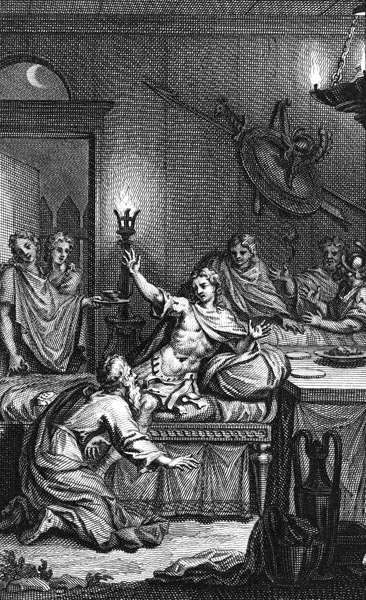
‘Priam pleads for Hector's body’ - Workshop of Bernard Picart, 1710
His words had moved Achilles to tears at the thought of his own father, and taking the old man’s hands he set him gently from him, while both were lost in memory. Priam remembered man-killing Hector, and wept aloud, at Achilles’ feet, while Achilles wept for his father Peleus and for Patroclus once more, and the sound of their lament filled the hut.
But when Achilles was sated with weeping, and the force of grief was spent, he rose instantly from his chair, and raising the old king by his arm, he took pity on his grey beard and hair, and spoke eloquently to him: ‘You are indeed unfortunate, and your heart has endured much sorrow. Surely, though, there is iron in your spirit, daring to come alone to our ships, and face the man who slew so many of your noble sons? Come, sit here, and we will shut away our sorrows, despite our grief, since there is but cold comfort in lament. The gods have spun the thread of fate for wretched mortals: we live in sorrow, while they are free from care. Two urns stand in Zeus’ palace containing the experiences he grants mortals, one holds blessings, the other ills. Those who receive a mixture of the two meet with good and ill, but those whom the Thunderer only serves from the jar of ills becomes an outcast, driven over the face of the earth by despair, a wanderer honoured neither by gods nor men. See how the gods showered glorious gifts on my father Peleus, from the moment of his birth, wealth and possessions beyond other men, kingship of the Myrmidons, and though but a mortal man, a goddess for a wife. Yet some god brought evil even to him, no crowd of princes, but an only son doomed to an untimely end. He receives no care from me, since I sit here in theland of Troy, far from my own country, bringing harm to you and your children. And you, my aged lord, they say you once were happy, renowned for your wealth and your sons, in all the lands, from the isle of Lesbos, where Macar reigned, through upper Phrygia to the boundless Hellespont. But from the moment that the heavenly gods brought this wretched war upon you, all has turned to battle and slaughter. Endure, let your heart not grieve forever, Sorrowing for your son will achieve nothing, you’ll not bring him back to life, though life will bring you other sorrows.’
BkXXIV:552-620 Achilles releases Hector’s corpse to Priam
‘Do not ask me to sit down, beloved of Zeus,’ replied the aged king, ‘while Hector’s corpse lies neglected by the huts, but give him back to me swiftly so my eyes can gaze on him, and accept the ransom, the princely ransom, I bring. May you have joy of it, and return to your native land, since you have shown me mercy from the first.’
Fleet-footed Achilles, frowning answered him; ‘I need no urging, old man. I have decided to return Hector’s body to you. My own mother, the daughter of the Old Man of the Sea, brought me a message from Zeus. And I know in my heart, such things don’t escape me, that some god led you to our swift ships. No mortal man, not even a strong young warrior, would dare to venture into this camp, nor having done so elude the guards, nor shift the bar across the gate. So don’t try to move my heart further, lest I defy Zeus’ command and choose, suppliant though you are, not to spare even you.’
The old king, gripped by fear, was silent. Then the son of Peleus ran from the hut, followed by his two companions, Automedon and Alcimus, the dearest of his friends after dead Patroclus. They un-harnessed the mules and horses, brought in the old king’s herald, his crier, and offered him a chair. Then from the well-made cart they lifted down the princely ransom for Hector’s body. They left there two white cloaks and a fine tunic, so that the corpse could be wrapped in them, before he gave it back to Priam to take home. Achilles then summoned two servant-girls and ordered them to wash and anoint the body, first carrying it to a place where Priam could not see his son, lest his grief at the sight provoke his anger and Achilles be angered in reply, and kill him in defiance of Zeus’ command. When the servant-girls had done washing the body and anointing it with oil, and had dressed it in the fine tunic and wrapped it in a cloak, Achilles himself placed it on a bier, and he and his comrades lifted it into the wooden cart. Then he sighed and called his dead friend by name: ‘Patroclus, do not be angered, if even in the House of Hades you learn that I have returned noble Hector to his dear father, who has given a princely ransom. Even of that you shall have your rightful share.’
With this, noble Achilles returned to the hut and sat down again on his richly inlaid chair opposite Priam, saying: ‘Venerable lord, your son’s body has been placed on a bier and I shall release it to you as you wished. At dawn you may look on him, and carry him back, but now let us eat. Even long-haired Niobe eventually thought to eat, though her twelve children had been slain, six daughters, six sons in their prime. Apollo angry that Niobe had boasted of bearing so many children compared with Leto who had borne but two, killed the sons with arrows from his silver bow, while his sister Artemis killed the daughters. The pair slew them all, and left them lying in their blood, for nine days, since Zeus had turned the people to stone and there was no one to bury the corpses. On the tenth day the heavenly gods gave them burial, and only then did Niobe, exhausted by her grief, take sustenance. Now, turned to stone herself, she stands among the crags on the desolate slopes of Sipylus, where men say the Nymphs that dance on the banks of Achelous take their rest, and broods on the sorrows the gods sent her. Come let us too take sustenance, venerable lord: in Ilium you can lament your son once more, and grieve for him with a flood of tears.’
BkXXIV:621-676 Achilles agrees a truce for Hector’s funeral
Swift Achilles sprang to his feet, and went and slaughtered a white-fleeced sheep, which his men flayed and prepared. They chopped it deftly, spitted the pieces, roasted them carefully, and then drew them from the spits. Automedon set out bread in neat baskets, while Achilles served the meat, and they helped themselves to the good things placed before them.
When they had sated their hunger and thirst, Dardanian Priam contemplated Achilles and how marvellously tall and handsome he was, the very image of a god. Achilles too marvelled, at Priam’s nobility and eloquence. When they had gazed at each other to their heart’s content, godlike king Priam said: ‘Beloved of Zeus, show me to my bed now, so that, lulled by sweet sleep, we may find ease in rest. My eyes have not closed since my son lost his life at your hands. Then I lamented and brooded over my endless sorrows, and grovelled in the dirt in my courtyard. Now I have tasted food and wetted my throat with red wine, who until now tasted nothing.’
Now Achilles ordered his friends and the servant-girls to set up bedsteads in the portico, cover them with fine purple blankets, and spread sheets above, and fleecy mantles on top to keep the guests warm. Torch in hand, the girls left the room and swiftly busied themselves at the task. Then fleet-footed Achilles spoke to Priam in a cooler tone: ‘You must sleep outside, venerable lord, in case one of the countless counsellors of the Achaeans comes to sit and talk with me, as is right. If he saw you, in the swift passage of darkness, he might hasten to King Agamemnon, and then the return of the corpse to you would be delayed. Now, tell me truly, how long do you need for noble Hector’s funeral. I will keep truce myself for that length of time, and restrain the army.’
The godlike old king answered him: ‘You would be doing me a great kindness Achilles, if you indeed allow me time to bury Hector. You know the city is surrounded, and the Trojans would fear to fetch wood from the far hills, otherwise. We will lament him nine days in the palace, and carry out the rites on the tenth. Then on the eleventh day we will raise his barrow, and the people feast. If we must, we will fight again on the twelfth.’
Fleet-footed Achilles replied: ‘It shall be as you say, aged Priam, and I will restrain the army for that length of time.’
With that, he clasped the old man’s right wrist, to reassure him. Then Priam and Idaeus the herald lay down to sleep in the portico, their minds still full of thoughts, while Achilles slept in the inner recess of his well-built hut, with the lovely Briseis by his side.
BkXXIV:677-717 Priam returns to Troy with the body
Gods and warriors, overcome by sleep, passed the night in slumber, but not Hermes the Helper, who was awake considering how to lead Priam from the ships, without being challenged by the trusty guards at the gate. Finally, standing at the head of Priam’s bed, he spoke to him: ‘Aged lord, now Achilles has spared you, it seems that though still ringed with enemies, you sleep without a care. You have ransomed your son for a princely sum, but the one your sons will need to give will be three times as great, if Atreides or one of his warriors finds you here.’
The old man woke, in fear, and roused the herald. Hermes harnessed the mules and horses, and undetected by their enemies, drove them quietly through the camp himself. As saffron-robed Dawn lit the wide earth, they reached the ford of eddying Xanthus, that noble river begotten by immortal Zeus, and Hermes left them for high Olympus. Lamenting and in tears the two men drove, Priam the chariot and horses, Idaeus the mule-cart carrying the bier. No one in Troy, man or woman, knew anything of them till Cassandra, lovely as golden Aphrodite, from the heights of Pergamus, saw her dear father driving the chariot, and the herald, the city crier, driving the mule-cart, and saw who lay there on the bier. She gave a loud cry, and called to the city below: ‘Men and women of Troy, if ever you rejoiced when Hector returned from battle, come now and gaze on him, who brought joy beyond compare to the city and its people.’
Soon the city emptied. Plunged in unbearable grief, all ran to the gate, and close beyond them met Priam, bringing home his dead. Hector’s beloved wife and royal mother flung themselves at the cart. Clasping Hector’s head, they wailed and tore their hair, while the great host of people wept. And they’d have been there, outside the gate, lamenting him the livelong day till the setting of the sun, if old Priam had not called out to them from the chariot: ‘Let the mules pass, and when I have brought him to the palace then you can take your fill of lament.’
BkXXIV:718-775 The lament for Hector
At Priam’s request, the crowd parted and made way for the cart. The family led the way to the royal palace, and there they laid the body on a wooden bed, and summoned the chorus of singers to stand beside it, to sing the dirges and lead the lamentation, while the women wailed in chorus. White-armed Andromache made the first lament, cradling the head of man-killing Hector: ‘Husband, you have died too young, leaving me a widow in the palace, and your son, whom we his unhappy parents brought into the world, is still a babe who I fear will never grow to manhood. For this city is doomed to perish utterly, as you have perished who watched over it, and kept its wives and children safe, who will soon be captive aboard the hollow ships, I among them. You my child will go with me, and labour somewhere at menial tasks for some harsh master. Or worse perhaps, some Greek will seize you by the arm and hurl you from the wall to your death, angered perhaps because Hector killed his brother, father, son, for many are the Achaeans whose mouths have bit the dust at the hands of Hector, and your father was not a kindly man in battle. Now the people lament you throughout the city, Hector, and unspeakable grief your death has brought your parents. The bitterest grief of all is mine, because you did not die in your bed, stretching out your arms to me, with some tender word that I might have treasured, in tears, night and day.’
Such was her lament, and the women added their grief to hers. Now Hecabe took up the impassioned dirge: ‘Hector, dearest to me of all my children, dear to the gods when you were alive, who care for you now therefore in death. Swift-footed Achilles robbed me of other sons, selling them beyond the restless sea in Samothrace, Imbros or in Lemnos veiled in smoke. You he killed with the sharp bronze and dragged you round his friend Patroclus’ barrow, whom you slew, not that he raised him from the dead by doing so, and yet you lie here fresh as dew, as if newly dead, like one whom Apollo of the Silver Bow has touched and killed with his gentlest dart.’
So she lamented, and stirred endless grief. Now Helen followed with a third lament: ‘Handsome Hector, dearest to me of all my Trojan brothers! Godlike Paris, my husband, brought me to this land of Troy, though I’d rather I had died there and then, and this is now the twentieth year since I abandoned my native country, yet in all that time I had no harsh or spiteful word from you. If any in the palace reproached me, your brothers, sisters, your brother’s fine wives, or your mother, for your father was ever gentle to me like my own, you would turn away their wrath, and restrain them with gentle acts and words. So I grieve aloud for you, and in my heart for my wretched self, since there is no one else in all wide Troy who’ll be kind or gentle to me, all of them shudder as I pass.’
BkXXIV:776-804 Hector’s funeral
So Helen lamented, and the whole crowd wept. But the old king, Priam, gave his orders: ‘Gather wood now, men of Troy, and bring it to the city, and have no fear of some crafty ambush by the Greeks. Achilles promised me, before I left the black ships, that he would restrain their army till the twelfth dawn comes.’
So they harnessed oxen and mules to the wagons, and assembled outside the city. For nine days they gathered huge piles of logs, and when the tenth dawn brought light to mortals they carried brave Hector, and, in tears, laid his body on the summit of the pyre and set the wood ablaze.
Next day, when rosy-fingered Dawn appeared, the people gathered at glorious Hector’s pyre. Then when all had assembled they worked together, quenching the embers with red wine, wherever the fire had reached. Then Hector’s brothers and his friends collected his ashes, still mourning him, their cheeks wet with tears. They placed the ashes, wrapped in a purple robe, inside a golden urn, and laid the urn in a hollow grave, covering it with large close-set stones. Then over it they piled the barrow, posting sentinels on every side, lest the bronze-greaved Greeks attacked them before the promised time. When they had heaped the mound, they returned to Troy, and gathered in Zeus-beloved Priam’s palace for the glorious funeral feast appointed.
And such were the funeral rites of Hector, tamer of horses.
The End of the Iliad