François de Chateaubriand
Travels in Italy
(Voyage en Italie)
Translated by A. S. Kline © Copyright 2010 All Rights Reserved.
This work may be freely reproduced, stored and transmitted, electronically or otherwise, for any non-commercial purpose. Conditions and Exceptions apply.
Contents
- About This Work
- First Letter to Monsieur Joubert
- Journal
- Second Letter to Monsieur Joubert
- Third Letter to Monsieur Joubert
- Tivoli, and Hadrian’s Villa
- The Vatican
- The Capitoline Museum
- The Doria Gallery
- A Moonlit Walk through Rome
- A Trip To Naples
- Pozzuoli and Solfatara
- Vesuvius
- Patria, or Liternum
- Baiae
- Herculaneum, Portici, Pompeii
- To Monsieur de Fontanes
About This Work
Chateaubriand’s Voyage en Italie, describes his Italian travels in the years 1803-4, during the first of his visits to the country. From France he crossed the Alps to Rome and its environs, from which he subsequently travelled to Naples, where Vesuvius, Baiae, and Pompeii figured amongst the sights he visited. His knowledge of the Classical world informs his wanderings among its ruins, and he enjoys the poetry of the picturesque while reflecting on the grandeur of the past. Rome, for him, represents a meeting of the Classical and Christian worlds, magnificent but in many ways a hollow tribute to human vanity, a theme he will revisit in his later travels to Greece, the Levant and the Holy Land. Naples represents a more picturesque and vibrant Italy. Articulating both cultural quest and voyage for pleasure, Chateaubriand writes of his journey as a ‘tourist’ rather than a scholar or adventurer, penning the work in the form of letters, derived from his travel notes and designed for his interested friends. Here he mingles personal memories with aesthetic and historical perceptions, against the background in which he is most at home, the European heritage, the works of the great poets, landscape and ruins, allowing him to muse freely on transience, the human voyage, and on beauty, found or created.
First Letter to Monsieur Joubert
(Monsieur Joubert, the elder brother of the Advocate General at the Court of Annulment, a man of rare spirit, a superior and benevolent soul, a charming and steadfast companion, with talents that would have won him a well-deserved reputation if he had not desired seclusion; a man too soon snatched from his family, and from that select society bound together by his presence; a man whose death has left in my life one of those voids the years impose on us, and which they cannot repair.)
Turin, the 17th June, 1803
I was unable to write to you from Lyon, my dear, friend, as I promised. You know how much I love that excellent city, where I was welcomed so warmly last year, and even more warmly this. I saw again the old Roman walls, defended in our day by the brave Lyonnais when the cannon-shot of the Convention forced our friend Fontanes to find another hearth for his daughter’s cradle. I saw the Abbey of the Two Lovers and Rousseau’s Fount. The hill-slopes along the Saône are more picturesque and delightful than ever, the little boats which sail that sweet river (the mitis Arar of Lucan: Pharsalia I) shrouded with canvas, lit at night by lamps, and piloted by young girls, delight the eye. You love the sound of bells: come to Lyon then; all the monasteries scattered about its hills seem to have regained their solitary inmates.
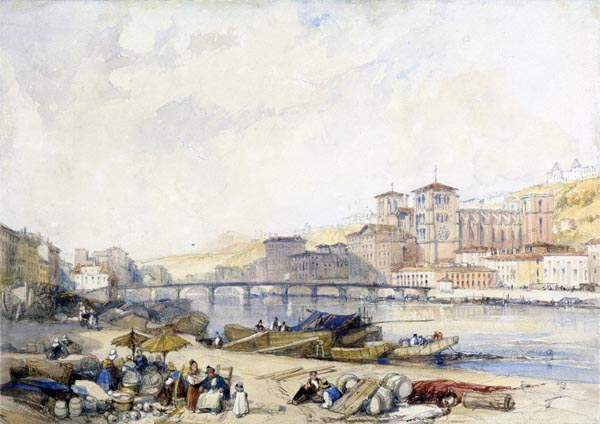
‘Lyons from Quayside on the Rhone’
James Duffield Harding, 1798 - 1863, British
Yale Center for British Art, Paul Mellon Collection
You already know that the Academy of Lyon has done me the honour of admitting me among its members. Here is a confession: if cleverness has merit, don’t look to my pride for the virtue it possesses; you know you would even seek to view hell in its most favourable light. The greatest pleasure I have experienced in my life is that of being honoured, in France and abroad, with unexpected expressions of interest. Occasionally, while I was staying in some wretched village inn, I would find a father and mother enter with their son; they had brought their child, they said, to thank me. Was it self-love that granted me then the intense pleasure of which I speak? In what way could it flatter my vanity that these obscure though worthy people should testify to their gratification, beside the open road, in a place where no-one but I could hear them? What moved me, or at least I venture to think so, was to have done some good; to have solaced afflicted hearts; to have rekindled in the depth of a mother’s breast the hope of rearing a Christian son, in other words, a dutiful son, respectful, and devoted to his parents. I have no idea what value my work (The Spirit of Christianity: Le Génie du Christianisme) may possess; but would I have tasted such pure delight if I had written, with all imaginable skill, a book which struck a blow at morality or religion?
Convey to our little circle, my dear friend, how much I miss it. It has an inexpressible charm, because one feels that people who speak so naturally of everyday matters are capable of discussing the most elevated subjects, and that their simplicity of discourse is not due to poverty of thought, but a matter of choice.
I left Lyon, the other day, at five in the morning. I will not give you a eulogy on that city: its ruins are there; they speak to posterity; and while courage, loyalty, and religion, find honour amongst men, Lyon will never be forgotten. (It is very sweet to find, twenty-four years later, in a neglected manuscript, the expression of feelings that I, more than ever, profess for the people of Lyon; it is even sweeter to have recently received from them the same marks of esteem with which they honoured me nearly a quarter of a century ago.)
Our friends have made me promise to write to them en route; my progress, however, has been too swift, and I lacked the time to honour my word. I merely scribbled with a pencil, in a pocket-book, the journal I now send you. You will find in the Postal List, the names of unknown places I came across; such as Pont-de-Beauvoisin and Chambery; but you have so often repeated to me the necessity of taking notes, notes, at every opportunity, that our friends can have no reason for complaint if I have followed your advice.
Journal
The road is gloomy enough on quitting Lyon. From Tour-du-Pin as far as Pont-de-Beauvoisin the countryside is bleak hedged farmland. On the approaches to Savoy you see three mountain ranges almost parallel, rising one above the other. The plain at the foot of these mountains is watered by the little river Guiers. This plain seen from a distance seems flat; but from close to is found to be dotted with irregular hills, and you encounter woods, wheat-fields, and vineyards. The mountains in the background are verdant and mossy, or crowned with crystal-like rocks. The Guiers flows through so deep a channel one might term its bed a valley; indeed, the inner reaches are overshadowed by trees. I have only seen this before in certain American rivers, particularly around Niagara.
In one place, you rub shoulders closely with the river; the opposite bank of the stream is formed of a barrier of stones resembling a high Roman wall, similar to those of the arena at Nîmes. (I had not then seen the Coliseum.)
On reaching Échelles the country becomes wilder. You follow, in order to seek an egress, tortuous defiles among rocks variously horizontal, shelving, or perpendicular. Over these rocks hang masses of white cloud, like the morning mists that rise from the earth, over low ground. These clouds rise above or sink below the huge granite masses, so as to reveal the mountain tops, or fill the space between them and the sky. The whole forms a chaos whose indefinite boundaries seem to belong to no specific element.
On the highest summit of these mountains is situated the Grande Chartreuse, the Carthusian monastery, while at their foot runs the road built by Charles Emmanuel II, Duke of Savoy (between 1667 and 1670). Religion dispenses its benefits from a point approaching Him who is in the heavens: the duke located his near to the dwellings of men.
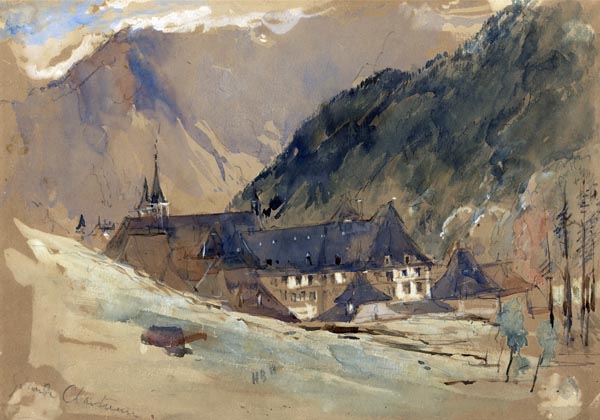
‘Grande Chartreuse’
Hercules Brabazon Brabazon, 1821 - 1906, British
Yale Center for British Art, Paul Mellon Collection
There was formerly an inscription here, announcing that Emmanuel, for the public good, had caused the hill to be cut through. During the revolutionary era, this inscription was effaced; Bonaparte had it restored; he merely added his name: if only he had always acted with similar nobility!
Formerly one penetrated the very heart of the rock, by a subterranean passage. This passage is now closed. I saw only tiny mountain birds, in this place, who float silently at the mouth of the cavern, like the dreams placed by Virgil at the entrance to hell: Foliisque sub omnibus haerent: clinging beneath every leaf (Aeneid VI:284).
Chambéry is situated in a hollow, whose elevated boundaries are quite bare: but you approach it through a charming defile, and leave by way of a lovely valley. The mountains which enclose this valley were partly clothed with snow. They revealed and hid themselves ceaselessly, under an ever-changing sky, formed of cloud and vapour.
It was at Chambéry that a man was welcomed by a woman, and as recompense for the hospitality he had received from her, the friendship she showed him, believed himself philosophically obliged to dishonour her. Either Jean Jacques Rousseau looked upon the conduct of Madame de Warens as a mere commonplace affair, and then, what becomes of the pretensions of our citizen of Geneva to virtue? Or he was of the opinion, that her conduct was reprehensible, and then sacrificed his memory of his benefactress to the vanity of writing a few eloquent pages; or perhaps Rousseau persuaded himself that his praise, and the charm of his style, might gloss over the sins he imputes to Madame de Warens, thus exhibiting the most odious species of self-love. Such is the danger of literature: the desire for fame sometimes overcomes noble and generous sentiments. Had Rousseau never become known, he would have buried in the valleys of Savoy the frailties of the woman who had cherished him, he would have sacrificed himself rather than expose his friend, he would have solaced her in her old age, instead of giving her a gold snuff-box, and then vanishing. But as all is now over for Rousseau, what can it matter to the author of the Confessions whether his dust is celebrated or unknown? Ah, may the echoes of friendship betrayed never be heard about my tomb!
The traces of history count for much in a traveller’s pleasure or disappointment. The Princes of the House of Savoy, adventurous and chivalrous, have closely wedded a memory of them to the mountains that adorned their little empire.
After Chambéry, the current of the Isére is worth viewing from the bridge of Montmélian. The Savoyards are agile, fairly well-built, of pale complexion, and regular figure; they share aspects of both the Italian and the Frenchman; and exhibit, like their valleys, an air of poverty short of outright destitution. Throughout their country, you come upon crosses erected beside the roads, and Madonnas carved from the trunks of pines and walnut-trees; indicating the devout nature of the people. Their little churches, enveloped in trees, form a touching contrast with their vast mountains. When the whirlwinds of winter descend from the summits, charged with eternal ice, the Savoyard finds sanctuary in his rural temple, and prays, beneath its thatched roof, to He who commands the elements.
The valleys one enters above Montmélian are bordered by heights of diverse form, sometimes half-denuded, sometimes clothed with forest. The bottoms of these valleys closely resemble, with regard to cultivation, the variations in terrain and the intricacies around Marly, conjoined there with more abundant streams and a river. The highway has less the air of a public road than of a path through a park. The walnut-trees with which this path is shadowed, reminded me of those we admired on our walks at Savigny. Will those trees find us together once more beneath their shade? (They have not found us so.)
The poet (Guillaume Amfrye de Chaulieu, writing of his birthplace Fontenay), in a melancholy moment, exclaimed:
‘Fair trees, that once saw my birth, Soon now you will see me die!’
Those who pass away beneath the shadow of the trees which witnessed their birth, have they any reason to lament?
The valleys I speak of terminate at a village bearing the pretty name of Aiguebelle. When I entered this village, the heights which overlook it were covered with snow: melting in the sun, it had descended with long crooked radials into the black and green cavities of the rock; you would have taken them for a firework spray, or a fine swarm of white snakes lancing from the summit of the mountains into the valley.
Aiguebelle seems quite close to the Alps: but soon, on turning past a large isolated rock that has tumbled into the road, you see new valleys which sink into the chain of hills that line the course of the River Arc. These valleys are of a more austere and savage character.
Mountains rise on both sides: their flanks soon become perpendicular; their sterile summits start to reveal glaciers; torrents, hurtling down from every direction, swell the Arc, which flows strongly. Amidst this tumult of waters I noticed a slight and noiseless cascade, which fell with infinite grace, screened by willows. Its moist drapery, shaken by the wind, might have seemed poetically the billowing robes of a Naiad, seated on a lofty precipice. The ancients would not have failed to dedicate an altar to the Nymphs in this spot.
Soon, the landscape took on its full grandeur: the forests of pine-trees, which up to that point had looked quite young, appeared much older; the road climbed, bending to and fro above the abyss: wooden bridges served to cross the gulfs, where you could see the water seething, and hear its roar.
Having passed Saint-Jean-de-Maurienne, arriving toward sunset at Saint-André I could obtain no horses, and was therefore obliged to stop. I went for a walk beyond the village. The air on the mountain summits cleared, their outlines traced with extraordinary clarity against the sky, while deep night slowly spread from the feet of the hills, and rose slowly toward their crests.
I heard the voice of the nightingale and the cry of an eagle; I saw the service-trees in flower along the valley, and snow on the heights: a castle, according to popular tradition the work of the Carthaginians, exhibited its ruins on a rocky crag. All the work of men’s hands in these regions is pitiful and transitory; sheepfolds, made of interwoven rushes; mud huts, built in a couple of days; as if the goatherd of Savoy, faced with the eternal masses that surround him, has not thought it worthwhile to trouble himself with the passing needs of his brief life! As if Hannibal’s ruined tower warns him of the transience and vanity of human effort!
Whilst contemplating this wilderness, I could not help admiring with awe, however, the hostility, more powerful than any obstacle, of that man who, from the Straits of Cadiz, forged a path over the Pyrenees and the Alps, to seek out the Romans! That the accounts handed down from antiquity do not tell us Hannibal’s exact route matters little: it is certain that this great general traversed the pathless heights, their inhabitants wilder even than the mountain streams, cliffs, and forests. I am told I shall gain a better understanding at Rome of that furious hatred, which the battles of the Trebia, Thrasimene, and Cannae, could not sate: I am assured that the walls of the Baths of Caracalla are scarred by the blows of pikes to the height of a man. Were not the hands of Germans, Gauls, Goths, Vandals, and Lombards raised against them? It was right that human vengeance should fall heavily on a people, themselves free, who founded their greatness only on the blood and slavery of others.
I left Saint-André at day-break, and arrived at about two in the afternoon at Lanslebourg, at the foot of Mont Cénis. On entering the village, I saw a peasant grasping a young eagle by its legs, whilst a pitiless mob aimed blows at that young monarch of the air, insulting the frailty of youth, and fallen majesty: the parent birds had both been killed. They offered to sell him to me; but he died of the ill treatment he had received, before I could free him. Is not this the very portrait of the little Louis XVII, his father, and mother?
Here you begin to ascend Mont Cénis (they were working on the road; it was not yet finished, and they were completing it); leaving behind the little river Arc, which leads you to the foot of the mountain: on the other side of Mont Cénis, the River Doria, Doria Riparia, opens the gate of Italy to you. I have often had occasion, in the course of my travels, to observe the usefulness of rivers. Not only are they (as Pascal says) great high roads which themselves travel onwards, but they point the way to men, and facilitate our passage of the mountains. In coasting by their banks, nations were discovered; and the first inhabitants of earth penetrated the wilderness, with the aid of their currents. The Greeks and Romans offered sacrifices to the rivers, which the myths make the offspring of Neptune, because they are formed from the Ocean vapours, and lead to the discovery of lakes and seas; wandering children who return to the paternal bosom and the grave.
Mont Cénis on the French side is unremarkable. The lake on the plateau seemed to me no more than a pond. I was disagreeably surprised, at the beginning of the descent toward Novalesa: I expected, I know not why, to view the plains of Italy; I only saw a deep black abyss; a chaos of torrents and precipices.
In general, the Alps, though higher than the mountains of North America, do not strike me as possessing that original character, that purity of aspect, you observe in the Appalachians, or even the elevated regions of Canada: the hut of a Seminole under a magnolia, or of a Chippewa under a pine, has a wholly different character to the cabin of a Savoyard under a walnut-tree.
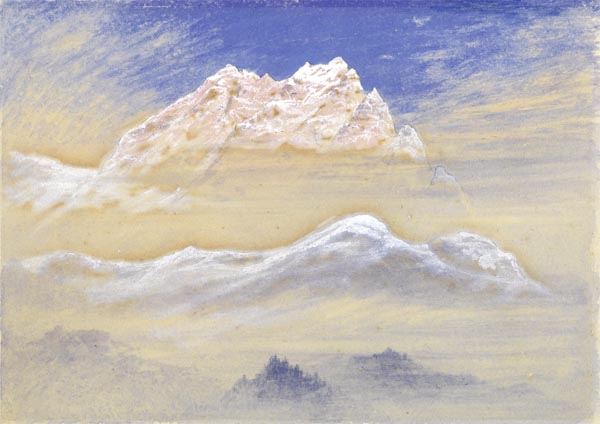
‘Portion of the Chain of the Terglon Alps as seen from near Rudmannsdorf, Italy’
Elijah Walton, 1832 - 1880
Yale Center for British Art, Paul Mellon Collection
Second Letter to Monsieur Joubert
Milan, Monday Morning, the 21st June, 1803.
My dear friend, I always begin my letter, without knowing when I shall have time to finish it. My total apologies to Italy! You will have seen, from my little journal, postmarked Turin, that I was not very impressed at first sight of her. The appearance of the neighbourhood of Turin is fine; but is still feels like France; one might fancy oneself in some Normandy close to mountains. Turin is a new city, clean, orderly, well-adorned with palaces, but possessing rather a sad aspect.
My opinions changed while crossing Lombardy. This result, however, is only produced in the traveller by degrees. You find, at first, countryside of great richness everywhere, and you say: ‘This is pleasant’, it is only when you start to consider the details that enchantment arrives. Meadows, whose greenness exceeds the freshness and delicacy of English turf, are mingled with fields of maize, rice, and wheat, surmounted by vines spreading from one prop to another, forming garlands above the corn; the whole studded with mulberry-trees, walnuts, young elms, willows, and poplars, and watered by rivers and canals. Scattered over the landscape, may be seen the country-men and women, bare-footed, large straw hats on their heads, singing as they mow the fields or reap the corn, or drive teams of oxen, or steer their boats upstream and downstream. This scene continues for forty leagues, increasing in richness as you approach Milan, the centre of the portrait. On the right you can see the Apennines; on the left the Alps.
You travel swiftly; the roads are excellent; the inns superior to those of France, and almost equal to those of England. I really begin to think that same France, well-ordered as it is, somewhat barbarous. (One must remember that this letter was written in 1803. If travelling was so convenient in Italy then, when it was merely a military outpost of France; how much easier to traverse that beautiful country today, in a time of profound peace, and with a plethora of new roads open? We are summoned there by our every wish! The Frenchman is a strange enemy: he is at first found to be somewhat insolent, cheerful, active, and far too restless; but he has no sooner left than he is regretted. The French soldier shares the work of the host under whose roof he lodges: his good-humour gives life and interest to every thing; at length he is seen as a sort of conscript belonging to the family. As for the roads and inns of France, they are far worse now than in 1803. In truth, we are in this respect, behind all the other countries of Europe, Spain excepted.)
I am no longer surprised at the contempt which the Italians have always entertained for us trans-Alpine peoples; Visigoths, Gauls, Germans, Scandinavians, Slavs, Anglo-Normans; our leaden skies, smoky cities, and muddy villages, must fill them with horror! The towns and villages here have quite another aspect; the houses are large, with exteriors of brilliant white; the streets are wide and frequently intersected by streams of running water, in which the women wash their clothes and bathe their children. Turin and Milan possess the regularity and cleanliness of London streets, with the architecture of the best quarters of Paris. They even own to a special refinement; in the middle of the streets (so that the movement of the carriage may be smoother) they set two rows of flat stones, over which the wheels run; so you escape the unevenness of the ground.
The temperature is delightful, though they tell me I will not experience the true Italian climate until I have passed the Apennines: the height and size of the apartments prevents ones suffering from the heat.
June the 23rd.
I have seen Murat: he received me with kindness and courtesy; and I have handed him a letter from the excellent Madame Bacchiochi (later Princess of Lucca, eldest sister to Buonaparte, who, at that time, was only First Consul); I have passed the day amongst aides-du-camp and young officers; no one could be more courteous. The French army is ever the same; always honourable.
I dined in great style with Monsieur de Melzi; he was involved in holding a fête on the occasion of the baptism of Murat’s child. Monsieur de Melzi knew my unfortunate brother, of whom we talked a while together. The Vice-President is a man of very dignified manners: his mansion is that of a prince, and of one who has always held that rank. His treatment of me has been cool but very polite, and he found me of an exactly similar disposition. I say nothing, my dear friend, of the works of art in Milan, and above all, of the cathedral (which they are completing). The Gothic style, even its marble, seems out of sympathy with the sun and the manners of Italy. I leave this instant; I will write to you from Florence (my letters from Florence cannot be found); and Rome.
Third Letter to Monsieur Joubert
On arrival at Rome, the evening of the 27th June, 1803.
Here I am at last! All my reservations have vanished. I am overwhelmed, haunted, by what I have encountered; I have seen, I believe, what no one else has seen; certainly what no other traveller has attempted to describe: those idiots; glacial spirits; barbarians! When they arrive here, have they too not traversed Tuscany; that English garden, in whose midst a temple rises; that is to say, Florence? Have they too not passed, in company with eagles and wild boars, the wilds of this second Italy, called the Roman States? Why do such people travel at all? Arriving as the sun was setting I found the whole population about to take their walk in the Arabia Deserta at the gates of Rome. What a city! What memories!
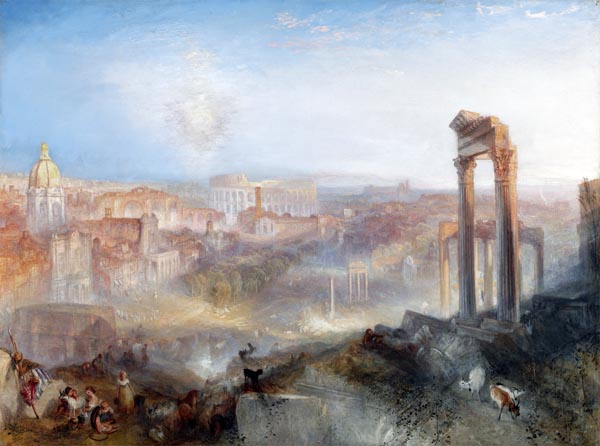
‘Modern Rome - Campo Vaccino’
Joseph Mallord William Turner (British, 1775 - 1851)
Getty Open Content Program
June the 28th, 11 pm.
I have been running about all this day, which is the eve of the festival of St. Peter. I have already seen the Coliseum, the Pantheon, Trajan’s Pillar, the Castle of St. Angelo, and St. Peter’s: and who knows what else? I saw the illuminations and fireworks which herald the grand ceremony tomorrow, dedicated to that Prince of Apostles. While I pretended to be admiring a light set on top of the Vatican, I was actually watching the effect of the moon on the Tiber, the Roman mansions, and the ruins, which are scattered about on every side.
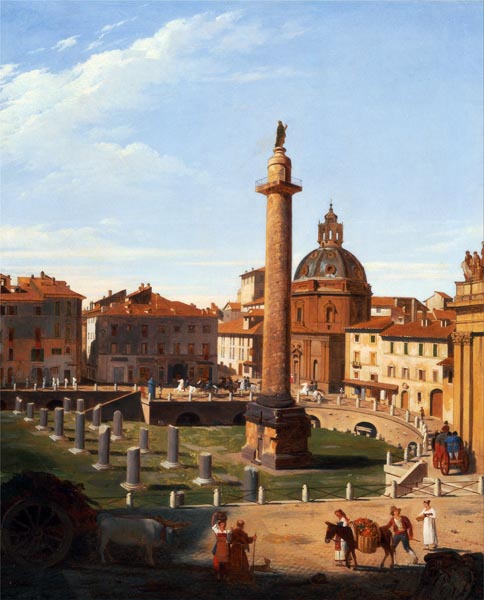
‘A View of Trajan's Forum, Rome’
Charles Lock Eastlake (1793 - 1865), British
Yale Center for British Art, Paul Mellon Collection
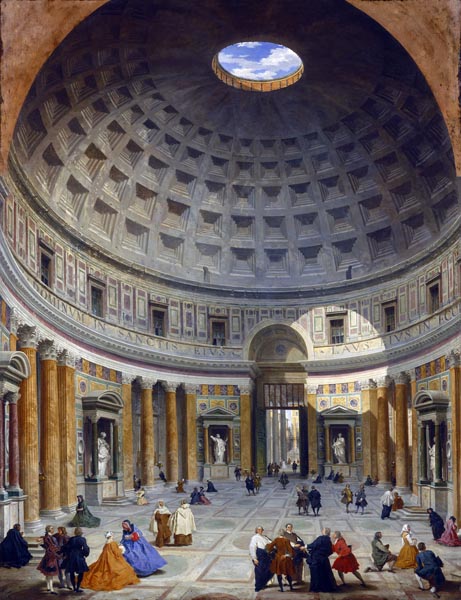
‘Interior of the Pantheon, Rome’
Giovanni Paolo Panini, Italian, 1691 - 1765
NGA Open Access
June the 29th.
I have just come from divine service at St. Peter’s. The Pope has a wonderful face; pale, sad, devout, all the tribulations of the Church seem written on his brow. The ceremony was superb; and at certain times, especially, overwhelming; but the singing mediocre, the church deserted; nobody there!
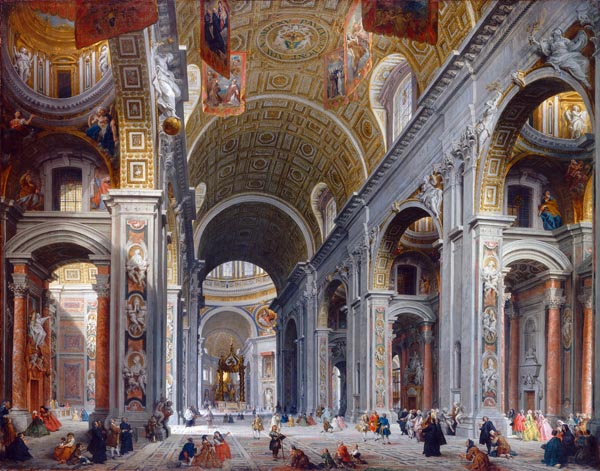
‘Interior of Saint Peter's, Rome’
Giovanni Paolo Panini, Italian, 1691 - 1765
NGA Open Access
July the 3rd, 1803.
I really do not know whether all these scraps of writing constitute a letter. I would be ashamed, my dear friend, of telling you so little did I not wish, before trying to describe things, to see them more clearly. Sadly, I find that modern Rome is already vanishing in its turn: everything comes to an end!
His Holiness received me yesterday. He made me sit down beside him in the most affecting manner, and told me, in an obliging way, that he had read Le Génie du Christianisme, a volume of which, indeed, lay open on his table. There cannot be a better man, a more worthy prelate, or a more unaffected prince; do not mistake me for Madame de Sévigné. The Secretary of State, Cardinal Consalvi, is a man of great wit and temperate character. Adieu! I must, after all, commit these scraps to the post.
Tivoli, and Hadrian’s Villa
December the 10th, 1803.
I am perhaps the first foreigner who has made an excursion to Tivoli in a frame of mind little suited to sightseeing. Witness my arrival alone at seven in the evening, on the 10th of December, at the Temple of the Sybil inn. I occupy a little room at the extremity of the house, facing the waterfall, whose roar I hear. I tried to take a look at it, but was only able to distinguish, in the depths of darkness, several glimmers of white produced by the movement of the water. It seemed to me that I perceived in the distance an enclosure formed of trees and houses and about this enclosure a ring of mountains. I do not know what alteration the daylight will make to this nocturnal landscape.
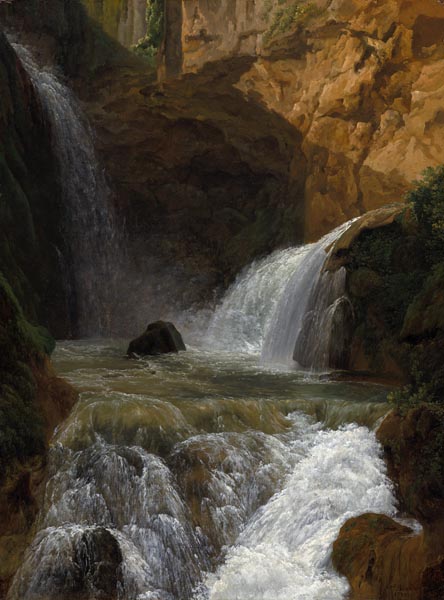
‘View of the Waterfalls at Tivoli’
Jean-Joseph-Xavier Bidauld (French, 1758 - 1846)
NGA Open Access
The place is suited to reflection and reverie. I recall my past life; I feel the weight of the present, and seek to penetrate the future. Where shall I be; what shall I be doing; who shall I be, twenty years hence? Whenever we reflect deeply on the future, a giant obstacle looms, opposing all the vague projects we conceive; an uncertainty caused by a certainty; that obstacle, that uncertainty is death, dreadful death that halts all, felling ourselves or others.
Are they friends you have lost? You have a thousand things to say to them, in vain: unhappy, isolated, a wanderer on this earth, with no one to whom you can confide pain or pleasure, you summon your friends, yet they can no longer appear, to ease your cares or share your joys! They can no longer tell you whether you were wrong, or right, in acting as you have. Now you must journey alone. What value is there in being rich, powerful, or famous? What use has prosperity without a friend? One thing has destroyed all; death! You waves, leaping into that profound darkness from which I hear your roar emerge, are you vanishing more swiftly than the days of man, or can you tell me what man is; you, who have seen so many generations pass by your banks?
December the 11th.
As soon as daylight appeared, I opened my windows. My first impression of Tivoli in the darkness was fairly accurate; though the waterfall looked tiny, and the trees which I thought I had seen, did not exist. A cluster of wretched houses occupied the far bank of the river; the whole was surrounded by bare mountains. However, a bright dawn behind the mountains, and the Temple of Vesta four paces from me, overlooking the grotto of Neptune, consoled me. Immediately above the fall, a herd of oxen, horses and asses were ranged along a sandbank: all these beasts had taken a step into the Teverone (Aniene), and with bowed necks were drinking, in a leisurely manner, from the water which passed before them like lightning, before vanishing over the fall. A Sabine peasant, clothed in a goat-skin, and wearing a kind of mantle rolled back over his left arm, leaned on his staff, and watched his charges drinking; a scene contrasting, in its silence and immobility, with the sound and movement of the waters.
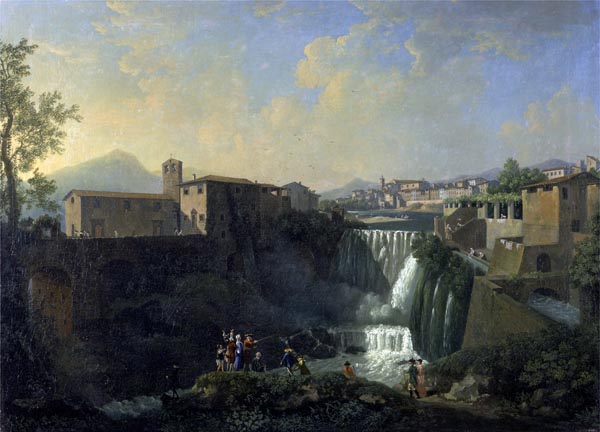
‘A View of Tivoli’
Thomas Patch, 1725 - 1782, British
Yale Center for British Art, Paul Mellon Collection
My breakfast ended, they brought me a guide in whose company I was to cross the bridge over the cascade (I had previously seen the Niagara Falls). From the bridge over the cascade we descended to the Cave of Neptune, so named, I believe, by Claude Vernet. The Anio, after the first waterfall below the bridge, plunges among rocks and reappears in this Cave of Neptune, in order to descend a second fall to the Cave of the Sirens.
The basin in the Cave of Neptune has the form of a chalice, and I have seen doves drinking at it. A dove-house excavated in the rock, but resembling an eagle’s eyrie rather than a shelter for doves, offers these poor birds illusory refuge; they think themselves perfectly safe in that seemingly inaccessible spot, they build their nests there; but a secret passage leads to it: during the hours of darkness, some raptor snatches away the chicks, which sleep without fear to the sound of the waters, from under their mothers wing. Observans nido implumes detraxit: on seeing them, snatched them featherless from the nest. (Virgil: Georgics IV, 513)
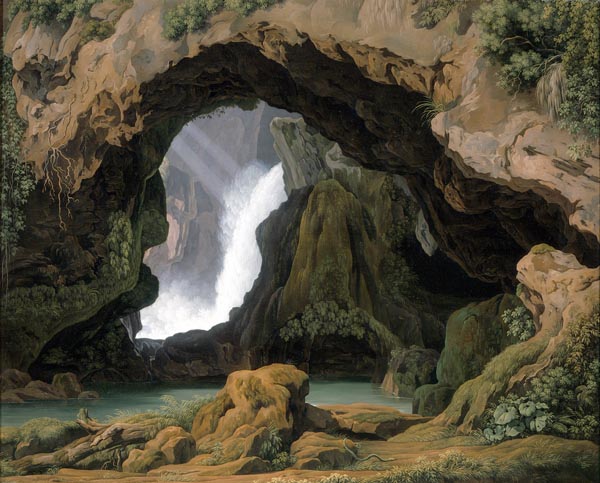
‘The Grotto of Neptune in Tivoli’
Johann Martin von Rohden (Germany, Kassel, 1778 - 1868)
LACMA Collections
Returning from the grotto of Neptune to Tivoli, and taking the Angelo Gate, the gate to the Abruzzo region, my guide led me towards the country of the Sabines; pubemque sabellum, and the Sabine race (Virgil Georgics II:167) I walked downstream along the Anio as far as a field of olives, where a picturesque view of this celebrated wilderness opens. At a glance, you could see the Temple of Vesta; the Caves of Neptune and that of the Sirens; and the little cascades that emerge from one of the porticoes of the Villa of Maecenas. A bluish vapour spread over the landscape, softening its outlines.
You gain some idea of the grandeur of Roman architecture when you consider that these structures, raised so many ages ago, have passed from the service of man to that of the elements; that they sustain today the weight and motion of a mass of waters, and have become the immoveable rocks above these tumultuous falls.
My walk lasted six hours; at the end of it I re-entered my inn, situated in a dilapidated court, to the walls of which memorial stones were fixed, covered with mutilated inscriptions. I have transcribed some of these:
DIS. MAN.
ULLAE PAULIN
VIXIT ANN. X.
MENSIBUS DIEB. 3.
SEI. DEUS.
SEI. DEA.
D. M.
VICTORIAE.
FILIAE QUAE.
VIXIT.ANN. XV
PEREGRINA,
MATER. B. M. F.
D. M.
LICINIA
ASELERIO
TENIS.
What could possibly prove more futile than all this? I read upon a block of stone the expressions of regret that some living person bestowed on the dead; the survivor has perished in turn and I, a barbarous Gaul, arrive two thousand years later, and surrounded by the ruins of Rome pore over these epitaphs in their secluded retreat; I, as indifferent to the mourner as to the mourned; I, who to-morrow will leave this place forever, and vanish, shortly, from the earth!
All the Latin poets who visited Tibur (Tivoli) wept on considering the brevity of life. Carpe diem: seize the day, cried Horace (Odes I:11); Te spectem suprema mihi cum venerit hora: Let me gaze on you, when my last hour has come: exclaimed Tibullus (I.1:59). Virgil (Georgics IV:494) depicts the last hour so: Invalidasque tibi tendens, heu! non tua palmas: stretching out to you, alas, hands no longer yours. Who has not lost some object of his affections? Who has not seen helpless arms extended toward him? A dying man has often wanted his friend to grasp his hand, as if doing so might win him to life, at the very moment when he feels death dragging him down. Heu! non tua!: alas, no longer yours! That exclamation of Virgil’s is admirable in its tenderness and sorrow. Woe to him that loves not the poets! I would almost say of such individuals what Shakespeare says of men insensible to music (The Merchant of Venice Act V Scene 1, 83-85).
Returning to my room, I found again the solitude I had left outside. The little terrace, belonging to the inn led to the Temple of Vesta. Painters know that patina of the centuries that time applies to old monuments, which varies with climate: it is there in the Temple of Vesta. You can make the circuit of the little building between the peristyle and the cella, in sixty paces. The true Temple of the Sybil is distinguished from this one by its square shape and the severe style of its architecture. When the falls of the Anio were located a little more to the right, as is assumed, the temple must have been suspended immediately above their cascade; the place was a perfect setting for the priestess’s inspired utterances, and the religious enthusiasm of the crowd.
I cast a last glance on the northern peaks, which the mists of evening had covered with a white veil, on the valley to the south, and on the entire landscape, and returned to my solitary room. At one in the morning, the wind blowing most violently, I rose, and spent the rest of the night on the terrace. The sky was filled with clouds: the wind, among the columns of the temple, added its moan to the noise of the falls: you might have thought you were hearing sad voices from the vents of the Sybil’s cave. The spray of the waterfall climbed back towards me from the depth of the abyss like a white ghost: it was indeed a genuine apparition! I imagined myself transported to the shores or heaths of my native Armorica (Brittany), amidst an autumn night; the memories of my paternal roof replaced those of the dwellings of the Caesars: everyone bears within themselves a little world composed of all they have seen and loved, to whose sanctuary they constantly retreat, even when traversing, and seeming to inhabit, an alien world.
In a few hours time, I am off to visit Hadrian’s Villa.
December the 12th.
The grand entrance to Hadrian’s Villa was through the hippodrome, on the ancient Via Tiburtina, and not far from the Tomb of the Plautii. There remain no vestiges of antiquity within the hippodrome, converted into a vineyard.
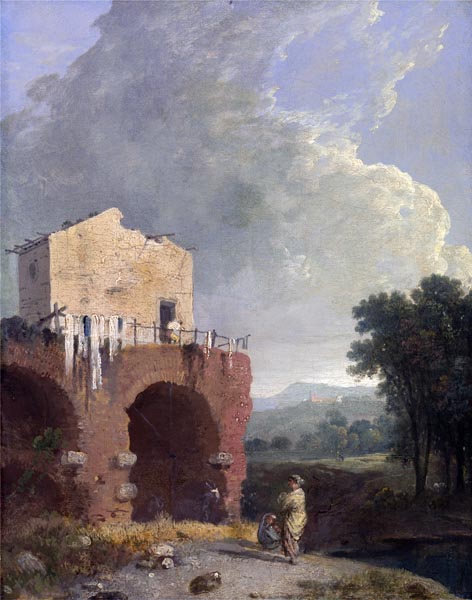
‘Hadrian's Villa’
Richard Wilson RA, 1714 - 1782, British, active in Italy (1750 - 1756)
Yale Center for British Art, Paul Mellon Collection
On exiting a narrow side-road, an avenue of pollarded cypresses led to a wretched farm-house, whose crumbling staircase was filled with sundry pieces of porphyry, verd-antique, granite, white marble rosettes, and various architectural ornaments. Behind this farm is the Roman theatre, in a fairly good state of preservation; a semicircle composed of three rows of seats. The base of this semicircle is a straight wall, which serves as diameter: the orchestra and the stage faced the Emperor’s box.
The son of the farmer’s wife, a little lad about twelve years old, almost naked, pointed out this box, and the dressing-rooms of the actors. Underneath the benches intended for the spectators, in a place where the farm-labourers now deposit the implements of their husbandry, I found the torso of a colossal Hercules, buried amidst ploughshares, harrows, and rakes: empires are born of the plough, and vanish beneath it.
The interior of the theatre serves as the farmyard and garden; it is planted with plum and pear-trees. The well that has been excavated in its centre, is adorned with two pillars, to which the buckets are attached; one of the pillars is made of dried earth and stones heaped together at random; the other from the lovely shaft of some fluted column: but, to erase the magnificence of this latter and assimilate it to the rusticity of the former, nature has draped it with a mantle of ivy. A herd of black pigs were raking and turning up the turf that covered the benches of the theatre. In order to overthrow the seats of the masters of the earth, Providence needed only to sow a few roots of fennel between the joints, and to deliver over that ancient enclosure’s Roman elegance to the unclean swine of loyal Eumaeus.
From the theatre, ascending by way of the farm’s staircase, I reached Palestrina (Praeneste), strewn with sundry ruins. The vaulted ceiling of a hall exhibited ornamentation in exquisite taste.
From here the valley starts, which Hadrian named the Vale of Tempe.
Est nemus Haemoniae, praerupta quod undique claudit silva. There is a grove in Haemonia, closed in on every side by wooded cliffs. (Ovid:Metamorphoses I:568-569)
At Stowe, in England, I have seen, a replica of this imperial fantasy: but Hadrian had laid out his English garden as became a man who possessed the world.
At the end of a little wood of green elms and oaks, you see ruins stretching the whole length of this Vale of Tempe; double and triple porticoes, which served to sustain the terraces of Hadrian’s creation. The vale extends farther than the eye can reach, toward the south; its floor is planted with reeds, olive-trees, and cypresses. The hill to the west, representing the ridge of Olympus, is adorned by the mass of Palace, Library, and Hospices, the Temples of Hercules and Jupiter, and the long arcades, festooned with ivy, that support these structures. A parallel, but lower height, borders the valley to the east; behind this hill rises the amphitheatre of mountains above Tivoli, which would have represented Ossa.
In a field of olive-trees, an angle of the wall of the Villa of Brutus forms a companion to the ruins of the Villa of Caesar. Liberty rests in peace beside despotism: the dagger of one and the axe of the other are now nothing more than rusty iron buried beneath the same rubble.
From the immense building which, according to tradition, was dedicated to receiving visitors, crossing rooms open on all sides, you arrive at the library. Here a maze of ruins begins, interspersed with young coppices; clumps of pine; and patches of olive-trees, diversely planted, that delight the eye and sadden the heart.
A fragment, suddenly detached from the vaulted roof of the library, fell at my feet, as I passed by: a little dust was raised, and several plants were broken and dragged down in its fall. The seeds of these plants will thrive again to-morrow; the noise and dust vanished on the instant: behold this new ruin, destined to lie for centuries near those which seemed to await it! Empires likewise plunge into eternity, where they rest in silence. Men are not unlike these ruins that tumble, one after another, to earth: the only differences among them, as among these ruins, is, that some fall in the presence of spectators, while others sink without witness.
I passed from the Library to the Circus of the Lyceum: they had just been cutting the bushes for firewood. This Circus adjoins the Temple of the Stoics. In the passage leading to it, glancing behind me, I could see the towering but dilapidated walls of the Library, which dominate the lower ones of the Circus. The former, half-hidden in the upper branches of wild olive-trees, were themselves overtopped by an enormous umbrella-pine; and above this rose the ultimate crest of Mount Calvo, capped with cloud. Never were heaven and earth, the works of nature and those of man, better wedded in a single picture.
The Temple of the Stoics (the Philosopher’s Hall) is not far from the Parade Ground. Through the opening of a portico as if through a telescope, you see, at the extremity of an avenue of olives and cypresses, Mount Palomba, crowned by the first Sabine village. On the left of the Pecile, and beneath the Pecile itself, the visitor descends into the Cento-Cellae (The Hundred Chambers) of the Praetorian Guard: these are vaulted chambers about eight feet square, of two, three, or four stories, having no communication with each other: light being admitted through their doorways. A moat runs the whole length of these cells, used for military purposes, which were most probably entered by means of a drawbridge. When the hundred bridges were let down, when the Praetorians passed, back and forth, over them, it must have formed a singular spectacle to adorn the gardens of the philosopher-Emperor who added another god to Olympus. These days, farm-workers, under the patrimony of St. Peter, come to dry their grain in the barracks of the Roman legionaries. When the imperial nation and its masters erected all those fine buildings, they little thought they were building cellars and granaries for a Sabine goatherd, or a farmer of Albano.
After exploring a portion of the Hundred Chambers, I still had time to visit that part of the gardens attached to the Thermae, the women’s baths: there, I was overtaken by rain. (See the letter which follows, regarding Rome, to Monsieur de Fontanes.)
When standing amidst Roman ruins, there are two questions I have often asked myself: the houses of private men were composed of a multitude of porticoes, vaulted chambers, chapels, halls, subterranean galleries, and dark secret passages: what was the use of all this display to an individual owner? Rooms for the slaves, guests, and dependents, generally appear to have been built apart.
In resolving this first question, I imagine the Roman citizen, at home, to have been a sort of monk, who erected cloisters for his private use. Perhaps that reclusive life, indicated only by the form of the buildings, may be a cause of the calmness we remark in the writings of the ancients? Cicero found, once more, in the long galleries of his dwelling, in the domestic temples it enclosed, that tranquillity he had lost in his commerce with men. Even the light which entered these rooms would seem to lend itself to quietude: it almost always fell from above, or from high windows: this perpendicular light, so uniform and tranquil, with which we illume our art-galleries, served the Romans, if you will allow the metaphor, to illuminate their meditations on the portrait of life. As for us, we must have windows open to the street, the market-place, the crossroad. Every thing that agitates or makes a noise delights us: contemplation, seriousness, silence fill us with ennui.
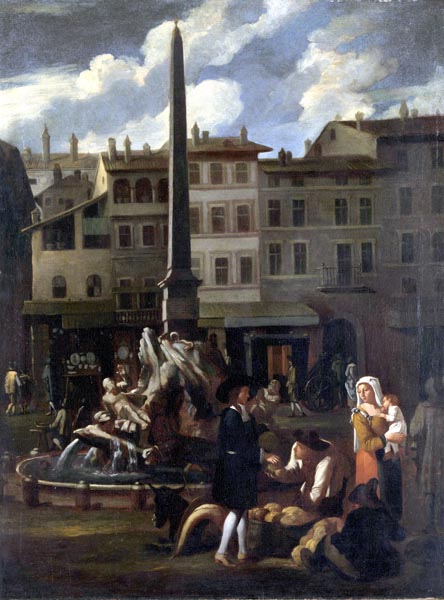
‘Market Scene in Rome, Piazza Navonna’
Manner of Michael Sweerts, 1650 - 1680
The Rijksmuseum
The second question which has always concerned me is this: why were so many edifices dedicated to the same uses? One sees endless halls dedicated to libraries; yet there were few books among the ancients. We find Thermae (Baths) at every step: the Baths of Nero, Titus, Caracalla, Diocletian, etc. Even had Rome been three times as populous as it ever has been, a tenth of these baths would have been sufficient for public use.
I answer that these monuments were probably abandoned and in a state of ruin, almost from the very moment of their erection. One emperor overturned or despoiled the works of his predecessors, with a view to undertaking similar ones himself, and these were, in turn, swiftly abandoned by his successor. The blood and sweat of the people were exhausted on useless works generated by individual vanity, till that moment when the world’s redeemers issued from the depths of the forests to plant the humble standard of the cross on these monuments to pride.
The rain having ceased, I visited the Garden Stadium; examined the temple of Diana, in front of which stands that of Venus; and penetrated amongst the rubble of the Emperor’s palace. The best preserved part of this formless ruin is a sort of cellar or cistern, of square shape, under the courtyard of the palace itself. The walls of this subterranean area are double, each wall two and a half feet deep, the space which separates them being about two inches.
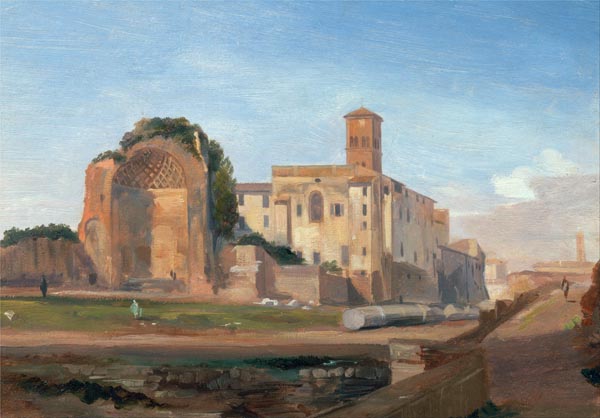
‘Temple of Venus and Rome, Rome’
Edward Lear (1812 - 1888), British
Yale Center for British Art, Paul Mellon Collection
Emerging, and leaving the palace behind me on the left, I walked to the right, toward the Roman Campagna. Passing over a field of corn, sown above underground vaults, I arrived at the Thermae (Baths), as yet still called halls of the philosophers, or Praetorian barracks; these are some of the most imposing ruins within the entire Villa. The beauty, height, strength, and lightness of the arches, the various inter-lacings of the porticoes which cross, intersect, or run parallel to the building, the landscape that adorns the background of this fragment of great architecture, produce an astounding impression. Hadrian’s Villa has furnished several precious remnants of the art of painting: the few arabesques that I have seen are of very skilful design, and the drawing is equally pure and delicate.
The Naumachia, situated behind the Thermae, is a basin excavated by human hands, into which enormous pipes, still visible, conducted the water. This basin, now dry, was then full, and hosted mock naval battles. It is well known, that, at these entertainments, one or two thousand men were often slaughtered for the amusement of the populace.
Around the Naumachia, terraces were built for the spectators; these terraces were supported by porticoes, which served as construction sites or shelter for the galleys.
A temple, imitating that of Serapis, in Egypt, adorned this scene: one half of the great dome (the Canopus) of this temple has fallen. At the sight of its sombre pillars, concentric arches, and a sort of cavity, from which the Oracle murmured, you would think you were no longer amongst the works of Italy or Greece, but that the genius of some other people had presided over this monument. An old sanctuary exhibits a few marks on its green and humid walls. I know not what plaints stray through that abandoned edifice.
I gained the temple of Pluto and Proserpine, commonly termed the Entrance to Hell. The temple is now the home of a vine-dresser; I could not therefore explore it; the owner, like the god, being absent. Below the Entrance to Hell, runs a valley known as the Vale of the Palace: you might take it for the Elysian Fields. Advancing south, and following a wall which supported the terraces attached to the Temple of Pluto, I saw the furthest fragments of the Villa, more than a league away.
Retracing my steps, I wanted to see the Academy, consisting of a garden, a Temple of Apollo, and various buildings intended for the use of the philosophers. A farm-worker opened a gate leading into the field of some other proprietor, and I found myself at the Odéon and the Greek Theatre; quite well preserved in form. Some melodious spirit must surely still haunt this spot dedicated to harmony; since I heard the notes of a blackbird, on the 12th of December: a troop of children, gathering olives, made the place echo with their songs; echoes which perhaps had once repeated the verse of Sophocles and the music of Timotheus.
Here my survey ended; a much longer one than is generally made: I owed as much to that Imperial traveller. Further on you can see the grand Portico, of which little remains; and still further, the relics of some other buildings, of unknown purpose: finally, the Colle di San Stephano, where the grounds of the Villa terminate, and on which stand the ruins of the Prytaneum.
From the Hippodrome to the Prytaneum, the Villa of Hadrian occupies the sites at present known as Roccabruna, Palazza, Aqua Fera, and Colle di San Stephano.
Hadrian was a remarkable prince, though not one of the greatest of the Roman emperors; yet he is one of those whose names we best remember today. He has left traces every where; including Hadrian’s Wall in Great Britain; the arena at Nîmes and the Pont du Gard, it may be, in France; temples in Egypt; aqueducts at Troy; new areas of the cities of Jerusalem and Athens; in Rome itself a bridge which is still in use, and a host of other monuments, attesting to his taste, activity, and power. He was himself poet, painter, and architect. His age was that of a restoration of the arts.
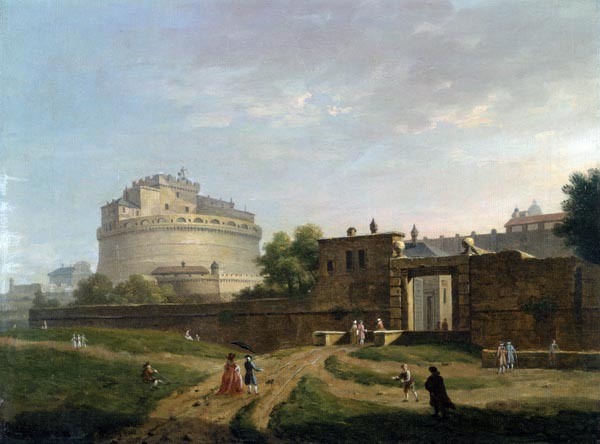
‘Castel Sant'Angelo, Rome’
John Inigo Richards RA, 1730/31? - 1810, British
Yale Center for British Art, Paul Mellon Collection
The fate of Hadrian’s Tomb (Castel Sant’Angelo, in Rome) is singular. The ornaments of this sepulchre served as weapons against the Goths. Civilization hurled columns and statues at the head of Barbarism, whose entrance, however, it could not prevent. The mausoleum became a fortress of the Popes, and was converted into a prison; which scarcely belies its original intent. These vast edifices erected over the ashes of men fail to increase the dimensions of the grave! The dead, in their sepulchral houses, are like the statue seated in that over-small Temple of Hadrian’s; if they wished to rise, they would strike their heads against the ceiling.
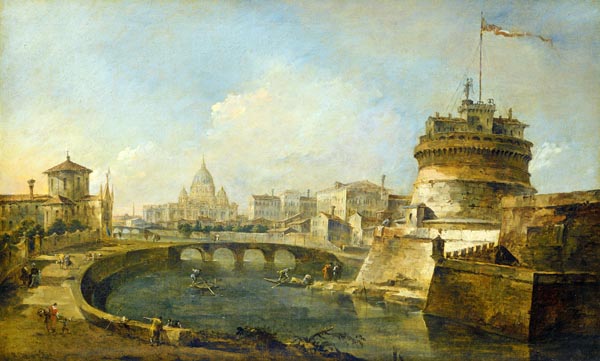
‘Fanciful View of the Castel Sant'Angelo, Rome’
Francesco Guardi, Italian, 1712 - 1793
NGA Open Access
Hadrian, on mounting the throne, said loudly to one of his enemies: ‘Behold, you are spared!’ The statement was magnanimous. But we fail to extend the same clemency to genius that we extend to political opponents. The jealous emperor, on seeing the master-works of Apollodorus, said quietly to himself: ‘Behold, he is lost!’ and the artist was slain.
I could not leave Hadrian’s Villa without first filling my pockets with little bits of porphyry, alabaster, verd-antique, painted stucco, and mosaic work; I have since thrown them away.
Now, these ruins exist for me no longer, since it is not likely that I shall be led again to the spot. Every instant you mourn, some moment, some thing, some person, you will never see again: life is continual death. Many travellers who preceded me inscribed their names on the marble of Hadrian’s Villa: they hoped to prolong their existence by attaching to a famous place a token of their visit: they were deceived! As I attempted to read one of these names, newly traced in pencil, a name which I thought I recognized, a bird flew from a clump of ivy; it shook down a few drops of the recent rain; the name vanished.
To-morrow, to the Villa d’Este. (See the letter below regarding Rome.)
The Vatican
December 22nd, 1802.
I visited the Vatican at one o’clock; a fine day, brilliant sun; the air extremely mild.
Solitude reigns over the vast flights of steps, or rather terraces that you could ascend with mules; solitude reigns over the galleries adorned with the master-pieces of genius, which in other days the Popes, in all their pride, traversed; solitude reigns over the works which so many celebrated artists have studied, so many illustrious men admired; Tasso, Ariosto, Montaigne, Milton, Montesquieu, kings and queens, powerful or fallen, and hosts of pilgrims from every quarter of the globe.
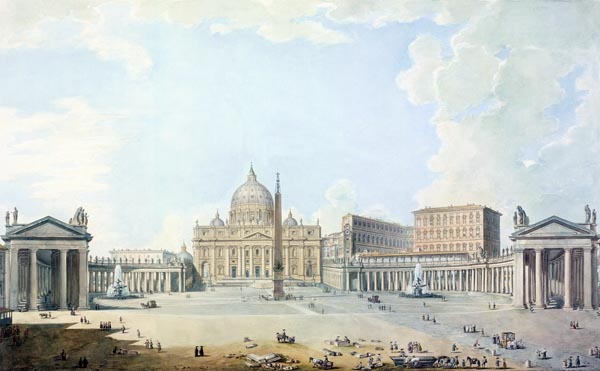
‘St. Peter's, the Basilica and the Piazza’
Francesco Panini (Italy, 1745 - 1812)
LACMA Collections
God dispelling Chaos.
I noted the angel that followed Lot and his wife.
A beautiful view of Frascati, over the roofs of Rome, from a corner or angle of the gallery.
The entrance to the Halls. — The Battle of Constantine; the tyrant and his horse drowning.
St. Leo halting Attila. Why has Raphael given a fierce instead of a religious air to the group of Christians? In order to express a feeling of divine aid.
The Holy Sacrament, Raphael’s first work; cold, and inexpressive of piety, but the disposition of the figures and the figures themselves admirable.
Apollo, the Muses, and the Poets. — The character of the poets very well expressed; but the whole presents a strange medley.
Heliodorus chased from the Temple. — A notable angel, a celestial female, imitated by Girodet, in his Ossian.
The Burning of a Town. — The woman bearing a vase: copied endlessly. The contrast between the man stupefied with fright and one who is trying to reach a child. The art too apparent. The mother and infant painted by Raphael a thousand times, and always excellently.
The School of Athens: I like the Cartoon quite as much.
The Deliverance of St. Peter. — The effect of the three lights quoted everywhere.
The Library: an iron gate bristling with spikes: truly the gate of science. The arms of one of the Popes — three bees — a happy symbol.
A magnificent Nave: the books invisible. Were they exhibited, one might here find materials capable of wholly reconstituting modern history.
The Christian Museum. — Instruments of martyrdom: iron claws to tear at the skin; a scraper to remove it; iron hammers; small pincers: what fine Christian antiquities! How did men suffer in the past? Just as at present — witness these instruments. In matters of suffering, the human race is stuck fast.
Lamps found in the Catacombs. — Christianity begins at the grave; from a funeral lamp that torch was kindled which lights the world. — Ancient crosses, ancient chalices, ancient implements, with which to administer communion. — Paintings brought from Greece, to preserve them from the Iconoclasts.
An ancient depiction of Jesus Christ, since reproduced by the painters; it can scarcely be older than the eighth century. Was Christ the most handsome of men, or was he ugly? The Greek and Latin fathers are divided in their opinion: I incline to the former view.
A Donation to the Church on papyrus: — the world recommences here.
The Museum of Antiquities. — A female head of hair found in a tomb. — Is it that of the mother of the Gracchi? — Is it that of Delia, Cynthia, Lalage, or Lycimnia (Terentia), of whose hair Maecenas, if we may believe Horace (Odes II.12), would not exchange a single strand for all the wealth of a Phrygian king?
Aut pinguis Phrygiae Mygdonias opes permutare velis crine Lycimniae? Would you exchange one strand of Lycimnia’s for the Mygdonian wealth of fertile Phrygia?
If anything embodies the idea of fragility, it is the hair of a young girl, which might have been an object of idolatry to that most fleeting of passions, and yet has survived the Roman Empire! Death, which breaks all chains, has not shattered this frail reed.
A beautiful twisted column of alabaster. — A winding-sheet of green fibrous chrysolite, recovered from a sarcophagus. Death, however, has nonetheless consumed his prey.
An Etruscan chalice. Who drank from this cup? One of the dead! Everything in this Museum is a treasure from the grave, whether it was used in the funeral rites, or appertained to the living.
The Capitoline Museum
December the 23rd, 1803.
A columnar Mile-Stone. — In the Courtyard, the feet and head of a Colossus: intentionally created so?
In the Senate-House; the names of modern senators; a She-Wolf struck by lightning; the geese on the Capitol.
Là sont les devanciers avec leurs descendants;
Tous les règnes y sont; on y voit tous les temps;
There are the forefathers with their descendants.
All reigns are there: one views there all the ages; (Père Le Moine: Saint Louis)
Ancient measures of corn, oil, and wine, in the shape of altars, with the heads of lions.
Paintings representing the most important events of the Roman Republic.
A statue of Virgil: the countenance is countrified but grave, the brow melancholy, the eyes animated; and there are lines diverging from the nostrils and terminating at the chin, furrowing each cheek.
Cicero: a certain regularity, with an expression of lightness; less force of character than philosophy; as much wit as eloquence.
The Alcibiades did not strike me with its beauty: something of the clown and the fool.
A young Mithridates, resembling an Alexander.
Consular regalia, both ancient and modern.
The Sarcophagus of Alexander Severus and his mother.
A bas-relief of the infant Jupiter on the Island of Crete: admirable.
A column of oriental alabaster, the most beautiful known to be extant.
An antique plan of Rome, in marble; the perpetuity of the Eternal City.
A bust of Aristotle: something intelligent and forceful there.
A bust of Caracalla: the eyes tense, the nose and mouth pointed; a wild and fierce expression.
A bust of Domitian: the lips pursed.
A bust of Nero: the visage large and round, sunken about the eyes, so that both forehead and chin project: the air of a debauched Greek slave.
Busts of Agrippina and Germanicus: the second long and thin; the first grave. A bust of Julian: the forehead small and narrow.
A bust of Marcus Aurelius: a broad brow, the eyes and the eyebrows lifted toward Heaven.
A bust of Vitellius: a large nose, thin lips, puffed cheeks, small eyes, and the head bent forwards a little, like that of a pig.
A bust of Caesar: the face thin; deeply furrowed; a prodigiously intellectual expression; the forehead very prominent between the eyes, as if the skin were puckered and intersected by a perpendicular wrinkle; the eyebrows low and touching the eyes; the mouth large, and singularly expressive; one might think it about to speak, it almost smiles; the nose prominent, but not as aquiline as it is usually represented; the temples flattened like those of Buonaparte; scarcely any dimension to the back of the head; the chin round and double; the nostrils a little contracted; a figure of imagination and genius.
A bas-relief: Endymion asleep, seated on a rock; his head bent to his chest, and leaning slightly towards the shaft of his spear, which rests upon his left shoulder; the left hand, resting carelessly on his spear, holds the lead of his dog, loosely, while the creature standing on its hind legs, endeavours to look over the rock. This is perhaps one of the most exquisite bas-reliefs in existence. (I made use of this pose in Les Martyrs).
From the windows of the Capitol, one can see the whole Forum, the Temples of Fortune and Concord, the two columns of the Temple of Jupiter Stator, the Rostra, the Temple of Faustina, the Temple of the Sun, the Temple of Peace, the ruins of Nero’s Golden Palace, those of the Coliseum, the triumphal arches of Titus, Septimus Severus, and Constantine; a vast cemetery of the ages, with their funeral monuments, bearing the date of their expiry.
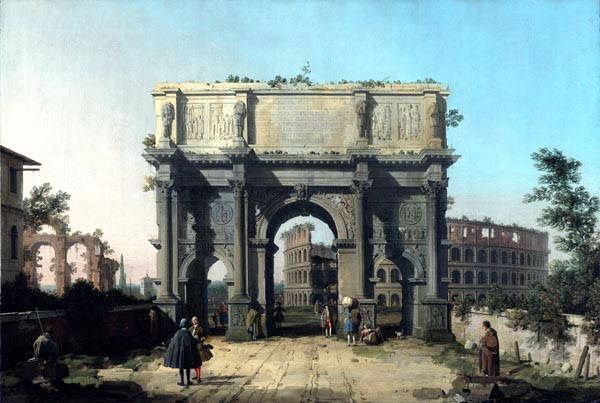
‘View of the Arch of Constantine with the Colosseum’
Canaletto (Giovanni Antonio Canal) (Italian, 1697 - 1768)
Getty Open Content Program
The Doria Gallery
December the 24th, 1803.
A large landscape by Gaspar Poussin: Views of Naples: illustration of a ruined temple standing on a plain.
The waterfall at Tivoli, and the Temple of the Sybil.
A landscape by Claude Lorraine. The Flight into Egypt, by the same master; the Virgin, halted at the edge of a wood, with the Child on her knees; an angel presents food to the Child, while St. Joseph removes the pack-saddle from an ass: a bridge in the background, over which several camels, with their drivers, are passing; on the horizon barely perceptible the buildings of a great city; the tranquillity of the light is quite marvellous.
Two more small landscapes by Claude Lorraine; one of which represents the marriage of some patriarch in a wood; this is perhaps the most finished work by the famous master.
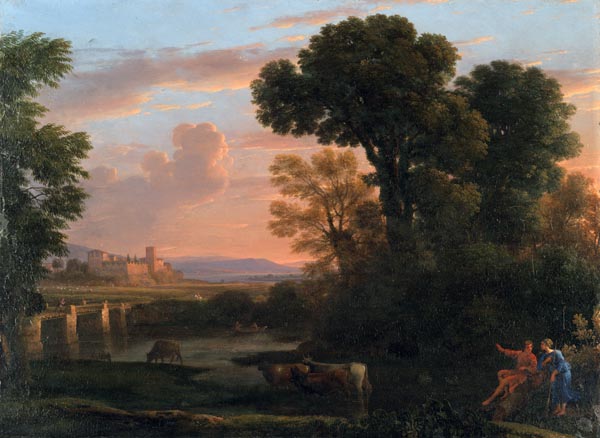
‘Pastoral Landscape’
Claude Gellée, called Claude Lorrain, French, active in Rome, 1604 - 1682
Yale Universty Art Gallery
The Flight into Egypt, by Nicolas Poussin: the Virgin and Child riding an ass, which an angel leads, descend a hill in a wood; St. Joseph follows; the effect of the wind is observable in the movement of their robes and the trees.
Several Dominichino landscapes: the colour bright and lively; the subject matter pleasant; but in general a raw vegetal tone, and a light lacking in mystery and the ideal: strange that French eyes have caught the light of the Italian atmosphere more truly!
A landscape by Annibale Carracci: great truth, but no elevation of style.
Diana and Endymion, by Rubens: the concept is good. Endymion is sleeping lightly, in the position of the beautiful Capitoline bas-relief. Diana, hovering in the air, rests one hand gently on the shoulder of the hunter, about to kiss the sleeper without waking him. The hand of the Goddess of Night is of the moon’s whiteness and her head scarcely distinguishable from the azure of the firmament. The whole is well drawn; but what Rubens drew well he painted badly; the great colourist forgot the power of his pencil when he picked up his palette.
Two heads, by Raphael. The Four Misers, by Albrecht Durer. Time plucking the feathers of Love, either by Titian or Albano: cold and mannered; the flesh-colours realistic.
The Aldobrandini Nuptials, copied from Nicolas Poussin: ten figures on the same level, forming three groups, of three, four, and three. The background is a grey expanse, breast-high: the attitudes and drawing possess the simplicity of sculpture, one might say of a bas-relief. No richness of ground-colour, no detail, draperies, furniture, trees, no accessories whatever; nothing but the figures grouped naturally.
A Moonlit Walk through Rome
From the top of the Trinità dei Monti, the steeples, and other buildings far off, look like first drafts blocked out by a painter, or like jagged coasts seen from the sea, while on board a ship at anchor.
The shadow of the Obelisk: how many have gazed at this shadow in Egypt and Rome?
Trinità dei Monti deserted: a dog barking in this French sanctuary. A little light in a high room of the Villa Medici.
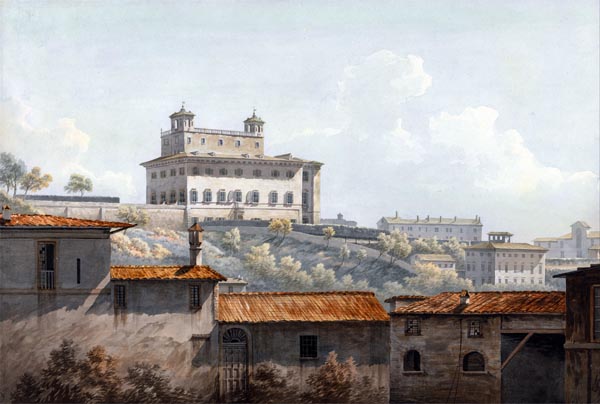
‘The Villa Medici, Rome’
John Warwick Smith (1749 - 1831), British
Yale Center for British Art, Paul Mellon Collection
The Corso: the calmness and whiteness of the buildings, the depth of the transverse shadows. The Colonna Square. The Antonine Column half-illuminated.
The Pantheon: beautiful by moonlight.
The Coliseum: its grandeur and silence in this same light.
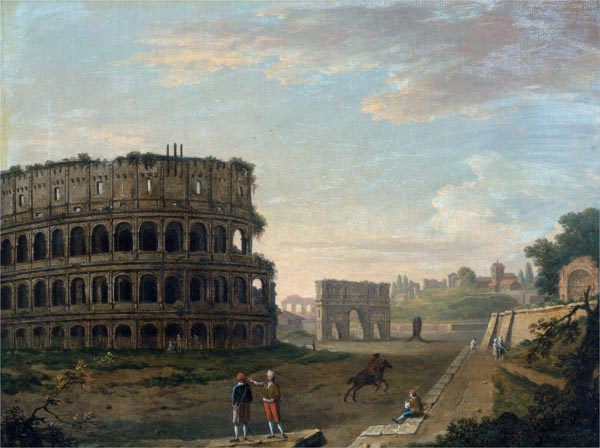
‘The Colosseum, Rome’
John Inigo Richards (1731 - 1810), British
Yale Center for British Art, Paul Mellon Collection
St. Peter’s: the effect of the moon on the dome; the Vatican, the Obelisk, the two fountains, and on the circular colonnade.
A young girl asked me for alms; her head enveloped in her raised robe: la poverina resembled a Madonna: she had chosen her time and place well. Had I been Raphael, I would have painted a picture of her. Romans will beg when dying of hunger, and are not importunate if refused: like their ancestors, they make no effort to sustain life; either the senate or their prince must support them.
Rome slumbers amid her ruins. That orb of the night, that globe which some have imagined to be a depopulated and deserted world, displays her pale solitudes above the solitudes of Rome; she lights streets without inhabitants; enclosures; squares; gardens where no one passes; monasteries no longer echoing with the voices of cenobites; cloisters as deserted as the porticoes of the Coliseum.
What was happening here eighteen centuries ago, at this hour? Not only is ancient Italy no more, but the Italy of the Middle Age has vanished. Nevertheless, traces of both are still plainly apparent at Rome; if the modern city vaunts her St. Peter’s and all her masterpieces, ancient Rome counters with her Pantheon and her mass of ruins; if the one marshals from the Capitol her consuls and emperors, the other leads from the Vatican her long succession of pontiffs. The Tiber separates these rival glories: founded in the same dust, Pagan Rome sinks faster and faster into her grave, while Christian Rome re-descends little by little into the catacombs from which she came.
I have in my mind subjects for a score of letters upon Italy, which might be published, if I could express my ideas as vividly as they are conceived; but the days are going by, and I must rest. I feel like a traveller, who, conscious that he must depart to-morrow, has sent his luggage on before. Our baggage consists of our illusions and our years: every minute some new fragment is given to what the Scripture calls that swift runner Time. (Of this score of letters which I have in my head, I have written only one; namely, that regarding Rome, to Monsieur de Fontanes. The several fragments that have preceded and follow might have formed materials for other letters; but I have given a description of Rome and Naples in the fourth and fifth books of Les Martyrs. Only the historical and political portion of what I wished to say concerning Italy is lacking.)
A Trip To Naples
Terracina, December the 31st.
Behold the people, carriages, things and objects one encounters pell-mell on the roads of Italy: The English and the Russians, who travel at great expense in fine sedans, with all the customs and all the prejudices of their respective countries; Italian families, journeying in old calashes, in order to travel economically to harvest the vines; monks on foot, leading by the bridle a restive mule, laden with relics; labourers driving carts drawn by large oxen, and bearing a little image of the Virgin on the pole or beam of a staff; country-women veiled, or with hair fantastically braided, wearing short brightly-coloured skirts, bodices open at the breast, and laced with ribbons, necklaces and bracelets of shells; wagons drawn by mules adorned with little bells, feathers, and red cloth; ferry-boats, bridges, mills; herds of asses, goats, and sheep; horse-dealers; couriers, with heads enveloped in a net, like the Spaniards; children quite naked; pilgrims, mendicants, penitents, in black and white robes; soldiers jolting along in wretched carts; squads of police; old men mingling with young girls. A great air of good-humour but a great air of curiosity too. They follow you with their eyes as long as they can; they look as if they wished to speak, but never say a word.
Ten at night.
I have just opened my window: the waves are breaking at the base of the walls of the inn. I never gaze at the sea again without a feeling of joy and almost tenderness
Gaeta, January 1st, 1804.
Another year gone by!
On the road from Fondi, I greeted the first orange-grove. The fine trees were as fully laden with ripe fruit as the most productive Normandy apple-trees. I write these few lines at Gaeta, on a balcony, at four in the afternoon, by the light of a brilliant sun, with the ocean in full view. Here Cicero died, in the land, as he himself said, which he had saved. Moriar in patria saepe servata (Seneca the Elder, quoting Livy. Seneca: Suasoriae 6:17) Cicero was slain by a man whom he had formerly defended; history is full of such ingratitude. Antony received, in the Forum, the head and hands of Cicero: he gave a golden crown, and a sum equal to two hundred thousand livres, to the assassin, for something beyond price: the head was nailed to the public tribune, between the orator’s hands. Under Nero, Cicero was highly praised; he was not spoken of under Augustus. In Nero’s day vice was perfected; previous assassinations ordered by the divine Augustus faded into insignificance, attempts seeming almost innocent when compared with the new. Besides, the people were far from free; they no longer knew what the word meant: were the slaves who attended the Games, in the Circus, capable of being inspired by the dreams of a Cato or a Brutus? The rhetoricians, in all the safety of servitude, were free to praise Cicero, the peasant from Arpinum. Nero himself would have been the first to harangue others on the excellence of liberty; and if the Roman people fell asleep during such a harangue, as one might imagine, their lord and master, according to custom, would have resorted to sharp blows, in order to make them applaud.
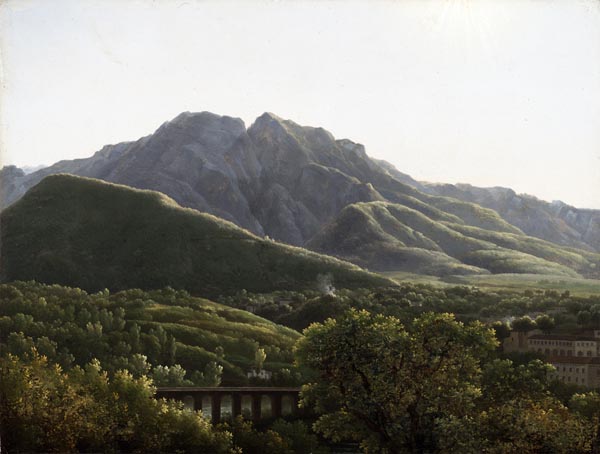
‘View of the Bridge and Part of the Town of Cava, Kingdom of Naples’
Jean-Joseph-Xavier Bidauld (French, 1758 - 1846)
Getty Open Content Program
Naples, the 2nd of January.
The Duke of Anjou, king of Naples, brother of Saint Louis, had Conrad, the legitimate heir to the crown of Sicily, put to death. Conrad, on the scaffold, threw his glove into the crowd. Who picked it up? Louis XVI, a descendant of Saint Louis.
The kingdom of the Two Sicilies must be regarded as something apart from Italy. Greek under the Romans, it has been since that time Saracen, Norman, German, French, and Spanish.
Medieval and Renaissance Italy was the Italy of two great factions, Guelf and Ghibelline; the Italy of republican rivalries and petty tyrannies: nothing was proclaimed but crime and liberty; everything was achieved at the point of a knife. The adventures of this Italy are full of romance: who has not heard of Ugolino, Francesca da Rimini, Romeo and Juliet, Othello? The Doges of Genoa and of Venice, the Princes of Verona, Ferrara and Milan, the warriors, navigators, writers, artists, and merchants, of this Italy, were all men of genius: Grimaldi, Fregose, Adorni, Dandolo, Marino Zeno, Morosini, Gradenigo, Scaligieri, Visconti, Doria, Trivulzio, Spinola, Carlo Zeno, Pisani, Christopher Colombus, Amerigo Vespucci, Gabato, Dante, Petrarch, Bocchacio, Ariosto, Machiavelli, Cardan, Pomponazzi, Achellini, Erasmus, Poliziano, Michelangelo, Perugino, Raphael, Giulio Romano, Dominichino, Titian, Correggio, the Medicis; yet amongst them all not a single knight; in fact, none of the ethos of Transalpine Europe.
At Naples, on the contrary, chivalry blended with the Italian character and noble exploits with popular uprisings. Tancred and Tasso; Joan of Naples; and the good king Réné who never reigned there; the Sicilian Vespers; Massaniello; and the last Duke of Guise; such is the history of the Two Sicilies. The breath of Greece expired at Naples; Athens pushed its frontiers as far as Paestum: its temples and tombs are ranged in line at the far horizon of an enchanted sky.
I was not impressed with Naples on arrival: from Capua, and its delights, to here, the country is fertile, but hardly picturesque. You enter Naples almost without seeing it, by a deeply-cut road. (You can no longer follow the old route, even if you desire to do so. In the last period of French rule, another entrance was made, and a fine road has been created round the hill of Posillipo.)
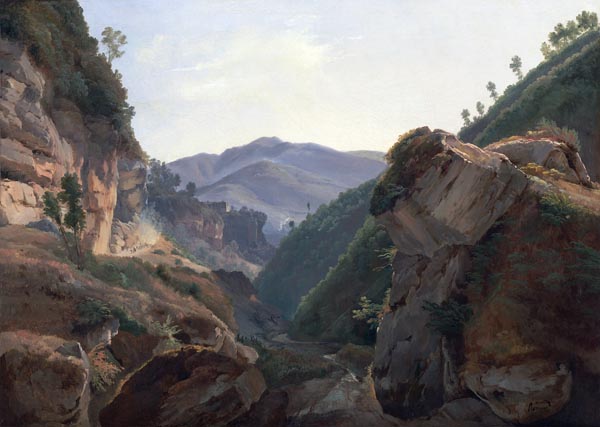
‘Mountain Landscape with Road to Naples’
Jean-Charles-Joseph Rémond (French, 1795 - 1875)
Getty Open Content Program
January the 3rd, 1804.
Visited the Museum.
A statue of Hercules, of which there are copies everywhere. Hercules in repose, leaning on the trunk of a tree: the lightness of the club. Venus: beauty of form; wet drapery. A bust of Scipio Africanus.
Why should ancient sculpture be so superior to the modern (this assertion, generally true, admits of numerous exceptions. Antique statuary has nothing that surpasses the Caryatids of the Louvre, by Jean Goujon. We have these master-works daily before our eyes, yet we fail to notice them. The Apollo has been praised far too much: the metopes of the Parthenon alone exhibit the perfection of Greek sculpture. What I said respecting the Arts, in Le Génie du Christianisme, is eccentric, and often incorrect. At that time I had not visited Greece, Italy, or Egypt.), while modern painting is apparently superior or, at all events, equal to the ancient?
With regard to sculpture, I reply:
The manners and customs of the ancients were more serious than ours, their passions less turbulent. Now, sculpture, which is unable to mark subtle nuances or movements, accommodates itself more easily to the tranquil gesture and grave physiognomy of the Greeks or Romans. Moreover, the antique draperies display the naked figure in part, a nakedness which was therefore always visible to the artist’s eye, whilst it is only rarely exposed to that of the modern sculptor; finally, the human form was more beautiful then.
With regard to painting, I would say:
Painting admits a higher degree of freedom in the way figures are posed; consequently, matter, when unfortunately it is visible, detracts less from the fine effects of drawing. The rules of perspective, with which sculpture has little involvement, are better understood by the moderns. We are likewise acquainted with a greater range of colours, although it is yet to be discovered whether they are purer or more brilliant.
In my review of the Museum, I admired Raphael’s Mother, painted by her son; unassuming and beautiful, she somewhat resembles Raphael himself, as the virgins of this divine master resemble angels.
Michelangelo, painted by himself.
Armida and Rinaldo; the scene involving the magic mirror.
Pozzuoli and Solfatara
January the 4th.
At Pozzuoli (Puteoli) I examined the Temple of the Nymphs, Cicero’s house, which he named the Puteolana, from which he often wrote to Atticus, and in which he probably composed his Second Philippic. This villa was built to the plan of the Academy in Athens; later embellished by Antistius Vetus, it was turned into a palace under the Emperor Hadrian, who died there, bidding farewell to his soul in the well-known lines:
Animula vagula, blandula,
Hospes comesque corporis…
Little soul, pale and wandering,
Guest and friend of my body…
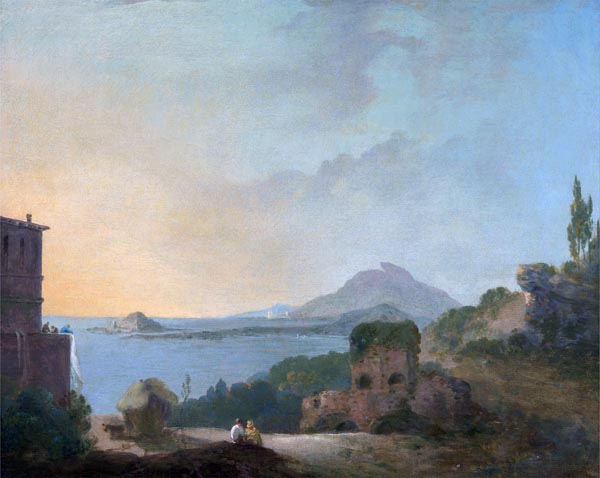
‘Cicero's Villa and the Gulf of Pozzuoli’
Richard Wilson (1714 - 1782), British
Yale Center for British Art, Paul Mellon Collection
He asked for an inscription on his tomb to the effect that he was killed by his physicians:
Turba medicorum regem interfecit: a crowd of doctors killed an Emperor (Dio 69.22.4)
The science has since progressed.
At that epoch, all men of talent were either Christians or ‘philosophers.’
A fine view from the Portico in which you see: a little orchard now occupying the site of Cicero’s house, the Temple of Neptune, and some tombs.
Solfatara: a volcanic field. The sound of springs of boiling water; the sound of Tartarus to the poets.
The view of the Gulf of Naples while returning: a cape outlined by the light of the setting sun; the reflection of this light on Vesuvius and the Apennines; the concord or harmony between this radiance and the sky. Diaphanous vapours on the surface of the water and half-way up the mountain. The white sails of vessels entering the port. The isle of Capri in the distance. The hill of the Camaldolese, with its convent and clump of trees, aboveNaples. The contrast of all this with Solfatara. A Frenchman inhabits the island to which Brutus retired. The Grotto of Aesculapius. The Tomb of Virgil, from which can be seen the birthplace of Tasso (Sorrento).
Vesuvius
January the 5th, 1804.
Today, the 5th of January, I left Naples, at seven in the morning; here I am at Portici. The sun has dispersed the cloud in the east, but the top of Vesuvius is, as ever, cloaked in mist. I ascend the mountain with a guide, who provides two mules, one for me, another for himself: we are off.
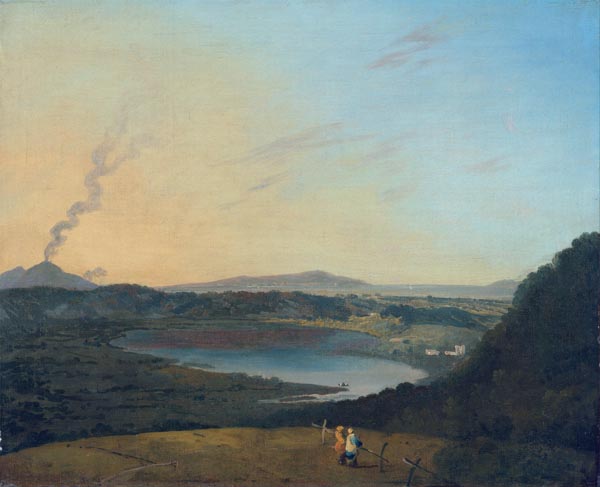
‘Lago d'Agnano with Vesuvius in the Distance’
Richard Wilson (1714 - 1782), British
Yale Center for British Art, Paul Mellon Collection
I begin my journey by a tolerably wide road, between two plantations of vines, trained up poplar-trees. I walk straight into a wintry easterly. I see, a little above the vapour descended from the middle regions of the air, the tops of some trees: they are the elms of the hermitage. The wretched dwellings of vine-dressers are visible on either side, among an abundance of Lachrymae Christi vine-stocks. For the rest: parched soil everywhere, naked vines mingled with pine-trees shaped like umbrellas, some aloes in the hedge, innumerable unstable stones, not a single bird.
I reach the first plateau. A bare plain stretches before me. I can see the twin summits of Vesuvius; on the left Mount Somma, on the right the present mouth of the volcano: these two heights are enveloped in pale clouds. I proceed. On one side the Somma slopes away, on the other I begin to distinguish the ravines cut into the cone of the volcano which I am about to climb. The lava from 1766 and 1769 covers the plain I am crossing. It is a smoky desert, where the lava, thrown out like dross from a forge, displays, on a black ground, its whitish scum exactly like dried moss.
With the cone of the volcano on the right, I follow the road to the left, and reach the foot of a hill or rather wall, formed of the lava which overwhelmed Herculaneum. This wall of sorts is planted with vines on the borders of the plain, and on the other side is a deep valley, filled by a copse. The cold becomes biting.
I climb this hill to visit the hermitage on the other side. The heavens lower: the clouds stream over the ground like grey smoke, or ashes driven before the wind. I begin to hear the murmur of the hermitage elm-trees.
The hermit came out to greet me. He held the bridle of my mule and I alighted. The hermit is a tall man with a frank expression and fine countenance. He invited me to his cell; laid the table, and set out bread, apples, and eggs. He sat opposite me, resting his elbows on the table, and conversed calmly while I breakfasted. The clouds gathered all round us, and not a thing could be seen from the windows of the hermitage. In this vapour-filled abyss you only hear the whistling of the wind, and the distant noise of the waves breaking on the shore of Herculaneum; a tranquil scene of Christian hospitality, set in a small cell at the foot of a volcano in the midst of a tempest!
The hermit handed me the book in which strangers who visit Vesuvius usually write a few words. In this volume I found not one remark worthy of mention: the French, with the good taste natural to our nation, had contented themselves with noting the date of their journey, or paying a compliment to the hermit for his hospitality. This volcano seems to had no very remarkable effect on its visitors; that confirms an idea I formed long ago; namely, that great objects and great subjects are less capable of giving birth to great ideas than is generally supposed; their greatness being evident, so to speak, all that is added to that fact is merely superfluous. Horace’s nascetur ridiculus mus: mountains will labour: what’s born? A ridiculous mouse! (Ars Poetica, 139) is true of all mountains.
I leave the hermitage at half-past two; I continue to climb the hill of lava, as before. On my left is the valley separating me from Mount Somma; on my right the plateau below the cone. My ascent follows the ridge of the hill. Not a living creature do I find in this region of desolation except a poor, thin, sallow, half-naked girl, bending under a load of wood, she has cut on the mountain.
The view is now totally obscured by clouds; the wind blowing them upward from the dark plain, which I had overlooked, sends them over the lava road on which I pursue my way: I hear only the sound of my mule’s footsteps.
Leaving the hill at length, I bend to the right and re-descend to the lava plain, which adjoins the volcanic cone, and which I crossed lower down on my road to the hermitage. Even in the midst of these calcined fragments, the mind can scarcely form any idea of the fiery ground and molten ore during an eruption. Dante had, perhaps, seen it when he described, in his Inferno, those burning sands or those eternal flames, which descend slowly and in silence ‘come di neve in alpe senza vento.’
...........arrivammo ad una landa
Che dal suo letto ogni pianta rimuove…
...........we reached a plain,
where the land repels all vegetation…
Lo spazzo era un’ arena arida e spessa…
The ground was dry, thick sand…
Sopra tutto il sabbion d’un cader lento
Piovean di foco dilatate falde,
Come di neve in alpe senza vento…
Dilated flakes of fire, falling slowly,
rained down over all the vast sands,
like snow in the windless mountains,
(Dante, Inferno, Canto XIV, 8-9,13, 28-30)
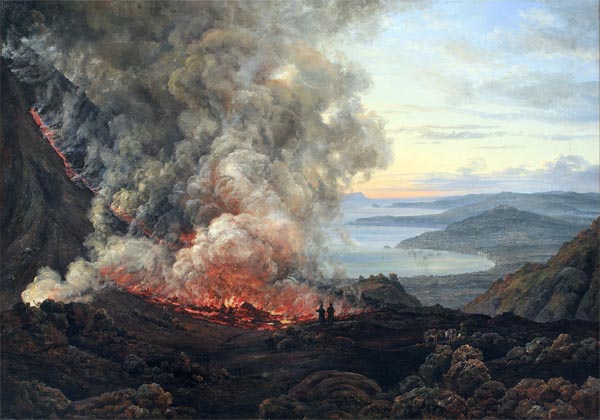
‘Eruption of the Volcano Vesuvius, 1821’
Richard Wilson (1714 - 1782), British
Statens Museum for Kunst
Snow is visible here, in many places; suddenly revealed, at intervals, are Portici, Capri, Ischia, Posillipo, the sea, studded with the white sails of fishing-boats, and the coast of the Gulf of Naples, bordered with orange-trees: a glimpse of paradise from the infernal regions.
I reach the foot of the cone, we alight from our mules; my guide hands me a long staff, and we begin to climb the huge mass of cinders. The clouds re-form, the fog thickens, and the darkness re-doubles.
Behold me now at the top of Vesuvius, seated at the mouth of the volcano, writing, and preparing for my descent into the crater. The sun appears from time to time through the mass of vapour which envelops the whole mountain. This fog, which hides from me one of the most beautiful landscapes in the world, serves to re-double the horrors of the place. Vesuvius, separated by clouds from the enchanted country at its base, has the appearance of being situated in the deepest desert; and the terror it inspires is in no degree diminished by the sight of a flourishing city at its foot.
I propose to my guide that I descend into the crater; he raises various objections in order to obtain a little more money. We agree on an amount, which he insists on receiving there and then. He takes off his coat; we walk for some time along the rim of the abyss, to find a place which is less steep, and more suitable for our descent. My companion halts, and signals for me to follow. We plunge down.
Behold us at the bottom of the gulf (it is exhausting, but there is little danger involved in a descent into the crater of Vesuvius. You would have to experience the misfortune of being surprised by an eruption. The latest eruptions changed the shape of the cone.); I despair of describing the chaos which surrounds me.
Picture a basin, a thousand feet in circumference and three hundred feet deep, which slopes downwards in the shape of a funnel. Its margin, or interior wall, is furrowed by the liquid fire which this basin has contained and expelled. The projecting parts of the walls resemble those brick pillars with which the Romans supported their piles of masonry. Large rocks hang down from various parts of the sides, and their fragments, projecting from a crust of cinders, cover the bottom of the abyss.
The depths of the basin are furrowed in various ways. Near the middle are three vents, or small mouths, not long open, which vomited flames during the occupation of Naples by the French in 1798.
Smoke breathes from the pores of the crater, especially on that side toward Torre del Greco. On the opposite side, toward Caserta, I see flame. If you plunge your hand into the cinders, you find them burning hot, at several inches below the surface. The prevailing colour of the crater is a dull charcoal. But Nature can impart beauty to even the most revolting of objects: the lava, in some places, is tinged with azure, ultramarine, yellow, and orange. Granite boulders, warped and contorted by the action of the fire, are bent at their extremities like the leaves of palms or acanthus. The volcanic matter, cooled on the rocks over which it flowed, forms roses, pendants, and ribbons; it also assumes the shapes of plants and animals, and imitates the various forms which are seen in agates. I particularly noticed, on a bluish rock, a white swan, modelled in lava so perfectly that you would have sworn you beheld that beautiful bird asleep on a placid lake, its head bent under its wing, and its long neck stretched over its back like a roll of silk.
Ad vada Maeandri concinit albus olor:
The white swan sings to the waters of Maeander. (Ovid: Heroides, VII, 4.)
Here, that perfect silence reigns, which I once met with at noon in the forests of America, when I held my breath, and heard nothing except the beating of my heart and the throbbing of the temporal arteries. Only now and then, gusts of wind, descending from the cone to the bottom of the crater, rustle through my clothes or whistle round my staff; I can hear stones tumbling, which my guide kicks aside as he climbs among the cinders. A confused echo, similar to the jarring of metal or glass, prolongs the noise of their fall then all is still. Contrast this dead silence with the fearsome explosions that shake these places when the volcano vomits fire from its entrails, and covers the earth with darkness!
A philosophical reflection might be made, here, serving to arouse our contempt for human affairs. What, in fact, are the famous revolutions of empires, in comparison with these convulsions of nature that change the face of earth and sea? It would be happiness, if men at least ceased to employ themselves in mutual torment, in the short time that they spend together! Vesuvius has never opened its maw to swallow up cities, without its fury surprising mankind in the midst of bloodshed and tears. What are the first signs of civilization, the first marks of the passage of men we have found, at Pompeii, under the extinct ashes of the volcano? Instruments of torture and skeletons in chains!
Times change, and human destinies possess a similar inconstancy. ‘Life,’ the Greek song says, ‘rolls swiftly on like the wheels of a chariot.’
Tρoχoξ αρματoξ γαρ οια
Вιοτoξ τρεχει χυλίσθειξ
Pliny lost his life owing to his desire to view, at a distance, the volcano, in whose centre I am now tranquilly seated. I see the abyss smoking round me. I reflect that a few fathoms below my feet there exists a gulf of fire. I reflect that the volcano might vent and hurl me into the air, among fragments of shattered stone.
What Providence led me here? By what chance did the storms of the Atlantic Ocean cast me ashore on the plains of Lavinia: Lavinaque venit litora (Virgil: Aeneid I, 2-3)? I cannot refrain from returning to the anxieties of this life, where, St. Augustine says, all things are full of misery, and hope devoid of happiness: ‘Rem plenam miseriae, spem beatitudinis inanem.’ (Augustine Letter XXVI to Licentius) Born on the coast of Armorica, the first sound which struck my ear on entering the world was that of the sea; and on how many strands have I not seen the same waves break that I meet again here!
Who could have predicted a few years since that I would hear these waves moaning beside the tombs of Scipio and Virgil, waves that rolled at my feet on the English coast, or the shores of Maryland? My name is inscribed on the hut of a Florida savage, and in a hermit’s book on Vesuvius. When shall I lay down the pilgrim’s staff and mantle at my ancestral door?
O patria! O divum domus Ilium!
O my country! O Ilium, house of the gods! (Virgil: Aeneid II, 241)
Patria, or Liternum
January the 6th, 1804.
Leaving Naples by way of the grotto of Posillipo, I jolted a full hour in a carriage over the plain; after traversing several little roads in deep shade, I got down from the vehicle to seek, on foot, Patria, the ancient Liternum. A clump of poplars was the first thing I saw, followed by vineyards, and a plain sown with wheat. Nature seemed beautiful, yet sorrowful. At Naples, as in the Roman States, the labourers barely visit the fields except at seed-time and harvest, after which they return to the suburbs, or to the larger villages. The country, therefore, is devoid of hamlets, herds, and inhabitants; and lacks the rural activity common to Tuscany, the Milanese, and Transalpine countries. Round Patria, however, I found several well-built farmhouses; in each yard, was a well decorated with flowers, accompanied by two pilasters, crowned with aloes in baskets. There is, throughout this country, a natural taste for architecture, which proclaims it the ancient seat of civilization and the arts.
Swampy ground overgrown with fern, adjoining wooded hollows, reminded me of Brittany. How long ago it is, that I left my native heaths? They have recently felled an old wood of oaks and elms, among which I was raised: I ought to utter a lament, like those beings whose lives were linked to the trees of Tasso’s enchanted forest (Gerusalemme Liberata, Canto XIII).
I saw in the distance, at the edge of the sea, Scipio’s Tower. At the far end of a building, which contains a chapel and a sort of inn, I entered the encampment of some fishermen; they were mending their nets by a stretch of water. Two of them brought a boat, and took me to a bridge, in the grounds of the tower. I passed dunes, on which grew laurels, myrtles, and dwarf olive-trees. Climbing, with difficulty, to the top of the tower, which serves as a landmark for boats at sea, my gaze wandered over that ocean which Scipio so often contemplated. Several fragments of ruined vaulting, the Grottos of Scipio, presented themselves to my enthusiastic investigation; and I trod, with profound respect, the earth which shrouds the bones of one whose glory sought solitude. I have nothing in common with that great citizen, save a last exile from which no man is recalled.
Baiae
January the 9th.
View from the top of Monte Nuovo: agriculture in the depth of hollows: myrtles and elegant heath-land.
Lake Avernus: is of circular shape, and sunk in a basin surrounded by mountains; its shores are planted with long-stemmed vines. The Cave of the Sybil is situated toward the south, on the slope of a steep bank, near a wood; I heard birds singing, and saw them fly about the cave, in spite of Virgil’s lines:
Quam super haud ullae poterant impune volantes
Tendere iter pennis…
Over which nothing could extend its wings
Safely in flight.............. (Aeneid VI: 239-240)
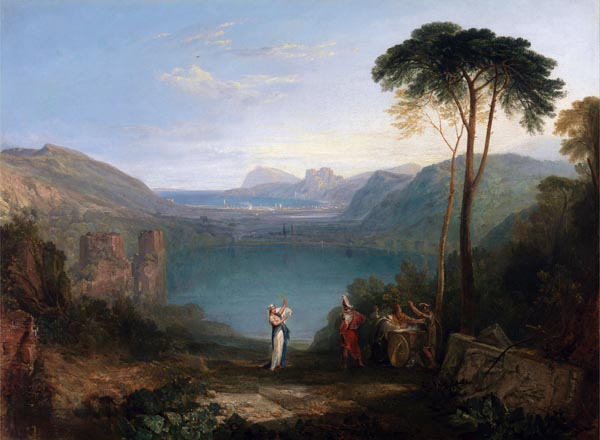
‘Lake Avernus - Aeneas and the Cumaean Sybil’
Joseph Mallord William Turner (1775 - 1851), British
Yale Center for British Art, Paul Mellon Collection
As to the golden bough, had all the doves in the world revealed it to me, I could not have plucked it.
Lake Avernus communicated with the Lucrine Lake: what is left of it, merged with the sea; the remains of Julia’s bridge.
It is the custom to embark, and follow the canal as far as the Baths of Nero. I had eggs boiled in the Phlegethon. Re-embarked, doubling the promontory. On an abandoned shore, washed by the waves, lie the ruins of a host of baths and Roman villas: Temples of Venus, Mercury, and Diana: the tombs of Agrippina and others, etc. Baiae was the Elysium of Virgil, and the Infernal Region of Tacitus.
Herculaneum, Portici, Pompeii
January the 11th.
The lava has filled Herculaneum, as melted lead fills the cavities of a mould.
Portici is a storehouse of antiquities.
Four parts of Pompeii have been unearthed:
- The temples, the soldiers’ quarters, the theatres;
- A house recently cleared by the French;
- An area of the town;
- A house outside the town.
The circumference of Pompeii is about four miles. The soldiers’ quarters are a kind of cloister, round which forty-two chambers are ranged; there are various words of Latin, mutilated and badly spelt, daubed on the walls. Nearby, the chained skeletons were discovered. ‘There the prisoners are at ease together,’ says Job (3:18), ‘they hear not the voice of the taskmaster.’
A little theatre: twenty-one semicircular terraces, with corridors behind. A large theatre: three doors to give egress from the stage at the back, communicating with the actors’ dressing rooms. Three terraces marked out for benches: the lower one largest, and of marble.
You enter by a corridor at the upper part of the theatre, and descend into the hall by the access passageways (vomitoria). Six doors open on this corridor. At a little distance stands a square portico, of sixty columns; and other pillars in a right line, from south to north; alignments which I do not thoroughly understand.
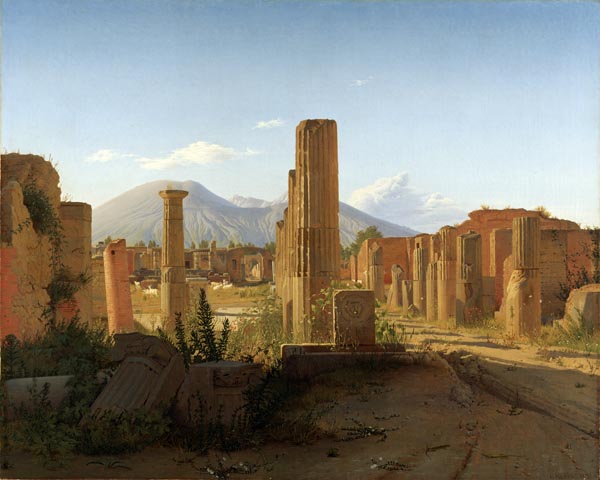
‘The Forum, Pompeii, with Vesuvius in the Distance’
Christen Schjellerup Købke (Danish, 1810 - 1848)
Getty Open Content Program
Two temples have been discovered; one reveals three altars and a raised sanctuary.
The house discovered by the French is very curious: the bed-rooms are extremely small, painted with blue or yellow, and decorated with little frescoes. In them you discern a Roman, an Apollo playing his lyre, landscapes, and perspectives of gardens or towns. In the largest room of this house, a painting represents Ulysses fleeing the Sirens: the son of Laertes, tied to the mast of his ship, listens to three Sirens stationed on the rocks; the first plucks the lyre, the second sounds a kind of trumpet, the third sings.
That part of Pompeii first discovered, is entered by a street about fifteen feet wide; there are pavements on both sides; the road in the middle still retains in several places, the marks of wheels. The street is bordered by shops and houses whose first story has fallen. In two of these houses, the following things are to be seen:
A surgery and a dressing-room, with analogous paintings.
A corn-mill has been pointed out to me, as have the marks of some sharp instrument on the walls of a pork-butcher’s or a baker’s shop; I no longer recall which.
This street leads to a gate of the city, where they have laid bare a portion of the surrounding wall. At this gate the row of tombs begins that borders the high-road. Having passed through the gate, you come upon the country-house so much talked of. The portico surrounding the garden of this house is composed of square pillars, ranged in threes. Beneath this first portico there is a second; here it was that the young female suffocated, the impression of whose front is delineated on the piece of earth which I saw at Portici. Death, like a sculptor, modelled his victim in clay.
In passing from one excavated part of the city to another, you cross a rich area of ground, cultivated, and planted here and there with vines. The heat was considerable, the earth smiling with verdure, and enamelled with flowers.
While walking through this city of the dead, one idea has pursued me. As they clear the different buildings at Pompeii, they remove whatever they discover, household utensils, implements of diverse trades, furniture, statues, manuscripts, etc. all of which are taken to the Portici Museum. In my opinion, they might have employed their time better: leaving these things as they found them, and where they found them; restoring the roofs, ceilings, floors and windows, in order to prevent the destruction of the walls and paintings; rebuilding the ancient circuit of the town, repairing the gates, and locating a guard of soldiers there, with some individuals well versed in the arts. Would that not make it the most interesting museum in the world? A Roman town preserved quite entire, as if its inhabitants had emerged a mere quarter of an hour ago!
One might, then, gain a better understanding of the domestic history of the Roman people, and the depth of Roman civilisation, in a few walks through the restored Pompeii, than by reading all the literary works of antiquity. The whole of Europe would visit; and the cost incurred by this scheme would be amply covered by affluent foreigners spending their money in Naples. Besides, there would be no need to complete such a plan quickly; the excavations might be slowly but surely continued; and nothing would be wanting but a few bricks and slates, a little plaster, stone, and wood, with some masonry and carpentry work, supplied in proportion to their progress. With respect to the restorations, a skilled architect could imitate the local style, models of which would be found in the landscapes painted on the walls of the houses of Pompeii itself.
What they do at present seems lamentable: snatched from their natural locations, the rarest curiosities are buried in cabinets where they are no longer in keeping with the surrounding objects. Besides, the structures discovered at Pompeii, will soon decay; the ash that overwhelmed them, at the same time preserved them; while, exposed to the air, they will perish, if not taken maintained and repaired.
In every country, only the public monuments, erected at great expense, employing blocks of granite and marble, have resisted the influence of time; while domestic dwellings, the true towns crumble into ruins, because the means possessed by private individuals have not enabled them to build for future ages.
To Monsieur de Fontanes
Rome, the 10th of January, 1804.
I have just arrived from Naples, my dear friend, and send you the fruits of my journey, since you have the right to them; a few laurel leaves snatched from the tomb of Virgil. Tenet nunc Parthenope: Naples now holds me (part of the epitaph on Virgil’s tomb). I should long since have given you a description of this classic region, calculated to interest such a mind as yours, but various circumstances prevented me. I will not leave Rome, however, without saying a few words about that celebrated city. We agreed I was to address you informally, and tell you of whatever chance impressions I gained in Italy, as I previously related to you the ideas I formed, while wandering through the solitudes of the New World. Without further preamble, then, I will attempt to give you some account of the environs of Rome, that is to say, the adjacent country and its ruins.
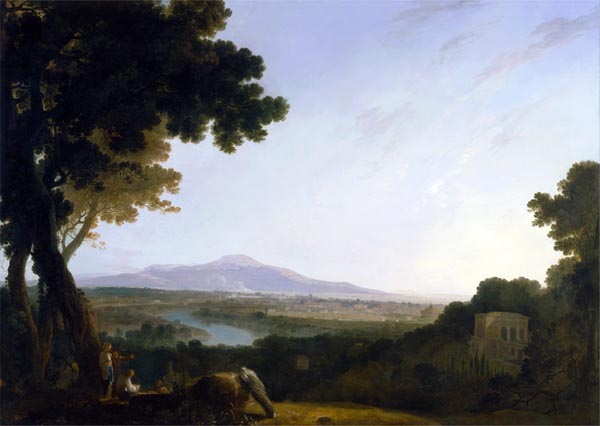
‘Rome from the Villa Madama’
Richard Wilson (1714 - 1782), British
Yale Center for British Art, Paul Mellon Collection
You have read all that has been written on this subject, but I am not sure that travellers have given you an accurate idea of the picture which the Roman countryside presents. Imagine something of the desolation of Tyre and Babylon, as described in Scripture: a silence and a solitude as great as was formerly the noise and tumult of men crowded together on this soil. One may almost fancy that the prophets curse is still heard, Venient tibi duo haec subito in die una: sterilitas et viduitas: these two things shall come to thee in a moment in one day, the loss of children, and widowhood (Isaiah, 47:9) You see here and there some remains of Roman roads, in places where nobody ever passes, and some dried-up tracks of winter torrents: these traces, seen from a distance, have themselves the appearance of large frequented roads, but are in reality the empty beds of waters that have vanished, like the Roman people. You scarcely see any trees; but on every side you behold the ruins of aqueducts and tombs; ruins that resemble the forests and native plants of a land composed of mortal dust and the debris of empire. I often thought I was gazing at rich crops in a plain; I approached: my eye had been deceived by withered grass. Occasionally beneath this barren harvest you find traces of an ancient culture. No birds, no labourers, no lowing of cattle, no villages. A few wretchedly managed farms appear amidst the nakedness of the country; the windows and doors are closed; no smoke, noise, or inhabitant emerges. A sort of savage, half-naked, pale and emaciated by fever, guards these melancholy dwellings, like those spectres in our Gothic legends that defend the entrances to abandoned castles. One might say that no nation has dared to succeed those masters of the world in their native land, and that these plains are as they were left by the iron soc of Cincinnatus, or the last Roman plough.
The midst of this uncultivated region is overlooked and rendered sadder by a monument popularly called the ‘Tomb of Nero’ (The real tomb of Nero was at the ‘Porta del Popolo,’ on the very spot where the church of Santa Maria del Popolo has since been erected); here the shade of the Eternal City lifts her head. Fallen from terrestrial power, she seems to have resolved, in her pride, on isolation: she has separated herself from the other cities of the world, and like a dethroned queen, nobly conceals her misfortunes in solitude.
It would be impossible to describe what one feels, when Rome suddenly appears amid her inania regna: insubstantial kingdom (Virgil, Aeneid VI:269), as if raising herself towards you from the sepulchre in which she lies. Try to imagine the emotion and astonishment which the prophets experienced when God, in a vision, showed them some city with which he had associated the destiny of his chosen people: Quasi aspectus splendoris: like a vision of splendour. (Vulgate: Ezekiel 8:2). The multitude of recollections and the crowd of sensations oppress you, so that your soul is confounded on beholding Rome, which has twice inherited the empire of the world, first as the heir to Saturn, and secondly to Jacob. (Montaigne, in his Travel Journal, thus describes the approach to Rome about two centuries ago: ‘At a distance, on our left, were the Apennines, their aspect being unpleasing, rugged, full of deep clefts, and unfitting for the passage of troops or ordnance. All the ground was treeless, a good part of it sterile, and lying open for more than ten miles or more, the dwellings being very sparse as in all this sort of country.’)
Perhaps, my dear friend, you might think, from my description, that nothing could be more frightful than the Roman Campagna; you would be much mistaken. It possesses inconceivable grandeur, in contemplating it, you are always ready to exclaim with Virgil (Georgics II: 173);
Salve, magna parens frugum, Saturnia tellus,
Magna virum!
Hail, land of Saturn, great mother of fruits
And men!
If you viewed these regions as an economist, they would displease you: but if as an artist, poet, or philosopher, you would perhaps not wish them otherwise The sight of corn-field or vineyard does not register as strongly as that of a country where modern agriculture has not renewed the soil, and which remains as antiquated as the ruins which cover it.
Nothing is as beautiful as the lines of the Roman horizon, with its gentle inclined planes, and the soft fugitive outlines of the mountains which terminate it. The valleys in the Campagna often take the form of an arena, a circus, or a race-course; the hills are cut into terraces, as if the mighty hand of the Romans had sculpted it throughout. A peculiar mist spreads through the distant air, smoothing objects and removing all harshness and unevenness from their forms. The shadows are never black and heavy; there are no masses so dark, even among the rocks and foliage, but that a little light always insinuates itself. A singularly harmonious tone weds earth, sky, and waters; all the surfaces are blended at their extremities by means of an insensible gradation of colour, with no possibility of determining where one nuance ends and another begins. You have doubtless admired that light in Claude Lorraine’s landscapes, which seems ideal and more beautiful than Nature? Well, it is the genuine light of Rome!
I did not neglect to visit the Villa Borghese, and admire the sun setting over the cypresses of Mount Marius and the pines of the Villa Pamphili, planted by Le Nôtre. I have also often ascended the Tiber to Ponte Mole, to enjoy that grand scene of departing day. The summits of the Sabine mountains then appear to consist of lapis lazuli and opal, while their bases and flanks are enveloped in vapour of a violet or purple hue. Sometimes beautiful clouds, like fragile chariots, borne on the evening wind with inimitable grace, allow you to imagine an apparition of the Olympian deities under this mythological sky. Sometimes ancient Rome seems to have extended towards the West all the purple of her Consuls and her Caesars, spread beneath the last footsteps of the god of day. This rich adornment does not vanish as swiftly as in our climate; just as you think the tints are vanishing, they suddenly illumine some other point of the horizon; twilight succeeds twilight, and the magic of sunset is prolonged. It is true that at this hour of repose in the Campagna, the air no longer resounds with bucolic song; you no longer hear the ‘dulcia linquimus arva; we are leaving the sweet fields’ (Virgil, Eclogue I:3) but you still see the great sacrificial victims of Clitumnus (see Virgil Georgics Book II: 146); white bulls and herds of half-wild horses, which descend to the banks of the Tiber, and quench their thirst in its waters. You might fancy yourself transported to the times of the ancient Sabines, or to the age of the Arcadian Evander, πoιμενεξ λαιων: shepherds of the people (an epithet of Homer’s describing the kings); when the Tiber was called Albula (Livy, History of Rome, I:1.3), and pious Aeneas ascended its unknown stream.
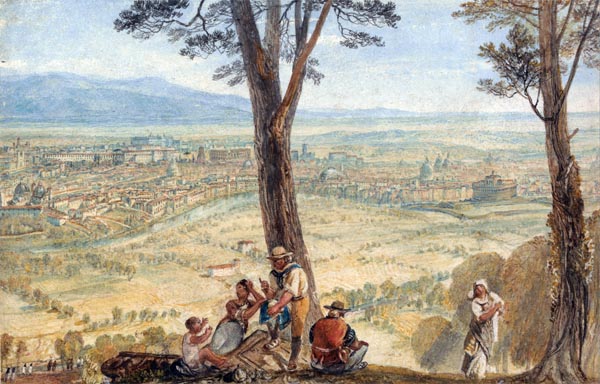
‘Rome from Monte Mario’
Joseph Mallord William Turner (1775 - 1851), British
Yale Center for British Art, Paul Mellon Collection
I confess without hesitation that the vicinity of Naples is more dazzling than that of Rome. When the blazing sun, or a large red moon rises above Vesuvius, like a shot fired from its volcanic crater, the bay of Naples, the coastline fringed with orange-groves, the mountains of Apulia, the island of Capri, the shores of Posillipo, Baiae, Miseno, Cumae, Lake Avernus, the Elysian fields, and all this Virgilian soil, present a magic spectacle to the view: still it does not possess, in my opinion, the imposing grandeur of the Roman Campagna. It is certainly true at least that one becomes deeply attached to this celebrated region. Two thousand years have elapsed since Cicero believed himself exiled forever under Greek skies, and wrote (Epistulae ad familiares II.12), to one of his intimate friends ‘Urbem, urbem, mi Rufi, cole, et in ista luce vive: live in Rome, Rome, my dear Rufus; inhabit that light.’ (I believe the passage occurs in the first book of the Familiar Epistles; but as I quote from memory, I hope that any little mistake in this respect will be overlooked.) The attractions of lovely Ausonia are still the same. Many examples are quoted of travellers who came to Rome for the purpose of passing a few days, and remained there all their lives. Poussin was forced to live out his life, in that country of beautiful landscapes; and at the very instant of writing this letter, I have the pleasure of being acquainted with Monsieur Jean Baptiste d’Agincourt, who has lived here for the last twenty-five years, and promises France too her very own Winckelmann.
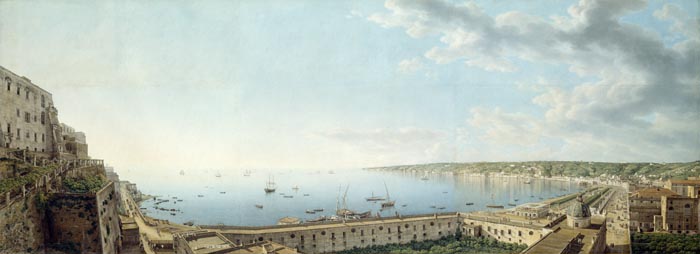
‘A View of the Bay of Naples, Looking Southwest from the Pizzofalcone towards Capo di Posilippo’
Giovanni Battista Lusieri (Italian, about 1755 - 1821)
Getty Open Content Program
Whoever is occupied solely with the study of antiquity and the fine arts, or who has no other ties in life should come and live in Rome. There they will find, for society, a land that nurtures reflection and takes possession of the heart, with walks which always offer instruction. The very stones they tread on will speak to them; the dust, blown by the winds around them, will contain some great human being. If they are unfortunate, if they have mingled the ashes of those they loved with the ashes of the illustrious dead, with what tranquil pleasure will they not pass from the tomb of the Scipios to the last resting place of a virtuous friend; from the charming sepulchre of Cecilia Metella to the modest grave of some ill-fated woman! They will fancy that their beloved shades find delight in straying among these monuments with that of a Cicero, still lamenting his dear Tullia, or Agrippina still drawn to the urn of Germanicus. If they are Christian, how will they be able to tear themselves from this land, which has become their own country, this land, which has witnessed the birth of a second empire more sacred in its origin, and greater in its power than that which preceded it, this land, where the friends whom we have lost, sleep with the martyrs in their catacombs, under the eye of the Father of the faithful, seeming as if they must be first to awake from their long sleep, being nearest to heaven!
Though Rome, viewed from within, resembles most European cities, it still preserves its individual character; no other city affords a similar mixture of architecture and ruins, from the Pantheon of Agrippa to the walls of Belisarius, from the monuments brought out of Alexandria to the dome raised by Michelangelo. The beauty of the women is another distinctive feature of Rome. They recall in their style and deportment the Clelias and Cornelias. You might imagine you saw ancient statues of Juno and Pallas, descended from their pedestals, walking about their temples. Among the Romans too is to be seen that flesh tone that artists call the antique tone, which they employ in their paintings. It appears natural that men, whose ancestors played so conspicuous a part in the world, should have served as models for Raphael and Dominichino, when they depicted the personages of history.
Another singularity of the city of Rome is the number of goats and, more especially, large oxen with enormous horns, lying at the feet of Egyptian obelisks, among the ruins of the Forum, and beneath those arches through which the ancients passed, conducting some triumphant Roman to that Capitol which Cicero called the public Council-House of the universe:
Romanos ad templa Deum duxere triumphos
Leading Roman triumphs to the gods’ temples (Virgil: Georgics Book II: 146)
Mingling with the usual noises of great cities is that of water, heard here on every side, as if you were close to the fountains of Bandusia or Egeria. From the summit of the hills enclosed by the boundaries of Rome, or at the extremity of several streets, you see the countryside in perspective; combining town and country to picturesque effect. In winter the tops of the houses are covered with turf, like the old thatched cottages of our peasantry. These circumstances combined, give Rome a rural appearance, suiting its history; her first dictators guided the plough; she owed her world empire to her labourers, and the greatest of its poets did not disdain to teach the children of Romulus the art of Hesiod:
Ascraeumque cano Romana per oppida carmen.
And sing the songs of Ascra in Roman towns. (Virgil: Georgics II:176)
As for the Tiber, which bathes this great city, and partakes of its glory, its fate is altogether strange. It runs through a corner of Rome, as if it did not exist; no one deigns to cast their eyes towards it, no one ever speaks of it, no one drinks its waters, the women do not use it for washing; it flows between the wretched houses which hide it, and hastens to hurl itself into the sea, ashamed of its modern name, the Tevere.
I will now, my dear friend, say something of those ruins, which you particularly requested me to mention, that occupy so much of the outskirts of modern Rome: I have examined them all in detail, both at Rome and Naples, except the temples of Paestum, which I have not had time to visit. You are aware that they assume different characters, according to the recollections attached to them.
One beautiful evening, last July, I was sitting in the Coliseum, on the step of an altar dedicated to the sufferings of the Passion. The setting sun poured floods of gold through all the galleries, where crowds had once thronged; at the same time, strong shadows emerged from the recesses of the ruined room and corridors, or fell to the ground in large black stripes. From the heights of the structure, I perceived, between the ruins, on the right of the edifice, the gardens of the palace of the Caesars, with a palm-tree, which seemed to have been placed in the midst of this wreck expressly for painters and poets. In this amphitheatre, instead of the shouts of joy from ferocious spectators watching Christians being torn apart by lions, nothing was now heard but the barking of dogs, which belong to the hermit who guards the ruins. But as soon as the sun fell below the horizon, the clock in the dome of Saint Peter’s resounded through the porticoes of the Coliseum. This correspondence, established by sacred sounds, between the two grandest monuments of Pagan and Christian Rome, invoked a lively emotion; I reflected that the modern edifice would fall as the ancient one had; that monuments succeed each other like the men who erected them; I called to mind that the same Jews, who, during their first captivity, worked on the pyramids of Egypt and the walls of Babylon, had also, during their last diaspora, built this enormous amphitheatre. The vaulted roofs that now re-echoed to the sound of this Christian bell were the work of a Pagan emperor, designated by prophecy to complete the final destruction of Jerusalem. Are not these sufficiently exalted, subjects of meditation, and do you not think that a city where such effects are to be produced at every step is worthy of being viewed?
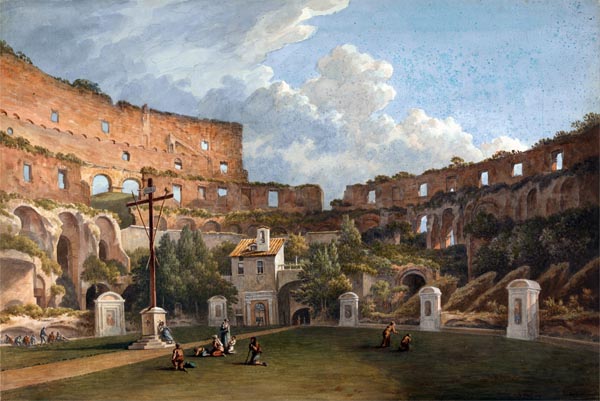
‘An Interior View of the Colosseum, Rome’
John Warwick Smith (1749 - 1831), British
Yale Center for British Art, Paul Mellon Collection
Yesterday, the 9th of January, I returned to the Coliseum, to see it at another season, in another aspect; I was surprised, on arrival, not to hear the dogs, which generally appeared in the upper corridors of the amphitheatre, barking among the withered grass. I knocked at the door of the hermitage, built beneath one of the arches; no one replied; the hermit was dead. The inclemency of the season, the absence of that worthy recluse, combined with several troubling recollections, redoubled the melancholy inspired by the place; I almost supposed myself looking at the ruins of a building which I had, a few days before, admired in all its newness and perfection! It is thus, my dearest friend, that we are constantly reminded of our nothingness; Human beings search outside themselves for reasons to be convinced; they meditate on the ruins of empires, forgetting that they are ruins yet more unstable, which will perish before these relics do. (The man to whom this letter is addressed is no more!) What most renders our life ‘the dream of a shade,’ (Pindar: Pythian 8: 92-97) is that we cannot hope to live long even in the recollection of our friends, because the hearts, in which our image is engraved, are like the object whose features it retains, mere clay subject to dissolution. At Portici, I was shown a piece of cinder from Vesuvius, which crumbles to the touch, but preserves the impression, though diminishing daily, of the arm and breast of a young woman, who was buried under the ruins of Pompeii. Though not flattering to our vanity, it is a true emblem of the traces left by our memory in the hearts of those who are themselves but dust and ashes. (Job 34:15 et al);
Before leaving for Naples, I passed some days alone at Tivoli. I wandered among the neighbouring ruins, and especially those of Hadrian’s Villa. Overtaken by rain in the midst of my excursion, I sought refuge in the halls of the Thermae, near the Pecile, under a fig-tree, whose growth had dislodged a wall. In a small octagonal room, a vine had penetrated through fissures in the arched roof, while its smooth stem, red and convoluted, climbed the wall like a serpent. Around me, through the arcades, different views of the Roman countryside opened. Large elder trees filled the deserted chambers, in which blackbirds had found their retreat. The fragments of masonry were decorated with the leaves of hart’s tongue fern (scolopendrium), its satin verdure seeming like mosaic-work over the white marble. Here and there lofty cypresses replaced columns, which had fallen in these palaces of death; wild acanthus crept at their feet over the ruins, as if nature had delighted in re-producing, over these mutilated architectural masterpieces, the ornamentation of their past beauty. The various rooms and the summits of the ruins resembled baskets and bouquets of greenery; the wind agitated these moist garlands, and the plants bent beneath the rain of heaven.
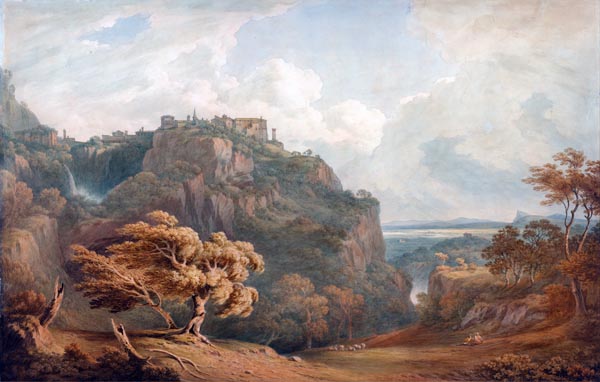
‘A View of Tivoli Looking Towards Rome’
John Warwick Smith (1749 - 1831), British
Yale Center for British Art, Paul Mellon Collection
Whilst contemplating this picture, a thousand confused ideas passed through my mind; at one moment I admired, at the next I detested Roman grandeur; at one instant I thought of the virtues, at another the vices, possessed by that master of the world who had wished to represent the empire by a garden. I thought of the events that had ruined this superb villa; I saw it despoiled of its most beautiful ornaments by Hadrian’s successor; I saw the barbarians passing by like a whirlwind, sometimes bivouacking here; and, in order to defend themselves among these monuments of art which they had half destroyed, crowning the Greek and Tuscan orders with Gothic battlements: finally, I saw Christians bringing back civilization to this district, planting vines, and driving the plough beside the Temple of the Stoics, and the Halls of the Academy. Before long the arts were reborn, and new rulers uncovered what still remained of these gorgeous palaces, to find artistic master-works. An inner voice echoed through these thoughts, repeating what has been written hundreds of times on the vanity of human affairs. Indeed there is a double vanity in the monuments of the Villa Adriana; they were, as we know, mere imitations of other monuments, scattered through the provinces of the Roman Empire; the real temple of Serapis at Alexandria, the real Academy at Athens, no longer exist; so that in the copies of Hadrian we see only the ruins of ruins.
Now, my dear friend, I should describe the Temple of the Sibyl at Tivoli, and the charming Temple of Vesta, suspended over the falls; but I cannot spare time for this purpose. I regret, too, that I am unable to depict that fount (Bandusia, see Odes III.13), on which Horace has conferred celebrity. Whilst there, I was in your domain, for you are heir to the Greek apheleia, that simplex munditiis: elegant simplicity (Odes BookI.V:5) described by the author of the Ars Poetica; but I saw it in very gloomy weather, and was not myself in good spirits. I will further confess: I was irritated by the roaring of water, though I was so often charmed by it in the forests of America. I still recall the happiness I felt during a night spent in the wilds, my fire half-extinguished, my guide asleep, and my horses grazing at a distance, on hearing the mingled melody of the winds and waters, in the depths of the woods. These murmurs, now loud, now faint, increasing and decreasing momentarily, occasionally made me start; every tree was to me a sort of lyre, from which the winds drew ineffable strains.
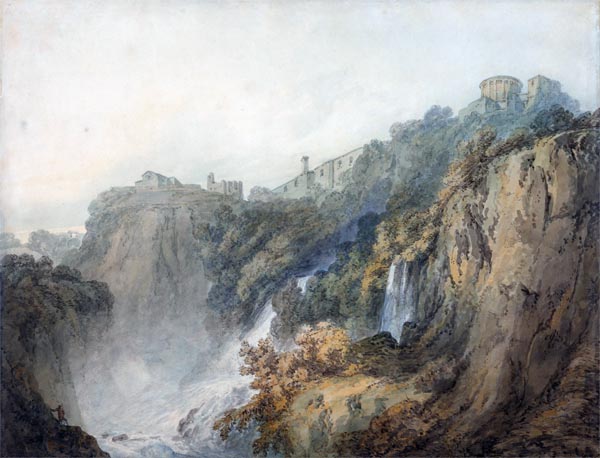
‘Tivoli with the Temple of the Sybil and the Cascades’
Joseph Mallord William Turner (1775 - 1851), British
Yale Center for British Art, Paul Mellon Collection
Now I find I am far less open to the charms of nature; and I doubt whether the cataract of Niagara itself would cause the same admiration in me as before. When one is very young, mute Nature is eloquent; there is superabundance in the heart of a man; all his future is before him (if my Aristarchus will allow me to use this expression); he hopes to communicate his sensations to the world, and feeds himself with a thousand chimeras. But at a more advanced age, as the prospects we had before us slip behind, and we are undeceived by the host of illusions, then solitary Nature becomes colder and speaks to us less: les jardins parlent peu. (La Fontaine: Fables, Book VIII: The Bear and the Garden Lover) For Nature to preserve its interest, we must attach our memories of society to it; we are less self-sufficient; absolute solitude oppresses us, and we feel a want of those conversations which are carried on, at night, in a low voice, among friends. (See Horace: Epistles Book I.V)
I could not leave Tivoli without visiting the house of the poet I have just quoted; it faces the Villa of Maecenas, and there he greeted floribus et vino genium memorem brevis aevi: with flowers and wine, the spirit that knows life’s brevity (Horace: Epistles: BookII.1:144-145). The hermitage could not have been large, as it is situated on the very ridge of the hill; but you feel that it must have been very secluded there, and that every thing was comfortable, though on a small scale. From the orchard, that fronts the house, the eye embraces an immense tract of country; a true retreat for a poet whom little suffices, and who enjoys so much that is not his, spatio brevi spem longam reseces; shut in a narrow space your far-reaching hopes (Horace: Odes: BookI.XI:7). After all, it is easy to be a philosopher like Horace. He had a house at Rome, and two country villas, the one at Utica, the other at Tivoli. He drank, with his friends, a wine made during the consulate of Tullus (Odes: Book III.VIII:9-12), his sideboard was covered with silver plate (Odes: Book IV.XI); and he said familiarly to the first minister of the master of the world, ‘I do not feel the deprivations of poverty; and if I wish for anything more, you, Maecenas, will not refuse me.’ (Odes: Book III.XVI) Thus situated, a man may very comfortably sing of Lalage (Odes: Book I.XXII), crown himself with brief lilies (Odes: Book I.XXXVI), talk of death while he is drinking Falernian (Odes: BookII.III), and throw sadness and fear to the winds (Odes: BookI.XXVI)
I note that Horace, Virgil, Tibullus, and Livy, all died before Augustus, whose fate in this respect was the same as that of Louis XIV: our great prince survived his contemporaries awhile, and was the last to descend to the grave, as if to be sure that nothing was left behind.
It will, doubtless, be a matter of indifference to you to know that the house of Catullus is sited at Tivoli, higher up than that of Horace, and is at present occupied by Christian monks; but you will, perhaps, deem it more worthy of remark, that Ariosto composed his ‘fables comiques’ (Boileau: Art poétique.III) at the very place where Horace enjoyed the good things of this world. It seems surprising that the author of Orlando Furioso, while living in retirement with the Cardinal d’Este at Tivoli, should have fixed on France as the subject of his divine extravaganzas, and a semi-barbarous France at that, while he held beneath his gaze the solemn monuments and grave memorials of the most serious and civilized nation on earth. In other respects, the Villa d’Este is the only modern building which interests me, among the ruins of proud habitations belonging to so many Emperors and Consuls. This House, of Ferrara, has had the singular good fortune to be celebrated by the two greatest poets of its age, and the two finest geniuses of modern Italy.
Piacciavi, generose Ercolea prole,
Ornamento, e splendor del secol nostro
Ippolito, etc.
Deign, gracious son of Hercules,
Ornament, and splendour of our age,
Hyppolitus, etc (Ariosto: Orlando Furioso: Canto I:3)
This is the exclamation of a happy man, who returns thanks to the powerful House which grants him favour, and of which he is the delight. Tasso, more emotional, conveys, in his invocation, the acknowledgments of a great but unfortunate man:
Tu magnanimo Alfonso, il qual ritogli, etc.
You, magnanimous Alfonso, who restrain etc. (Tasso: Gerusalemme liberate 1.4)
It is a noble use of power to protect exiled talent and restore neglected worth. Ariosto and Hippolyus d’Este have left, in the valleys of Tivoli, a reputation not inferior, in its charm, to that of Horace and Maecenas. But what has become of protector and protected? At the moment that I write this letter, the House of Este is extinct, and the villa of Cardinal d’Este is a crumbling ruin like that of Augustus’s first minister: such is the history of men and things.
Linquenda tellus, et domus, et placens Uxor.
We are destined to leave earth, home, our loving wife.
(Horace: Odes Book II. XIV.21)
I spent nearly a whole day at this superb villa; I could not leave off admiring the immense prospect enjoyed from the heights of its terraces; below you, gardens extend with their plane-trees and cypresses; beyond the gardens are the ruins of the house once belonging to Maecenas, on the bank of the ancient Anio (formerly the Teverone, now the Aniene); on the opposite hill, on the far side of the river, is a wood of ancient olives, among these are the ruins of Varus’s villa (that Publius Quintilius Varus who was massacred with his legions in Germany. See the admirable passage in Tacitus: Annals I.55 et seq); a little further to the left, in the plain, rise the three mountains Monticelli, San Francesco, and Sant’ Angelo, and between the summits of these three neighbouring mountains appears the distant azure summit of old Soracte; on the horizon, at the extremity of the Roman Campagna, describing a circle to the west and south, may be discerned the heights of Montefiascone, Rome, Civita-Vecchia, Ostia, the sea, and Frascati, surmounted by the pines of Tusculum; finally, turning to locate Tivoli in the east, the entire circumference of this immense prospect is terminated by Mount Ripoli, where once were located the houses of Brutus and Atticus, at the foot of which lies the Villa Adriana and its ruins.
We might follow, in the midst of this picture, the course of the Teverone (Aniene), which descends rapidly toward the Tiber, as far as the bridge, where stands the mausoleum of the Plautian family, built in the form of a crenellated tower. The high road to Rome is also visible, crossing the plain. It was the ancient Tiburtine way, once bordered by sepulchres; along which, pyramidal haystacks now mimic the tombs.
It would be difficult to find, the world over, a more astounding view, and one more calculated to engender powerful reflections. I do not speak of Rome, though the domes of that city are visible, which alone commends the prospect; I speak only of the locations and monuments enclosed by its vast extent. There you behold the house in which Maecenas, satiated with the luxuries of the world, died of a wasting illness; Varus left this hillside to shed his blood in the marshes of Germany; Cassius and Brutus abandoned these retreats, in order to convulse their country in Civil War. Beneath these tall pines of Frascati, Cicero dictated his Tusculan Disputations; Hadrian caused another Peneus to flow at the foot of this hill, and transported to this region the place-names, charms and memories of the Vale of Tempe. Near this source of Lake Solfatara (Albulus) the captive Queen of Palmyra (Zenobia) ended her days in obscurity, and her city of an hour vanished into the desert. It was here that King Latinus consulted the god Faunus in the forest of Albunea, the Sibyl; here was the temple of Hercules, and here the Tiburtine Sybil dictated her oracles. These are the mountains of the ancient Sabines, the plains of old Latium, the land of Saturn and Rhea, cradle of the golden age, sung by all the poets; the pleasant hills of Tivoli and Mount Lucretilis (Monte Gennaro) which only French genius has been able to describe, through the art of Poussin and Claude Lorraine.
I descended from the Villa d’Este (at the close of my description of the Villa Adriana, I spoke of a walk, planned for the next day to the Villa d’Este. I have not given the details of this walk, because they will be found in my previous letter regarding Rome, to Monsieur de Fontanes); about three o’clock in the afternoon; and crossed the Teverone (Aniene) over the Bridge of Lupus, for the purpose of re-entering Tivoli by the Sabine gate. In passing through the grove of old olive-trees, which I have mentioned, I perceived a white chapel, Santa Maria di Quintiliolo, built above the ruins of the villa formerly belonging to Quintilius Varus. It was Sunday; the door of the chapel was open, I entered. I saw three altars arranged in the form of a cross; on the middle one was a silver crucifix, before which burnt a lamp suspended from the roof. A solitary man, with a troubled air, was kneeling by a bench; he was praying with such fervour that he did not even raise his eyes at the noise of my footsteps, as I approached. I felt what I have experienced a thousand times on entering a church; a certain solace for the troubles of the heart (to speak as our old scriptures do), and an indescribable disgust for all things earthly. I sank to my knees at some distance from the man, and, inspired by the place, could not refrain from uttering this prayer: ‘God of the traveller, who suffers the pilgrim to adore you in this humble refuge, built on the ruins of a palace of the great; Mother of the afflicted, who has established your rites of mercy on lands once those of an unfortunate Roman, who died far from his country in the forests of Germany! Here, at the foot of your solitary altar, are but two prostrate sinners: grant this stranger, bowed so humbly before your majesty, all that he requests; may this man’s prayers, in turn, serve to eradicate my failings; so that we two Christians, who are unknown to each other, who have never met but for one instant during our lives, and who are about to part and no more see each other here below, may be astonished when we meet once more, at the foot of your throne, to owe a mutual share of happiness to the intercession of this day, and the miracle of your charity!’
When I contemplate, my dear friend, all these leaves scattered across my table, I am alarmed at having trifled to such an extent, and hesitate to send you such a letter. Indeed, I am aware I have said nothing, and forgotten a thousand things I ought to have said. How can it be, for instance, that I have not spoken of Tusculum, of Cicero, who, according to Seneca the Elder, was ‘the only genius ever produced by the Roman people, to match the greatness of their empire: illud ingenium quod solum populus Romanus par imperio suo habuit’ (Seneca the Elder: Controversiae I:11)? My travels to Naples, my descent into the crater of Vesuvius (there is only, as I have already observed, a degree of fatigue attendant on the descent into the crater of Vesuvius, but no danger, unless one were surprised by a sudden eruption; and even then, if not thrown into the air by the explosion, experience has proved that one may still save oneself, since the lava, which flows very slowly, congeals sufficiently quickly for a person to pass swiftly over it); my tours to Pompeii, Caserta (I can find no notes of mine about Caserta), Solfatara, Lake Avernus, and the Cave of the Sibyl would interest you. Baiae, where so many memorable scenes occurred, itself deserves a volume. I could fancy that I yet see the tower of Bauli (Bacoli), where Agrippina’s house stood, and where she used that sublime expression to the assassins sent by her son: ‘Ventrem feri: strike at my womb’ (Tacitus, Annals:14.8). The Isle of Nisida, which served as a retreat to Brutus, after the murder of Caesar, the bridge of Caligula, the marvellous Piscina (cistern), and all those palaces, built in the sea, of which Horace speaks (Odes Book II:XVIII), are well worth one lingering awhile. Virgil set, or found, in these places the beautiful fictions of the sixth book of his Aeneid. It was from here that he wrote these modest words to Augustus, the only lines of prose, I believe, written by this great man, left to us: ‘Ego vero frequentes a te litteras accipio… De Aenea quidem meo, si, me hercule, jam dignum auribus haberem tuis, libenter mitterem; sed tanta inchoata res est, ut pene vitio mentis tantum opus ingressus mihi videar; cum praesertim, ut scis, alia quoque studia ad id opus multoque potiora impertiar. Indeed I often receive letters from you… In truth, I would willingly send something of Aeneas, if, by Hercules, it were yet fit for your ear; but the thing is so incoherent, that it almost seems to me a mental lapse merely to have begun it; especially since, as you know, other effects too and far better are to be imparted to the work’ (This fragment occurs in Macrobius, Saturnalia I:11. See Les Martyrs regarding the sojourn at Baiae.)
My pilgrimage to the tomb of Scipio Africanus, is one of those which has given me the most satisfaction, though I failed in attaining the object of my journey. I had been told that the mausoleum of this famous Roman still existed, and that even the word patria was distinguishable on it, being all that remained of the inscription, said to have been carved there (Valerius Maximus, 1.5,c.3): Ingrata patria, ne ossa quidem habebis: ungrateful fatherland, you shall not even have my bones! I went to Patria, the ancient Liternum; I did not find the tomb, but wandered, however, through the ruins of the house, which the greatest and most pleasant of men inhabited during his exile; I seemed to see Hannibal’s conqueror walking the shoreline opposite Carthage, and consoling himself, for the injustice shown him by Rome, with the delights of friendship, and the consciousness of his own rectitude.
I was not only told that this tomb was in existence, but I have read of the fact mentioned above in some travels, though I do not recollect by whom they were written. I doubt the truth of these statements, however, for the following reasons:
- It appears to me that Scipio, in spite of his just complaints against Rome, loved his country too much to have wished such an inscription engraved on his tomb. It is contrary to all we know of the spirit of the ancients.
- The inscription spoken of, is almost literally conceived in terms of the imprecation Livy puts into the mouth of Scipio on leaving Rome (Livy: Ab Urbe Condita XXXVIII. 53.8) May this not have given rise to the error?
- Plutarch mentions that in the neighbourhood of Gaieta a bronze urn was found in a marble tomb, where the ashes of Scipio would most probably have been deposited, and that it bore an inscription very different from the one now under discussion.
- The ancient Liternum having taken the name of Patria, this may have given birth to the report that ‘patria’ was the only remaining word of the inscription on the tomb. Would it not be a very singular coincidence indeed if the town should be called Patria, and the same word should also be found in this solitary state on Scipio’s monument; unless we suppose the one to have been taken from the other?
Still, it is possible that various authors with whom I am unacquainted have spoken of this inscription in a manner which removes all doubt. I grant that there is even a phrase in Plutarch apparently favourable to the opinion I am contesting. A man of great merit, and who is the dearer to me because he is very unfortunate(Monsieur Bertin, the elder, whom I can now name. He was then an exile, and persecuted by Buonaparte, on account of his devotion to the house of Bourbon) visited Patria much about the same time that I did. We have often spoken about this celebrated place; but I am not quite sure whether he said that he had seen the tomb or the engraved word (which would resolve the difficulty), or whether he only grounded his arguments on popular tradition. For my own part I could not locate the tomb itself, but merely saw the ruins of the villa, which are of no great consequence.
Plutarch mentions the opinion of those who place the tomb of Scipio near Rome; but they evidently confounded the Tomb of the Scipios with that of Scipio Africanus. Livy affirms that the latter was at Liternum, and that it was surmounted by a statue, which a tempest had thrown down; adding that he himself had seen the statue (Livy: Ab Urbe Condita: 38.56.2-4). We know too from Seneca, Cicero, and Pliny, that the other tomb, namely that of the Scipios, had actually existed at one of the gates of Rome. It was discovered during the pontificate of Pius VI, and the inscriptions appertaining to it were conveyed to the museum of the Vatican. Among the names of the Scipios found in this monument, that of Africanus is lacking.
As to the modern Romans, Duclos appears to have been sarcastic when he calls them the Italians of Rome. It strikes me that there is still among them the makings of an uncommon people. When the Italians are closely examined, traits of great courage, patience, genius, and profound traces of their ancient manner of life are to be discovered in them, something of a superior air, and various noble customs still partaking of royalty. Before you condemn this opinion, which may perhaps appear singular, you must hear my reasons for it, and at present I have not time to give them.
How many observations I still need to express to you regarding Italian literature! Do you know, I never saw Count Alfieri but once in my life; and can you guess in what circumstance? I saw him placed in his coffin! I was told that he was scarcely at all altered. His countenance appeared to me noble and grave; death had doubtless imparted some further degree of austereness to it. The coffin being rather too short, the corpse’s head was bowed on its chest, which gave it a dreadful appearance. Through the kindness of one who was very dear to Alfieri, (the lady for whom the premature epitaph was written, which I here subjoin, has not long belied the expression hic sita est: She has gone to rejoin Count Alfieri. Nothing is so sad I think as to read again, towards the end of your days, what you wrote in your youth: all that was present when you held the pen has passed away; you spoke of what was living, and now there are none but the dead. He who grows old, on his pilgrimage through life, turns sometimes to look behind him at the former companions of his journey, and finds they have all vanished! He seems to proceed alone, along a deserted road); and the politeness of a gentleman, who was also the Count’s friend, I am in possession of some curious particulars as to the posthumous works, life, and opinions of this celebrated man. Most of the newspapers in France have given vague and distorted accounts of the matter. Till I am able to communicate these particulars, I send you the epitaph which Alfieri wrote for his noble friend, at the same time as he composed his own:
HIC. SITA. EST.
AL. E. ST…
ALB... COM…
GENERE. FORMA. MORIBUS.
INCOMPARABILI. ANIMI. CANDORE.
PRAECLARISSIMA.
A. VICTORIO. ALFERIO.
JUXTA. QUEM. SARCOPHAGO. UNO. *
TUMULATA. EST.
ANNORUM... SPATIO.
ULTRA. RES. OMNES. DILECTA.
ET. QUASI. MORTALE. NUMEN.
AB IPSO. CONSTANTER. HABITA.
ET. OBSERVATA.
VIXIT ANNOS… MENSES… DIES…
HANNONIAE. MONTIBUS. NATA.
OBIIT. DIE… MENSIS…
ANNO DOMINI. M. D. CCC.
Here lies E(louise) de S(tolberg-Gedern), Countess of A(lbany): illustrious by her ancestry, beauty, and elegance of manner; and the incomparable candour of her mind. Buried beside Vittorio Alfieri, in the same grave, he honoured her, beyond all others, for (…) years; and, though mortal, she was constantly treasured and revered by him as though she were a divinity. Born at Mons; she lived…years…months…days, and died on the…day of the month of…in the year 18… (Composed in 1800)
* Sic inscribendum, me, ut opinor et opto, praemoriente: sed, aliter jubente Deo, aliter inseribendum: Qui. juxta, eam. sarcophago. uno Conditus. erit. Quamprimùm: To be inscribed thus, if I die first as I believe and hope I shall; but if God ordain it otherwise, the inscription to be thus altered: buried by direction of one who will soon be enclosed in the same tomb. (The poet Vittorio Alfieri died in 1803. His mistress, Louise, the former wife of the Jacobite claimant to the English and Scottish thrones, Charles Edward Stuart, died in 1824.)
The simplicity of this epitaph, and especially of the note which accompanies it, I find extremely moving.
For the moment, I have done. I send you this heap of fragments; do what you like with them. In describing the different matters of which I have treated, I do not think that I have omitted anything of note, unless it is that the Tiber is still the flavus Tiberinus, the golden Tiber, of Virgil. (Aeneid VII:30-31) It is said to gain its colour from the silt washed down by the rain in the mountains from which it descends. I have often, in the serenest weather, while contemplating its discoloured waves, considered its tempestuous beginning; the remainder of its life’s course is spent beneath a serener sky, in vain; the stream continues to be tainted with the waters of the storms that troubled its source.
The End of Chateaubriand’s Voyage en Italie