François-René de Chateaubriand
 Atala
Atala 
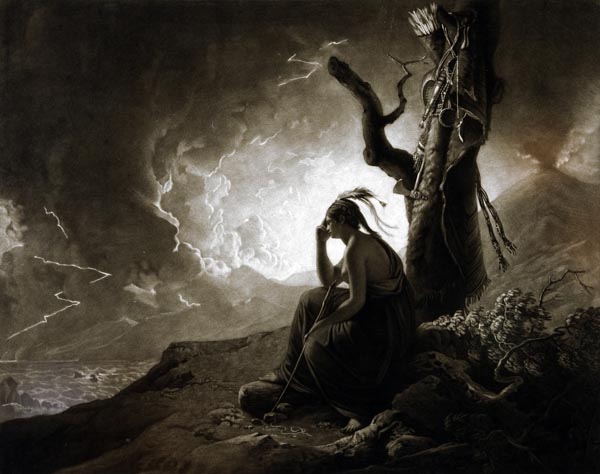
‘The Widow of an Indian Chief’
John Rubens Smith (American, b. England, 1775 - 1849)
Yale University Art Gallery
Translated by A. S. Kline © Copyright 2011 All Rights Reserved
This work may be freely reproduced, stored and transmitted, electronically or otherwise, for any non-commercial purpose. Conditions and Exceptions apply.
Contents
Prologue
France once possessed, in North America, a vast empire that stretched from Labrador to Florida and from the shores of the Atlantic to the farthest lakes of Upper Canada.
Four great rivers, having their sources in the same mountain chain, appeared on the charts as dividing these immense regions: the St. Lawrence River lost towards the east in the Gulf of that name; the Western River (a cartographic error) shown bearing its waters to unknown seas; the Bourbon River (Saskatchewan) its waters flowing east to north (into Lake Winnipeg, whose waters eventually drain via the Nelson River) into Hudson Bay, and the Mississippi which runs from north to south into the Gulf of Mexico.
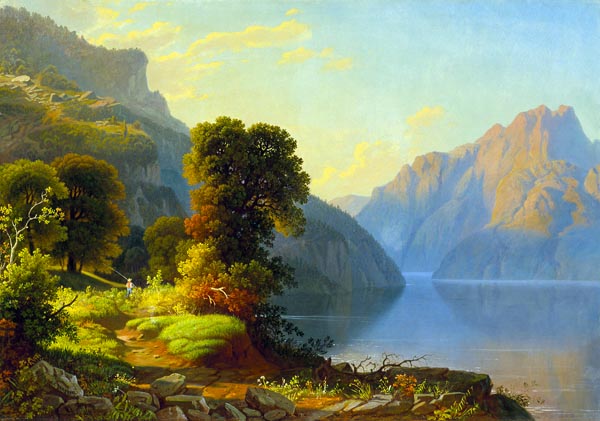
‘A View of a Lake in the Mountains’
George Caleb Bingham (United States, Virginia, Augusta County, 1811 - 1879)
LACMA Collections
This latter river, in its course of over two thousand miles, waters a delightful territory that the inhabitants of the United States call the New Eden, and to which the French have given the noble name of Louisiana. A thousand other rivers, tributaries of the rivers Mississippi, Missouri, Illinois, Arkansas, Ohio, Wabash, and Tennessee, enrich it with their sediments and fertilise its waters. When all these rivers are swollen with winter floods, when storms blow down whole segments of forest, uprooted trees choke their sources. Soon mud cements them, creepers bind them, and plants, taking root everywhere, serve to consolidate the debris. Carried by the foaming currents, they descend to the Mississippi. The river takes them, drives them towards the Gulf of Mexico, grounds them on sand banks, and swells the number of its mouths. At intervals, it raises its voice, while passing below the hills, and pours its overflowing waters among forest colonnades and the pyramids of Indian graveyards; it is the Nile of the wilderness. But grace is always joined to magnificence in natural scenery: as the main current carries these corpses of pine and oak to the sea, one finds, on the two lateral flows re-ascending along the shore, floating islands of pistia (water-lettuce) and water lilies, whose yellow flowers rise like small pavilions. Green snakes, blue heron, flamingos, and young alligators embark, as passengers, on these flowery vessels, and the fleet, spreading golden sails to the wind, floats off dreamily towards some secluded angle of the river.
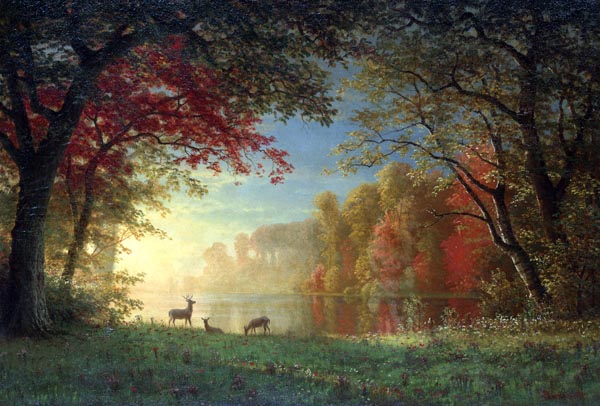
‘Indian Sunset: Deer by a Lake’
Albert Bierstadt (American, born Germany, 1830 - 1902)
Yale University Art Gallery
Both banks of the Mississippi present the most extraordinary picture. On the western side, savannah stretches as far as the eye can see, its distant waves of verdure seeming to rise into the azure sky where they vanish. In these boundless prairies one sees herds of three or four thousand wild buffalo straying at random. Sometimes a bison, full of years, cuts through the waves as he swims, to sleep amongst the deep grasses, on an island in the Mississippi. With his forehead adorned with twin horns, and his ancient and mud-streaked beard, you would take him for a god of the river, casting a satisfied gaze on the grandeur of its flow, and the wild abundance of its shores.
Such is the view to the west, but the scene is quite different on the opposite bank, revealing an admirable contrast to the former. Suspended above the currents, clustered on the rocks and mountains, and scattered in the valleys, are trees of all shapes, colours, and scents, mingled, growing together, ascending into the air towards heights that exhaust the gaze. Wild vines, catalpas, and gourds intertwine at the foot of these trees, climb their boughs, cling to the extremities of their branches, shooting from maple to tulip-tree, tulip-tree to hibiscus, forming a thousand grottoes, a thousand arches, a thousand lattices. Often wandering from tree to tree, these vines traverse arms of rivers over which they build bridges of flowers. From within these masses, the magnolia lifts its motionless cone; topped by huge white flowers, it dominates the whole forest, and owns no rival but the palm that lightly sways its leafy fans nearby.
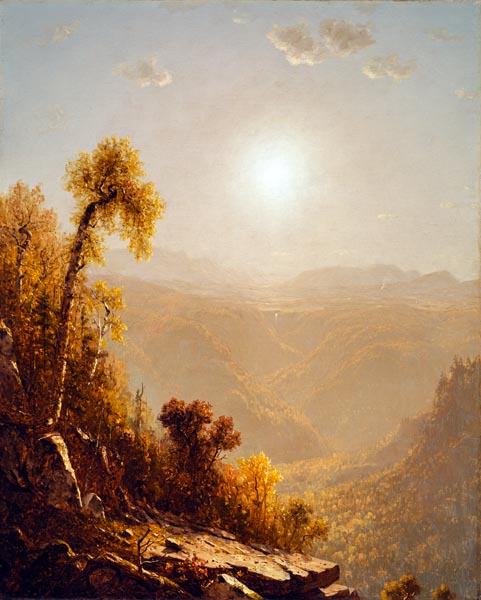
‘October in the Catskills’
Sanford Robinson Gifford (United States, New York, Greenfield, 1823 - 1880)
Yale University Art Gallery
Here a multitude of creatures, set down in these retreats by the Creator’s hand, spread life and enchantment. At the extremity of avenues, one sees bears drunk on grapes, stumbling over branches of elm; caribou swim in a lake; black squirrels play amongst the dense foliage; mockingbirds, Virginian doves the size of a sparrow, settle on grass red with strawberries; green parrots with yellow heads; crimson woodpeckers; fiery cardinals climb in spirals in the crowns of cypress trees; hummingbirds glitter among Florida jasmine; and bird-eating snakes hiss as they hang from the wooded domes, swaying there like lianas.
If all is silence and rest in the savannah on the other bank of the river, here, on the contrary, all is movement and a murmur of sound: beaks pecking the trunks of oak-trees; the rustling of creatures on the move, grazing, or crushing the cores of fruits between their teeth; the whisper of waves; faint moans, a muted lowing, or a gentle cooing, filling the wilderness with a wild and tender harmony. But when a breeze rises and animates these solitudes, swaying these floating islands, mingling these masses of white, azure, green, and pink, mixing all colours, merging together all murmurs; then such noises sound from the depths of the forests, such things present themselves to the eye, that I would try in vain to describe them to those who have not traversed these tracts of primitive nature.
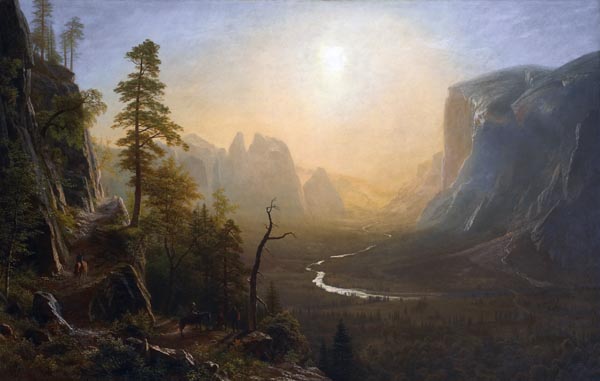
‘Yosemite Valley, Glacier Point Trail’
Albert Bierstadt (American, born Germany, 1830 - 1902)
Yale University Art Gallery
After the discovery of the Mississippi by Father Jacques Marquette and the unfortunate Robert Cavelier de La Salle, the first French who settled in Biloxi and New Orleans, formed an alliance with the Natchez Indian nation, whose power was considerable in those parts. Quarrels and jealousies subsequently stained the hospitable land with blood. Among these savages was an old man named Chactas who by his age, his wisdom and experience of life, was a patriarch favoured by those wild places. Like all men he had acquired virtue through adversity. Not only did the forests of the New World bring him their misfortunes, but he carried them with him to the shores of France. Confined in the galleys at Marseilles through a cruel injustice; set free; and subsequently presented to Louis XIV; he had conversed with the great men of the age, and attended the ceremonies at Versailles, the tragedies of Racine, and the funeral orations of Bossuet: in a word, the Savage had observed society in its most splendid forms.
For several years, after returning to the bosom of his country, Chactas enjoyed repose. However the heavens exacted a heavy price for their favour, for the old man became blind. A young girl accompanied his steps beside the Mississippi, as Antigone guided the footsteps of Oedipus on Mount Cythaeron, or as Malvina led Ossian on the cliffs of Morven.
Despite the numerous injustices that Chactas had experienced at the hands of the French, he still held affection for them. He always remembered Fénelon, whose guest he had been, and wished to render some service to that virtuous man’s compatriots. A favourable opportunity presented itself. In 1725, a Frenchman named René, driven by passion and misfortune, arrived in Louisiana. He ascended the Mississippi as far as the Natchez, and asked to be received as a warrior of that nation. Chactas having questioned him, and finding him unwavering in his resolution, adopted him as his son and presented him with an Indian wife, named Celuta. Shortly after the marriage, the Savages prepared themselves for a beaver hunt.
Chactas, though blind, was designated by the Council of Sachems (elderly counsellors) to command the expedition, because of the respect in which the Indian tribes held him. Prayers and fasting commence: Medicine men interpret dreams; the Manitous (deities, present in sacred objects) are consulted; sacrifices of tobacco are made; fillets of elk-tongue are burned; they are observed carefully to see if they crackle in the flames, in order to discover the will of the Spirits; at last the members of the party set off, after having eaten of a sacred dog. René is a member of the expedition. With the help of reverse currents, the canoes ascend the Mississippi, and enter the course of the Ohio. It is autumn. The beautiful wilds of Kentucky reveal themselves to the astonished eyes of the young Frenchman.
One night, in the moonlight, while the Natchez slept in their canoes, and the Indian fleet, raising its sails of hide, fled before a light breeze, René, remaining alone with Chactas, asked him for an account of his adventures. The old man agreed to satisfy him, and sitting beside him at the stern of the canoe, he commenced with these words:
The Tale
The Hunters
“It is a singular destiny my dear son, that unites us. I see in you the civilized man who chooses to become a savage; you see in me the savage, whom the Great Spirit (I do not know for what purpose) wished to civilize. In the course of our lives, through opposing aims, you have come to occupy my place, and I am seated in yours: so we must inevitably possess a totally different view of things. Who, between us, has won or lost most through this change of position? That, the Spirits alone know, the least knowledgeable of whom has more wisdom than all of mankind put together.
At the next ‘moon of flowers’ (May), it will be seven times ten snows, and three since my mother gave birth to me, on the banks of the Mississippi. The Spaniards had recently settled Pensacola Bay, but no white man yet inhabited Louisiana. I had scarcely counted seventeen falls of leaf, before I advanced with my father, the warrior Outalissi, against the Muscogee, a powerful nation of the Floridas. We joined our Spanish allies, and the battle was fought on a branch of the Mobile River. Areskoui (the war-god) and the Manitous were not favourable to us. Our enemies triumphed; my father lost his life; I was twice wounded in defending him. Oh! If only I had descended then to the land of souls I would have avoided the misfortunes that awaited me on earth! The Spirits commanded otherwise: I was carried by the fugitives to St. Augustine.
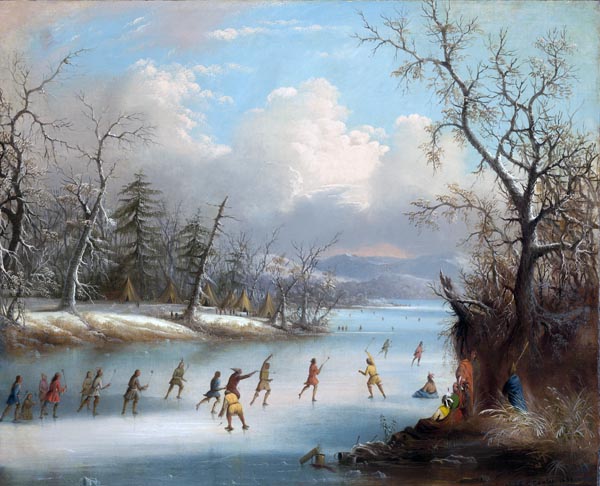
‘Indians Playing Lacrosse on the Ice’
Edmund C. Coates (American, b. England, 1816 - 1871)
Yale University Art Gallery
In this city, newly built by the Spaniards, I risked being sent to the mines of Mexico, when an old Castilian, named Lopez, moved by my youth and my innocence, offered me sanctuary, and introduced me to his sister with whom he lived, as he lacked a wife.
Both of them showed me the most tender of feelings. I was raised with great care; I was taught by all kinds of masters. But after spending thirty moons in St. Augustine, I was seized by disgust for city life. I was visibly wasting away: sometimes I remained motionless for hours, gazing at the summits of the distant forest; sometimes I might be found sitting by some river-bank, sadly contemplating its flow. I imagined the woods through which its course had passed, and my soul was lost in the solitude.
Unable to resist the urge to return to the wilds, I presented myself before Lopez one morning, dressed in the clothes of a savage, holding my bow and arrows in one hand, and my European clothes in the other. I gave them to my generous patron, at whose feet I fell, shedding torrents of tears. I called myself odious names, I accused myself of ingratitude: ‘But,’ I said, ‘O my father, finally you must see for yourself: I will die if I do not adopt the life of an Indian.’
Lopez, struck with astonishment, tried to dissuade me from my purpose. He represented to me the danger that I would run, by risking my falling into the hands of the Muscogee once more. But seeing that I was determined to adventure all, bursting into tears and hugging me, ‘Go,’ he cried, ‘Child of Nature! Resume that manly independence, of which Lopez has no wish to deprive you. If I were younger myself, I would enter the wilderness with you (of which I too have sweet memories!) and return you to the arms of your mother. When you are deep in your forests, think now and then of this old Spaniard who gave you shelter, and remember, so as to attract the love of your fellow men, that the first experience you acquired of the human heart, was all in its favour.’ Lopez ended with a prayer to the God of Christianity, a religion I had refused to embrace, and we parted tearfully.
The punishment for my ingratitude was not long delayed. My inexperience led me astray in the woods, and I was taken by a party of Muscogees and Seminoles, as Lopez had predicted. I was recognised as Natchez, by my clothing and the feathers that adorned my head. They bound me, though lightly, because of my youth. Simaghan, the head of the band, wanted to know my name, I replied: ‘My name is Chactas, son of Outalissi, son of Miscou, who has taken more than a hundred scalps from Muscogee braves.’ Simaghan replied: ‘Chactas, son of Outalissi, son of Miscou, rejoice; you will be burned to death in the Grand Village.’ I replied, ‘That is well,’ and I sang my song of death.
Wholly captive as I was, I could not, during the first days, restrain my admiration for my enemies. The Muscogees, and above all their allies the Seminoles, breathe out cheerfulness, affection, and contentment. Their step is light, their aspect open and serene. They speak often and volubly; their language is harmonious and smooth. Even age can not deprive the Sachems of their joyful simplicity: like the ageing birds of our woods, they still blend their old songs with the new airs of their young offspring.
The women who accompanied the band, showed a tender pity for and kindly curiosity towards my youth. They questioned me about my mother, about the early days of my life; they wanted to know whether my mossy cradle had been hung among flowering maple branches, whether the breezes rocked me beside the nests of young fledglings. A thousand other questions followed concerning the state of my heart: they asked me if I had seen a white doe in my dreams, and whether the trees in the hidden valley had counselled me to love. I answered those mothers, daughters and wives, in all innocence. I told them: ‘You are the graces of day, and the night loves you like the dew. Man comes from your womb to hang at your breasts, and on your lips; you know the magic words that lull all pain. That is what she who brought me into this world told me, she who will never look upon me again! She said further that virgins were mysterious flowers found in solitary places.’
Such praise gave the women much pleasure; and they smothered me with a host of gifts; they brought me coconut milk, maple sugar, sagamite stew, bear hams, beaver pelts, shells to adorn myself, and moss for my bed. They sang, they laughed with me, and then they took to shedding tears, when they thought of my being burned to death.
One night the Muscogee had set up camp on the edge of the forest, I was sitting by the war-fire, with the hunter committed to guarding me. Suddenly I heard the whisper of a garment over the grass, and a woman partly-veiled came to sit beside me. Tears flowed from beneath her eyelids; in the firelight a small gold crucifix shone at her breast. She was uniformly beautiful; in her visage could be seen unknown degrees of virtue and passion, whose appeal was irresistible. To this she joined more tender graces; extreme sensitivity, combined with a profound melancholy, breathed in her eyes; her smile was heavenly.
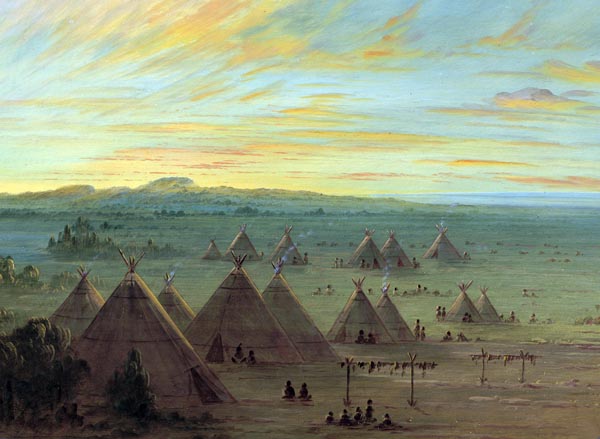
‘A Crow Village on the Salmon River’
George Catlin (American, 1796 - 1872)
The National Gallery - Open Access
I thought she was the Virgin of Last Love, that virgin sent to prisoners of war to bring enchantment to their grave. Persuaded that this was so, I spoke to her, haltingly, yet with a confusion that did not arise from fear of the pyre: ‘Lady, you are worthy of a first love, and are not created to be the last. The movements of a heart that will soon cease to beat would only respond sadly to the movements of yours. How can life and death mingle? You will make me regret the daylight far too deeply. Let some other be happier than I, and a long embrace unite the liana and the oak!’
The young girl then said: ‘I am no Virgin of Last Love. Are you a Christian?’ I replied that I had never betrayed the Spirits of my hut. At these words, the Indian girl made an involuntary movement. She said: ‘I pity you for being no more than a wicked idolater. My mother made me (sic) a Christian; I am named Atala, the daughter of Simaghan, who wears the gold bracelets, and is leader of this band of warriors. We go to Apalachucla where you will be burned.’ As she uttered these words, Atala rose and walked away.”
Here Chactas was forced to interrupt his story. A crowd of memories weighed on his spirit; his dimmed eyes inundated his faded cheeks with tears: so two hidden springs, in earth’s deep night, might be revealed by the water they let fall among the rocks.
“O my son!” he said, at last, “You see that Chactas is in no way wise, despite his reputation for wisdom. Alas, my dear boy, men can see no more than this: that they are still able to weep! Several days rolled by; the daughter of the Sachem returned each evening to speak with me. Sleep had fled from my eyes, and Atala was in my heart, like the memory of my ancestral cradle.
On the seventeenth day of our march, about the time when mayflies emerge from the water, we entered the Great Alachua Savannah. It is surrounded by hills, which, rising one behind another, in ascending towards the clouds, bear tiered forests of sweet gum, citron-trees, magnolia and live oak. The chief, on arriving there, uttered his cry, and the warrior band made camp at the foot of the hills. I was removed to a distance, near the edge of one of those natural wells, so renowned in Florida. I was tied to the foot of a tree; a warrior watched me closely. I had scarcely spent an instant in this place, when Atala appeared beneath the sweet gum trees beside the spring. ‘Hunter,’ she said to the Muscogee brave, ‘if you wish to pursue the deer, I will guard the prisoner.’ The warrior bounded for joy at these words spoken by the chief’s daughter; he leapt from the summit of the hill and strode off over the plain.
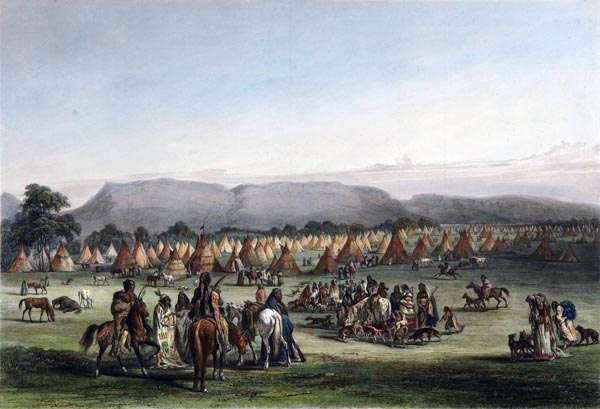
‘Encampment of the Piekann Indians’
Karl Bodmer (Swiss, 1809 - 1893)
Yale University Art Gallery
Strange contradiction of the human heart! I, who had longed to say things of mystery to one whom I already loved like the sun, was now tongue-tied and confused. I think I would have preferred to have been thrown to the alligators in the river than to find myself alone thus with Atala. The daughter of the wilderness was as troubled as her prisoner; we maintained a profound silence, the Spirits of Love had stolen our words. At last, Atala, making an effort, said this: ‘Warrior, you are very lightly bound; you could easily escape.’ At these words, boldness returned to my tongue, and I answered: ‘Lightly bound, O woman ...!’ I did not know how to end my words. Atala hesitated a few moments then said: ‘Save your self.’ And she released me from the tree. I seized the rope; I placed it again in the hands of the girl, previously a stranger to me, forcing her beautiful fingers to close on my bonds. ‘Take it! Take it up once more!’ I cried. ‘You are mad,’ Atala said in a trembling voice. ‘Wretch! Do you not know that you will be burned to death? What are you thinking of? Do you not realise that I am the daughter of a formidable Sachem?’ ‘There was a time,’ I replied with tears, ‘when I too was carried in a beaver skin, on my mother’s shoulders. My father had a fine hut, and his deer drank the waters of a thousand torrents; but now I wander without a home. When I am no more, there will be no friend to place a little grass on my body, to screen it from the flies. No one cares for the body of an unfortunate stranger.’
These words moved Atala. Her tears fell into the spring. ‘Ah! I replied earnestly, ‘if only your heart spoke as mine does! Is not the wilderness free? Have not the forests corners where we may hide? Do those born in huts need many things to be happy! O daughter fairer than a husband’s first dreams! O my beloved! Dare to follow my footsteps.’ Such were my words. Atala replied in a tender voice: ‘My young friend, you have learned the language of the white man, it is easy to deceive an Indian girl.’ ‘What!’ I cried, ‘you call me your young friend! Ah! If a poor slave...’ ‘Well!’ she said, leaning towards me, ‘a poor slave ...’ I resumed eagerly: ‘Let a kiss assure you of his loyalty!’ Atala heard my prayer. As a fawn appears to hang on the pink flowers of the lianas it seizes with its sensitive tongue, on the steep slopes of a mountain, so I remained suspended on the lips of my beloved.
Alas, my dear son, pain touches closely on pleasure. Who would have thought that the very instant when Atala granted me the first token of her love, would be the very one in which she would destroy my hopes? White-haired old Chactas, what was your astonishment, when the daughter of Sachem pronounced these words! ‘Sweet prisoner, I foolishly yielded to your desire; but where can this passion lead us? My religion separates me from you forever ... O my mother! What is it you have done?’ Atala ceased suddenly, and stifled some fatal secret that almost escaped her lips. Her words plunged me into despair. ‘Well!’ I cried, ‘I will be as cruel as you; I will not flee. You will see me framed in fire; you will hear my groans, and you will be filled with joy.’ Atala seized my hands in both of hers. ‘Poor young idolater,’ she cried, ‘you truly stir my pity! Do you wish me to weep with all my heart? What torment that I cannot fly with you! Unfortunate was your mother’s womb, O Atala! Why not throw yourself to the alligators in this river!’
At that moment, the alligators, at the approach of sunset, began to grunt and bellow.’ Atala said: ‘Let us leave this place.’ I dragged Simaghan’s daughter to the foot of the hills that formed leafy depths in thrusting their promontories into the savannah. Everything was calm and beautiful in the wilderness. The wood-stork was clattering on her nest, the forest echoed to the monotonous call of quails, the whistling of parakeets, the bellowing of bison and the neighing of the mares belonging to the Seminoles.
Our passage was all but silent. I walked at Atala’s side; she held the end of the rope, I had forced her to take up once more. Sometimes we shed tears; sometimes we attempted to smile. A glance, sometimes towards the sky, sometimes fixed on the ground, an ear attentive to the song of the bird, a gesture toward the setting sun, a hand tenderly clasped, a breast in turn throbbing or tranquil, the names of Chactas and Atala softly repeated at intervals ... Oh, love’s first walk together, the remembrance of you must be truly powerful, since, after so many years of misfortune, you still stir the heart of old Chactas!
How incomprehensible are mortal beings agitated by passion! I had just abandoned the generous Lopez, I had exposed myself to every danger in order to be free; yet, in an instant, a woman’s glance had altered my preferences; my resolutions; my thoughts! Forgetting my country, my mother, my home, and the terrible death that awaited me, I had become indifferent to everything that was not Atala! Without the strength to cling to human reason, I had suddenly retreated into a species of childhood; and far from being able to do anything to save myself from the evils that awaited me I almost needed help in sleeping and eating!
It was in vain therefore that after our walks in the savannah, Atala, throwing herself at my feet, asked me once more to leave her. I protested that I would return to the camp alone, if she refused to bind me to the tree again. She was obliged to satisfy me, hoping to convince me at another time.
On the following day, which was to decide my fate, we halted in a valley near Cuscowilla, the capital of the Seminoles. These Indians unite with the Muscogees to form the Creek Confederacy. The daughter of that land of palm-trees came to find me in the middle of the night. She led me into a large pine forest, and renewed her entreaties to persuade me to escape. Without answering her, I took her hand in mine, and forced this enchanted doe to wander with me in the forest. The night was delightful. The Spirit of the breeze shook her azure hair, fragrant with the scent of pines, and one breathed the faint smell of amber exhaled by the alligators lying beneath the tamarinds of the river-bank. The moon shone in the midst of a spotless blue sky, and its pearl-grey light fell on the indeterminate summits of the forest. Not a sound was heard, except some distant unknown harmony that reigned in the depth of the trees: it seemed that the soul of solitude sighed throughout the whole extent of wilderness.
Among the trees, we saw a young man who, holding a torch in his hand, resembled the Spirit of Spring, traversing the forest in order to re-animate nature. It was a lover who was off to learn his fate at the hut of his mistress. If the virgin extinguishes the torch, she accepts the vows offered, if she veils herself without extinguishing it, she rejects him as a husband.
The Warrior, slipping through the shadows, chanted these words in a low voice:
‘I outrun the sun’s footsteps on the mountain-summits, to seek my lonely dove among the forest oaks.
I have hung at her neck a string of cowrie-shells; see, three red for my love; three purple for my fears; three blue ones for my hopes;
Mila’s eyes are like an ermine’s, her hair light as a field of rice; her mouth a pink shell garnished with pearls, her two breasts are two little spotless kids, born to one mother on the same day.
Let Mila quench this torch! Let her mouth cast upon it a voluptuous shade! I will render her womb fertile. The hope of the nation will hang at her fecund breast, and I will smoke my peace-pipe beside my son’s cradle!
Oh! Let me outrun the sun’s footsteps on the summits, to seek my lonely dove among the forest oaks!’
So sang the young man, whose accents troubled the depths of my soul, and made Atala’s visage pale. Our hands trembled in each other’s grasp. But we were distracted from this scene, by a scene no less dangerous to us.
We passed a child’s grave, which served as a boundary to two nations. It had been placed at the edge of the road, according to custom, so that young women, going to the stream, might draw the soul of the innocent creature into their breast, and return it to its homeland. We saw, at this moment, newly-wed brides who, desiring the fulfilments of motherhood, sought, with parted lips, to gather to them the soul of the little child that they conceived as wandering among the flowers. The true mother arrived next to lay a wreath of maize and white lilies on the grave. She watered the earth with her milk and, seated on the moist grass, spoke to her child in a tender voice:
‘Why do I mourn for you in your cradle of earth, O my newborn? When the fledgling has grown, it must seek its food, and finds many a bitter seed in the desert. At least you did not know weeping; at least your heart has not been exposed to the devouring breath of mankind. The bud that withers in its sheath passes with all its scent, as you, O my son, with all your innocence! Happy are those who die in the cradle, who have known only a mother’s smiles and kisses!’
Already captivated by our own hearts, we were overwhelmed by these images of love and motherhood, which seemed to pursue us in these enchanted solitudes. I carried Atala in my arms deep into the forest, and I spoke words that today I would seek for in vain on my lips. The south wind, my dear son, loses its heat in traversing the icy mountains. Memories of love in the heart of an old man are like the light of day reflected by the tranquil orb of the moon, when the sun has set and silence hangs over the huts of Savages.
Who could save Atala? Who could prevent her succumbing to nature? Nothing but a miracle, no doubt, and that miracle was achieved! Simaghan’s daughter had recourse to the Christian God; she threw herself on the ground, and uttered a fervent prayer to her mother and the Holy Virgin. It was at this moment, O René, that I gained a marvellous understanding of that religion, which, in the forest, amidst all the hardships of life, can fill the wretched with a thousand blessings; of that religion which, opposing its power to the torrent of passion, alone suffices to defeat them, when all favours them; the secrecy of the woods; the absence of men; and the fidelity of shadows. Oh, how divine she seemed to me, the innocent Savage, the ignorant Atala, who kneeling before an old fallen pine, as at the foot of an altar, offered to her God prayers for an idolatrous lover! Her eyes, raised to the orb of night, her cheeks, shining with tears of religion and love, were of an immortal beauty. Several times it seemed to me as if she were about to take flight towards the heavens; and several times I thought I saw Spirits, descending with the moon’s rays, and heard them among the branches of the trees, those Spirits that the God of the Christians sends to hermits among the rocks, when he is disposed to gather them to him. I was distressed, fearing that Atala had only a little time to spend on earth.
Yet she shed so many tears, she showed herself so wretched, that I might perhaps have consented to leave, if a war-cry had not echoed through the forest. Four armed men hurled themselves on me: we had been discovered; the warrior chieftain had given orders to pursue us.
Atala, who resembled a queen in the nobility of her carriage, disdained to speak to these warriors. She gave them a proud glance, and went to Simaghan’s side.
She could obtain no mercy. They redoubled my guard; they multiplied my bonds; they sent my lover away. Five nights passed, and we reached Apalachucla situated on the bank of the River Chata Uche. I was promptly crowned with flowers; they painted my face with azure and vermilion; beads were attached to my nose and ears, and they placed a chichikoué (gourd rattle) in my hand.
Thus prepared for the sacrifice, I entered Apalachucla, to the repeated cries of the crowd. All was over with me, when suddenly the sound of a conch was heard, and the Mico, or head Sachem of the nation, ordered them to gather round.
You know, my son, the torments to which the Indians subject prisoners of war. Christian missionaries, at the peril of their lives, and through tireless acts of charity, had succeeded, among several nations, in achieving the substitution of a milder punishment, that of slavery, for the horrors of the stake. The Muscogee had not yet adopted this custom; though a significant number had declared in its favour. It was to decide on this important matter that the Mico had summoned the Sachems. I was led to the place of their deliberations.
Not far from Apalachucla, the council house stood on an isolated mound. Three circles of columns formed the elegant architecture of this rotunda. The columns were of carved and polished cypress; they increased in height and thickness, and decreased in number, as they approached the centre, marked by a single pillar. From the top of this pillar ran strips of bark, which, passing over the top of the other columns, covered the pavilion, in the shape of a fan.
The Council assembled. Fifty aged warriors, in beaver cloaks, sat on tiers facing the door of the pavilion. The great leader was seated in their midst, holding the peace pipe, freshly painted to indicate war, in his hand. To the right of the old men, were seated fifty women wearing robes covered with swans’ feathers. Warrior chieftains, tomahawk in hand, feathers in their hair, arms and chests stained with blood, sat on the left.
At the foot of the central column, the council-fire burned. The leading medicine man, surrounded by his eight sacred attendants, and dressed in long robes, adorned with an owl trophy on his head, poured sweet-gum resin into the flames, and offered a sacrifice to the sun. These triple ranks of aged men, mature women, and warriors; the priests; the clouds of incense; the sacrifice; all served to give the council an imposing appearance.
I stood there, tightly-bound, in the midst of the gathering. The sacrifice completed, the Mico began speaking, and delivered a simple explanation of the matter that had brought them together. He threw a belt of blue wampum beads to the floor, as a witness to the authority of what he had just said.
Then a Sachem of the tribe of the Eagle rose, and spoke thus:
‘My father the Mico, Sachems, Women, Warriors of the four tribes, of Eagle, Beaver, Snake and Turtle, do not waver from the customs of our ancestors; let us burn the prisoner, not soften our hearts. The white-man’s custom that they propose to you, would only prove pernicious. Accept the red wampum that represents my words. I have spoken.’ And he threw a belt of red beads onto the ground.
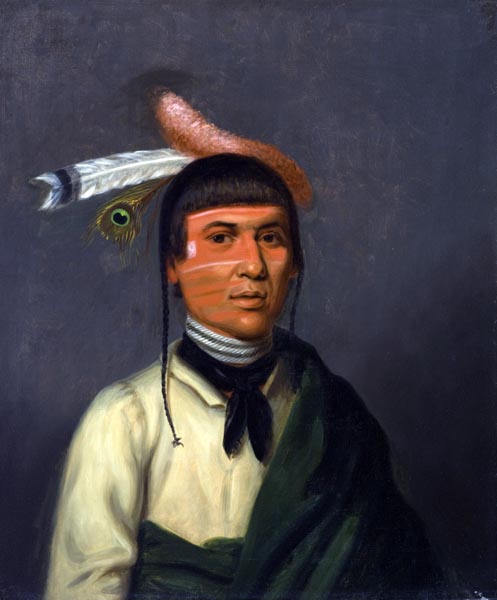
‘NoTin (Wind), a Chippewa Chief’
Henry Inman (United States, New York, Utica, 1801 - 1846)
Yale University Art Gallery
A woman now rose and said:
‘My father the Eagle, you have the mind of a fox, and the cautious slowness of a turtle. I would polish the bond of friendship with you, and together we will plant the tree of peace. But let us alter our ancestral customs, in as much as they have proved fatal. Let us have slaves to cultivate our fields, and hear no more the howls of the captive, that trouble a mother’s heart. I have spoken.’
As we see the waves of the sea breaking during a storm, as the dry leaves in autumn are lifted by the whirlwind, as the reeds of the Mississippi bow and rise again at a sudden flood, as a group of elk stags bell in the depths of the forest, so the Council murmured and sounded. The Sachems, warriors, and women spoke alternately or all together. Interests conflicted, opinions were divided, the council was nearly dissolved; but finally ancient custom prevailed, and I was condemned to the stake.
Circumstance caused my punishment to be delayed; the Festival of the Dead or the Feast of Souls was due. It is the custom not to put to death any prisoner during the days devoted to this ceremony. I was closely guarded; and doubtless the Sachems removed Simaghan’s daughter, as I saw no sign of her.
Meanwhile, the tribes from more than three hundred miles around were arriving in droves to celebrate the Feast of Souls. They had built a long-hut in a remote place. On the appointed day, each clan exhumed the remains of their fathers from their individual graves, and the skeletons were suspended, by rank and family, from the walls of the Chamber of Communal Ancestry. The winds, (a storm had risen) forests, and cataracts roared outside, while the elders of the various nations concluded treaties between themselves of peace and alliance beneath the bones of their fathers.
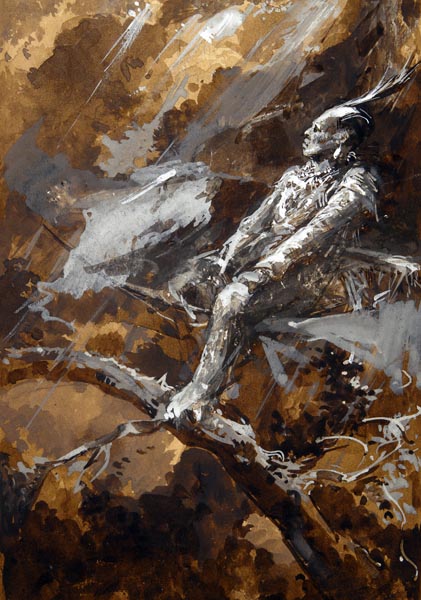
‘Indian in a Storm’
Victor Nehlig (American, 1830 - 1909)
Yale University Art Gallery
They celebrated funeral-games; foot-races; the ball-game; five-stones. Two girls tried to capture a willow-wand. Their breasts touched, their hands fluttered over the wand which they raised above their heads. Their lovely bare feet intertwined, their lips met, their sweet breath mingled, their hair flowed down and interwove; they looked towards their mothers, blushing: the crowd applauded. The medicine man invoked Michabo, the Great Hare; god of the waters. He told of the Great Hare’s battles against Matchi-Manitou, the spirit of evil. He spoke of the first man, and the first woman Atahensic, cast down from heaven for loss of innocence; of the earth red with fraternal blood, her son the impious Jouskeka slaying his brother the righteous Tawiskaron; the flood descending at the command of the Great Spirit; Masso alone saved in his bark canoe, and the raven sent out to discover land; he spoke too of the beautiful Enda, rescued from the land of the spirits by her husband’s sweet songs.
After these games and songs, they prepared to grant their forefathers an eternal burial place.
On the banks of the River Chata Uche, stood a wild fig tree consecrated to the popular religion. The young girls were accustomed to wash their bark cloaks in this place and expose them to the breezes of the wilderness, under the branches of this ancient tree. It was there that a huge grave had been dug. They left the funeral chamber, singing a hymn to the dead; each family carrying some sacred relic. They reached the grave, and lowered the relics into it, which were spread out in layers, separated by bear and beaver pelts. The grave-mound rose steadily, and on it was planted the Tree of Tears and Sleep.
Let us have pity for mankind, my dear son! These same Indians whose customs were so touching; these same women who testified to so tender an interest in me, now, with loud cries, demanded punishment be exacted on me; and entire tribes delayed their departure for the pleasure of seeing a young man suffer dreadful torment.
In a valley to the north, some distance from the Grand Village, a grove of cypress and pine trees rose, called the Grove of Blood. It was reached via the remains of one of these monuments of whose origin we know nothing, being the work of a people now forgotten. At the centre of this wood, lay an open space, where they sacrificed prisoners of war. They lead me there in triumph. All was ready for my death: they had planted there the stake dedicated to Areskoui (the war-god); pines, elms, and cypresses fell beneath the axe; the pyre rose higher; the spectators constructed an amphitheatre from branches, and trunks of trees. Each devised a torment: one proposed taking my scalp, another to scorch my eye sockets with heated hatchets. I commenced my death chant.
‘I do not fear torture: I am brave, O Muscogees, I defy you! I despise you as less than women. Outalissi, my father, the son of Miscou, drank from the skulls of your most famous warriors; you will draw not one sigh from my heart.’
Provoked by my song, a warrior pierced my arm with an arrow; I said: ‘Brother, I thank you.’
Despite the efforts of the executioners, the preparations for my sacrifice could not be completed before sunset. They consulted the medicine man who forbade their disturbing the Spirits of the shades, and my death was therefore delayed until the next day. But in their impatience to enjoy the spectacle, and to be ready all the sooner at daybreak, the Indians did not quit the Grove of Blood; they lit great fires and began feasting and dancing.
I, however, was stretched out on my back. Ropes extending from my neck, legs, and arms were attached to stakes driven into the ground. Warriors lay down on the ropes, and I could not make a move, without their being warned. The night advanced: the songs and dances ceased by degrees; the fires gave off no more than a reddish glow, before which could be seen the shadows of various Savages as they passed; all slept; as the noise of men died away, that of the wilderness increased, and to the tumult of voices succeeded the moans of the wind in the forest.
It was the hour when a young Indian woman, who has just become a mother, wakes with a start in the middle of the night, because she thinks she has heard the cries of her first-born demanding sweet nourishment. Eyes fixed on the heavens, where a crescent moon wandered among the clouds, I reflected on my fate. Atala seemed to me a monster of ingratitude. To abandon me at the moment of my execution, I who had devoted myself to the flames rather than leave her! And yet I felt that I still loved her, and would die joyfully for her.
There is in extreme pleasure, a pang that awakens us, as if to warn us to enjoy the fleeting moment; in the greatest pain, on the contrary, some heaviness sends us to sleep; eyes wearied with weeping naturally seek to close, and the goodness of Providence makes itself evident in the midst of our misfortunes. I yielded, despite myself, to that heavy sleep which the wretched sometimes taste. I dreamed that the ropes were removed; I seemed to feel that relief one experiences when, after being strongly bound, a helping hand loosens our chains.
This sensation became so intense, that it encouraged me to raise my eyelids. By the moonlight, a ray of which escaped between two clouds, I saw a tall white figure bending over me, and occupied in silently un-ravelling my bonds. I was about to cry out, when a hand, which I instantly recognized, closed my mouth. A single rope remained, but it seemed impossible to cut, without waking a warrior who covered it entirely with his body. Atala reached out her hand to it, the warrior half-awakened, raised himself from the ground. Atala was motionless, watching him. The Indian thought he was dreaming of a ghost among the ruins; he lay down again, closing his eyes and invoking his Manitou. The knot was untied. I rose; I followed my deliverer, who placed the tip of a bow in my hand while grasping its other extremity. But what dangers surrounded us! Sometimes we were near to striking against sleeping Indians; sometimes a guard challenged us, and Atala replied in an assumed voice. Children were crying, dogs barking. Scarcely had we emerged from the fatal enclosure when howls shook the forest. The camp woke, a thousand lights were lit; Savages with torches were seen running from all sides; and we flung ourselves headlong on our way.
When dawn broke over the Appalachians, we were already far away. What was my happiness when I found myself once again in the solitude with Atala, Atala my deliverer, Atala who gave herself to me forever! Words failed my tongue; I fell to my knees; and I said to Simaghan’s daughter: ‘Men are such little things, but when the Spirits visit them, then they are less than nothing. You are a spirit, you have visited me, and I can not speak before you.’ Atala gave me her hand with a smile: ‘I had to accompany you’, she said, ‘since you could not escape without me. Tonight, I won over the medicine man with gifts, I made your tormentors drunk with fire-water, and I must venture my life for you, since you were ready to relinquish yours for me. Yes, young idolater,’ she added in a tone which frightened me, ‘the sacrifice will be reciprocal.’
Atala gave me the weapons she had taken care to bring; then she bandaged my wound. In cleaning it with a morsel of papaya, she moistened it with her tears. ‘This is a balm,’ I said ‘that you apply to my wound.’ ‘I fear lest it may not prove a poison,’ she replied. She tore one of the veils from her breast, from which she first made a compress, fastening it with a lock of her hair.
That intoxication which incapacitates the Indians for some length of time, and is for them a kind of illness, doubtless prevented them from following us at first. If they sought us later, it is likely they did so towards the west, convinced that we had tried to reach the Mississippi; but we had followed the direction of the Pole star, directing our path by the moss growing on the tree-trunks.
We were not long in realising that we had gained little by my deliverance. The wilderness now revealed its immeasurable solitudes to us. Inexperienced in forest life, diverted from our true path, and moving at random, what would become of us? Often, in gazing at Atala, I remembered that ancient story of Hagar, that Lopez had read to me, she who had wandered in the desert of Beersheba, long ago, when men lived three times as long as the oak-tree.
Atala made me a cloak from the inner bark of an ash-tree, since I was virtually naked. She embroidered moccasins of muskrat skin, using a porcupine bristle. I took care in turn of her adornment. Sometimes I would put on her head a wreath of the blue mallows we found on our route in abandoned Indian cemeteries; sometimes I made her necklaces from the red seedpods of azaleas; and then I would take to smiling, in contemplating her marvellous beauty.
When we encountered a river, we would cross on a raft or by swimming. Atala would support herself with a hand on my shoulder; and like two wandering swans, we traversed the solitary waves.
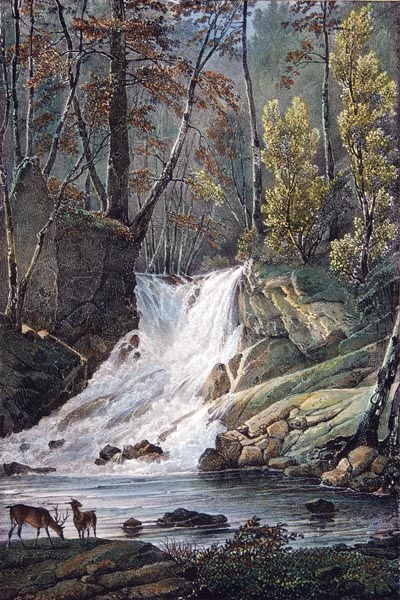
‘Indian Brook in the Residence of Captn. Phillips’
Louise Jules Frédéric Villeneuve (French, 1796 - 1842)
Yale University Art Gallery
Often in the intense heat of day, we sought shelter under the mossy cedars. Almost all the trees in Florida, especially cedar and live-oak, are covered with a white moss (tillandsia usneoides: Spanish moss) that reaches from their branches to the ground. When at night, by moonlight, you see on the bare savannah an isolated oak clothed in this drapery you might imagine it to be a ghost, trailing its long veils behind it. The scene is no less picturesque in broad daylight; for a host of butterflies, brilliant flies, hummingbirds, green parakeets, and blue jays, cling to these mosses, which produce the effect of a white wool tapestry on which some European weaver has embroidered insects and glittering birds.
It was in the shade of these smiling inns, prepared by the Great Spirit, that we rested. When the winds descended from heaven to sway our great cedar, so that the aerial castle built among its branches was set afloat along with the birds and travellers sleeping in their shelter; so that a thousand sighs rose from the corridors and vaults of our moving edifice; not even the wonders of the ancient world could approach that monument of the wilderness.
Every night we lit a large fire, and we built a shelter, of bark raised on four stakes. If I had killed a wild turkey, a pigeon, or a wood-cock, we suspended it before the oak-wood fire, at the end of a thin pole planted in the ground, and we gave to the wind the task of turning the hunter’s prey. We ate the lichens called tripe-de-roche, the bark of sweet birch, and may-apples, which have a peach and raspberry taste. Black walnuts, maples, and sumach, provided wine for our table. Sometimes I would seek, among the reeds, a plant (sarracenia flava; the yellow pitcher plant) whose flower, an elongated cone, contained a glass of the purest dew. We blessed Providence which, in the soft stem of a flower, had placed this clear spring among the noisome marshes, as it had set hope in the depths of hearts sickened with grief, as it had made virtue spring from the breast amidst the miseries of life.
Alas, I soon discovered that I was deceived by Atala’s apparent calm. As we advanced, she became sadder. Often she trembled without cause, and turned her head about anxiously. I caught her throwing me a passionate look, which she transferred to the sky with deep melancholy. What frightened me most of all, was a secret, a thought hidden in the depths of her soul, which I saw in her eyes. Always pulling at me and pushing me away, reviving and destroying my hopes, when I thought I had progressed a little way into her heart, I found myself at the same point as before. How many times she told me: ‘O my young lover! I love you like the shade of the trees in the middle of the day! You are beautiful as the wilderness with all its flowers and breezes. If I lean towards you, I shudder; if my hand falls on yours, I feel as if I am about to die. The other day when the wind blew your hair across my face as you were resting on my breast, I thought I felt the light touch of invisible spirits. Yes, I have seen the young she-goats on the hills of Oconee; I have heard tell of men full of days, but the gentleness of young goats and the wisdom of old men are less delightful and less powerful than your words. Ah, but, my poor Chactas, I shall never be your wife!’
The perpetual conflict between Atala’s love and her religion, her abandonment to tenderness and yet the chasteness of her morality, the pride of her character joined to a profound sensibility, the elevation of her soul in great matters, its susceptibility in small ones, made her a being incomprehensible to me. Atala could have no small influence on a man; filled with passion, she was filled with power; a man was forced either to love her or hate her.
After a precipitous march of fifteen nights’ duration, we entered the Allegany Mountain Range, and reached a branch of the Tennessee River, which empties into the Ohio. On Atala’s advice, I made a canoe by stitching bark together using fir-tree roots, and coating it with plum-tree resin. Then I embarked with Atala, and we abandoned ourselves to the river’s flow.
The Indian village of Sticoe, with its pyramidal tombs and ruined huts, appeared on our left, on turning a promontory; we passed the Keowee Valley on the right, terminated by a view of the huts of Jore, hanging from the face of the mountain of the same name. The river that swept us onwards flowed between high cliffs, beyond which they the setting sun could be seen. These profound solitudes were undisturbed by the presence of man. We saw only a solitary Indian hunter who, leaning on his bow, and motionless on the brow of a cliff, appeared, on the mountain, like a statue raised to the Spirit of this wilderness.
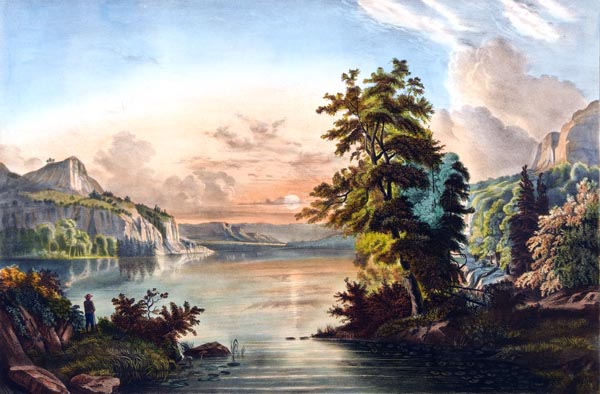
‘Indian Lake Sunset’
Currier & Ives (American, active 1834 - 1907)
Yale University Art Gallery
Atala and I united our silence with the silence of that landscape. Suddenly that daughter of exile, in a voice full of emotion and melancholy, sang of her lost country:
‘Happy are those who have not seen the smoke of a stranger’s feast; who have only ever sat at their father’s table!
If the Mississippi blue jay asked the nonpareil (cyanospiza ciris: the painted bunting) of Florida: “Why do you complain so sadly? Do you not possess here beautiful waters and lovely shade, and all kinds of pasture as in your forests?” “Yes,” the fugitive nonpareil would reply; “but I nest in the jasmine, who can bring me that? And do you have with you the sunshine of my savannah?”
Happy are those who have not seen the smoke of a stranger’s feast; who have only ever sat at their father’s table!
After hours of painful travel, the passenger sits sadly. He gazes around him at the roofs of men; the traveller has nowhere to lay his head. The traveller knocks at the cabin door; he places his bow behind the door, he asks for hospitality; the owner gestures and the traveller takes up his bow again, and returns to the wilds!
Happy are those who have not seen the smoke of a stranger’s feast; who have only ever sat at their father’s table!
Marvellous tales told beside the hearth; tender effusions of the heart; enduring habits of love so necessary to life; you fill the days of those who never leave their country! Their tombs are in their homeland, with the setting sun, the tears of their friends and the charms of religion.
Happy are those who have not seen the smoke of a stranger’s feast; who have only ever sat at their father’s table!’
So sang Atala. Nothing interrupted her plaints, except the unintelligible voice of our canoe among the waves. At two or three points only, they were repeated by a faint echo, to which a second fainter echo replied; and to that a third fainter still: one would have believed that the souls of two lovers, once wretched as we, attracted by that touching harmony, were pleased to sigh with those last sounds in the hills.
However, the solitude, the constant presence of the beloved object, even our troubles, increased our love with every moment. Atala’s strength began to fail her, and passion, by exhausting her body, was near to conquering her virtue. She continually prayed to her mother, whose angry shade she seemed to wish to appease. Sometimes she asked if I could not hear a plaintive voice, if I could not see flames rising from the earth. As for me, exhausted, but ever burning with desire, thinking that I might be irretrievably lost in the midst of the forest, I prepared a hundred times to seize my bride in my arms, a hundred times I offered to build a hut on these shores, and bury ourselves there together. But she always resisted: ‘Consider,’ my young friend, she said, ‘what a warrior owes his country. What is a woman beside the duties you must discharge? Take courage, son of Outalissi, do not murmur against your destiny. The human heart is like the fresh-water sponge, which now absorbs pure water in times of calm, and now swells with clouded water when the sky troubles the wave. Has that sponge the right to say: “I thought there would be no storms; that the sun would never burn?”’
O René, if you fear the miseries of the heart beware of solitude: great passions are solitary, and to transport them to the wilderness is to grant them their power once more. Overwhelmed by anxieties and fears, at risk of falling into the hands of hostile Indians, of being engulfed by the waters, bitten by snakes, devoured by wild creatures, finding a meagre supply of food hard to come by, and not knowing which way to turn our steps, it seemed our troubles could be no greater, when accident arrived to crown them.
It was the twenty-seventh sun since we had left the cabins: the moon of fire (July) had begun its course, and everything around us signalled a storm. Towards the hour when Indian mothers hang up their hoe on a branch of a sabin bush (juniperus sabina; creeping juniper), and parrots retreat into cypress hollows, the sky began to cloud. The noises of solitude died away, the wilderness fell silent, and the woods rested in a universal calm. Soon the rumbling of distant thunder, spreading through forests as old as the earth, brought forth sublime sounds. Fearful of being swamped, we hastened to gain the river bank, and take shelter in the woods.
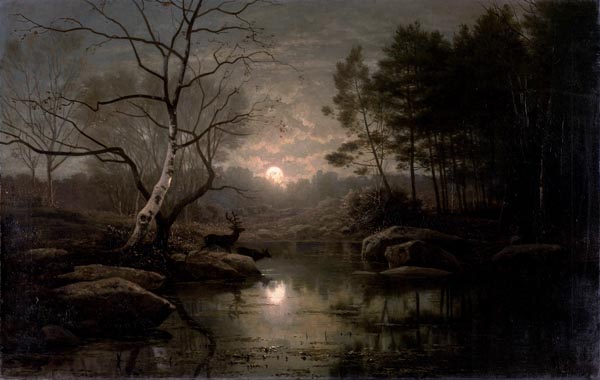
‘Forest Landscape in the Moonlight’
Georg Eduard Otto Saal, 1861
The Rijksmuseum
The place was a marsh. We moved with difficulty under a canopy of wild sarsaparilla (aralia nudicaulis, false sarsaparilla), among vines, indigo plants (indigofera), haricots, and rampant lianas that hindered our feet like nets. The spongy ground shook around us and at every instant we were near to being engulfed in some quagmire. Innumerable insects and huge bats blinded us; rattlesnakes rustled on all sides; and wolves, bears, wolverines, and wildcats that were hiding in these retreats, filled them with their cries.
But the darkness increased: lowering clouds entered the forest shade. The sky was torn and lightning traced a fleeting diamond-shape of fire. A strong wind out of the sunset, piled cloud on cloud; the forest bowed; the sky was rent in swift succession, and through the crevasses fresh heavens and fiery landscapes were seen. How terrible, how magnificent a spectacle! Lightning set fire to the woods; the blaze spread like flaming hair; columns of sparks and smoke assailed the clouds that vented their lightning-strikes amidst the vast conflagration. Then the Great Spirit covered the mountains with dense shadow; amidst the chaos a huge confused howling arose created by the roar of the winds, the moaning of the trees, the cries of wild creatures, the crackling of the flames, and the repeated claps of thunder, muttering as they died over the waters.
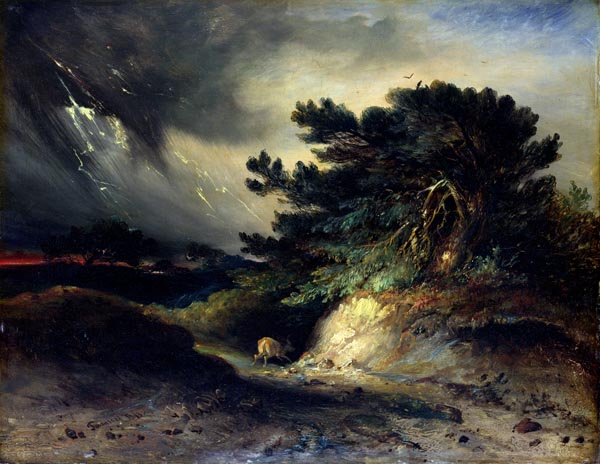
‘The Thunderstorm’
Johannes Tavenraat, 1843
The Rijksmuseum
The Great Spirit knows that in that moment I saw only Atala, I thought only of her. Under the leaning trunk of a birch-tree, I managed to protect her from the torrential rain. Seated beneath the tree, holding my beloved in my lap, and warming her bare feet between my hands, I was more joyful than a new mother who feels for the first time the infant leap in her womb.
We listened to the noise of the storm; suddenly I felt Atala’s tears fall on my breast: ‘Storm of my heart,’ I cried, ‘is this a drop of your rain-shower?’ Then closely embracing her that I loved: ‘Atala,’ I said, ‘you are hiding something from me. Open your heart to me, O my beautiful one! It is best for a friend to look into one’s soul! Tell me of that other secret sorrow, you persist in hiding. Ah! I see, you are weeping for your homeland.’ She replied swiftly: ‘Child of mankind, how should I weep for that country, when my father was not from its land of palm trees?’ ‘What,’ I replied, in great surprise, ‘your father was not from the land of palms! Who then set you on this earth? Tell me.’ Atala then spoke these words:
‘Before my mother brought by her marriage, to the warrior Simaghan, thirty mares, twenty buffaloes, a hundred measures of oil pressed from acorns, fifty beaver skins and many other riches, she had known a white man. However, the mother of my mother threw water in her face, and forced her to marry the magnanimous Simaghan, a kingly man, honoured like a god among the tribes. But my mother said to her new husband: ‘My womb has conceived; kill me.’ Simaghan replied: ‘May the Great Spirit guard me from any evil action! I will not mutilate you, I will not cut off your nose or ears, for you have proven true and have not dishonoured my bed. The fruit of your womb will my fruit and I will not come to you until after the departure of the birds of the rice-field, when the thirteenth moon shines.’ At that time, I broke the waters of my mother’s womb, and began to grow, till I was proud as a Spaniard or a Savage. My mother made me a Christian, so that her God and my father’s God was also my God. Then heartache overcame her, and she descended into that little cave adorned with animal-skins, from which no one returns.’
Such was Atala’s tale. ‘And who then was your father, poor orphan?’ I said. ‘What name did men give him on earth, and what name did he bear among the Spirits?’ ‘I have never bathed the feet of my father,’ said Atala, ‘I only know he lived with his sister at St. Augustine, and has always been faithful to my mother: Philip was his name among the angels, and men called him Lopez.’
At these words I uttered a cry that rang throughout the solitude; the sound of my transports mingled with the noise of the storm. Clasping Atala to my heart, I sobbed out: ‘O my sister! O daughter of Lopez, daughter of my benefactor!’ Atala, frightened, asked me what caused my outburst; but when she learned that Lopez was the generous host who had adopted me at St. Augustine, and whom I had left in order to be free, she too was seized by confusion and joy.
The arrival of this fraternal friendship which came to join its love to our love overwhelmed our hearts. Now Atala’s resistance would be rendered ineffectual; I felt her vainly raise a hand to her breast, and make a signal movement; I had already clasped her, I was already intoxicated by her breath, I had already drunk all the magic of love from her lips. Eyes lifted to heaven, illuminated by lightning flashes, I held my wife in my arms, in the presence of the Eternal. Nuptial glory, worthy of our misfortunes and the grandeur of our love: proud forests stirring your lianas and tree-tops as curtains and canopy to our bed, blazing pine-trees forming flaming torches for our marriage, swollen river, roaring mountains, Nature terrible and sublime, were you not a mere device intended to deceive us, unable to cloak one man’s bliss for even an instant with your mysterious horrors!
Atala offered no more than a feeble resistance; I had achieved a moment of happiness, when suddenly a fiery flash, followed by a burst of lightning, furrowed the dense shadows, filled the forest with sulphurous smoke, and shattered a tree at our feet. We fled. To our surprise, in the silence that succeeded, we heard the sound of a bell! Both listened, in astonishment, to that sound, so foreign to the wilderness. A moment later, a dog barked in the distance; it drew nearer, redoubled its howls, reached us, then yelped with joy at our feet; an old Hermit, carrying a little lantern, followed behind through the darkness of the forest. ‘Let Providence be blessed!’ he cried out, when he saw us. ‘I have been seeking you for some time! The dog sensed you were there at the start of the storm, and led me here. Great God! How young they are! Poor children! How they must have suffered! Come: I have brought a bear-skin, it will cloak this young woman; there is a little wine in this gourd. Praise God in all his works! His mercy is very great, and His goodness infinite!’
Atala fell at the feet of the priest: ‘Chieftain of all prayer,’ she said, ‘I am a Christian. Heaven it is that has sent you to save me.’ ‘My daughter,’ said the hermit, raising her, ‘we always ring the Mission bell at night and during storms, to summon strangers; and, like our brothers in Lebanon and among the Alps, we have taught our dog to seek out lost travellers.’
As for me I barely comprehended the hermit; such charity seemed to me so far beyond mankind, I thought I must be dreaming. By the light of the little lantern the hermit was holding, I saw that his beard and hair were soaked with water; his feet, hands and face had been bloodied by the thorns. ‘Old man’, I cried, at last, ‘what a heart you must have, not to fear the lightning-bolts!’ ‘Fear!’ the priest replied, with a show of warmth, ‘fear, when there are human beings in peril, and I can be useful to them! I would be then an unworthy servant of Jesus Christ!’ ‘But do you know,’ I said, ‘that I am no Christian?’ ‘Young man,’ replied the hermit, have I asked your religion? Jesus Christ did not say: “My blood will cleanse this man, but not that.” He died for Jew and Gentile, and he simply viewed all men as brothers and unfortunates. What I do for you here is so very little, and elsewhere you will find much greater assistance; but the glory ought not to redound to the priests. What are we feeble solitaries but the crude instruments of a heavenly work? Ah! How cowardly would a soldier prove if he retreated, when his leader, cross in his hand, his forehead crowned with thorns, went before him for the salvation of mankind?’
These words gripped my heart; tears of admiration and tenderness fell from my eyes. ‘My dear children,’ said the missionary, ‘I govern in these forests a small tribe of your brother savages. My cave is quite near here on the mountain; come and warm yourselves in my dwelling; you will not find there the conveniences of life, but you will have shelter; and we must thank God’s goodness for it, since there are many for whom it is lacking.’”
The Labourers
“There are just men whose conscience is so tranquil, that one cannot approach them without participating in the peace they exhale, so to speak, from their hearts and their speech. The more the Hermit spoke, the more I felt the passions in my breast subside, and even the storm in the heavens seemed to die away at the sound of his voice. The clouds had soon dispersed enough to allow us to leave our retreat. We emerged from the forest, and began to climb the slopes of a high mountain. The dog trotted ahead, carrying the quenched lantern on the end of a stick. I held Atala’s hand, and we followed the missionary. He often turned round to look at us, gazing in pity at our youth and wretchedness. A book was suspended from his neck; he leaned on a white stick. He was tall, his visage pale and thin, his looks simple and sincere. He had not the cold and unprepossessing manner of a man born without passions; it was evident that he had seen hard times, and the furrows on his brow revealed the true scars of passion, healed by the power and love of God and mankind. When he spoke to us, standing erect and motionless, with his long beard, his modestly downcast eyes, the affectionate tone of his voice, all revealed in him something calm and sublime. Anyone who has seen, as I have, Father Aubry walking alone with his stick and his breviary in the wilds, has a true idea of the Christian pilgrim on earth.
After half an hour of dangerous passage along the mountain paths, we reached the missionary’s cave. We entered through moist trailing ivy and squashes (cucurbita maxima), which the rain had dragged from the rocks. Inside there was only a mat of papaya leaves, a calabash to hold water, a few wooden pots, a spade, a tame snake, and on a stone that served as table, a crucifix and the Christians’ book.
‘Landscape with the Temptation of Saint Anthony’
Roelandt Savery (Flemish, 1576 - 1639)
The Getty Open Content Program
The man of ancient days hastened to light a fire of dry vine-stems; he broke some maize between two stones, and having made it into a cake, he set it to bake in the ashes. When the cake had taken on a beautiful golden colour in the fire, he served it to us piping hot, with walnut butter from a maple-wood pot.
The evening having brought serenity once more, the servant of the Great Spirit proposed that we go and seat ourselves at the entrance to the cave. We followed him to a place which commanded an extensive view. The remnants of the storm stretched in confusion eastwards; the fires from the conflagration that lightning had ignited in the forest still shone in the distance; at the foot of the mountain, a whole grove of pine-trees had been hurled into the swamp, and the river drove onwards pell-mell waterlogged clay, tree-trunks, the corpses of animals, and dead fish, whose silvery bellies could be seen floating on the surface of the water.
In the midst of this scene, Atala recounted our story to this aged Spirit of the Mountain. His heart seemed touched, and tears flowed down his beard: ‘My child,’ he said to Atala, ‘you must offer your sufferings to God, for whose glory you have already done so much; it will bring you repose. See these forests filling with smoke, these torrents ebbing, these clouds dissipating; do you think that He who can calm such a storm can not soothe the pain of a human heart? If you have no better retreat, my dear girl, I offer you a place in the midst of the little flock that I have had the joy of summoning to Jesus Christ. I will instruct Chactas, and I will give him to you as your husband when he is worthy of being such.’
At these words, I fell at the Hermit’s feet, shedding tears of joy; but Atala became pale as death. The old man raised me in a kindly manner, and it was then that I realised that both hands had been mutilated. Atala understood his sufferings at once. ‘Barbarians!’ she cried.
‘My daughter’, the priest said with a smile, ‘how can this compare with what my Divine Master suffered? If the idolatrous Indians tortured me, they are poor blind creatures whom God will one day enlighten. I cherish them even more in proportion to the evils they have done me. I could not settle in my homeland to which I returned, and where an illustrious queen did me the honour of wishing to see these trivial marks of my ministry. And what more glorious reward could I receive for my work, than to have obtained permission from the head of our religion to celebrate the divine sacrifice with these mutilated hands? It only remained for me, following such an honour, to try and make myself worthy of it: I returned to the New World, to consume the rest of my life in serving my God. I will soon have inhabited this solitude for thirty years, and tomorrow it will be twenty-two years, since I took possession of this cave. When I arrived in these parts, I found only wandering families, whose manners were ferocious and way of life wretched. I made them listen to words of peace, and their manners have gradually softened. They now live together at the foot of this mountain. I have tried, in teaching them the ways of salvation, to teach them the finer arts of life, but not to excess, so keeping those honest people in that simplicity that makes for happiness. As for myself, afraid to worry them by my presence, I retired to this cavern, where they come to consult me. It is here that, far from men, I worship God in the grandeur of these solitudes, and prepare for death, that speaks to me of old age.’
With these words, the Hermit knelt down, and we imitated his example. He began a prayer aloud, to which Atala responded. Silent lightning rent the heavens again in the east, and above the sunset clouds, three suns shone together (twin parhelia, sundogs, or phantom suns alongside the sun). A family of foxes, scattered by the storm, stretched out their black muzzles at the edge of a cliff, and the rustling of plants could be heard, drying in the evening breeze, their battered stalks lifting again on every side.
We returned to the cave, where the hermit spread a bed of moss from the cypress-trees for Atala. A profound languor was visible in the eyes and movements of the girl; she gazed at Father Aubry, as if she wished to communicate a secret to him, but something seemed to hold her back, either my presence, or a certain sense of shame, or the futility of its avowal. I heard her rise in the middle of the night; she sought the Hermit, but since he had yielded his bed to her, he had gone to contemplate the beauty of the heavens and pray to God on the mountaintop. He told me, the next day, that it was often his custom to do so, even during the winter, loving to see the bare summits of the forest swaying, the clouds flying through the sky, and to hear the winds and torrents moaning in the solitude. My sister was therefore obliged to return to bed, where she fell asleep. Alas, filled with hope, I merely saw in Atala’s languidness the signs of a transient weariness!
The next morning, I awoke to the songs of mockingbirds and cardinals, roosting in the acacias and laurels which surrounded the cave. I went to pick a magnolia flower, and I laid it, moistened with morning tears, beside the sleeping Atala’s head. I hoped, in accord with the religion of my country, that the soul of some child which had died in infancy would descend upon this flower in a drop of dew, and a happy dream would carry it to the womb of my future wife. Then I sought out my host; I found him, the hem of his robe tucked into his pockets, a rosary in hand, waiting for me seated on the trunk of a pine tree that had fallen due to its venerable age. He proposed I should go with him to the Mission, while Atala was yet asleep; I accepted his offer, and we set off at once.
In descending the mountain, I came across oak-trees on which the Spirits appeared to have incised strange characters. The hermit told me he had traced them himself, that they were verses by an ancient poet named Homer, and a few sentences by another poet still more ancient, named Solomon. There was some sort of mysterious harmony between the wisdom of those ages, those verses carved into the moss, the old Hermit who had etched them, and the old oak-trees which served as books.
His name, age, and the date of his mission were also marked on a reed from the savannah, at the foot of these trees. I was astonished at the fragility of this last monument: ‘It will last longer than me’ replied the priest, ‘and will still possess more value than the little that I have achieved.’
From there, we arrived at the entrance to a valley, where I saw a marvellous object: it was a natural bridge, similar to that in Virginia, of which you may have heard. Men, my son, especially those in your country, often mimic nature, and their copies are always of a limited size, it is not thus with nature when she seems as if imitating the work of men, offering them, in effect models. It is then that she throws bridges from the summit of one mountain to the summit of another, suspends roadways in the clouds, extends rivers as canals, sculpts mountains to form pillars, and for ponds excavates seas.
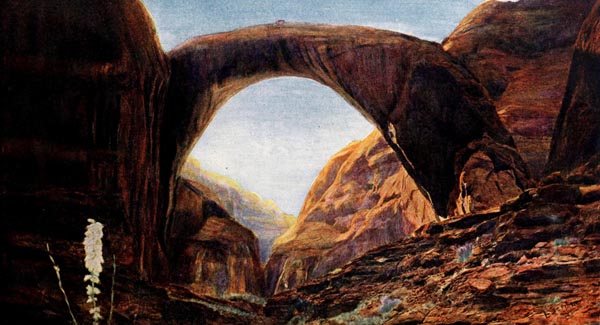
‘The Rainbow Bridge, Utah’
The World Book; [Electronic Resource] Organized Knowledge in Story and Picture - Michael Vincent O'Shea, Ellsworth D. Foster, George Herbert Locke (p135, 1917)
Internet Archive Book Images
We passed under the single arch of the bridge, and found ourselves before another wonder: it was the cemetery of the Indians from the Mission, or the Groves of the Dead. Father Aubry had permitted his neophytes to inter their dead in their own manner and retain the Indian name for their place of burial; he had merely sanctified the place by a cross. The ground was divided, like the communal cornfield, into as many lots as there were families. Each lot possessed an individual stand of timber, which varied according to the taste of those who had planted it. A stream meandered noiselessly through the midst of these groves, which was called the Stream of Peace. This felicitous sanctuary of souls was closed to the east by the bridge under which we had passed; two hills bordered it to the north and south; it was only open towards the west, where stood a large wood of pine-trees. The trunks of these trees, red mottled with green, ascending without branching to their summits, resembled tall columns, and formed the peristyle of this temple of the dead; a religious sound reigned there, like the dull murmur of an organ beneath the arched vaulting of a church; but when one penetrated the depths of the sanctuary, one heard only the hymns of birds celebrating an eternal festival in memory of the dead.
Leaving this wood, we discovered the Mission village, situated beside a lake in the middle of a savannah dotted with flowers. It was reached along an avenue of magnolias and live oaks that bordered one of those old roads which are found near the mountains that divide Kentucky from the Floridas. As soon as the Indians saw their pastor on the plain, they abandoned their work and ran to meet him. Some kissed his robe, others aided his footsteps; mothers lifted their young children in their arms to allow them to see the follower of Jesus Christ, who shed tears. He inquired, as he walked, about events in the village; he gave advice to one, gently chided another, he spoke of the harvest to be gathered, children to be educated, sorrows needing consolation, and mingled talk of God with all his speeches.
Thus escorted, we arrived at the foot of a large cross beside the path. It was there that the servant of God was accustomed to celebrate the mysteries of his religion: ‘My dear neophytes,’ he said, turning to the crowd, ‘you have a new brother and sister; and as an additional happiness, I see that Divine Providence spared your harvest yesterday: here are two great reasons to thank him. Therefore let us offer holy sacrifice, and let each bring to it profound meditation, a lively faith, infinite gratitude and a humble heart.’
As soon as the divine priest had donned a white tunic of mulberry bark, sacred vessels were taken from a tabernacle at the foot of the cross, the altar was prepared on a piece of rock, water was drawn from a nearby stream, and a bunch of wild grapes furnished the sacrificial wine. We all knelt in the long grass, and the mystery commenced.
Dawn appearing behind the mountains, lit the east. All was of gold or rose-colour in the solitude. The sun, announced by all this splendour, emerged at last from an abyss of light, and its first rays fell on the consecrated host, which the priest, at this very same moment, raised in the air. O the charm of religion! O the magnificence of Christian worship! As priest an old hermit; for an altar a rock; for a church the wilderness; as assistants innocent Savages! No, I have no doubt; that at the moment when we prostrated ourselves, the great mystery was accomplished, and that God descended on earth, because I felt Him descend into my heart.
After the sacrifice, from which as far as I was concerned only Lopez’s daughter was lacking, we returned to the village. There appeared, in that place, the most moving blend of social life with the life of nature: at the corner of a cypress grove in the ancient wilderness, burgeoning agriculture could be seen; ears of maize rolled in waves of gold over the trunk of a felled oak, and the sheaf of one summer replaced the tree three centuries old. Everywhere one could see the forest in flames sending thick smoke into the air, while the plough progressed slowly through the remains of tree-roots. Surveyors with long chains were measuring the field; arbitrators were establishing primary ownership; the bird yielded its nest; the lair of the wild beast gave way to a cabin; the rumbling of forges could be heard, and the blows of the axe creating last echoes, themselves expiring with the trees that gave them birth.
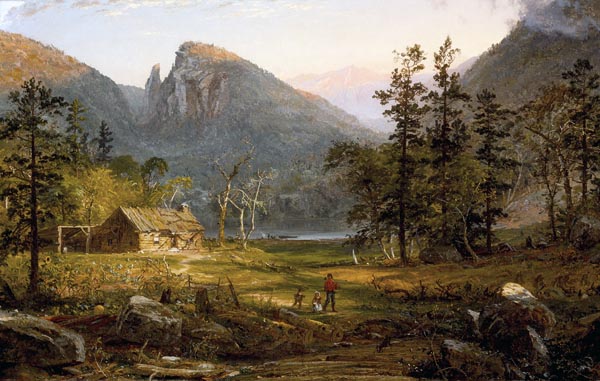
‘Pioneer's Home, Eagle Cliff, White Mountains’
Jasper Francis Cropsey (United States, New York, Rossville, 1823 - 1900)
LACMA Collections
I wandered with delight in the midst of these scenes, made sweeter by thoughts of Atala and the dreams of happiness with which I indulged my heart. I admired the triumph of Christianity over the savage life; I saw the Indian becoming civilised at the bidding of religion; I attended the wedding of primitive man to the Earth: Man, by this mighty contract, abandoning to the land the legacy of his sweat, and the land engaging, in return, to bear faithfully the harvest, offspring and ashes of Man.
Meanwhile, they brought a child to the missionary, who baptised him among the jasmine flowers, beside a spring, as a coffin, in the midst of games and toil, was carried to the Groves of the Dead. A husband and wife received the nuptial blessing beneath an oak tree, and we then went to help them settle in a corner of the wilderness. The pastor went before us, granting his blessing here and there, on rock, tree, and fountain, as formerly, according to the Christians’ book, God blessed the untilled earth, in granting his legacy to Adam. This procession, which with its flocks followed its venerable leader, pell-mell, from rock to rock, seemed to my softened heart like those migrations of the first peoples, when Shem, with his children, walked through the unknown world, following the sun that went before him.
I wished to know, of the holy hermit, how he ruled his children; he replied to me with great kindness: ‘I have laid down no laws for them; I have only taught them to love, to pray to God, and to hope for a better life: all the world’s laws are there. You can see, in the centre of the village, one hut that is larger than the others: it serves as a chapel in the rainy season. They assemble there, morning and evening, to praise the Lord, and when I am absent, an old man takes the prayers; since old age is, like motherhood, a kind of sacred office. Then they go to work in the fields, and though the holdings are separate, so that everyone can learn social economy, the harvest is placed in communal granaries, to maintain fraternal love. Four old men distribute equally the proceeds of labour. Add to this religious ceremonies, many hymns, the cross where I celebrated the mysteries, the young elm tree under which I preach on fine days, our graveyard near our fields of corn, our waters into which I plunge the little ones and the Saint Johns of this new Bethany, and you will have a complete idea of this kingdom of Jesus Christ.’
The Hermit’s words delighted me, and I felt the superiority of this calm and busy life over the idle wanderings of the Savage.
Oh, René, I do not murmur against Providence, but I confess that I never remember that evangelical society, without feeling the bitterness of regret. If only a hut, with Atala, on these shores, might have rendered my life happy! There all my journeys would have ended; there with my wife, unknown to mankind, hiding my happiness in the depths of the forest, my life would have flowed onwards like these rivers of the wilderness, that lack even a name. Instead of this peace which I had dared to promise myself then, with what trouble have I not filled my days! A continual plaything of fortune, shipwrecked on every shore, long exiled from my country, and finding on my return, only a ruined hut and my friends in the grave: such was to be the destiny of Chactas.”
The Drama
“If my dream of happiness was yet alive, it was also of short duration, and my awakening awaited me at the Hermit’s cave. I was surprised, on arriving there at midday, not to see Atala running to meet our steps. Some sudden horror seized me. Approaching the cave, I hardly dared to call to Lopez’s daughter: my imagination was equally terrified, as to whether sound or silence would succeed to my cries. Even more afraid of the darkness which prevailed at the rocky entrance, I said to the missionary: ‘O you, whom the heavens support and strengthen, penetrate these shadows.’
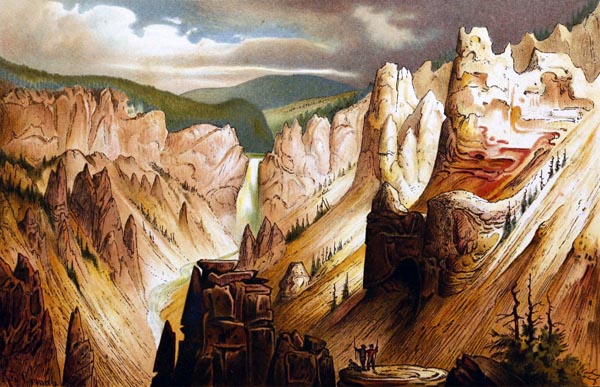
‘Canyon and Falls of the Yellowstone River’
The Wild West: an Artistic Journey Through the Great Plains and Rocky Mountains of the Union - Rudolf Cronau (p5, 1890)
Internet Archive Book Images
How weak is the man whom passions dominate! How strong the man who trusts in God! There was more courage in that religious heart, burdened by its seventy-six years than in all my youthful ardour. The man of peace entered the cave, and I stood outside filled with terror. Soon a low murmur, like a complaint, issued from the depths of the rock, and struck my ear. Heaving a cry, and regaining my strength, I rushed into the darkness of the cavern ...Spirits of my Fathers: you alone know the sight that met my eyes!
The Hermit had lit a torch of pine; he grasped it with a trembling hand over Atala’s bed. That lovely young woman half-raised on one elbow, appeared pale and dishevelled. Drops of sweat, the product of agony, glistened on her forehead; her eyes half-extinguished still seeking to express her love for me, and her mouth attempting to smile. Struck as if by a lightning-bolt, staring, arms outstretched, lips parted, I remained motionless. A profound silence reigned for a moment among the three personages at this scene of sorrow. The Hermit was first to break it: ‘This,’ he said, ‘is merely a fever brought on by fatigue, and if we resign ourselves to the will of God, he will take pity on us.’
At these words, the flow of blood, which had seemed suspended, resumed its course through my heart, and with the adaptability of the Savage, I passed suddenly from excessive fear to excess trust. But Atala allowed me but a moment. Her head swaying sadly, she beckoned us to approach her bed.
‘My father,’ she said, in a faint voice, turning to the priest, ‘I am near to death. O Chactas! Listen without despair to the fatal secret I have concealed, in order not to render you wretched too, and to show obedience to my mother’s memory. Try not to interrupt me with expressions of sorrow, which would hasten the few moments I have left to live. I have many things to tell, with a heart whose beat is fading ... with an icy burden that my breast can scarcely bear … I feel I cannot be too swift.’
After a few moments silence, Atala continued:
‘My sad fate began almost before I had seen the light. My mother conceived me in misfortune; I exhausted her womb, and her flesh was torn in giving birth to me: they despaired of my life. To preserve it, my mother uttered a vow: she promised to the Queen of Angels that I would dedicate my virginity to her, if I escaped death ... A fatal vow that sends me onwards to the tomb!
I had just turned fifteen, when I lost my mother. A few hours before she died she called me to her bed. “My daughter,” she said, in the presence of the missionary who was bringing consolation to her last moments, “my daughter, you know the vow I made for you. Would you deny your mother? Oh, my Atala! I leave you in a world that is not worthy of possessing a Christian amidst all these idolaters, who persecute the God of your father and mine, that God who, after having granting you life, saved you by a miracle. Ah, my dear child, by accepting the virgin’s veil, you will simply be abandoning the cares of the wilderness and the fatal passions that have troubled your mother’s womb! Come, my beloved, come; swear on this picture of the Saviour’s Mother, held in the hands of this holy priest, and between those of your dying mother, so as not to compromise me in the sight of heaven. Remember that I gave a promise on your behalf in order to save your life, and if you do not keep my promise, you will plunge your mother’s soul into eternal torment.”
O my mother! Why did you speak thus! O Religion that brings me both pain and happiness, that destroys and consoles me! And you, dear and sad object of a passion that consumes me to the very point of death, you see now, O Chactas, what has determined the severity of our fate! ... Bursting into tears, and throwing myself into my mother’s arms, I promised all that I was asked to promise. The missionary pronounced the terrible words over me, and handed me the scapular that binds me forever. My mother threatened me with her curse if I ever broke my vows, and after having recommended me to keep that secret hidden inviolably from the heathen persecutors of my religion, she died, while holding me in her embrace.
I did not at first realise the danger of my oaths. Full of enthusiasm, and a true Christian, proud of the Spanish blood flowing through my veins, I could see only men around me who were unworthy to receive my hand; I congratulated myself on having no other spouse but my mother’s God. I saw you, a young handsome captive, I was moved by your fate, I dared to speak to you at the stake in the forest; thus I felt the whole weight of my vows.’
As Atala finished speaking these words, clenching my fists, and glaring at the missionary with a menacing expression, I exclaimed: ‘This then is the religion you praised so highly! Have done with this vow that snatches Atala from me! Have done with this God who thwarts nature! Man, priest, why have you come to these forests?’
‘Calm your self, ‘said the old man, in a dreadful voice, ‘subdue your passions and avoid, blasphemer, bringing the wrath of heaven upon you! It ill suits you, young man, having barely entered upon life, to complain of your sorrows! Where are the marks of your suffering? Where are the injustices you have endured? Where are the virtues which alone might give you some right to complain? What service have you rendered? What good have you done? Ah! Wretch, you offer me only passion, and dare accuse Heaven! When you have, like Father Aubrey, spent thirty years in exile among the mountains, you will be less swift to judge the designs of Providence; you will realise that you know nothing, that you are nothing, and that there is no punishment so severe, no evil so terrible, that the corrupt flesh does not deserve to suffer it.’
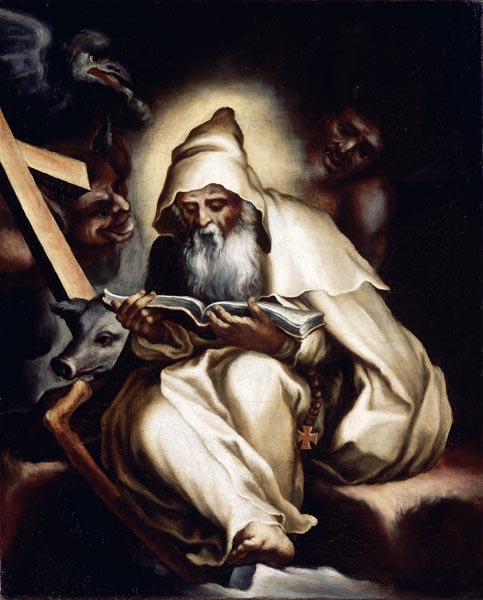
‘The Temptation of Saint Anthony’
Lelio Orsi (Italian, 1511 - 1587)
The Getty Open Content Program
The lightning which shot from the old man’s eyes, the beard that beat on his breast, his violent words, made him resemble a god. Overcome by his majesty, I fell at his knees and asked forgiveness for my anger. ‘My son,’ he replied in a tone so sweet that remorse entered my soul, ‘my son, it is not on my own behalf that I reprimanded you. Alas, you are right, my dear boy: I came to do a little good in these forests, and God has no servant more unworthy than I. But, my son, Heaven, Heaven; behold what one should never accuse! Forgive me if I have offended you, but listen to your sister. There may be a cure, let us not lose all hope. Chactas, a religion as divine as this, has made a virtue of hope!’
‘My young friend,’ Atala continued, ‘you have witnessed my struggles, and yet you have only seen a small part; I have hidden the rest from you. No, the black slave who waters with his sweat the burning sands of Florida is less miserable than Atala has been. Urging you to flee, yet certain to die if you left me; fearing to fly with you into the wilderness, and yet panting after the shade of the woods... Ah! If it had only been a question of leaving family, friends, home; if it had even meant merely (a fearful thing) the loss of my soul! But your shade, O my mother, your shade was always there, reproaching me for its suffering! I heard your complaint; I saw the flames of hell consuming you. My nights were arid and filled with phantoms, my days were desolate; the evening dew dried as it fell on my burning flesh; I parted my lips to the breeze, and the breeze, far from bringing me its freshness, blazed with the fire of my breath. What agony to see you constantly beside me, far from all others, in profound solitude, and feeling between you and me an unconquerable barrier! To pass my life at your feet, to serve you like a slave, to prepare your meals and your bed in some unnoticed corner of the universe, would have proved the ultimate happiness to me; this happiness, I touched, and could not enjoy. What plans have I not dreamed of! What dreams have not issued from this sad heart! Sometimes, fixing my eyes on you, I was on the point of forming desires as foolish as they were culpable: sometimes I wanted to be the only other living creature on earth; sometimes, feeling a divinity that restrained me in my dreadful transports, I would have wished that divinity annihilated, as long as, I might have been hurled, clasped in your arms, from abyss to abyss with the remnants of God and the world! Even now ... Shall I tell you? Even now, when eternity is about to engulf me, as I prepare to appear before the inexorable Judge, at the instant when, in obedience to my mother, I see with joy my virginity consume my life; well, by a terrible contradiction, I endure the regret of not having been yours!’
‘My daughter,’ the missionary interrupted, ‘your pain leads you astray. This excess of passion in which you indulge, is seldom wholesome, it is not even natural; and in that it is less culpable in the eyes of God, because it is rather something errant in the mind than vicious in the heart. You must therefore give over these outbursts, which are not worthy of your innocence. But also, my dear child, your ready imagination, has made you too anxious concerning your vows. Religion exacts no greater sacrifice than accords with humanity. Its true sentiments, its temperate virtues are even above the exalted sentiments and virtues of so-called heroism. If you have succumbed, well then, poor lost sheep, the Good Shepherd will have been seeking you, to return you to the flock. The treasures of repentance are open to you: it requires torrents of blood to wash away our sins in the eyes of mankind; a single tear suffices God. Rest assured, then, my dear daughter, your situation demands calm; let us address ourselves to God, who heals all the wounds of his servants. If it is His will, as I hope, that you escape this suffering, I will write to the bishop of Quebec; he has the required authority to relieve you of your vows, which are only simple vows, and you will live out your days beside me with Chactas as your husband.’
At these words, spoken by the old man, Atala was seized with a lengthy convulsion, from which she only emerged with signs of being in terrible pain. ‘What!’ she said, clasping her hands passionately, ‘there was a remedy! I could be relieved of my vows!’ ‘Yes,’ my daughter,’ replied the priest, ‘and you still may.’ ‘It is too late, it is too late!’ she cried. ‘I must die, at the moment when I learn that I might have been happy! If only I had met this saintly old man earlier! What happiness I might have enjoyed, beside you, with Chactas a Christian...comforted, reassured by this august priest... in this wilderness ... forever ... Oh! That would have been too great a happiness!’ ‘Be calm,’ I cried, seizing the wretched girl’s hand; ‘be calm, we shall taste of this happiness.’ ‘Never, Never!’ cried Atala.’ ‘Why should we not?’ I replied. ‘You do not know all,’ the virgin girl cried: ‘Yesterday, it was...during the storm...I was about to violate my vows, I was about to plunge my mother into the flames of the abyss; her curse was already upon me; I had already betrayed that God who had saved my life...When you kissed my trembling lips, you did not know, you could not know that you clasped one who was already dead!’ ‘Oh, Heavens!’ exclaimed the missionary, ‘dear child, what have you done?’ ‘I have committed a crime, my father,’ said Atala, her eyes wandering, ‘but I have only destroyed myself, I have saved my mother.’ ‘Have done, then,’ I cried filled with terror. ‘Well!’ she said, ‘I anticipated my weakness; leaving the village, I brought with me...’ ‘What?’ I replied, in horror. ‘Poison!’ said the priest.’ ‘It is in my veins,’ cried Atala.
The torch fell from the Hermit’s hand; I fell, half-dead, beside Lopez’s daughter; the old man clasped us both in his arms, and all three, in the darkness, mingled our tears for an instant over that funereal couch.
‘Let us stir ourselves, stir ourselves!’ the courageous hermit soon cried, lighting a lamp. ‘We are wasting precious moments: intrepid Christians, let us brave the assaults of adversity; the halter at our neck, ashes on our heads, let us throw ourselves at the feet of the Most High, to implore His mercy, or to submit to His decrees. Perhaps there is yet time. My daughter, you should have warned me last night.’
‘Alas! My father,’ said Atala, ‘I looked for you, last night but Heaven, as a punishment for my sins, kept you from me. Any help would anyway have been useless; since the Indians themselves, so skilled in what concerns poison, know no remedy for that which I have taken. O Chactas! Judge of my astonishment when I saw that the effect was not as sudden as I had anticipated! My love has increased my strength; my soul was not able to part from you so readily.’
It was no longer with my sobs that I punctuated Atala’s story, it was by those transports only known to Savages. I rolled furiously on the ground, arms writhing, biting at my hands. The old priest, with a wonderful tenderness, ran from brother to sister, lavishing his attention on us. In the quiet of his heart and under the burden of years, he knew how to hearken to our youth, and his religion furnished him with accents softer and even more intense than our own passions. That priest, who for forty years had consumed himself each day in the service of God and mankind in those mountains, surely he recalled for us the image of those burnt sacrifices of the tribes of Israel, sending up their smoke before the Lord, in the high places?
Alas, in vain he attempted to remedy Atala’s ills. Fatigue, pain, poison and a passion more deadly than all poisons put together, united to rob that solitude of its flower. Towards evening, frightening symptoms became manifest, a general numbness seized Atala’s limbs, and the extremities of her body began to grow cold: ‘Touch my fingers,’ she said to me, ‘do you not find them cold as ice?’ I did not know how to answer, and my hair stood on end with horror; then she added: ‘Yesterday, my beloved, your touch alone made me shudder, and now I can no longer feel your hand, I can barely hear your voice, the objects in this cave are vanishing one by one. Are there no birds singing? The sun must be near setting now? Chactas, its rays in the wilderness, will shine so beautifully on my grave!’
Atala realizing that these words might plunge us into tears, said: ‘Forgive me, my dear friends, I am very weak; but perhaps I will grow stronger. Yet to die so young, in an instant, when my heart is so full of life! Priest: take pity on me, sustain me. Do you think my mother will be content, and that God will pardon me for what I have done?’
‘My daughter,’ the good priest replied, shedding tears, and wiping them away with his trembling, and mutilated fingers; ‘my daughter, all your troubles arise from ignorance; it is your savage education and lack of necessary instruction that has misled you; you did not know that a Christian must not dispose of her own life. Console yourself, my dear lamb; God will forgive you, because of the innocence of your heart. Your mother, and the foolhardy missionary who directed you, were more culpable than you; they applied their powers to leading you into an indiscreet vow; but the peace of the Lord be with them! You show all three a terrible example of the dangers of enthusiasm, and lack of enlightenment in matters of religion. Rest assured, my child that He who sounds out hearts and minds will judge you according to your intentions, which were pure, and not your action which is reprehensible.
As for life, if the time has come to rest in the Lord, ah, my dear child, how little you lose, in losing this world! Despite the solitude in which you lived, you have known sorrows; what then would you have thought if you had witnessed the evils of society, if, landing on the shores of Europe, your ear had been struck by the long cry of pain that rises from those ancient lands? The inhabitant of the cabin, and the palace, all suffer, all groan here on earth; queens have been seen to weep like the simplest of women, and you would marvel at the quantity of tears the eyes of kings may contain!
Is it your love that you regret? My daughter, that is as much as to cry over a dream. Do you know the heart of man, and can you enumerate the vagaries of his desire? Rather you might calculate the number of waves that the sea displays in a storm. Atala, acts of sacrifice and generosity are not eternal bonds: one day, perhaps, disgust would have followed satiety, the past would have counted for nothing, and only the disadvantages of a poor mistaken union would have been apparent. Without doubt, my daughter, the most beautiful love was that of the man and woman first formed by the hand of the Creator. Paradise had been created for them, they were innocent and immortal. Perfect in soul and body, they were completely suited: Eve was created for Adam and Adam for Eve. If they could not preserve that state of happiness, how should any couple after them? Not to speak of marriages between the first-born of men of these ineffable unions, where the sister was the brother’s wife, where love and fraternal affection mingled in the same heart, and the purity of the one increased the delight of the other. All these unions were troubled; jealousy crept to the altar, made of turf, on which goats were sacrificed; it reigned in Abraham’s tent; and in these same beds where the patriarchs tasted so much joy that they were consoled for the deaths of their mothers.
‘Hagar Weeping’
Gerbrand van den Eeckhout (Dutch, 1621 - 1674)
The Getty Open Content Program
Do you flatter yourself then, my child that you would be more innocent and happy in your relationship, than those holy families from whom Jesus Christ was descended? I will spare you the details of household cares, quarrels, mutual recriminations, and all the hidden anxieties that watch over the pillow of the conjugal bed. Woman renews her pain every time she becomes a mother, and she marries with tears. What ill there is simply in the loss of a newborn, to whom she has yielded her milk, and who dies at her breast! The mountain echoed with grief and nothing could console Rachel whose children were no more. The bitterness attached to human affections is so deep, that I have seen in my own country great ladies, loved by kings, quit the court to bury themselves among cloisters, and scourge that rebellious flesh, whose pleasure is merely pain.
But perhaps you will say that these examples do not concern you; your whole ambition reduced to living in a secluded cabin with the man of your choice; that you looked less for the sweetness of marriage than the charms of that folly youth calls love? Illusions, chimeras, conceits, the dreams of a faulty imagination! For I too, my daughter, I too have experienced the troubles of the heart: this head was not always bald, nor this breast as calm as it seems today. Trust to my experience: if Man, constant in his affections, could endlessly nourish a feeling constantly renewed, no doubt solitude and love would make him the equal even of God; because those are the two eternal delights of the Great Being. But the soul of man becomes wearied, and never loves the same object deeply for long. There are always some points at which two hearts fail to meet, and they are sufficient at last to render life unbearable.
Finally, my dear girl, the great error men make in their dreams of happiness is to forget the infirmity of death attached to their nature: life must end. Sooner or later, whatever your happiness might have been, that beautiful face would have altered to the universal visage that the grave imparts to the family of Adam; even the eye of Chactas could not then distinguish you from your sisters in the grave. Love does not extend its empire beyond the coffin. What shall I say? (O vanity of vanities!) What shall I say of earthly friendship? Would you, my dear girl, know its extent? If a man returned to the daylight, years after his death, I doubt he would be received with joy, even by those who have shed the most tears in his memory; so quickly are fresh relationships formed, so readily do we adopt new habits, so natural to man is inconstancy, so small a thing is our own life even in the hearts of our friends!
Thank Divine Goodness therefore, my dear girl, that withdraws you so swiftly from this vale of misery. Already the white robe and shining crown of the virgin is being prepared for you among the clouds; already I hear the Queen of Angels calling to you: “Come, my worthy servant, come, my dove, to be seated on the throne of innocence amidst all those girls who have sacrificed their beauty and youth in the service of humanity, the education of children, and the master-works of penitence. Come, mystic rose, to rest on the breast of Jesus Christ. That coffin, the bridal bed you have chosen, will not prove false; and the embraces of your heavenly spouse will never end!”’
As the last rays of sunlight quell the breezes, and spread calm over the sky, so the peaceful words of that old man calmed the passions in my beloved’s breast. She seemed concerned only with my pain, and the means of helping me to bear her loss. Now she would tell me that she would die in happiness if I promised to dry my tears; now she would talk of my mother, my home; she sought to distract me from present pain, by awakening past sufferings in me. She exhorted me to patience, to virtue. ‘You will not always be unhappy,’ she said: ‘if Heaven tests you today, it is only to render you more sympathetic to the troubles of others. The heart, O Chactas, is like those trees that only give their balm for the wounds of men when the axe has wounded them themselves.’
When she had thus spoken, she turned to the missionary, sought from him the solace that she had made me feel, and, by turns consoling and consoled, she gave and received the word of life on the bed of death.
But the hermit’s zeal redoubled. His old bones were revived by the ardour of charity, and ever preparing remedies, relighting the fire, smoothing the bed, discoursed admirably concerning God and the happiness of the righteous. With the torch of religion in hand, he seemed to precede Atala to the grave, to show her marvellous secrets. The humble cave was filled with the grandeur of this Christian death, and heavenly spirits were no doubt attending at the scene where religion fought alone against love, youth and death.
It triumphed, this divine religion, and its victory was indicated by a saintly sorrow that succeeded the first transports of passion in our hearts. Towards midnight Atala seemed to revive so as to repeat the prayers that the priest pronounced at the side of her bed. Shortly afterwards, she gave me her hand, and with a voice that was barely audible, said to me: ‘Son of Outalissi, do you remember that first night when you took me for the Virgin of Past Loves? What a singular omen of our destiny!’ She paused; then continued: ‘When I realise I am leaving you forever, my heart makes so profound an effort to revive, that I almost feel the power to make myself immortal by force of love. But, Oh, my Lord, may your will be done!’ Atala was silent for a few moments; then she added: ‘It only remains for me to ask forgiveness for the evils I have caused you. I have tormented you greatly through my pride and my whims. Chactas, a little earth thrown on my body will set a whole world between us, and deliver you forever from the weight of my misfortunes.’
‘Forgive you!’ I replied, drowning in tears, Is it not I who have caused all your troubles?’ ‘My friend,’ she said, interrupting me, ‘you have made me very happy, and if I were to begin life again, I would still prefer the happiness of having loved you for a few moments in wretched exile, to a lifetime of rest in my homeland.’
Here Atala’s voice faded; the shadow of death spread around her eyes and mouth; her wandering fingers searched for something to hold; she conversed softly with invisible spirits. Soon, making an effort, she tried, but in vain, to remove the little crucifix from her neck; she asked me to unfasten it myself, and she said:
‘When I spoke to you for the first time, you saw this cross shining on my breast, in the glow of the fire; it is the only property Atala possesses. Lopez, your father and mine, sent it to my mother a few days after my birth. Receive this legacy from me, O my brother; keep it in memory of my misfortunes. You will have recourse to that God of the unfortunate among the sorrows of your life. Chactas, I have a last request to make. Friend, our union was fated to be brief on earth, but after this life there is another longer one. How terrible it would be to be parted from you forever! Today, I merely go ahead of you, and go to await you in the heavenly empire. If you have loved me, take instruction in the Christian religion, which will prepare you for our meeting. It reveals a miracle to your sight, that religion, since it enables me to leave you, without my dying in an agony of despair. Yet, Chactas, I only ask a simple promise from you, I know exactly what demanding a vow may cost. Perhaps such a vow would part you from some woman happier than me ... O my mother, forgive your daughter. O Virgin, restrain your anger. I fall into weakness once more, and steal from you, O my God, thoughts that should only be yours!’
Racked with pain, I promised Atala that I would embrace the Christian religion some day. At this spectacle, the Hermit, rising, in an inspired manner, and extending his arms towards the roof of the cave, cried: ‘It is time; it is time to call on God here!’
Scarcely had he uttered those words, when a supernatural power forced me to bow my head, and kneel at the foot of Atala’s bed. The priest opens a secret hiding-place which contained a gold ciborium, covered with a silken veil; he bowed in profound adoration. The cave seemed suddenly illuminated; the voices of angels were heard in the air and the tremor of celestial harps and when the Hermit took the sacred vessel from its tabernacle I thought I saw God himself emerge from the mountain slopes.
The priest opened the ciborium; he took the host, white as snow, between two fingers, and approached Atala, pronouncing mysterious words. The saint raised his eyes towards Heaven, in ecstasy. All his sorrows seemed suspended, all his life gathered on his lips; they parted, and moved respectfully to meet the God hidden within the mystical bread. Then the divine old man dipped a little piece of cotton into consecrated oil; he rubbed Atala’s temples, he gazed for a moment at the dying girl, and suddenly firm words escaped him: ‘Depart, Christian soul: go to join your Creator!’ Raising my bowed head, I cried out, as I looked towards the vessel of holy oil: ‘My father, will this remedy grant Atala life?’ ‘Yes, my son,’ said the old man falling into my arms, ‘eternal life!’ Atala had just expired.”
At this point, and for the second time since beginning his story, Chactas was obliged to stop. His tears flooded down, and his voice gave out only broken phrases. The blind Sachem opened the clothes at his breast, and drew forth Atala’s crucifix.
“Behold,” he cried, “the pledge of Adversity! O René, O my son, you see what I can no longer see! Tell me, after so many years, is the gold altered? Do you see there the traces of my tears? Could you recognize the place where a saint touched it with her lips? Why is Chactas no Christian, still? What frivolous reasons of politics and homeland hold him as yet to the errors of his fathers? No, I wish for no more delay. The earth cries out to me: ‘When will you descend into your grave, why are you waiting to embrace a divine religion?’...O earth, you will not have long to wait: as soon as some priest has plunged this head white with sorrow beneath the wave, I hope to rejoin my Atala. But let me complete what is left to tell of my story.”
The Funeral
“O René, I shall not describe to you now the despair that seized my soul, when Atala had breathed her last. It would require more passion than I retain; it would require that the sun be visible once more to my darkened eyes, that they might ask it how many tears they shed then in its light. Yes, this moon that shines now on our heads, weary of illuminating the wilds of Kentucky; yes, this river that now bears our canoes, will suspend the flow of its waters before my tears for Atala cease their flow! For two whole days, I was insensible to the hermit’s speech. In trying to soothe my sorrows, that excellent man did not employ the vain reasoning of this earth, he contented himself with saying: ‘My son, it is the will of God,’ and clasped me in his arms. I had never thought there could be so much consolation in these few words of Christian resignation, if I had not experienced it for myself.
The tenderness, the unction, the unfailing patience of that old servant of God, finally overcame my obstinate suffering. I was ashamed of the tears I had forced him to shed. ‘My father,’ I said, ‘enough: let the passions of a young man no longer trouble the peacefulness of your days. Let me carry away the remains of my wife; I will bury them in some corner of the wilds, and even though I am condemned to life, I will try to make myself worthy of that eternal marriage which Atala promised me.’
At this unexpected show of renewed fortitude, the good father leapt for joy; he cried out: ‘O blood of Jesus Christ, blood of my Divine Master, I recognize your merit in this! Without doubt, you have saved this young man. My God, complete your work. Bring peace to this troubled soul, and leave him nothing of his misfortunes, but humble and useful memories.’
The righteous man refused to grant me the body of Lopez’s daughter, but he proposed to call together his neophytes, and bury her with all Christian ceremony; I in turn refused. ‘The misfortunes and virtues of Atala,’ I said, ‘were unknown to man; let her grave dug secretly by our hands, share in that obscurity.’ We agreed that we would leave the next day, at sunrise, to bury Atala beneath the arch of the natural bridge at the entrance to the Groves of the Dead. It was also resolved that we would spend the night in prayer beside the body of that saintly girl.
Towards evening, we carried her precious remains to the opening of the cave, which faced north. The hermit had wrapped her in a piece of linen from Europe, woven by his mother: it was the only possession remaining from his homeland, and had long been destined for his own shroud. Atala was lying on a bed of sensitive plants (mimosa pudica) culled from the mountain; her feet, head, shoulders and part of her breast were uncovered. A faded magnolia flower was visible in her hair... the same one I had placed on that virgin’s bed, to render it fruitful. Her lips, like a rosebud, plucked two mornings past, seemed to languish, and smile. In her cheeks, which were dazzlingly white, a few blue veins could be distinguished. Her lovely eyes were closed, her small feet were together, and her hands like alabaster pressed an ebony crucifix to her heart; the scapular belonging to her vows was round her neck. She seemed under an enchantment cast by the Angel of Melancholy, and the dual sleep of innocence and the grave. I have not seen anything more heavenly. Whoever was unaware that the young girl had ever been alive would have taken her for a statue of Virginity portrayed in sleep.
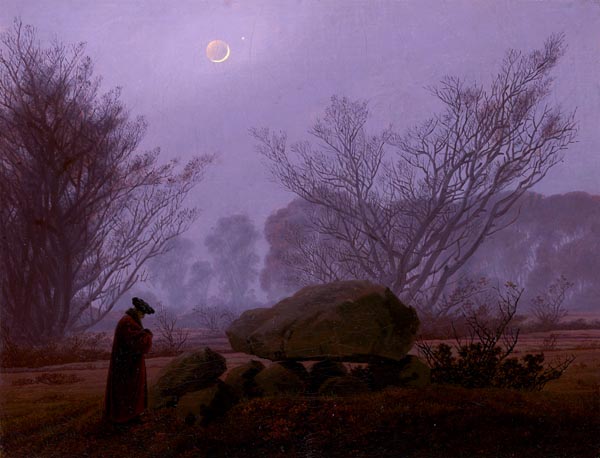
‘A Walk at Dusk’
Caspar David Friedrich (German, 1774 - 1840)
The Getty Open Content Program
The priest did not cease from prayer all that night. I sat quietly beside the funeral bier of my Atala. How many times, in her sleep, had I supported that lovely head on my lap! How many times had I leant above her, to hear and to breathe her breath! But now no sound came from that immobile form, and I awaited beauty’s awakening in vain!
The moon lent her pale torch to that funereal wake. She hung in the midst of night, like a white vestal come to weep over the coffin of a dear companion. Soon, through the woods, she spread her great melancholy secret, that she likes to relate to the old oak-trees and the ancient sea-shores. From time to time, the priest plunged a flowery branch into consecrated water, then shaking the wet bough, perfumed the night with heavenly balms. Sometimes he repeated, in a traditional chant, a few plaints of that ancient poet Job; saying:
‘I fade like a flower; I am cut down like the grass of the fields.
Wherefore is light given to those that are in misery; and life unto the bitter in soul?’
So the old man chanted. His deep rhythmic voice echoed through the silence of the wilderness. The names, of God and of the grave, sounded among all those echoes, a host of torrents, the whole forest. The cooing of the Virginian doves, the fall of a stream in the mountain, the ringing of the bell which called to travellers, mingled with those dirges, and it seemed as if one heard a distant choir of otherworldly voices from the Groves of the Dead, responding to that of the Hermit.
But a bar of gold formed in the East. Kestrels (falco sparverius) cried among the rocks, and martens (martes americana - south of their present range, but here located in a mountainous area) returned to their hollow elms: it was the signal for Atala’s cortège. I raised the body on my shoulders; the hermit walked in front of me, spade in hand. We began to descend from rock to rock; old age and death slowed our steps equally. At the sight of the dog we had found in the forest, that now, leaping with joy, traced a far different path for us, I burst into tears. Often Atala’s long hair, toyed with by the morning breeze, extended its golden veil over my eyes; bowing frequently under the burden, I was obliged to lower it onto the mossy ground, and sit beside it, to regain my strength. Finally, we arrived at the place marked out by my sorrow, and we descended beneath the arch of the bridge. O my son, you should have seen the young Indian and the old hermit, kneeling face to face in the wilderness, digging a grave with their hands for the poor girl whose body was lying nearby, in the dry gully of a stream!
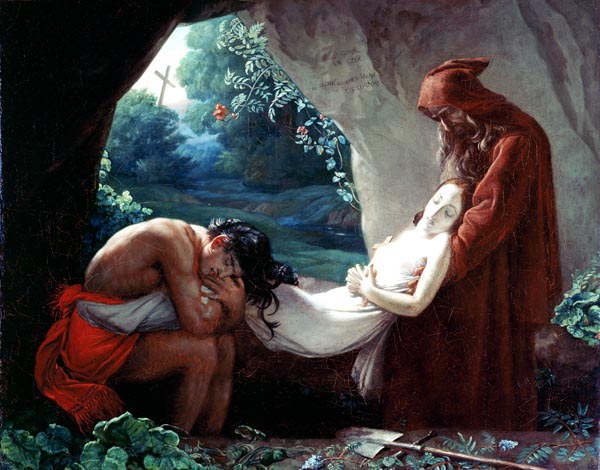
‘The Burial of Atala’
After Anne-Louis Girodet de Roucy-Trioson (French, 1767 - 1824)
The Getty Open Content Program
When our labour was complete, we deposited the lovely girl in her bed of clay. Alas, I had hoped to prepare another bed for her! Then taking a little dust in my hand, and maintaining a fearful silence, I gazed for the last time on Atala’s face. Then I poured the dust of sleep over her eighteen-year old brow; I saw the features of my sister, gradually vanish; and her graces hidden behind the veil of eternity; for a while her form conquered the dark soil, like a white lily rising from the midst of dark clay. ‘Lopez,’ I cried then, ‘behold your son burying your daughter!’ and I finished covering Atala with the dust of sleep.
We returned to the cave, and I told the missionary of the intention I had formed of settling near to him. The saint, who had a wonderful knowledge of the human heart, exposed my motives and the self-deceit of sorrow. ‘Chactas, son of Outalissi,’ he said, ‘while Atala lived, I myself asked you to stay with me; but now your fate is altered: you owe your life to your tribe. Believe me, my son, sorrow is not eternal, sooner or later it must end, as the heart of man ends; it is one of our great miseries: we are not even capable of remaining wretched for long. Return to the Mississippi: go and comfort your mother, who weeps for you every day, and needs your support. Obtain instruction in your Atala’s religion, whenever you can find the opportunity, and remember that you promised her to be virtuous and a Christian. I myself will watch here over her grave. Go, my son! God, the soul of your sister, and the heart of your old friend will go with you.’
Such were the words of the man of the rocks; his authority was too great, his wisdom too profound, for me not to obey him. The next day I left my venerable host, who pressing me to his heart, gave me his last advice, his last blessing, and his last tears. I went to the grave; I was surprised to find a small cross there erected above the site, as we see the mast of a shipwrecked vessel yet standing. I judged that the Hermit had come to pray at the tomb during the night; this mark of friendship and religion made my tears flow in abundance. I was tempted to reopen the grave, and see my beloved once more; a religious fear prevented me. I sat down on the freshly turned earth. Elbow on knee, and head in hand, I remained buried in the most bitter reverie. O René, it is there that I first indulged in serious reflection on the vanity of our days, and the greater vanity of our projects! Oh, my child, who has not countenanced such reflections! I am no more than an old stag whitened by many winters; my years vie with those of the raven: well, despite the many days burdening my head, despite a long life experience of life, I have never yet met a man who has not been deceived in his dreams of happiness, no heart that does not suffer some hidden wound. The heart that appears calmest resembles the natural wells of the Alachua savannah: the surface appears calm and clear, but when you look into the depths of the basin, you see some monstrous alligator that the well nourishes with its waters.
Having thus seen the sun rise and set on this place of sorrow, the next day at the first cry of the wood stork (mycteria americana), I prepared to leave that sacred burial-ground. I left, as if I left a bourn from which I wanted to launch myself on the path of virtue. Three times I evoked the soul of Atala; three times the Spirit of the wilderness echoed my cries from beneath the funereal arch. Then I saluted the East and saw, far off on the mountain trail, the hermit on his way to the hut of some unfortunate. Falling to my knees, and clasping the grave tightly, I cried out: ‘Sleep in peace in this foreign land, oh, too unhappy girl! As the reward for your love, your exile, and your death, you are abandoned, even by Chactas!’ Thus, shedding floods of tears, I parted from Lopez’s daughter, thus I tore myself away from that place, leaving at the foot of a natural monument, a monument nobler still: the humble tomb of virtue.”
Epilogue
Chactas, son of Outalissi, the Natchez, had finished telling his tale to René the European. Fathers repeated it to their children, and I, a traveller in distant lands, I have faithfully reported what the Indians told me. I saw in this story a portrait of a nation of hunters and a nation of labourers; religion, the highest legislature for mankind; the dangers of ignorance and religious enthusiasm, as opposed to enlightenment, charity and the true spirit of the Gospel; the war of passions and virtues in a simple heart; and finally the triumph of Christianity over the most ardent of emotions and the most terrible of fears, love and death.
When a Seminole told me this story, I found it deeply instructive and lovely in its perfection, because within it were enclosed the flower of the wilderness; the charm of the woodland cabin; and a simplicity in telling of sorrow that I cannot flatter myself as having retained. But one thing remained for me to discover. I asked what had become of Father Aubry, and nobody could tell me. I would have remained forever ignorant, if Providence which directs everything, had not found what I sought. Here is how it came to pass:
I had traversed the banks of the Mississippi, which once formed the southern gateway to New France, and I was curious to see, in the north, the other wonder of that empire, the Falls of Niagara. I was close to those cataracts, in the ancient lands of the Agonnonsioni (the Iroquois), when one morning, crossing a plain, I saw a woman sitting under a tree and holding a dead child on her knees. I approached the young mother, quietly, and I heard her say:
“If you had stayed with us, dear child, how gracefully your arm would have bent the bow! Your grasp would have tamed the angry bear; and the mountain-tops, your feet would have outpaced the deer in the race. White ermine of the rock, so young, to enter the land of souls! How will you live there? Your father is not there to nourish you with the spoils of the chase. You will be cold, and no Spirit will give you furs to cover yourself. Oh, I must hasten to join you, to sing you songs, and hold you to my breast.”
And the young mother sang in a quivering voice, rocked the child on her lap, moistening his lips with maternal milk, and lavished on the dead all the care given to life.
This woman wanted to mummify the body of her son on the branches of a tree, according to the Indian custom, before bearing it to the graves of his ancestors. She therefore stripped the newborn, and breathing a few moments into its mouth, she said: “Soul of my son, sweet soul; your father once created you with a kiss on my lips; alas, mine has not the power to grant you a second birth!” Then she uncovered her breast, and embraced those chill remains, which would have revived at the fire of the maternal heart if God had not withheld the breath which gives life.
She rose, and looked around for a tree on whose branches she could expose her child. She selected a maple with red flowers, festooned with garlands of flowering bean (apios Americana, or priceana), which gave off the sweetest of perfumes. With one hand she bent one of the lower branches down, with the other she placed the body upon it; then letting the branch go, it returned to its natural position, bearing the remains of innocence, clothed in fragrant foliage. Oh! How touching is that Indian custom! I saw you in your desolate surroundings, proud monuments to Crassus and Caesar, and I still prefer these aerial tombs of the savages, these mausoleums of flowers and greenery that the bee perfumes, the breeze sways, and in which the American nightingale (Mimus polyglottos, the northern mockingbird) builds its nest, and utters its plaintive melody. If it is the remains of a young girl that the hand of a lover suspends from the tree of death; if it is the remains of a beloved child that a mother has placed where small birds nest, the charm of it is redoubled. I approached the woman who moaned at the foot of the maple; I laid my hands on her head, giving the customary three cries of grief. Then, without speaking to her, taking a branch as she had, I drove off the insects that buzzed around the child's body. But I took care not to frighten a neighbouring dove. The Indian mother spoke to it, saying: “Dove, if you are not the soul of my son who has flown, you are doubtless a mother searching for something from which to make a nest. Take this hair, which I will no longer wash in sarsaparilla water; take it for your little ones to sleep in: may the Great Spirit preserve them to you!”
Meanwhile the mother was weeping with joy on finding such kindness from a stranger. As this was happening, a young man approached, and said, “Daughter of Celuta, remove our child’s body, we will spend no more time here, and will leave at sunrise.” I said, then: “Brother, I wish you clear skies, deer in plenty, a beaver coat and hope. You are not of this wilderness?” “No,” replied the young man, “we are exiles, and we go to find a home.” In saying this, the warrior bowed his head on his breast, and with the tip of his bow, he broke the heads of the flowers. I saw there was a grief of some kind behind his story, and I was silent. The woman removed her son’s body from the branches, and gave it to her husband to bear. Then I asked: “Would you allow me to visit your hearth tonight?” “We have no cabin," replied the warrior; “if you wish to follow us, we camp near the falls.” “I would be pleased to do so,” I replied, and we left together.
We soon arrived at the edge of the cataract, which was announced by a mighty roar. It is formed by the Niagara River, which flows out of Lake Erie, and into Lake Ontario; its vertical height is a hundred and forty-four feet. From Lake Erie to the Falls the river runs through a steep incline, and at the Falls is less a river than a flood, whose torrents rush toward the gaping mouth of an abyss. The cataract divides into two branches, and bends in a horseshoe. Between the two falls a hollow island juts out below, hanging, with all its trees, over a chaos of waves. The mass of the river rushing through the midst, curves to form a wide semi-circular arch, then unrolls in a snowy sheet, shining in the sunlight with a whole spectrum of colours. The eastern fall plunges into fearful darkness; like a column of water from the Flood. A thousand rainbows arch and curve above the abyss. Striking the worn rocks, the water breaks in foaming eddies, which rise above the trees, like the smoke of a vast conflagration. Pines, wild walnut trees, rocks carved in the shapes of phantoms, decorate the scene. Eagles, driven on the currents of air, descend wheeling into the abyss; and wolverines cling by their flexible tails to the end of low branches, to seize broken carcasses of elks and bears from the abyss.
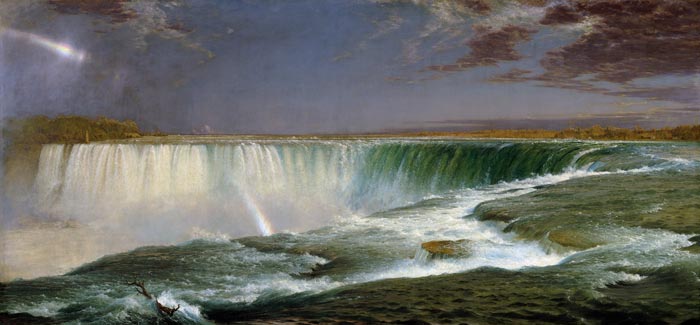
‘Niagara’
Frederic Edwin Church (American, 1826 - 1900)
The Getty Open Content Program
While I contemplated this spectacle, with a pleasure mingled with terror, the Indian woman and her husband left me. I sought them up-river, above the falls, and soon discovered them in a place appropriate to mourning. They were lying on the grass with a group of old men, beside a few human remains wrapped in animal skins. Astonished at all I had seen over the past few hours, I sat down with the young mother, and asked her: “What is all this, my sister?” She replied: “My brother, this was our homeland, and the ashes are those of our ancestors, which will follow us into exile.” “And how,” I cried, “have you been reduced to such misery?” The daughter of Celuta replied: “We are the remnants of the Natchez. After the massacre the French made of our nation to avenge their brothers, those of our brothers who escaped the victors found sanctuary among the Chickasaw our neighbours. We have lived here peacefully for many years; but seven moons ago the white people of Virginia seized our lands, saying they had been granted to them by a king in Europe. We raised our eyes to heaven, and carrying the remains of our ancestors, we made our way across the wilderness. I gave birth during the march; and as my milk was tainted because of our sufferings, it has killed my child.” In saying this, the young mother wiped her eyes with her hair; I wept too.
Now, I addressed her again: “My sister, let us worship the Great Spirit, everything happens by his command. We are all wanderers; our fathers were as we; but there is a place where we will all rest. If I were not afraid of speaking as thoughtlessly as white men do I would ask you if you have heard of Chactas, of the Natchez?” At these words, the Indian woman gazed at me and said: “Who has spoken to you of Chactas, the Natchez?" I replied: “A wise man.” The Indian replied: “I will tell you what I know, because you drove the flies away from the body of my son, and you have spoken true words concerning the Great Spirit. I am the grand-daughter of René the European, whom Chactas adopted. Chactas, who received baptism, and René my unfortunate grandfather, perished in the massacre.”
“Man always journeys from suffering to suffering,” I replied, bowing my head. “Perhaps, then, you can also give me news of Father Aubry?” “His fated has proved no happier than that of Chactas,” said the Indian woman. “The Cherokee, enemies of the French, entered his mission; they were led there by the sound of the bell that rang to summon travellers. Father Aubry could have saved himself, but he would not abandon his children, and he remained behind to sustain them in dying, by setting them an example. He was burned to death, enduring dreadful torment; they could not extract a cry from him that could bring shame on his God or dishonour on his country. He did not cease, during the ordeal, from praying for his executioners, and sympathizing with the fate of their victims. To force him to reveal some sign of weakness, the Cherokee led to his feet a Christian savage whom they had mutilated horribly. But they were truly surprised when they saw the young man throw himself to his knees and kiss the wounds of the old hermit who cried to him: “My child, we have been made a spectacle for angels and men.” The Indians, infuriated, plunged a red-hot iron down his throat, to prevent him from speaking. Then, no longer able to console mankind, he died.
They say that the Cherokees, accustomed as they were to seeing Savages endure suffering with fortitude, could not help but confess that there was in the humble courage of Father Aubry something unknown to them, which surpassed all earthly courage. Several of them, struck by his death, became Christians.
A few years later, Chactas, on his return from the lands of the white man, having learned of the priest’s misfortunes, departed to gather his ashes and those of Atala. He arrived at the place where the Mission was located, but he could barely recognize it. The lake had overflowed, and the savannah was changed to a marsh; the natural bridge, in collapsing, had buried Atala’s grave and the Groves of the Dead beneath its ruins. Chactas wandered for hours in that place; he visited the Hermit’s cave which he found full of brambles and raspberries, and in which a doe was nursing her fawn. He sat on the rock of the Vigil of Death, where he saw only a few feathers fallen from the wings of some bird of passage. While he wept, the missionary’s tame snake emerged from the brush nearby, and came to coil at his feet. Chactas warmed at his breast that loyal friend, the sole one remaining amidst the ruins. Outalissi’s son told us that several times at the approach of night, he thought he saw the shades of Atala and Father Aubry arise in the twilight mist. Those visions filled him with a religious fear and a sorrowful joy.
After searching in vain for his sister’s grave, and that of the hermit, he was about to abandon the place, when the deer from the cave leapt in front of him. She paused at the foot of the Mission cross. This cross was then half-surrounded by water, the wood was eaten away by moss, and a wild pelican was wont to use its rotten arms as a perch. Chactas realised that the grateful deer had led him to the grave of his host. He dug under the rock that once served as an altar, and found the remains of a man and a woman. He had no doubt that they were those of the priest and the virgin, which the angels perhaps had buried in that place; he wrapped them in bear pelts, and made his way back to his own land carrying the precious remains, which rattled at his shoulders like a quiver of death. At night, he put them beneath his head, and dreamed of love and virtue. O stranger, here you may gaze on those ashes, along with those of Chactas himself!”
As the Indian woman finished pronouncing these words, I rose; I approached the sacred ashes, and prostrated myself before them in silence. Then I strode away, exclaiming: “Thus passes on earth all that is good, virtuous, and sensitive! Man, you are no more than a swift thought, a sorrowful dream; you exist solely in misfortune; you are no more than the sadness in your soul, and the eternal melancholy of your mind!”
These reflections occupied me all night. The next morning, at daybreak, my hosts left me. The young warriors led the way, and the wives followed; the former were in charge of the holy relics, while the latter carried their infants; the old men walked slowly in the midst, between their ancestors and their posterity, between memory and hope, between their lost homeland and the homeland to come. Oh, what tears are shed when our native land is abandoned thus, when from the brow of the hill of exile, we turn for the last time to see the roof under which we were nourished, and that river, beside our cabin, which continues to flow sorrowfully through the deserted fields of our homeland!
Unhappy Indians, whom I have seen wandering, bearing the ashes of your ancestors, in the wilderness of the New World, you who have shown me hospitality despite your misery, I can not repay that hospitality today, for I wander, as you do, at the mercy of mankind; and less happy than you in my exile, I do not carry with me the bones of my fathers.
The End of Chateaubriand’s ‘Atala’