An Anthology of Shakespearean Quotations
Arranged by Theme
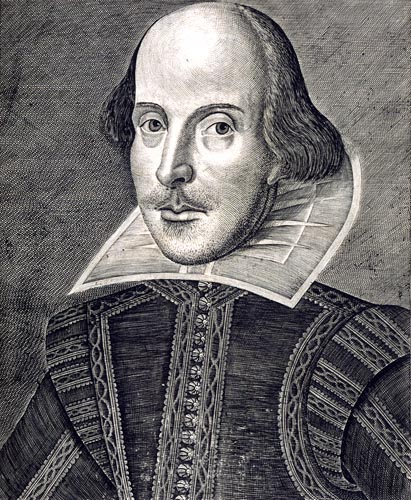
‘William Shakespeare’
First Folio. Mr. William Shakespeares Comedies, Histories, & Tragedies - William Shakespeare (1623)
The British Library
Arranged by A. S. Kline © Copyright 2010 All Rights Reserved
This work may be freely reproduced, stored and transmitted, electronically or otherwise, for any non-commercial purpose. Conditions and Exceptions apply.
Contents
- Commands
- Compassion, Empathy, Mercy and Forgiveness
- Compliments and their Opposites
- Conscience and Doubt
- Constancy, Trust and Faith
- Courage and Cowardice
- Crime, Punishment, Justice and the Law
- Death and Fate
- Dishonour, Dishonesty, Inconstancy and Betrayal
- Doctors, Illness, Medicine
- England and Elsewhere
- Freedom and Imprisonment
- Friendship
- Good Advice and Bad
- Good Wishes and their Opposites
- Happiness and Sadness, Humour and Gravity
- Honour and Honesty
- Kings and Kingship
- Journeys and Travel
- Language and the Arts
- Learning, Literature,Wit, Wisdom and Foolishness
- London
- Love and Jealousy, Hatred and Envy
- Lust, Desire, Passion, Sexuality
- Madness and Sanity
- Magic, Astrology, Superstition, and the Supernatural
- Men
- Music, Song and Dance
- Myths and Fables
- Nature, Trees, Flowers, Creatures
- Ownership, Money and Possession
- Prayers, Pleas, Curses, Threats and Promises
- Pride and Humility
- Rank and Status, Power, Order, Custom and Authority
- Service and Slavery
- Sleep, Waking, Dreams, Visions and Imagination
- Sons and Daughters
- Theatre, Drama and the Stage
- Time
- Truths, Truisms, Proverbs and Philosophy
- War and Conflict, Peace and Reconciliation
- Weather, Days and Seasons
- Wishes, Hopes, Purpose, and Will
- Women
- Youth and Age
Commands
Be collected:
No more amazement: tell your piteous heart
There’s no harm done.
(The Tempest. Act 1. Scene 2. Prospero speaking.)
Burn but his books.
(The Tempest. Act 3. Scene 2. Caliban speaking.)
Look thou be true; do not give dalliance
Too much the rein: the strongest oaths are straw
To the fire i’ the blood
(The Tempest. Act 4. Scene 1. Prospero speaking.)
Come not within the measure of my wrath;
(The Two Gentlemen of Verona. Act 5. Scene 4. Valentine speaking.)
Sail like my pinnace to these golden shores.
(The Merry Wives of Windsor. Act 1. Scene 3. Falstaff speaking.)
Be as thou wast wont to be;
See as thou wast wont to see:
Dian’s bud o’er Cupid’s flower
Hath such force and blessed power.
(A Midsummer Night’s Dream. Act 4. Scene 1. Oberon speaking.)
Do as I bid you; shut doors after you:
Fast bind, fast find;
A proverb never stale in thrifty mind.
(The Merchant of Venice. Act 2. Scene 5. Shylock speaking.)
Run, run, Orlando; carve on every tree
The fair, the chaste and unexpressive she.
(As You Like It. Act 3. Scene 2. Orlando speaking.)
But, mistress, know yourself: down on your knees,
And thank heaven, fasting, for a good man’s love:
(As You Like It. Act 3. Scene 5. Rosalind speaking.)
Come, madam wife, sit by my side
and let the world slip: we shall ne’er be younger.
(The Taming of the Shrew. Induction. Scene 2. Sly speaking.)
And kiss me, Kate, we will be married a Sunday.
(The Taming of the Shrew. Act 2. Scene 1. Petruchio speaking.)
Ours be your patience then, and yours our parts;
Your gentle hands lend us, and take our hearts.
(All’s Well That Ends Well. Act 5. Scene 3. King speaking.)
‘…stand at her doors,
And tell them there thy fixed foot shall grow
Till thou have audience.
(Twelfth Night. Act 1. Scene 3. Duke Orsino speaking.)
Be Mercury, set feathers to thy heels,
And fly like thought from them to me again.
(King John. Act 4. Scene 2. King John speaking.)
Go thou, and like an executioner,
Cut off the heads of too fast growing sprays,
That look too lofty in our commonwealth:
All must be even in our government.
(King Richard the Second. Act 3. Scene 4. Richard speaking.)
The game’s afoot:
Follow your spirit, and upon this charge
Cry ‘God for Harry, England, and Saint George!’
(King Henry the Fifth. Act 3. Scene 1. King Henry speaking.)
Defer no time, delays have dangerous ends;
(King Henry the Sixth Part 1. Act 3. Scene 2. Alençon speaking.)
Blush, Blush, thou lump of foul deformity;
(King Richard the Third. Act 1. Scene 2. Lady Anne speaking.)
Friends, Romans, countrymen, lend me your ears;
I come to bury Caesar, not to praise him.
(Julius Caesar. Act 3. Scene 2. Antony speaking.)
‘…Awake!
Shake off this downy sleep, death’s counterfeit,
And look on death itself! Up, up, and see
The great doom’s image!
(Macbeth. Act 2. Scene 3. Macduff speaking.)
At once, good night:
Stand not upon the order of your going,
But go at once.
(Macbeth. Act 3. Scene 4. Lady Macbeth speaking.)
Though you untie the winds and let them fight
Against the churches; though the yesty waves
Confound and swallow navigation up;
Though bladed corn be lodged and trees blown down;
Though castles topple on their warders’ heads;
Though palaces and pyramids do slope
Their heads to their foundations; though the treasure
Of nature’s germens tumble all together,
Even till destruction sicken; answer me‘…
(Macbeth. Act 4. Scene 1. Macbeth speaking.)
Show his eyes, and grieve his heart;
Come like shadows, so depart!
(Macbeth. Act 4. Scene 1. Macbeth and the Witches speaking.)
Out, damned spot! Out, I say!
(Macbeth. Act 5. Scene 1. Lady Macbeth speaking.)
Hang out our banners on the outward walls;
The cry is still ‘They come:’
(Macbeth. Act 5. Scene 5. Macbeth speaking.)
Ring the alarum-bell! Blow, wind! Come, wrack!
At least we’ll die with harness on our back.
(Macbeth. Act 5. Scene 5. Macbeth speaking.)
Get thee to a nunnery: why wouldst thou be a breeder of sinners?
(Hamlet. Act 3. Scene 1. Hamlet speaking.)
Let the doors be shut upon him, that he may play the fool no where but in’s own house.
(Hamlet. Act 3. Scene 1. Hamlet speaking.)
Come, come, and sit you down; you shall not budge;
You go not till I set you up a glass
Where you may see the inmost part of you.
(Hamlet. Act 3. Scene 4. Hamlet speaking.)
Leave wringing of your hands: peace! Sit you down,
And let me wring your heart; for so I shall,
If it be made of penetrable stuff,
(Hamlet. Act 3. Scene 4. Hamlet speaking.)
O, step between her and her fighting soul:
Conceit in weakest bodies strongest works:
(Hamlet. Act 3. Scene 4. Ghost of Hamlet’s Father speaking.)
Queen Gertrude O Hamlet, thou hast cleft my heart in twain.
Hamlet O, throw away the worser part of it,
And live the purer with the other half.
(Hamlet. Act 3. Scene 4. Hamlet speaking.)
Assume a virtue, if you have it not.
(Hamlet. Act 3. Scene 4. Hamlet speaking.)
Come, my coach! Good night, ladies; good night, sweet ladies;
good night, good night.
(Hamlet. Act 4. Scene 5. Ophelia speaking.)
Lay her i’ the earth:
And from her fair and unpolluted flesh
May violets spring! I tell thee, churlish priest,
A ministering angel shall my sister be,
When thou liest howling.
(Hamlet. Act 5. Scene 1. Laertes speaking.)
Be buried quick with her, and so will I:
(Hamlet. Act 5. Scene 1. Hamlet speaking.)
Go, bid the soldiers shoot.
(Hamlet. Act 5. Scene 2. Fortinbras speaking.)
Blow, winds, and crack your cheeks! Rage! Blow!
You cataracts and hurricanoes, spout
Till you have drench’d our steeples, drown’d the cocks!
You sulphurous and thought-executing fires,
Vaunt-couriers to oak-cleaving thunderbolts,
Singe my white head! And thou, all-shaking thunder,
Smite flat the thick rotundity o’ the world!
Crack nature’s moulds, an germens spill at once,
That make ingrateful man!
(King Lear. Act 3. Scene 2. Lear speaking.)
Note: Germens, germs, seeds.
Put out the light, and then put out the light:
If I quench thee, thou flaming minister,
I can again thy former light restore,
Should I repent me: but once put out thy light,
Thou cunning’st pattern of excelling nature,
I know not where is that Promethean heat
That can thy light relume.
(Othello. Act 5. Scene 2. Othello speaking.)
O sun,
Burn the great sphere thou movest in!
Darkling stand
The varying shore o’ the world.
(Antony and Cleopatra. Act 4. Scene 15. Cleopatra speaking.)
With thy sharp teeth this knot intrinsicate
Of life at once untie:
(Antony and Cleopatra. Act 5. Scene 2. Cleopatra speaking.)
Note: Intrinsicate, intricate.
No more be grieved at that which thou hast done:
Roses have thorns, and silver fountains mud;
Clouds and eclipses stain both moon and sun,
And loathsome canker lives in sweetest bud.
(Sonnet 35)
Be wise as thou art cruel; do not press
My tongue-tied patience with too much disdain;
(Sonnet 140)
Compassion, Empathy, Mercy and Forgiveness
O, I have suffered
With those that I saw suffer
(The Tempest. Act 1. Scene 2. Miranda speaking.)
O, the cry did knock against my very heart!
(The Tempest. Act 1. Scene 2. Miranda speaking.)
The direful spectacle of the wreck, which touch’d
The very virtue of compassion in thee
(The Tempest. Act 1. Scene 2. Prospero speaking.)
I would the lightning had
Burnt up those logs that you are enjoin’d to pile!
Pray, set it down and rest you: when this burns,
‘Twill weep for having wearied you.
(The Tempest. Act 3. Scene 1. Miranda speaking.)
Your charm so strongly works ‘em
That if you now beheld them, your affections
Would become tender.
Prospero Dost thou think so, spirit?
Ariel Mine would, sir, were I human.
(The Tempest. Act 5. Scene 1. Ariel and Prospero speaking.)
I am sorry for thee: thou art come to answer
A stony adversary, an inhuman wretch
uncapable of pity, void and empty
From any dram of mercy.
(The Merchant of Venice. Act 3. Scene 2. Portia speaking.)
The quality of mercy is not strain’d,
It droppeth as the gentle rain from heaven
Upon the place beneath:
(The Merchant of Venice. Act 4. Scene 1. Portia speaking.)
I have forgiven and forgotten all;
(All’s Well That Ends Well. Act 5. Scene 3. King speaking.)
O, the most piteous cry of the poor souls! Sometimes to see ‘em, and not to see ‘em; now the ship boring the moon with her main-mast, and anon swallowed with yeast and froth, as you’d thrust a cork into a hogshead.
(The Winter’s Tale. Act 3. Scene 3. Clown speaking.)
He hath a tear for pity and a hand
Open as day for melting charity:
(King Henry the Fourth Part 2. Act 4. Scene 4. Henry speaking.)
Wilt thou draw near the nature of the gods?
Draw near them then in being merciful:
Sweet mercy is nobility’s true badge:
(Titus Andronicus. Act 1. Scene 1. Tamora speaking.)
Mercy but murders, pardoning those that kill.
(Romeo and Juliet. Act 3. Scene 1. Escalus speaking.)
‘…Yet do I fear thy nature;
It is too full o’ the milk of human kindness
To catch the nearest way: thou wouldst be great;
Art not without ambition, but without
The illness should attend it: what thou wouldst highly,
That wouldst thou holily; wouldst not play false,
And yet wouldst wrongly win:
(Macbeth. Act 1. Scene 5. Lady Macbeth speaking.)
What if this cursed hand
Were thicker than itself with brother’s blood,
Is there not rain enough in the sweet heavens
To wash it white as snow? Whereto serves mercy
But to confront the visage of offence?
(Hamlet. Act 3. Scene 3. Claudius speaking.)
I must be cruel, only to be kind:
(Hamlet. Act 3. Scene 4. Hamlet speaking.)
O, reason not the need:
(King Lear. Act 2. Scene 4. Lear speaking.)
Is there any cause in nature that makes these hard hearts?
(King Lear. Act 3. Scene 6. Lear speaking.)
‘…Mine enemy’s dog,
Though he had bit me, should have stood that night
Against my fire;
(King Lear. Act 4. Scene 7. Cordelia speaking.)
Pray you now, forget and forgive:
(King Lear. Act 4. Scene 7. Lear speaking.)
She loved me for the dangers I had pass’d,
And I loved her that she did pity them.
This only is the witchcraft I have used:
(Othello. Act 1. Scene 3. Othello speaking.)
‘…but yet the pity of it, Iago! O Iago, the pity of it, Iago!
(Othello. Act 4. Scene 1. Iago speaking.)
‘…but if there be
Yet left in heaven as small a drop of pity
As a wren’s eye, fear’d gods, a part of it!
(Cymbeline. Act 4. Scene 2. Imogen speaking.)
Pardon’s the word to all.
(Cymbeline. Act 5. Scene 5. Cymbeline speaking.)
Compliments and their Opposites
There’s nothing ill can dwell in such a temple:
If the ill spirit have so fair a house,
Good things will strive to dwell with’t.
(The Tempest. Act 1. Scene 2. Miranda speaking.)
To the most of men this is a Caliban
And they to him are angels.
Miranda My affections
Are then most humble; I have no ambition
To see a goodlier man.
(The Tempest. Act 1. Scene 2. Prospero and Miranda speaking.)
Antonio He misses not much.
Sebastian No; he doth but mistake the truth totally.
(The Tempest. Act 2. Scene 1. Antonio and Sebastian speaking)
You are gentlemen of brave mettle; you would lift
the moon out of her sphere, if she would continue
in it five weeks without changing.
(The Tempest. Act 2. Scene 1. Gonzalo speaking.)
‘…this lord of weak remembrance
(The Tempest. Act 2. Scene 1. Antonio speaking.)
Though thou canst swim like a
duck, thou art made like a goose.
(The Tempest. Act 2. Scene 2. Stephano speaking.)
That’s a brave god and bears celestial liquor.
(The Tempest. Act 2. Scene 2. Caliban speaking.)
‘…but you, O you,
So perfect and so peerless, are created
Of every creature’s best!
(The Tempest. Act 3. Scene 1.Ferdinand speaking.)
They say there’s but five upon this isle: we are three
of them; if th’ other two be brained like us, the
state totters.
(The Tempest. Act 3. Scene 2. Trinculo speaking.)
Who though they are of monstrous shape, yet, note,
Their manners are more gentle-kind than of
Our human generation you shall find
Many, nay, almost any.
(The Tempest. Act 3. Scene 3. Gonzalo speaking.)
...a grace it had, devouring.
(The Tempest. Act 3. Scene 3. Prospero speaking.)
So rare a wonder’d father and a wise
Makes this place Paradise.
(The Tempest. Act 4. Scene 1. Prospero speaking.)
A devil, a born devil, on whose nature
Nurture can never stick; on whom my pains,
Humanely taken, all, all lost, quite lost;
(The Tempest. Act 4. Scene 1. Prospero speaking.)
O, wonder!
How many goodly creatures are there here!
How beauteous mankind is! O brave new world,
That has such people in’t!
Prospero ‘Tis new to thee.
(The Tempest. Act 5. Scene 1. Miranda and Prospero speaking.)
Why, man, she is mine own,
And I as rich in having such a jewel
As twenty seas, if all their sand were pearl,
The water nectar and the rocks pure gold.
(The Two Gentlemen of Verona. Act 2. Scene 4. Valentine speaking.)
Thou subtle, perjured, false, disloyal man!
(The Two Gentlemen of Verona. Act 4. Scene 2. Silvia speaking.)
There is Anne Page, which is daughter to Master Thomas
Page, which is pretty virginity.
(The Merry Wives of Windsor. Act 1. Scene 1. Evans speaking.)
Thou art the Mars of malcontents: I second thee; troop on.
(The Merry Wives of Windsor. Act 1. Scene 3. Pistol speaking.)
Come, I cannot cog and say thou art this and that, like a many of these lisping hawthorn-buds, that come like women in men’s apparel, and smell like Bucklersbury in simple time;
(The Merry Wives of Windsor. Act 3. Scene 3. Falstaff speaking.)
Note: Bucklersbury; a street where apothecaries sold herbs.
Grace is grace, despite of all controversy; as, for example, thou thyself art a wicked villain, despite of all grace.
(Measure for Measure. Act 1. Scene 2. Lucio speaking.)
The hand that hath made you fair hath made you good:
(Measure for Measure. Act 3. Scene 1. Duke Vincentio speaking.)
They brought one Pinch, a hungry lean-faced villain,
A mere anatomy, a mountebank,
A threadbare juggler and a fortune-teller,
A needy, hollow-eyed, sharp-looking wretch,
A dead-looking man:
(The Comedy of Errors. Act 5. Scene 1. Antipholus of Ephesus speaking.)
‘…he is a very valiant trencherman;
(Much Ado About Nothing. Act 1. Scene 1. Beatrice speaking.)
What, my dear Lady Disdain! Are you yet living?
(Much Ado About Nothing. Act 1. Scene 1. Benedick speaking.)
Why, i’ faith, methinks she’s too low for a high
praise, too brown for a fair praise and too little
for a great praise:
(Much Ado About Nothing. Act 1. Scene 1. Benedick speaking.)
She speaks poniards, and every word stabs: if her breath were as terrible as her terminations, there were no living near her; she would infect to the north star.
(Much Ado About Nothing. Act 2. Scene 1. Benedick speaking.)
‘There did I see that low-spirited swain, that base minnow of thy mirth,’
Costard Me?
Ferdinand (Reads) ‘…that unlettered small-knowing soul,’
Costard Me?
Ferdinand ‘…that shallow vassal,’
Costard Still me?
Ferdinand ‘…which, as I remember, hight Costard,’
Costard O, me!
(Love’s Labours Lost. Act 1. Scene 1. King Ferdinand and Costard speaking.)
O happy fair!
Your eyes are lode-stars; and your tongue’s sweet air
More tuneable than lark to shepherd’s ear,
When wheat is green, when hawthorn buds appear.
(A Midsummer Night’s Dream. Act 1. Scene 1. Hermia speaking.)
Ill met by moonlight, proud Titania.
(A Midsummer Night’s Dream. Act 2. Scene 1. Oberon speaking.)
Get you gone, you dwarf;
You minimus, of hindering knot-grass made;
You bead, you acorn.
(A Midsummer Night’s Dream. Act 3. Scene 2. Lysander speaking.)
If he, compact of jars, grow musical,
We shall have shortly discord in the spheres.
(As You Like It. Act 2. Scene 7. Duke Senior speaking.)
What stature is she of?
Orlando Just as high as my heart.
Jaques You are full of pretty answers. Have you not been
acquainted with goldsmiths’ wives, and conned them
out of rings?
(As You Like It. Act 3. Scene 2. Jacques and Orlando speaking.)
Where dwell you, pretty youth?
Rosalind With this shepherdess, my sister; here in the skirts of the forest, like fringe upon a petticoat.
(As You Like It. Act 3. Scene 2. Rosalind speaking.)
Thou hast a lady far more beautiful
Than any woman in this waning age.
(The Taming of the Shrew. Induction. Scene 2. A Lord speaking.)
Sacred and sweet was all I saw in her.
(The Taming of the Shrew. Act 1. Scene 1. Lucentio speaking.)
You lie, in faith; for you are call’d plain Kate,
And bonny Kate and sometimes Kate the curst;
But Kate, the prettiest Kate in Christendom
Kate of Kate Hall, my super-dainty Kate,
For dainties are all Kates, and therefore, Kate,
Take this of me, Kate of my consolation;
Hearing thy mildness praised in every town,
Thy virtues spoke of, and thy beauty sounded,
Yet not so deeply as to thee belongs,
Myself am moved to woo thee for my wife.
(The Taming of the Shrew. Act 2. Scene 1. Petruchio speaking.)
Why does the world report that Kate doth limp?
O slanderous world! Kate like the hazel-twig
Is straight and slender and as brown in hue
As hazel nuts and sweeter than the kernels.
(The Taming of the Shrew. Act 2. Scene 1. Petruchio speaking.)
No, no, no, your son was misled with a snipt-taffeta fellow there, whose villanous saffron would have made all the unbaked and doughy youth of a nation in his colour:
(All’s Well That Ends Well. Act 4. Scene 5. Lafeu speaking.)
He lost a wife
Whose beauty did astonish the survey
Of richest eyes, whose words all ears took captive,
Whose dear perfection hearts that scorn’d to serve
Humbly call’d mistress.
King Praising what is lost
Makes the remembrance dear.
(All’s Well That Ends Well. Act 5. Scene 3. Lafeu and the King speaking.)
‘…he does it with a better grace, but I do it more natural.
(Twelfth Night. Act 2. Scene 3. Sir Andrew Aguecheek speaking.)
It is an heretic that makes the fire,
Not she which burns in’t.
(The Winter’s Tale. Act 2. Scene 3. Paulina speaking.)
What you do
Still betters what is done. When you speak, sweet.
I’d have you do it ever: when you sing,
I’d have you buy and sell so, so give alms,
Pray so; and, for the ord’ring your affairs,
To sing them too: when you do dance, I wish you
A wave o’ the sea, that you might ever do
Nothing but that; move still, still so,
And own no other function: each your doing,
So singular in each particular,
Crowns what you are doing in the present deeds,
That all your acts are queens.
(The Winter’s Tale. Act 4. Scene 4. Perdita speaking.)
‘…too true, my lord:
If, one by one, you wedded all the world,
Or from the all that are took something good,
To make a perfect woman, she you kill’d
Would be unparallel’d.
(The Winter’s Tale. Act 5. Scene 1. Paulina speaking.)
Stars, stars,
And all eyes else dead coals!
(The Winter’s Tale. Act 5. Scene 1. Leontes speaking.)
Ay, the most peerless piece of earth, I think,
That e’er the sun shone bright on.
(The Winter’s Tale. Act 5. Scene 1. Gentleman speaking.)
‘…for she was as tender
As infancy and grace.
(The Winter’s Tale. Act 5. Scene 3. Leontes speaking.)
‘…every wretch, pining and pale before,
Beholding him, plucks comfort from his looks:
A largess universal like the sun
His liberal eye doth give to every one,
Thawing cold fear, that mean and gentle all,
Behold, as may unworthiness define,
A little touch of Harry in the night.
(King Henry the Fifth. Prologue to Act 4. Chorus speaking.)
I, that am rudely stamp’d, and want love’s majesty
To strut before a wanton ambling nymph;
I, that am curtail’d of this fair proportion,
Cheated of feature by dissembling nature,
Deformed, unfinish’d, sent before my time
Into this breathing world, scarce half made up,
And that so lamely and unfashionable
That dogs bark at me as I halt by them;
Why, I, in this weak piping time of peace,
Have no delight to pass away the time,
Unless to spy my shadow in the sun
And descant on mine own deformity:
(King Richard the Third. Act 1. Scene 1. Richard Duke of Gloucester speaking.)
A sweeter and a lovelier gentleman,
Framed in the prodigality of nature,
Young, valiant, wise, and, no doubt, right royal,
The spacious world cannot again afford,
(King Richard the Third. Act 1. Scene 2. Richard Duke of Gloucester speaking.)
Hear you this Triton of the minnows? Mark you
His absolute ‘shall’?
(Coriolanus. Act 3. Scene 1. Coriolanus speaking.)
That shows thee a weak slave; for the weakest goes
to the wall.
(Romeo and Juliet. Act 1 Scene 1. Gregory speaking.)
She will not stay the siege of loving terms,
Nor bide the encounter of assailing eyes,
Nor ope her lap to saint-seducing gold:
O, she is rich in beauty,
(Romeo and Juliet. Act 1. Scene 1. Romeo speaking.)
But, soft! What light through yonder window breaks?
It is the east, and Juliet is the sun.
(Romeo and Juliet. Act 2. Scene 2. Romeo speaking.)
Benvolio Why, what is Tybalt?
Mercutio More than prince of cats, I can tell you. O, he is the courageous captain of compliments.
(Romeo and Juliet. Act 2. Scene 4. Mercutio speaking.)
(Enter Nurse and her man, Peter)
Mercutio A sail, a sail!
Benvolio Two, two; a shirt and a smock.
(Romeo and Juliet. Act 2. Scene 4. Mercutio and Benvolio speaking.)
This was the noblest Roman of them all:
All the conspirators save only he
Did that they did in envy of great Caesar;
He only, in a general honest thought
And common good to all, made one of them.
His life was gentle, and the elements
So mix’d in him that Nature might stand up
And say to all the world ‘This was a man!’
(Julius Caesar. Act 5. Scene 5. Antony speaking.)
Thou art the best o’ the cut-throats;
(Macbeth. Act 3. Scene 4. Macbeth speaking.)
Since my dear soul was mistress of her choice
And could of men distinguish, her election
Hath seal’d thee for herself; for thou hast been
As one, in suffering all, that suffers nothing,
A man that fortune’s buffets and rewards
Hast ta’en with equal thanks: and blest are those
Whose blood and judgment are so well commingled,
That they are not a pipe for fortune’s finger
To sound what stop she please. Give me that man
That is not passion’s slave, and I will wear him
In my heart’s core, ay, in my heart of heart,
As I do thee.
(Hamlet. Act 3. Scene 2. Hamlet speaking.)
See, what a grace was seated on this brow;
Hyperion’s curls; the front of Jove himself;
An eye like Mars, to threaten and command;
A station like the herald Mercury
New-lighted on a heaven-kissing hill;
A combination and a form indeed,
Where every god did seem to set his seal,
To give the world assurance of a man:
This was your husband.
(Hamlet. Act 3. Scene 4. Hamlet speaking.)
‘…Have you eyes?
Could you on this fair mountain leave to feed,
And batten on this moor?
(Hamlet. Act 3. Scene 4. Hamlet speaking.)
Cordelia, Cordelia! stay a little. Ha!
What is’t thou say’st? Her voice was ever soft,
Gentle, and low, an excellent thing in woman.
I kill’d the slave that was a-hanging thee.
(King Lear. Act 5. Scene 3. Lear speaking.)
Desdemona What wouldst thou write of me, if thou shouldst
praise me?
Iago O gentle lady, do not put me to’t;
For I am nothing, if not critical.
(Othello. Act 2. Scene 1. Iago speaking.)
To suckle fools and chronicle small beer.
(Othello. Act 2. Scene 1. Iago speaking.)
I cry you mercy, then:
I took you for that cunning whore of Venice
That married with Othello. You, mistress,
That have the office opposite to Saint Peter,
And keep the gate of hell!
(Othello. Act 4. Scene 2. Othello speaking.)
Thou art rash as fire, to say
That she was false: O, she was heavenly true!
(Othello. Act 5. Scene 2. Emilia speaking.)
Fie, wrangling queen!
Whom every thing becomes, to chide, to laugh,
To weep; whose every passion fully strives
To make itself, in thee, fair and admired!
No messenger, but thine; and all alone
To-night we’ll wander through the streets and note
The qualities of people. Come, my queen;
(Antony and Cleopatra. Act 1. Scene 1. Antony speaking.)
The demi-Atlas of this earth, the arm
And burgonet of men. He’s speaking now,
Or murmuring ‘Where’s my serpent of old Nile?’
For so he calls me: now I feed myself
With most delicious poison.
(Antony and Cleopatra. Act 1. Scene 5. Cleopatra speaking.)
I will tell you.
The barge she sat in, like a burnish’d throne,
Burn’d on the water: the poop was beaten gold;
Purple the sails, and so perfumed that
The winds were love-sick with them; the oars were silver,
Which to the tune of flutes kept stroke, and made
The water which they beat to follow faster,
As amorous of their strokes. For her own person,
It beggar’d all description:
(Antony and Cleopatra. Act 2. Scene 2. Enobarbus speaking.)
Age cannot wither her, nor custom stale
Her infinite variety:
(Antony and Cleopatra. Act 2. Scene 2. Enobarbus speaking.)
Now boast thee, death, in thy possession lies
A lass unparallel’d. Downy windows, close;
And golden Phoebus never be beheld
Of eyes again so royal! Your crown’s awry;
I’ll mend it, and then play.
(Antony and Cleopatra. Act 5. Scene 2. Charmian speaking.)
All of her that is out of door most rich!
If she be furnish’d with a mind so rare,
She is alone the Arabian bird, and I
Have lost the wager.
(Cymbeline. Act 1. Scene 6. Iachimo speaking.)
By Jupiter, an angel! Or, if not,
An earthly paragon! Behold divineness
No elder than a boy!
(Cymbeline. Act 3. Scene 6. Belarius speaking.)
Falseness cannot come from thee; for thou look’st
Modest as Justice, and thou seem’st a palace
For the crown’d Truth to dwell in:
(Pericles, Prince of Tyre. Act 5. Scene 1. Pericles speaking.)
Thou that art now the world’s fresh ornament
And only herald to the gaudy spring,
(Sonnet 1)
My mistress’ eyes are nothing like the sun;
Coral is far more red than her lips’ red;
(Sonnet 130)
For I have sworn thee fair and thought thee bright,
Who art as black as hell, as dark as night.
(Sonnet 147)
Conscience and Doubt
Sebastian But, for your conscience?
Antonio Ay, sir; where lies that?
(The Tempest. Act 2. Scene 1. Sebastian and Antonio speaking.)
Our doubts are traitors, and make us lose the good we oft might win by fearing to attempt.
(Measure for Measure. Act 1. Scene 4. Lucio speaking.)
‘…well, my conscience says ‘Launcelot, budge not.’ ‘Budge,’ says the
fiend. ‘Budge not,’ says my conscience. ‘Conscience,’ say I, ‘you counsel well;’ ‘ Fiend,’ say I, ‘you counsel well:’
(The Merchant of Venice. Act 2. Scene 2. Launcelot speaking.)
I can no other answer make but thanks,
And thanks; and ever thanks; and oft good turns
Are shuffled off with such uncurrent pay:
But, were my worth as is my conscience firm,
You should find better dealing.
(Twelfth Night. Act 3. Scene 3. Sebastian speaking.)
Thrice is he armed that hath his quarrel just,
And he but naked, though lock’d up in steel
Whose conscience with injustice is corrupted.
(King Henry the Sixth Part 2. Act 3. Scene 2. The King speaking.)
O coward conscience, how dost thou afflict me!
The lights burn blue. It is now dead midnight.
Cold fearful drops stand on my trembling flesh.
What do I fear? Myself? There’s none else by:
Richard loves Richard; that is, I am I.
(King Richard the Third. Act 5. Scene 3. King Richard speaking.)
Let not our babbling dreams affright our souls:
Conscience is but a word that cowards use,
Devised at first to keep the strong in awe:
Our strong arms be our conscience, swords our law.
March on, join bravely, let us to’t pell-mell
If not to heaven, then hand in hand to hell.
(King Richard the Third. Act 5. Scene 3. King Richard speaking.)
‘…why do I yield to that suggestion
Whose horrid image doth unfix my hair
And make my seated heart knock at my ribs,
Against the use of nature? Present fears
Are less than horrible imaginings:
My thought, whose murder yet is but fantastical,
Shakes so my single state of man that function
Is smother’d in surmise, and nothing is
But what is not.
(Macbeth. Act 1. Scene 3. Macbeth speaking.)
Macbeth This is a sorry sight.
(Looking on his hands)
Lady Macbeth A foolish thought, to say a sorry sight.
(Macbeth. Act 2. Scene 2. Macbeth and Lady Macbeth speaking.)
‘…the play ‘s the thing
Wherein I’ll catch the conscience of the king.
(Hamlet. Act 2. Scene 2. Hamlet speaking.)
Thus conscience does make cowards of us all;
And thus the native hue of resolution
Is sicklied o’er with the pale cast of thought,
And enterprises of great pith and moment
With this regard their currents turn awry,
And lose the name of action.
(Hamlet. Act 3. Scene 1. Hamlet speaking.)
O Hamlet, speak no more:
Thou turn’st mine eyes into my very soul;
And there I see such black and grained spots
As will not leave their tinct.
(Hamlet. Act 3. Scene 4. Gertrude speaking.)
O, what damned minutes tells he o’er
Who dotes, yet doubts, suspects, yet strongly loves!
(Othello. Act 3. Scene 3. Othello speaking.)
Love is too young to know what conscience is;
Yet who knows not conscience is born of love?
(Sonnet 151)
Constancy, Trust and Faith
O heaven, were man
But constant, he were perfect! That one error
Fills him with faults; makes him run through all th’ sins:
(The Two Gentlemen of Verona. Act 5. Scene 4. Proteus speaking.)
‘…he wears his faith but as
the fashion of his hat; it ever changes with the
next block.
(Much Ado About Nothing. Act 1. Scene 1. Beatrice speaking.)
Sigh no more, ladies, sigh no more,
Men were deceivers ever,
One foot in sea and one on shore,
To one thing constant never:
(Much Ado About Nothing. Act 2. Scene 3. Balthasar sings.)
You draw me, you hard-hearted adamant;
But yet you draw not iron, for my heart
Is true as steel: leave you your power to draw,
And I shall have no power to follow you.
(A Midsummer Night’s Dream. Act 2. Scene 1. Helena speaking.)
For she is wise, if I can judge of her,
And fair she is, if that mine eyes be true,
And true she is, as she hath proved herself,
And therefore, like herself, wise, fair and true,
Shall she be placed in my constant soul.
(The Merchant of Venice. Act 2. Scene 6. Lorenzo speaking.)
The man that hath no music in himself,
Nor is not moved with concord of sweet sounds,
Is fit for treasons, stratagems and spoils;
The motions of his spirit are dull as night
And his affections dark as Erebus:
Let no such man be trusted.
(The Merchant of Venice. Act 5. Scene 1. Lorenzo speaking.)
‘Tis not the many oaths that makes the truth,
But the plain single vow that is vow’d true.
(All’s Well That Ends Well. Act 4. Scene 2. Diana speaking.)
Prove true, imagination, O, prove true,
(Twelfth Night. Act 3. Scene 4. Viola speaking.)
It is required
You do awake your faith.
(The Winter’s Tale. Act 5. Scene 3. Paulina speaking.)
Had I but served my God with half the zeal
I served my king, he would not in mine age
Have left me naked to mine enemies.
(King Henry the Eighth. Act 3. Scene 2. Wolsey speaking.)
I am as true as truth’s simplicity
And simpler than the infancy of truth.
(Troilus and Cressida. Act 3. Scene 2. Troilus speaking.)
If I profane with my unworthiest hand
This holy shrine, the gentle fine is this:
My lips, two blushing pilgrims, ready stand
To smooth that rough touch with a tender kiss.
(Romeo and Juliet. Act 1. Scene 5. Romeo speaking.)
‘…there is no time so miserable but a man may be true.
(Timon of Athens. Act 4. Scene 3. First Thief speaking.)
There’s no art
To find the mind’s construction in the face:
He was a gentleman on whom I built
An absolute trust.
(Macbeth. Act 1. Scene 4. Malcolm speaking.)
He’s here in double trust;
(Macbeth. Act 1. Scene 7. Macbeth speaking.)
King Lear So young, and so untender?
Cordelia So young, my lord, and true.
(King Lear. Act 1. Scene 1. Lear and Cordelia speaking.)
Upon such sacrifices, my Cordelia,
The gods themselves throw incense. Have I caught thee?
He that parts us shall bring a brand from heaven,
And fire us hence like foxes.
(King Lear. Act 5. Scene 3. Lear speaking.)
Imogen Why did you throw your wedded lady from you?
Think that you are upon a rock; and now
Throw me again.
(Embracing him)
Posthumus Hang there like a fruit, my soul,
Till the tree die!
(Cymbeline. Act 5. Scene 5. Imogen and Posthumus speaking.)
‘Fair, kind and true’ is all my argument,
‘Fair, kind, and true’ varying to other words;
And in this change is my invention spent,
(Sonnet 105)
Courage and Cowardice
How many cowards, whose hearts are all as false
As stairs of sand, wear yet upon their chins
The beards of Hercules and frowning Mars;
Who, inward search’d, have livers white as milk;
(The Merchant of Venice. Act 3. Scene 2. Bassanio speaking.)
We’ll have a swashing and a martial outside,
As many other mannish cowards have
That do outface it with their semblances.
(As You Like It. Act 1. Scene 3. Rosalind speaking.)
‘…he’s a great quarreller: and but that he hath the gift of a coward to allay the gust he hath in quarrelling, ‘tis thought among the prudent he would quickly have the gift of a grave.
(Twelfth Night. Act 1. Scene 3. Maria speaking.)
‘…only to exasperate you; to awake your dormouse valour; to put fire in your heart and brimstone in your liver.
(Twelfth Night. Act 3. Scene 2. Fabian speaking.)
‘…and assure thyself, there is no love-broker in the world can more prevail in man’s commendation with woman than report of valour.
(Twelfth Night. Act 3. Scene 2. Sir Toby Belch speaking.)
For courage mounteth with occasion:
(King John. Act 2. Scene 1. King Philip speaking.)
‘The purpose you undertake is dangerous;…Why, that’s certain: ‘tis dangerous to take a cold, to sleep, to drink; but I tell you, my lord fool, out of this nettle, danger, we pluck this flower, safety.
(King Henry the Fourth Part 1. Act 2. Scene 3. Hotspur speaking.)
Why, thou knowest I am as valiant as Hercules: but beware instinct; the lion will not touch the true prince. Instinct is a great matter; I was now a coward on instinct.
(King Henry the Fourth Part 1. Act 2. Scene 4. Falstaff speaking.)
The better part of valour is discretion; in the which better part I have saved my life.
(King Henry the Fourth Part 1. Act 5. Scene 4. Falstaff speaking.)
‘…Full bravely hast thou flesh’d
Thy maiden sword.
(King Henry the Fourth Part 1. Act 5. Scene 4. Prince Hal speaking.)
For Nym, he hath heard that men of few words are the best men; and therefore he scorns to say his prayers, lest a’ should be thought a coward:
(King Henry the Fifth. Act 3. Scene 2. Boy speaking.)
You may as well say, that’s a valiant flea that dare eat his breakfast on the lip of a lion.
(King Henry the Fifth. Act 3. Scene 7. Orleans speaking.)
Cowards die many times before their deaths;
The valiant never taste of death but once.
Of all the wonders that I yet have heard.
It seems to me most strange that men should fear;
Seeing that death, a necessary end,
Will come when it will come.
(Julius Caesar. Act 2. Scene 2. Caesar speaking.)
‘…Art thou afeard
To be the same in thine own act and valour
As thou art in desire? Wouldst thou have that
Which thou esteem’st the ornament of life,
And live a coward in thine own esteem,
Letting ‘I dare not’ wait upon ‘I would,’
Like the poor cat i’ the adage?
(Macbeth. Act 1. Scene 7. Lady Macbeth speaking.)
Macbeth If we should fail?
Lady Macbeth We fail!
But screw your courage to the sticking-place,
And we’ll not fail.
(Macbeth. Act 1. Scene 7. Macbeth and Lady Macbeth speaking.)
This is the very painting of your fear:
This is the air-drawn dagger which, you said,
Led you to Duncan. O, these flaws and starts,
Impostors to true fear, would well become
A woman’s story at a winter’s fire,
(Macbeth. Act 3. Scene 4. Lady Macbeth speaking.)
Fie, my lord, fie! A soldier, and afeard?
(Macbeth. Act 5. Scene 1. Lady Macbeth speaking.)
I have almost forgot the taste of fears;
The time has been, my senses would have cool’d
To hear a night-shriek; and my fell of hair
Would at a dismal treatise rouse and stir
As life were in’t: I have supp’d full with horrors;
Direness, familiar to my slaughterous thoughts
Cannot once start me.
(Macbeth. Act 5. Scene 5. Macbeth speaking.)
Why, what should be the fear?
I do not set my life in a pin’s fee;
And for my soul, what can it do to that,
Being a thing immortal as itself?
(Hamlet. Act 1. Scene 4. Hamlet speaking.)
What, frighted with false fire!
(Hamlet. Act 3. Scene 2. Hamlet speaking.)
Now, whether it be
Bestial oblivion, or some craven scruple
Of thinking too precisely on the event,
A thought which, quarter’d, hath but one part wisdom
And ever three parts coward, I do not know
Why yet I live to say ‘This thing’s to do;’
Sith I have cause and will and strength and means
To do’t.
(Hamlet. Act 4. Scene 4. Hamlet speaking.)
Crime, Punishment, Justice and the Law
No, not so much perdition as an hair
(The Tempest. Act 1. Scene 2. Prospero speaking.)
We must not make a scarecrow of the law,
Setting it up to fear the birds of prey,
And let it keep one shape, till custom make it
Their perch and not their terror.
(Measure for Measure. Act 2. Scene 1. Lucio speaking.)
The jury, passing on the prisoner’s life,
May in the sworn twelve have a thief or two
Guiltier than him they try.
(Measure for Measure. Act 2. Scene 1. Angelo speaking.)
Condemn the fault and not the actor of it!
Why, every fault’s condemn’d ere it be done:
(Measure for Measure. Act 2. Scene 2. Angelo speaking.)
Every true man’s apparel fits your thief: if it be
too little for your thief, your true man thinks it
big enough; if it be too big for your thief, your
thief thinks it little enough:
(Measure for Measure. Act 4. Scene 2. Abhorson speaking.)
Haste still pays haste, and leisure answers leisure;
Like doth quit like, and Measure still for Measure.
(Measure for Measure. Act 5. Scene 1. Duke Vincentio speaking.)
They say, best men are moulded out of faults;
And, for the most, become much more the better
For being a little bad:
(Measure for Measure. Act 5. Scene 1. Mariana speaking.)
Adriana Where is thy master, Dromio? Is he well?
Dromio of Syracuse No, he’s in Tartar limbo, worse than hell.
A devil in an everlasting garment hath him;
One whose hard heart is button’d up with steel;
A fiend, a fury, pitiless and rough;
A wolf, nay, worse, a fellow all in buff;
A back-friend, a shoulder-clapper, one that countermands
The passages of alleys, creeks and narrow lands;
A hound that runs counter and yet draws dry-foot well;
One that before the judgement carries poor souls to hell.
(The Comedy of Errors. Act 2. Scene 1. Adriana and Dromio of Syracuse speaking.)
Ferdinand Sir, I will pronounce your sentence: you shall fast a week with bran and water.
Costard I had rather pray a month with mutton and porridge.
(Love’s Labours Lost. Act 1. Scene 1. King Ferdinand and Costard speaking.)
Either to die the death or to abjure
For ever the society of men.
Therefore, fair Hermia, question your desires;
Know of your youth, examine well your blood,
Whether, if you yield not to your father’s choice,
You can endure the livery of a nun,
For aye to be in shady cloister mew’d,
To live a barren sister all your life,
Chanting faint hymns to the cold fruitless moon.
Thrice-blessed they that master so their blood,
To undergo such maiden pilgrimage;
But earthlier happy is the rose distill’d,
Than that which withering on the virgin thorn
Grows, lives and dies in single blessedness.
(A Midsummer Night’s Dream. Act 1. Scene 1. Theseus speaking.)
That would hang us, every mother’s son.
(A Midsummer Night’s Dream. Act 1. Scene 1. All speaking.)
The brain may devise laws for the blood, but a hot temper leaps
o’er a cold decree
(The Merchant of Venice. Act 1. Scene 2. Portia speaking.)
‘…truth will come to light; murder cannot be hid long; a man’s son
may, but at the length truth will out.
(The Merchant of Venice. Act 2. Scene 2. Launcelot speaking.)
I am a Jew. Hath not a Jew eyes? Hath not a Jew hands, organs, dimensions, senses, affections, passions? fed with the same food, hurt with the same weapons, subject to the same diseases, healed by the same means, warmed and cooled by the same winter and summer, as a Christian is? If you prick us, do we not bleed? If you tickle us, do we not laugh? If you poison us, do we not die? And if you wrong us, shall we not revenge?
(The Merchant of Venice. Act 3. Scene 1. Shylock speaking.)
A Daniel come to judgment! Yea, a Daniel!
O wise young judge, how I do honour thee!
(The Merchant of Venice. Act 4. Scene 1. Shylock speaking.)
For, as thou urgest justice, be assured
Thou shalt have justice, more than thou desirest.
(The Merchant of Venice. Act 4. Scene 1. Shylock speaking.)
Well, Time is the old justice that examines all such
offenders, and let Time try:
(As You Like It. Act 4. Scene 1. Orlando and Rosalind speaking.)
I’ll answer him by law: I’ll not budge an inch, boy;
(The Taming of the Shrew. Induction. Scene 1. Sly speaking.)
And do as adversaries do in law,
Strive mightily, but eat and drink as friends.
(The Taming of the Shrew. Act 1. Scene 2. Tranio speaking.)
The web of our life is of a mingled yarn, good and
ill together: our virtues would be proud, if our
faults whipped them not; and our crimes would
despair, if they were not cherished by our virtues.
(All’s Well That Ends Well. Act 4. Scene 3. Second Lord speaking.)
Fabian I will prove it legitimate, sir, upon the oaths of
judgment and reason.
Sir Toby Belch And they have been grand-jury-men since before Noah
was a sailor.
(Twelfth Night. Act 3. Scene 2. Fabian and Sir Toby Belch speaking.)
Still you keep o’ the windy side of the law:
(Twelfth Night. Act 3. Scene 4. Fabian speaking.)
A thousand knees
Ten thousand years together, naked, fasting,
Upon a barren mountain and still winter
In storm perpetual, could not move the gods
To look that way thou wert.
(The Winter’s Tale. Act 3. Scene 2. Paulina speaking.)
How oft the sight of means to do ill deeds
Make deeds ill done!
(King John. Act 4. Scene 2. King John speaking.)
‘…for we that take purses go by the moon and the seven stars, and not by Phoebus,
(King Henry the Fourth Part 1. Act 1. Scene 2. Falstaff speaking.)
Prince Henry I see a good amendment of life in thee; from praying
to purse-taking.
Falstaff Why, Hal, ‘tis my vocation, Hal; ‘tis no sin for a
man to labour in his vocation.
(King Henry the Fourth Part 1. Act 1. Scene 2. Prince Hal and Falstaff speaking.)
The breath no sooner left his father’s body,
But that his wildness, mortified in him,
Seem’d to die too; yea, at that very moment
Consideration, like an angel, came
And whipp’d the offending Adam out of him,
(King Henry the Fifth. Act 1. Scene 1. Archbishop of Canterbury speaking.)
‘…I will weep for thee;
For this revolt of thine, methinks, is like
Another fall of man. Their faults are open:
Arrest them to the answer of the law;
And God acquit them of their practises!
(King Henry the Fifth. Act 2. Scene 2. King Henry speaking.)
Between two horses, which doth bear him best;
Between two girls, which hath the merriest eye;
I have perhaps some shallow spirit of judgement;
But in these nice sharp quillets of the law,
Good faith, I am no wiser than a daw.
(King Henry the Sixth Part 1. Act 2. Scene 4. Warwick speaking.)
Dick The first thing we do, let’s kill all the lawyers.
Cade Nay, that I mean to do. Is not this a lamentable thing, that of the skin of an innocent lamb should be made parchment? That parchment, being scribbled o’er, should undo a man?
(King Henry the Sixth Part 2. Act 4. Scene 2. Dick and Cade speaking.)
Suspicion always haunts the guilty mind;
The thief doth fear each bush an officer.
(King Henry the Sixth Part 3. Act 5. Scene 6. Gloucester speaking.)
Off with his head!
(King Richard the Third. Act 3. Scene 4. Gloucester speaking.)
Let’s kill him boldly, but not wrathfully;
Let’s carve him as a dish fit for the gods,
Not hew him as a carcass fit for hounds:
(Julius Caesar. Act 2. Scene 1. Brutus speaking.)
Stars, hide your fires;
Let not light see my black and deep desires:
The eye wink at the hand;
(Macbeth. Act 1. Scene 4. Macbeth speaking.)
Is this a dagger I see before me,
The handle toward my hand?
(Macbeth. Act 2. Scene 1. Macbeth speaking.)
Will all great Neptune’s ocean wash this blood
Clean from my hand? No, this my hand will rather
The multitudinous seas in incarnadine,
Making the green one red.
(Macbeth. Act 2. Scene 2. Macbeth speaking.)
I had thought to have let in some of all professions that go the primrose way to the everlasting bonfire.
(Macbeth. Act 2. Scene 3. Porter speaking.)
Confusion now hath made his masterpiece!
Most sacrilegious murder hath broke ope
The Lord’s anointed temple, and stole thence
The life o’ the building!
(Macbeth. Act 2. Scene 3. Macduff speaking.)
Where we are, there’s daggers in men’s smiles:
(Macbeth. Act 2. Scene 3. Macbeth speaking.)
Blood hath been shed ere now, i’ the olden time,
Ere human statute purged the gentle weal;
Ay, and since too, murders have been perform’d
Too terrible for the ear: the times have been,
That, when the brains were out, the man would die,
And there an end; but now they rise again,
With twenty mortal murders on their crowns,
And push us from our stools
(Macbeth. Act 3. Scene 4. Macbeth speaking.)
‘…I am in blood
Stepp’d in so far that, should I wade no more,
Returning were as tedious as go o’er:
(Macbeth. Act 3. Scene 4. Macbeth speaking.)
Yet who would have thought the old man to have had so much blood in him.
(Macbeth. Act 5. Scene 1. Lady Macbeth speaking.)
‘…foul deeds will rise,
Though all the earth o’erwhelm them, to men’s eyes.
(Hamlet. Act 1. Scene 2. Hamlet speaking.)
Murder most foul, as in the best it is;
But this most foul, strange and unnatural.
(Hamlet. Act 1. Scene 5. Ghost of Hamlet’s Father speaking.)
O villain, villain, smiling, damned villain!
My tables,--meet it is I set it down,
That one may smile, and smile, and be a villain;
(Hamlet. Act 1. Scene 5. Hamlet speaking.)
‘…use every man after his desert, and who should ‘scape whipping?
(Hamlet. Act 2. Scene 2. Hamlet speaking.)
I am myself indifferent honest; but yet I could accuse me of such things that it were better my mother had not borne me: I am very proud, revengeful, ambitious, with more offences at my beck than I have thoughts to put them in, imagination to give them shape, or time to act them in. What should such fellows as I do crawling between earth and heaven? We are arrant knaves, all; believe none of us.
(Hamlet. Act 3. Scene 1. Hamlet speaking.)
Marry, this is miching mallecho; it means mischief.
(Hamlet. Act 3. Scene 2. Hamlet speaking.)
Note: Miching mallecho: covert mischief, with a pseudo-Spanish derivation.
Now might I do it pat, now he is praying;
(Hamlet. Act 3. Scene 3. Hamlet speaking.)
Such an act
That blurs the grace and blush of modesty,
Calls virtue hypocrite, takes off the rose
From the fair forehead of an innocent love
And sets a blister there, makes marriage-vows
As false as dicers’ oaths:
(Hamlet. Act 3. Scene 4. Hamlet speaking.)
‘…I am a man
More sinn’d against than sinning.
(King Lear. Act 3. Scene 2. Lear speaking.)
Through tatter’d clothes small vices do appear;
Robes and furr’d gowns hide all.
(King Lear. Act 4. Scene 6. Lear speaking.)
The gods are just, and of our pleasant vices
Make instruments to plague us:
(King Lear. Act 5. Scene 3. Edgar speaking.)
Desdemona Wouldst thou do such a deed for all the world?
Emilia The world’s a huge thing: it is a great price for a small vice.
(Othello. Act 4. Scene 3. Othello speaking.)
It is the cause, it is the cause, my soul,--
Let me not name it to you, you chaste stars!--
It is the cause. Yet I’ll not shed her blood;
Nor scar that whiter skin of hers than snow,
And smooth as monumental alabaster.
Yet she must die, else she’ll betray more men.
(Othello. Act 5. Scene 2. Othello speaking.)
‘…O ill-starr’d wench!
Pale as thy smock! When we shall meet at compt,
This look of thine will hurl my soul from heaven,
And fiends will snatch at it. Cold, cold, my girl!
Even like thy chastity. O cursed, cursed slave!
Whip me, ye devils,
From the possession of this heavenly sight!
Blow me about in winds! Roast me in sulphur!
Wash me in steep-down gulfs of liquid fire!
O Desdemona! Desdemona! Dead!
O! O!
(Othello. Act 5. Scene 2. Othello speaking.)
‘…and even but now he spake,
After long seeming dead, Iago hurt him,
Iago set him on.
(Othello. Act 5. Scene 2. Cassio speaking.)
Help, master, help! Here’s a fish hangs in the net, like a poor man’s right in the law; ‘twill hardly come out.
(Pericles, Prince of Tyre. Act 2. Scene 1. Second Fisherman speaking.)
Death and Fate
Stand fast, good Fate, to his hanging: make the rope of his destiny our cable, for our own doth little advantage. If he be not born to be hanged, our case is miserable.
(The Tempest. Act 1. Scene 1. Gonzalo speaking.)
Now would I give a thousand furlongs of sea for an acre of barren ground, long heath, brown furze, any thing. The wills above be done, but I would fain die a dry death.
(The Tempest. Act 1. Scene 1. Gonzalo speaking.)
He that dies pays all debts.
(The Tempest. Act 3. Scene 2. Stephano speaking.)
A man I am cross’d with adversity;
(The Two Gentlemen of Verona. Act 4. Scene 1. Valentine speaking.)
Be absolute for death; either death or life
Shall thereby be the sweeter. Reason thus with life:
If I do lose thee, I do lose a thing
That none but fools would keep.
(Measure for Measure. Act 3. Scene 1. Duke Vincentio speaking.)
If I must die,
I will encounter darkness as a bride,
And hug it in mine arms.
(Measure for Measure. Act 3. Scene 1. Claudio speaking.)
Claudio Death is a fearful thing.
Isabella And shamed life a hateful.
Claudio Ay, but to die, and go we know not where;
To lie in cold obstruction and to rot;
This sensible warm motion to become
A kneaded clod; and the delighted spirit
To bathe in fiery floods, or to reside
In thrilling region of thick-ribbed ice;
To be imprison’d in the viewless winds,
And blown with restless violence round about
The pendent world; or to be worse than worst
Of those that lawless and incertain thought
Imagine howling: ‘tis too horrible!
The weariest and most loathed worldly life
That age, ache, penury and imprisonment
Can lay on nature is a paradise
To what we fear of death.
(Measure for Measure. Act 3. Scene 1. Isabella speaking.)
If I must die,
I will encounter darkness as a bride,
And hug it in mine arms.
(Measure for Measure. Act 3. Scene 1. Claudio speaking.)
A man that apprehends death no more dreadfully but as a drunken sleep; careless, reckless, and fearless of what’s past, present, or to come; insensible of mortality, and desperately mortal.
(Measure for Measure. Act 4. Scene 2. Provost speaking.)
If the old fantastical duke of dark corners had been at home, he had lived.
(Measure for Measure. Act 4. Scene 3. Lucio speaking.)
That life is better life, past fearing death,
Than that which lives to fear:
(Measure for Measure. Act 5. Scene 1. Duke Vincentio speaking.)
No, the world must be peopled. When I said I would die a bachelor, I did not think I should live till I were married.
(Much Ado About Nothing. Act 2. Scene 3. Benedick speaking.)
I will live in thy heart, die in thy lap, and be buried in thy eyes; and moreover I will go with thee to thy uncle’s.
(Much Ado About Nothing. Act 5. Scene 2. Benedick speaking.)
Let us sit and mock the good housewife Fortune from
her wheel, that her gifts may henceforth be bestowed equally.
(As You Like It. Act 1. Scene 2. Celia speaking.)
Le Beau What colour, madam! How shall I answer you?
Rosalind As wit and fortune will.
Touchstone Or as the Destinies decree.
Celia Well said: that was laid on with a trowel.
(As You Like It. Act 1. Scene 2. Le Beau, Rosalind, Touchstone and Celia speaking.)
I am a feather for each wind that blows:
(The Winter’s Tale. Act 2. Scene 3. Leontes speaking.)
Now bless thyself: thou mettest with things dying, I with things newborn.
(The Winter’s Tale. Act 3. Scene 3. Shepherd speaking.)
Florizel What, like a corse?
Perdita No, like a bank for love to lie and play on;
Not like a corse; or if, not to be buried,
But quick and in mine arms.
(The Winter’s Tale. Act 4. Scene 4. Perdita speaking.)
Why do you bend such solemn brows on me?
Think you I bear the shears of destiny?
Have I commandment on the pulse of life?
(King John. Act 4. Scene 2. King John speaking.)
There is no sure foundation set on blood,
No certain life achieved by others’ death.
(King John. Act 4. Scene 2. King John speaking.)
My liege, her ear
Is stopp’d with dust;
(King John. Act 4. Scene 2. Messenger speaking.)
O, but they say the tongues of dying men
Enforce attention like deep harmony:
(King Richard the Second. Act 2. Scene 1. John of Gaunt speaking.)
By my troth, I care not; a man can die but once
(King Henry the Fourth Part 2. Act 3. Scene 2. Feeble speaking.)
A’ made a finer end and went away an it had been any christom child; a’ parted even just between twelve and one, even at the turning o’ the tide: for after I saw him fumble with the sheets and play with flowers and smile upon his fingers’ ends, I knew there was but one way; for his nose was as sharp as a pen, and a’ babbled of green fields.
(King Henry the Fifth. Act 2. Scene 3. Hostess speaking.)
So did he turn and over Suffolk’s neck
He threw his wounded arm and kiss’d his lips;
And so espoused to death, with blood he seal’d
A testament of noble-ending love.
(King Henry the Fifth. Act 4. Scene 6. Exeter speaking.)
Slave, I have set my life upon a cast,
And I will stand the hazard of the die:
(King Richard the Third. Act 5. Scene 4. King Richard speaking.)
Romeo Courage, man; the hurt cannot be much.
Mercutio No, ‘tis not so deep as a well, nor so wide as a church-door; but ‘tis enough,’twill serve: ask for me to-morrow, and you shall find me a grave man.
(Romeo and Juliet. Act 3. Scene 1. Mercutio speaking.)
O, I am fortune’s fool!
(Romeo and Juliet. Act 3. Scene 1. Romeo speaking.)
O, give me thy hand,
One writ with me in sour misfortune’s book!
I’ll bury thee in a triumphant grave;
A grave? O no! A lantern, slaughter’d youth,
For here lies Juliet, and her beauty makes
This vault a feasting presence full of light.
Death, lie thou there, by a dead man interr’d.
(Romeo and Juliet. Act 5. Scene 3. Romeo speaking.)
How oft when men are at the point of death
Have they been merry! Which their keepers call
A lightning before death: O, how may I
Call this a lightning? O my love! My wife!
Death, that hath suck’d the honey of thy breath,
Hath had no power yet upon thy beauty:
(Romeo and Juliet. Act 5. Scene 3. Romeo speaking.)
Why art thou yet so fair? Shall I believe
That unsubstantial death is amorous,
And that the lean abhorred monster keeps
Thee here in dark to be his paramour?
For fear of that, I still will stay with thee;
And never from this palace of dim night
Depart again: here, here will I remain
With worms that are thy chamber-maids; O, here
Will I set up my everlasting rest,
And shake the yoke of inauspicious stars
From this world-wearied flesh.
(Romeo and Juliet. Act 5. Scene 3. Romeo speaking.)
There is a tide in the affairs of men,
Which, taken at the flood, leads on to fortune;
Omitted, all the voyage of their life
Is bound in shallows and in miseries.
On such a full sea are we now afloat;
And we must take the current when it serves,
Or lose our ventures.
(Julius Caesar. Act 4. Scene 3. Brutus speaking.)
If you can look into the seeds of time,
And say which grain will grow and which will not,
Speak then to me, who neither beg nor fear
Your favours nor your hate.
(Macbeth. Act 1. Scene 3. Banquo speaking.)
‘…nothing in his life
Became him like the leaving it; he died
As one that had been studied in his death
To throw away the dearest thing he owed,
As ‘twere a careless trifle.
(Macbeth. Act 1. Scene 4. Malcolm speaking.)
But yet I’ll make assurance double sure,
And take a bond of fate:
(Macbeth. Act 4. Scene 1. Macbeth speaking.)
I will not be afraid of death and bane,
Till Birnam forest come to Dunsinane.
(Macbeth. Act 5. Scene 3. Macbeth speaking.)
‘Out, out, thou strumpet, Fortune! All you gods,
In general synod take away her power;
Break all the spokes and fellies from her wheel,
And bowl the round nave down the hill of heaven,
As low as to the fiends!’
(Hamlet. Act 2. Scene 2. First Player speaking.)
Indeed this counsellor
Is now most still, most secret and most grave,
Who was in life a foolish prating knave.
Come, sir, to draw toward an end with you.
(Hamlet. Act 3. Scene 4. Hamlet speaking.)
A man may fish with the worm that hath eat of a king, and eat of the fish that hath fed of that worm.
(Hamlet. Act 4. Scene 3. Hamlet speaking.)
That skull had a tongue in it, and could sing once: how the knave jowls it to the ground, as if it were Cain’s jaw-bone, that did the first murder! It might be the pate of a politician, which this ass now o’er-reaches; one that would circumvent God, might it not?
(Hamlet. Act 5. Scene 1. Hamlet speaking.)
Alas, poor Yorick! I knew him, Horatio: a fellow of infinite jest, of most excellent fancy:
(Hamlet. Act 5. Scene 1. Hamlet speaking.)
Imperious Caesar, dead and turn’d to clay,
Might stop a hole to keep the wind away:
(Hamlet. Act 5. Scene 1. Hamlet speaking.)
Sweets to the sweet: farewell!
(Scattering flowers)
I hoped thou shouldst have been my Hamlet’s wife;
I thought thy bride-bed to have deck’d, sweet maid,
And not have strew’d thy grave.
(Hamlet. Act 5. Scene 1. Gertrude speaking.)
There’s a divinity that shapes our ends,
Rough-hew them how we will.
(Hamlet. Act 5. Scene 1. Hamlet speaking.)
Not a whit, we defy augury: there’s a special providence in the fall of a sparrow. If it be now, ‘tis not to come; if it be not to come, it will be now; if it be not now, yet it will come: the readiness is all:
(Hamlet. Act 5. Scene 2. Hamlet speaking.)
Had I but time, as this fell sergeant, death,
Is strict in his arrest, O, I could tell you.
But let it be.
(Hamlet. Act 5. Scene 2. Hamlet speaking.)
Gloucester O, let me kiss that hand!
King Lear Let me wipe it first; it smells of mortality.
(King Lear. Act 4. Scene 6. Gloucester and Lear speaking.)
The wheel is come full circle: I am here.
(King Lear. Act 5. Scene 3. Edmund speaking.)
‘…No, no, no life!
Why should a dog, a horse, a rat, have life,
And thou no breath at all? Thou’lt come no more,
Never, never, never, never, never!
Pray you, undo this button: thank you, sir.
Do you see this? Look on her, look, her lips,
Look there, look there!
(King Lear. Act 5. Scene 3. Lear speaking.)
‘Tis destiny unshunnable, like death:
(Othello. Act 3. Scene 3. Othello speaking.)
Kill me to-morrow: let me live to-night!
(Othello. Act 5. Scene 2. Desdemona speaking.)
I kiss’d thee ere I kill’d thee: no way but this;
Killing myself, to die upon a kiss.
(Othello. Act 5. Scene 2. Othello speaking.)
No: I will go seek
Some ditch wherein to die; the foul’st best fits
My latter part of life.
(Antony and Cleopatra. Act 4. Scene 6. Enobarbus speaking.)
Bid that welcome
Which comes to punish us, and we punish it
Seeming to bear it lightly.
(Antony and Cleopatra. Act 4. Scene 14. Antony speaking.)
I am dying, Egypt, dying; only
I here importune death awhile, until
Of many thousand kisses the poor last
I lay up thy lips.
(Antony and Cleopatra. Act 4. Scene 15. Antony speaking.)
I am dying, Egypt, dying:
Give me some wine, and let me speak a little.
Cleopatra No, let me speak; and let me rail so high,
That the false housewife Fortune break her wheel,
Provoked by my offence.
(Antony and Cleopatra. Act 4. Scene 15. Antony and Cleopatra speaking.)
Finish, good lady; the bright day is done,
And we are for the dark.
(Antony and Cleopatra. Act 5. Scene 2. Iras speaking.)
Give me my robe, put on my crown; I have
Immortal longings in me:
(Antony and Cleopatra. Act 5. Scene 2. Cleopatra speaking.)
Here’s a few flowers; but ‘bout midnight, more:
The herbs that have on them cold dew o’ the night
Are strewings fitt’st for graves.
(Cymbeline. Act 4. Scene 2. Belarius speaking.)
No, I will rob Tellus of her weed,
To strew thy green with flowers: the yellows, blues,
The purple violets, and marigolds,
Shall as a carpet hang upon thy grave,
While summer-days do last. Ay me! poor maid,
Born in a tempest, when my mother died,
This world to me is like a lasting storm,
Whirring me from my friends.
(Pericles, Prince of Tyre. Act 4. Scene 1. Marina speaking.)
For he being dead, with him is beauty slain,
And, beauty dead, black chaos comes again.
(Venus and Adonis. Lines 1019-1020)
Tired with all these, for restful death I cry,
As, to behold desert a beggar born,
And needy nothing trimm’d in jollity,
And purest faith unhappily forsworn,
(Sonnet 66)
No longer mourn for me when I am dead
Then you shall hear the surly sullen bell
Give warning to the world that I am fled
From this vile world,
(Sonnet 71)
So shalt thou feed on Death, that feeds on men,
And Death once dead, there’s no more dying then.
(Sonnet 146)
Dishonour, Dishonesty, Inconstancy and Betrayal
There is not only disgrace and dishonour in that,
monster, but an infinite loss.
(The Tempest. Act 4. Scene 1. Stephano speaking.)
The world is still deceived with ornament.
In law, what plea so tainted and corrupt,
But, being seasoned with a gracious voice,
Obscures the show of evil? In religion,
What damned error, but some sober brow
Will bless it and approve it with a text,
Hiding the grossness with fair ornament?
There is no vice so simple but assumes
Some mark of virtue on his outward parts:
(The Merchant of Venice. Act 3. Scene 2. Portia speaking.)
Who cannot be crushed with a plot?
(All’s Well That Ends Well. Act 4. Scene 3. Parolles speaking.)
A nest of traitors!
(The Winter’s Tale. Act 2. Scene 3. Leontes speaking.)
Convey me to my bed, then to my grave:
Love they to live that love and honour have.
(King Richard the Second. Act 2. Scene 1. John of Gaunt speaking.)
Thy ignomy sleep with thee in the grave,
But not remember’d in thy epitaph!
(King Henry the Fourth Part 1. Act 5. Scene 4. Prince Hal speaking.)
Note: Ignomy, ignominy.
Lord, Lord, how subject we old men are to this vice of lying!
(King Henry the Fourth Part 2. Act 3. Scene 2. Falstaff speaking.)
Smooth runs the water where the brook is deep;
And in his simple show he harbours treason.
(King Henry the Sixth Part 2. Act 3. Scene 1. Suffolk speaking.)
If beauty have a soul, this is not she;
If souls guide vows, if vows be sanctimonies,
If sanctimony be the gods’ delight,
If there be rule in unity itself,
This is not she.
(Troilus and Cressida. Act 5. Scene 2. Troilus speaking.)
Instance, O instance! strong as Pluto’s gates;
Cressid is mine, tied with the bonds of heaven:
Instance, O instance! strong as heaven itself;
The bonds of heaven are slipp’d, dissolved, and loosed;
And with another knot, five-finger-tied,
The fractions of her faith, orts of her love,
The fragments, scraps, the bits and greasy relics
Of her o’er-eaten faith, are bound to Diomed.
(Troilus and Cressida. Act 5. Scene 2. Troilus speaking.)
O, swear not by the moon, the inconstant moon,
That monthly changes in her circled orb,
Lest that thy love prove likewise variable.
(Romeo and Juliet. Act 2. Scene 2. Juliet speaking.)
Why, man, he doth bestride the narrow world
Like a Colossus, and we petty men
Walk under his huge legs and peep about
To find ourselves dishonourable graves.
Men at some time are masters of their fates:
The fault, dear Brutus, is not in our stars,
But in ourselves, that we are underlings.
(Julius Caesar. Act 1. Scene 2. Cassius speaking.)
(Casca first, then the other Conspirators and Brutus stab Caesar)
Caesar Et tu, Brute! Then fall, Caesar.
(Dies)
(Julius Caesar. Act 3. Scene 1. Caesar speaking.)
This was the most unkindest cut of all;
For when the noble Caesar saw him stab,
Ingratitude, more strong than traitors’ arms,
Quite vanquish’d him: then burst his mighty heart;
And, in his mantle muffling up his face,
Even at the base of Pompey’s statua,
Which all the while ran blood, great Caesar fell.
O, what a fall was there, my countrymen!
Then I, and you, and all of us fell down,
Whilst bloody treason flourish’d over us.
(Julius Caesar. Act 3. Scene 2. Antony speaking.)
But ‘tis strange:
And oftentimes, to win us to our harm,
The instruments of darkness tell us truths,
Win us with honest trifles, to betray’s
In deepest consequence.
(Macbeth. Act 1. Scene 3. Banquo speaking.)
Had I but died an hour before this chance,
I had lived a blessed time; for, from this instant,
There ‘s nothing serious in mortality:
All is but toys: renown and grace is dead;
The wine of life is drawn, and the mere lees
Is left this vault to brag of.
(Macbeth. Act 2. Scene 3. Macbeth speaking.)
‘…when our actions do not,
Our fears do make us traitors.
(Macbeth. Act 4. Scene 2. Lady Macduff speaking.)
But cruel are the times, when we are traitors
And do not know ourselves, when we hold rumour
From what we fear, yet know not what we fear,
But float upon a wild and violent sea
Each way and move.
(Macbeth. Act 4. Scene 2. Ross speaking.)
I shall the effect of this good lesson keep,
As watchman to my heart. But, good my brother,
Do not, as some ungracious pastors do,
Show me the steep and thorny way to heaven;
Whiles, like a puff’d and reckless libertine,
Himself the primrose path of dalliance treads,
(Hamlet. Act 1. Scene 3. Ophelia speaking.)
Truth’s a dog must to kennel; he must be whipped out‘…
(King Lear. Act 1. Scene 4. Fool speaking.)
Othello By heaven, I’ll know thy thoughts.
Iago You cannot, if my heart were in your hand;
Nor shall not, whilst ‘tis in my custody.
(Othello. Act 3. Scene 3. Othello and Iago speaking.)
O Antony,
Nobler than my revolt is infamous,
Forgive me in thine own particular;
But let the world rank me in register
A master-leaver and a fugitive:
(Antony and Cleopatra. Act 4. Scene 9. Enobarbus speaking.)
Betray’d I am:
O this false soul of Egypt! this grave charm,--
Whose eye beck’d forth my wars, and call’d them home;
Whose bosom was my crownet, my chief end,--
Like a right gipsy, hath, at fast and loose,
Beguiled me to the very heart of loss.
What, Eros, Eros!
(Antony and Cleopatra. Act 4. Scene 11. Antony speaking.)
O,
Men’s vows are women’s traitors!
(Cymbeline. Act 3. Scene 4. Imogen speaking.)
O, never say that I was false of heart,
Though absence seem’d my flame to qualify.
(Sonnet 109)
When my love swears that she is made of truth
I do believe her, though I know she lies,
(Sonnet 138)
Doctors, Illness, Medicine
‘…these follies are within you and shine through you like the water in an urinal, that not an eye that sees you but is a physician to comment on your malady.
(The Two Gentlemen of Verona. Act 2. Scene 1. Speed speaking.)
I pray thee, peace. I will be flesh and blood;
For there was never yet philosopher
That could endure the toothache patiently,
(Much Ado About Nothing. Act 5. Scene 1. Leonato speaking.)
‘…give me leave
To speak my mind, and I will through and through
Cleanse the foul body of the infected world,
If they will patiently receive my medicine.
(As You Like It. Act 2. Scene 7. Jacques speaking.)
This is the very false gallop of verses: why do you infect yourself with them?
(As You Like It. Act 3. Scene 2. Touchstone speaking.)
‘…I
Do come with words as medicinal as true,
Honest as either, to purge him of that humour
That presses him from sleep.
(The Winter’s Tale. Act 2. Scene 3. Paulina speaking.)
The labour we delight in physics pain.
(Macbeth. Act 2. Scene 3. Macbeth speaking.)
Let’s make us med’cines of our great revenge,
To cure this deadly grief.
(Macbeth. Act 4. Scene 3. Malcolm speaking.)
Macbeth Cure her of that.
Canst thou not minister to a mind diseased,
Pluck from the memory a rooted sorrow,
Raze out the written troubles of the brain
And with some sweet oblivious antidote
Cleanse the stuff’d bosom of that perilous stuff
Which weighs upon the heart?
Doctor Therein the patient
Must minister to himself.
Macbeth Throw physic to the dogs; I’ll none of it.
(Macbeth. Act 5. Scene 3. Macbeth and Doctor speaking.)
Not poppy, nor mandragora,
Nor all the drowsy syrups of the world,
Shall ever medicine thee to that sweet sleep
Which thou owedst yesterday.
(Othello. Act 3. Scene 3. Iago speaking.)
‘…for her physician tells me
She hath pursued conclusions infinite
Of easy ways to die.
(Antony and Cleopatra. Act 5. Scene 2. Octavius Caesar speaking.)
England and Elsewhere
‘…she is a region in Guiana, all gold and bounty. I will
be cheater to them both, and they shall be
exchequers to me; they shall be my East and West
Indies, and I will trade to them both.
(The Merry Wives of Windsor. Act 1. Scene 3. Pistol speaking.)
Marry, this is the short and the long of it; you
have brought her into such a canaries as ‘tis wonderful.
(The Merry Wives of Windsor. Act 2. Scene 2. Mistress Quickly speaking.)
Mortality and mercy in Vienna live in thy tongue and heart.
(Measure for Measure. Act 1. Scene 1. Duke Vincentio speaking.)
This will last out a night in Russia,
When nights are longest there:
(Measure for Measure. Act 2. Scene 1. Angelo speaking.)
Sure, these are but imaginary wiles
And Lapland sorcerers inhabit here.
(The Comedy of Errors. Act 4. Scene 3. Antipholus of Syracuse speaking.)
I will go on the slightest errand now to the Antipodes that you can devise to send me on; I will fetch you a tooth-picker now from the furthest inch of Asia; bring you the length of Prester John’s foot; fetch you a hair off the great Cham’s beard, do you any embassage to the Pigmies.
(Much Ado About Nothing. Act 1. Scene 1. Benedick speaking.)
‘…he hath an argosy bound to Tripolis, another to the Indies; I understand moreover, upon the Rialto, he hath a third at Mexico, a fourth for England, and other ventures he hath, squandered abroad.
(The Merchant of Venice. Act 1. Scene 3. Shylock speaking.)
‘…a ship of rich lading wrecked on the narrow seas; the Goodwins, I think they call the place; a very dangerous flat and fatal, where the carcasses of many a tall ship lie buried,
(The Merchant of Venice. Act 3. Scene 1. Salerio speaking.)
Tranio, since for the great desire I had
To see fair Padua, nursery of arts,
I am arrived for fruitful Lombardy,
The pleasant garden of great Italy;
(The Taming of the Shrew. Act 1. Scene 1. Lucentio speaking.)
And what should I do in Illyria?
My brother he is in Elysium.
(Twelfth Night. Act 1. Scene 2. Viola speaking.)
‘…you are now sailed into the north of my lady’s opinion; where you will hang like an icicle on a Dutchman’s beard, unless you do redeem it by some laudable attempt either of valour or policy.
(Twelfth Night. Act 3. Scene 2. Fabian speaking.)
‘…he does smile his face into more lines than is in the new map with the augmentation of the Indies:
(Twelfth Night. Act 3. Scene 2. Maria speaking.)
The Emperor of Russia was my father:
(The Winter’s Tale. Act 3. Scene 2. Hermione speaking.)
SCENE III. Bohemia. The sea-coast.
... (Exit, pursued by a bear)
(The Winter’s Tale. Act 3. Scene 3. Stage Directions.)
This England never did, nor never shall,
Lie at the proud foot of a conqueror,
But when it first did help to wound itself.
Now these her princes are come home again,
Come the three corners of the world in arms,
And we shall shock them. Nought shall make us rue,
If England to itself do rest but true.
(King John. Act 5. Scene 7. Philip the Bastard speaking.)
This royal throne of kings, this scepter’d isle,
This earth of majesty, this seat of Mars,
This other Eden, demi-paradise,
This fortress built by Nature for herself
Against infection and the hand of war,
This happy breed of men, this little world,
This precious stone set in the silver sea,
Which serves it in the office of a wall,
Or as a moat defensive to a house,
Against the envy of less happier lands,
This blessed plot, this earth, this realm, this England,
(King Richard the Second. Act 2. Scene 1. John of Gaunt speaking.)
This land of such dear souls, this dear, dear land,
Dear for her reputation through the world,
Is now leased out, I die pronouncing it,
Like to a tenement or pelting farm:
England, bound in with the triumphant sea
Whose rocky shore beats back the envious siege
Of watery Neptune, is now bound in with shame,
With inky blots and rotten parchment bonds:
That England, that was wont to conquer others,
Hath made a shameful conquest of itself.
(King Richard the Second. Act 2. Scene 1. John of Gaunt speaking.)
And sigh’d my English breath in foreign clouds,
Eating the bitter bread of banishment;
(King Richard the Second. Act 3. Scene 1. Bolingbroke speaking.)
‘…but it was always yet the trick of our English nation, if
they have a good thing, to make it too common.
(King Henry the Fourth Part 2. Act 1. Scene 2. Falstaff speaking.)
There is a world elsewhere.
(Coriolanus. Act 3. Scene 3. Coriolanus speaking.)
O, she doth teach the torches to burn bright!
It seems she hangs upon the cheek of night
Like a rich jewel in an Ethiope’s ear;
Beauty too rich for use, for earth too dear!
(Romeo and Juliet. Act 1. Scene 5. Romeo speaking.)
Macduff Stands Scotland where it did?
Ross Alas, poor country!
Almost afraid to know itself. It cannot
Be call’d our mother, but our grave
(Macbeth. Act 4. Scene 3. Macduff and Ross speaking.)
All the perfumes of Arabia will not sweeten this little hand.
(Macbeth. Act 5. Scene 1. Lady Macbeth speaking.)
Such was the very armour he had on
When he the ambitious Norway combated;
So frown’d he once, when, in an angry parle,
He smote the sledded Polacks on the ice.
(Hamlet. Act 1. Scene 1. Horatio speaking.)
Something is rotten in the state of Denmark.
(Hamlet. Act 1. Scene 4. Marcellus speaking.)
‘…it was the very day that young Hamlet was born; he that is mad, and sent into England.
Hamlet Ay, marry, why was he sent into England?
First Clown Why, because he was mad: he shall recover his wits there; or, if he do not, it’s no great matter there.
Hamlet Why?
First Clown ‘Twill, a not be seen in him there; there the men are as mad as he.
(Hamlet. Act 5. Scene 1. First Clown and Hamlet speaking.)
Goose, if I had you upon Sarum plain,
I’d drive ye cackling home to Camelot.
(King Lear. Act 2. Scene 2. Lear speaking.)
Once more, well met at Cyprus.
(Othello. Act 2. Scene 1. Othello speaking.)
Like to the Pontic sea,
Whose icy current and compulsive course
Ne’er feels retiring ebb, but keeps due on
To the Propontic and the Hellespont,
(Othello. Act 3. Scene 3. Othello speaking.)
Let Rome in Tiber melt, and the wide arch
Of the ranged empire fall! Here is my space.
(Antony and Cleopatra. Act 1. Scene 1. Antony speaking.)
Britain is a world by itself;
(Cymbeline. Act 3. Scene 1. Cloten speaking.)
The natural bravery of your isle, which stands
As Neptune’s park, ribbed and paled in
With rocks unscalable and roaring waters,
With sands that will not bear your enemies’ boats,
But suck them up to the topmast. A kind of conquest
Caesar made here; but made not here his brag
Of ‘Came, and saw and overcame’
(Cymbeline. Act 3. Scene 1. Queen speaking.)
Hath Britain all the sun that shines? Day, night,
Are they not but in Britain? I’ the world’s volume
Our Britain seems as of it, but not in ‘t;
In a great pool a swan’s nest: prithee, think
There’s livers out of Britain.
(Cymbeline. Act 3. Scene 4. Imogen speaking.)
Freedom and Imprisonment
Might I but through my prison once a day
Behold this maid: all corners else o’ the earth
Let liberty make use of; space enough
Have I in such a prison.
(The Tempest. Act 1. Scene 2. Ferdinand speaking.)
Thou shalt be as free
As mountain winds:
(The Tempest. Act 1. Scene 2. Prospero speaking.)
Why, that’s my dainty Ariel! I shall miss thee:
But yet thou shalt have freedom
(The Tempest. Act 5. Scene 1. Prospero speaking.)
‘…then to the elements
Be free, and fare thou well!
(The Tempest. Act 5. Scene 1. Prospero speaking.)
Now I want
Spirits to enforce, art to enchant,
And my ending is despair,
Unless I be relieved by prayer,
Which pierces so that it assaults
Mercy itself and frees all faults.
As you from crimes would pardon’d be,
Let your indulgence set me free.
(The Tempest. Act 5. Scene 1. Prospero speaking.)
A man is master of his liberty:
Time is their master, and, when they see time,
They’ll go or come.
(The Comedy of Errors. Act 2. Scene 1. Luciana speaking.)
I am trusted with a muzzle and enfranchised with a clog; therefore I have decreed not to sing in my cage. If I had my mouth, I would bite; if I had my liberty, I would do my liking: in the meantime let me be that I am and seek not to alter me.
(Much Ado About Nothing. Act 1. Scene 3. Don John speaking.)
A daughter, and a goodly babe,
Lusty and like to live: the queen receives
Much comfort in’t; says ‘My poor prisoner,
I am innocent as you.’
(The Winter’s Tale. Act 2. Scene 2. Emilia speaking.)
This child was prisoner to the womb and is
By law and process of great nature thence
Freed and enfranchised,
(The Winter’s Tale. Act 2. Scene 2. Paulina speaking.)
I have been studying how I may compare
This prison where I live unto the world:
And for because the world is populous
And here is not a creature but myself,
I cannot do it;
(King Richard the Second. Act 5. Scene 5. Richard speaking.)
I would have thee gone:
And yet no further than a wanton’s bird;
Who lets it hop a little from her hand,
Like a poor prisoner in his twisted gyves,
And with a silk thread plucks it back again,
So loving-jealous of his liberty.
(Romeo and Juliet. Act 2. Scene 2. Juliet speaking.)
Note: Gyves, fetters.
I had else been perfect,
Whole as the marble, founded as the rock,
As broad and general as the casing air:
But now I am cabin’d, cribb’d, confined, bound in
To saucy doubts and fears.
(Macbeth. Act 3. Scene 4. Macbeth speaking.)
They have tied me to a stake; I cannot fly,
But, bear-like, I must fight the course.
(Macbeth. Act 5. Scene 7. Macbeth speaking.)
But that I am forbid
To tell the secrets of my prison-house,
I could a tale unfold whose lightest word
Would harrow up thy soul, freeze thy young blood,
Make thy two eyes, like stars, start from their spheres,
Thy knotted and combined locks to part
And each particular hair to stand on end,
Like quills upon the fretful porpentine:
(Hamlet. Act 1. Scene 5. Ghost of Hamlet’s Father speaking.)
Hamlet Denmark’s a prison.
Rosencrantz Then is the world one.
Hamlet A goodly one; in which there are many confines, wards and dungeons, Denmark being one o’ the worst.
Rosencrantz We think not so, my lord.
Hamlet Why, then, ‘tis none to you; for there is nothing either good or bad, but thinking makes it so: to me it is a prison.
(Hamlet. Act 2. Scene 2. Hamlet and Rosencrantz speaking.)
O wretched state! O bosom black as death!
O limed soul, that, struggling to be free,
Art more engaged!
(Hamlet. Act 3. Scene 3. Claudius speaking.)
Note: Limed, caught with lime like a bird on a branch.
No, no, no, no! Come, let’s away to prison:
We two alone will sing like birds i’ the cage:
When thou dost ask me blessing, I’ll kneel down,
And ask of thee forgiveness: so we’ll live,
And pray, and sing, and tell old tales, and laugh
At gilded butterflies, and hear poor rogues
Talk of court news; and we’ll talk with them too,
Who loses and who wins; who’s in, who’s out;
And take upon’s the mystery of things,
As if we were God’s spies: and we’ll wear out,
In a wall’d prison, packs and sects of great ones,
That ebb and flow by the moon.
(King Lear. Act 5. Scene 3. Lear speaking.)
I had rather be a toad,
And live upon the vapour of a dungeon,
Than keep a corner in the thing I love
For others’ uses.
(Othello. Act 3. Scene 3. Othello speaking.)
Make not your thoughts your prisons:
(Antony and Cleopatra. Act 5. Scene 2. Octavius Caesar speaking.)
He brings me liberty.
My resolution’s placed, and I have nothing
Of woman in me: now from head to foot
I am marble-constant; now the fleeting moon
No planet is of mine.
(Antony and Cleopatra. Act 5. Scene 2. Cleopatra speaking.)
‘…our cage
We make a choir, as doth the prison’d bird,
And sing our bondage freely.
(Cymbeline. Act 3. Scene 3. Aviragus speaking.)
Friendship
Friendship is constant in all other things
Save in the office and affairs of love:
(Much Ado About Nothing. Act 2. Scene 1. Claudio speaking.)
O, is it all forgot?
All school-days’ friendship, childhood innocence?
We, Hermia, like two artificial gods,
Have with our needles created both one flower,
Both on one sampler, sitting on one cushion,
Both warbling of one song, both in one key,
As if our hands, our sides, voices and minds,
Had been incorporate. So we grow together,
Like to a double cherry, seeming parted,
But yet an union in partition;
Two lovely berries moulded on one stem;
So, with two seeming bodies, but one heart;
(A Midsummer Night’s Dream. Act 3. Scene 2. Helena speaking.)
Give me your hands, if we be friends,
And Robin shall restore amends.
(A Midsummer Night’s Dream. Act 5. Scene 1. Puck speaking.)
I was too young that time to value her;
But now I know her. If she be a traitor,
Why so am I: we still have slept together,
Rose at an instant, learn’d, play’d, eat together,
And wheresoe’er we went, like Juno’s swans,
Still we went coupled and inseparable.
(As You Like It. Act 1. Scene 3. Celia speaking.)
Oft our displeasures, to ourselves unjust,
Destroy our friends and after weep their dust
Our own love waking cries to see what’s done,
While shame full late sleeps out the afternoon.
(All’s Well That Ends Well. Act 5. Scene 3. King speaking.)
Ceremony was but devised at first
To set a gloss on faint deeds, hollow welcomes,
Recanting goodness, sorry ere ‘tis shown;
But where there is true friendship, there needs none.
(Timon of Athens. Act 1. Scene 2. Timon speaking.)
A friend should bear his friend’s infirmities,
(Julius Caesar. Act 4. Scene 3. Cassius speaking.)
But, in the beaten way of friendship, what make you at Elsinore?
(Hamlet. Act 2. Scene 2. Hamlet speaking.)
To his good friends thus wide I’ll ope my arms;
And like the kind life-rendering pelican,
Repast them with my blood.
(Hamlet. Act 4. Scene 5. Laertes speaking.)
If thou didst ever hold me in thy heart
Absent thee from felicity awhile,
And in this harsh world draw thy breath in pain,
To tell my story.
(Hamlet. Act 5. Scene 2. Hamlet speaking.)
But if the while I think on thee, dear friend,
All losses are restored and sorrows end.
(Sonnet 30)
Good Advice and Bad
In my school-days, when I had lost one shaft,
I shot his fellow of the self-same flight
The self-same way with more advised watch,
To find the other forth, and by adventuring both
I oft found both:
(The Merchant of Venice. Act 1. Scene 1. Bassanio speaking.)
Love all, trust a few,
Do wrong to none: be able for thine enemy
Rather in power than use, and keep thy friend
Under thy own life’s key: be check’d for silence,
But never tax’d for speech.
(All’s Well That Ends Well. Act 1. Scene 1. Countess Rousillon speaking.)
Yield not thy neck
To fortune’s yoke, but let thy dauntless mind
Still ride in triumph over all mischance.
(King Henry the Sixth Part 3. Act 3. Scene 3. King of France speaking.)
Not a man in England
Can advise me like you: be to yourself
As you would to your friend.
(King Henry the Eighth. Act 1. Scene 1. Norfolk speaking.)
Where you are liberal of your loves and counsels
Be sure you be not loose; for those you make friends
And give your hearts to, when they once perceive
The least rub in your fortunes, fall away
Like water from ye, never found again
But where they mean to sink ye.
(King Henry the Eighth. Act 2. Scene 1. Buckingham speaking.)
Love thyself last: cherish those hearts that hate thee;
Corruption wins not more than honesty.
Still in thy right hand carry gentle peace,
To silence envious tongues.
(King Henry the Eighth. Act 3. Scene 2. Wolsey speaking.)
These violent delights have violent ends
And in their triumph die, like fire and powder,
Which as they kiss consume: the sweetest honey
Is loathsome in his own deliciousness
And in the taste confounds the appetite:
Therefore love moderately; long love doth so;
Too swift arrives as tardy as too slow.
(Romeo and Juliet. Act 2. Scene 6. Friar Lawrence speaking.)
To beguile the time,
Look like the time; bear welcome in your eye,
Your hand, your tongue: look like the innocent flower,
But be the serpent under’t.
(Macbeth. Act 1. Scene 5. Lady Macbeth speaking.)
‘…keep you in the rear of your affection,
Out of the shot and danger of desire.
The chariest maid is prodigal enough,
If she unmask her beauty to the moon:
(Hamlet. Act 1. Scene 3. Laertes speaking.)
Give thy thoughts no tongue,
Nor any unproportioned thought his act.
Be thou familiar, but by no means vulgar.
Those friends thou hast, and their adoption tried,
Grapple them to thy soul with hoops of steel;
But do not dull thy palm with entertainment
Of each new-hatch’d, unfledged comrade. Beware
Of entrance to a quarrel, but being in,
Bear’t that the opposed may beware of thee.
Give every man thy ear, but few thy voice;
Take each man’s censure, but reserve thy judgment.
Costly thy habit as thy purse can buy,
But not express’d in fancy; rich, not gaudy;
For the apparel oft proclaims the man,
And they in France of the best rank and station
Are of a most select and generous chief in that.
Neither a borrower nor a lender be;
For loan oft loses both itself and friend,
And borrowing dulls the edge of husbandry.
This above all: to thine ownself be true,
And it must follow, as the night the day,
Thou canst not then be false to any man.
(Hamlet. Act 1. Scene 3. Polonius speaking.)
‘…for in the very torrent, tempest, and, as I may say, the whirlwind of passion, you must acquire and beget a temperance that may give it smoothness.
(Hamlet. Act 3. Scene 2. Hamlet speaking.)
Be not too tame neither, but let your own discretion be your tutor: suit the action to the word, the word to the action; with this special o’erstep not the modesty of nature: for any thing so overdone is from the purpose of playing, whose end, both at the first and now, was and is, to hold, as ‘twere, the mirror up to nature; to show virtue her own feature, scorn her own image, and the very age and body of the time his form and pressure.
(Hamlet. Act 3. Scene 2. Hamlet speaking.)
Have more than thou showest,
Speak less than thou knowest,
(King Lear. Act 1. Scene 4. Fool speaking.)
What, in ill thoughts again? Men must endure
Their going hence, even as their coming hither;
Ripeness is all:
(King Lear. Act 5. Scene 2. Edgar speaking.)
O, beware, my lord, of jealousy;
It is the green-eyed monster which doth mock
The meat it feeds on;
(Othello. Act 3. Scene 3. Iago speaking.)
Therefore, despite of fruitless chastity,
Love-lacking vestals and self-loving nuns,
That on the earth would breed a scarcity
And barren dearth of daughters and of sons,
Be prodigal: the lamp that burns by night
Dries up his oil to lend the world his light.
(Venus and Adonis. Lines 751-756)
Good Wishes and their Opposites
‘…would thou mightst lie drowning
The washing of ten tides!
(The Tempest. Act 1. Scene 1. Antonio speaking.)
Spring come to you at the farthest
In the very end of harvest!
(The Tempest. Act 4. Scene 1. Ceres speaking.)
Look down, you gods,
And on this couple drop a blessed crown!
(The Tempest. Act 5. Scene 1. Gonzalo speaking.)
Joy, gentle friends! Joy and fresh days of love
Accompany your hearts!
(A Midsummer Night’s Dream. Act 5. Scene 1. Theseus speaking.)
Your heart’s desires be with you!
(As You Like It. Act 1. Scene 2. Celia speaking.)
I do desire we may be better strangers.
(As You Like It. Act 3. Scene 2. Orlando speaking.)
Tis pity
Parolles What’s pity?
Helena That wishing well had not a body in’t,
Which might be felt; that we, the poorer born,
Whose baser stars do shut us up in wishes,
Might with effects of them follow our friends,
And show what we alone must think, which never
Return us thanks.
(All’s Well That Ends Well. Act 1. Scene 1. Parolles and Helena speaking.)
Sleep dwell upon thine eyes, peace in thy breast!
Would I were sleep and peace, so sweet to rest!
(Romeo and Juliet. Act 2. Scene 2. Romeo speaking.)
Now, good digestion wait on appetite,
And health on both!
(Macbeth. Act 3. Scene 4. Macbeth speaking.)
Hail to thee, lady! And the grace of heaven,
Before, behind thee, and on every hand,
Enwheel thee round!
(Othello. Act 2. Scene 1. Cassio speaking.)
Well, happiness to their sheets!
(Othello. Act 2. Scene 3. Iago speaking.)
Farewell, my dearest sister, fare thee well:
The elements be kind to thee, and make
Thy spirits all of comfort!
(Antony and Cleopatra. Act 3. Scene 2. Octavius Caesar speaking.)
Let all the number of the stars give light
To thy fair way!
(Antony and Cleopatra. Act 3. Scene 2. Lepidus speaking.)
Happiness and Sadness, Humour and Gravity
The king’s son have I landed by himself;
Whom I left cooling of the air with sighs
In an odd angle of the isle and sitting,
His arms in this sad knot.
(The Tempest. Act 1. Scene 2. Ariel speaking.)
And left thee there; where thou didst vent thy groans
As fast as mill-wheels strike.
(The Tempest. Act 1. Scene 2. Prospero speaking.)
Misery acquaints a man with strange bed-fellows.
(The Tempest. Act 2. Scene 2. Trinculo speaking.)
‘…nothing but heart’s-sorrow
And a clear life ensuing.
(The Tempest. Act 3. Scene 3. Ariel speaking.)
O jest unseen, inscrutable, invisible,
As a nose on a man’s face, or a weathercock on a steeple!
(The Two Gentlemen of Verona. Act 2. Scene 1. Speed speaking.)
Falstaff will learn the humour of the age,
(The Merry Wives of Windsor. Act 1. Scene 3. Falstaff speaking.)
He that commends me to mine own content
Commends me to the thing I cannot get.
I to the world am like a drop of water
That in the ocean seeks another drop,
Who, falling there to find his fellow forth,
Unseen, inquisitive, confounds himself:
(The Comedy of Errors. Act 1. Scene 2. Antipholus of Syracuse speaking.)
A wretched soul, bruised with adversity,
We bid be quiet when we hear it cry;
But were we burdened with like weight of pain,
As much or more would we ourselves complain:
(The Comedy of Errors. Act 2. Scene 1. Adriana speaking.)
Don Pedro In faith, lady, you have a merry heart.
Beatrice Yea, my lord; I thank it, poor fool; it keeps on the windy side of care.
(Much Ado About Nothing. Act 2. Scene 1. Beatrice speaking.)
Well, every one can master a grief but he that has it.
(Much Ado About Nothing. Act 3. Scene 2. Benedick speaking.)
A jest’s prosperity lies in the ear
Of him that hears it, never in the tongue
Of him that makes it;
(Love’s Labours Lost. Act 5. Scene 2. Rosaline speaking.)
This passion, and the death of a dear friend, would
go near to make a man look sad.
(A Midsummer Night’s Dream. Act 5. Scene 1. Theseus speaking.)
I am never merry when I hear sweet music.
(The Merchant of Venice. Act 5. Scene 1. Jessica speaking.)
O, how full of briers is this working-day world!
Celia They are but burs, cousin, thrown upon thee in holiday foolery: if we walk not in the trodden paths our very petticoats will catch them.
Rosalind I could shake them off my coat: these burs are in my heart.
(As You Like It. Act 1. Scene 3. Rosalind and Celia speaking.)
Rosalind O Jupiter, how weary are my spirits!
Touchstone I care not for my spirits, if my legs were not weary.
(As You Like It. Act 2. Scene 4. Rosalind and Touchstone speaking.)
But, O, how bitter a thing it is to look into happiness through another man’s eyes!
(As You Like It. Act 5. Scene 2. Orlando speaking.)
No profit grows where is no pleasure ta’en:
(The Taming of the Shrew. Act 1. Scene 1. Tranio speaking.)
Whose want, and whose delay, is strew’d with sweets,
Which they distil now in the curbed time,
To make the coming hour o’erflow with joy
And pleasure drown the brim.
(All’s Well That Ends Well. Act 2. Scene 3. Parolles speaking.)
Why, he will look upon his boot and sing; mend the ruff and sing; ask questions and sing; pick his teeth and sing. I know a man that had this trick of melancholy sold a goodly manor for a song.
(All’s Well That Ends Well. Act 3. Scene 1. Clown speaking.)
What, man! ‘Tis not for gravity to play at cherry-pit with Satan:
(Twelfth Night. Act 3. Scene 4. Sir Toby Belch speaking.)
‘…it seemed sorrow wept to take leave of them, for their joy waded in tears.
(The Winter’s Tale. Act 5. Scene 2. 3rd Gentleman speaking.)
Grief fills the room up of my absent child,
Lies in his bed, walks up and down with me,
Puts on his pretty looks, repeats his words,
Remembers me of all his gracious parts,
Stuffs out his vacant garments with his form;
(King John. Act 3. Scene 4. Constance speaking.)
Yet again, methinks,
Some unborn sorrow, ripe in fortune’s womb,
Is coming towards me, and my inward soul
With nothing trembles:
(King Richard the Second. Act 2. Scene 2. The Queen speaking.)
Each substance of a grief hath twenty shadows,
(King Richard the Second. Act 2. Scene 2. Bushy speaking.)
‘…it would be argument for a week, laughter for a month and a good jest for ever.
(King Henry the Fourth Part 1. Act 2. Scene 2. Prince Hal speaking.)
What doth gravity out of his bed at midnight?
(King Henry the Fourth Part 1. Act 2. Scene 4. Falstaff speaking.)
‘…a plague of sighing and grief! It blows a man up like a bladder.
(King Henry the Fourth Part 1. Act 2. Scene 4. Falstaff speaking.)
Verily,
I swear, ‘tis better to be lowly born,
And range with humble livers in content,
Than to be perk’d up in a glistering grief,
And wear a golden sorrow.
(King Henry the Eighth. Act 2. Scene 3. Anne Boleyn speaking.)
If you have tears, prepare to shed them now.
(Julius Caesar. Act 3. Scene 2. Antony speaking.)
Second Murderer I am one, my liege,
Whom the vile blows and buffets of the world
Have so incensed that I am reckless what
I do to spite the world.
First Murderer And I another
So weary with disasters, tugg’d with fortune,
That I would set my lie on any chance,
To mend it, or be rid on’t.
(Macbeth. Act 3. Scene 1. Murderers speaking.)
For this relief much thanks: ‘tis bitter cold,
And I am sick at heart.
(Hamlet. Act 1. Scene 1. Francisco speaking.)
‘Tis not alone my inky cloak, good mother,
Nor customary suits of solemn black,
Nor windy suspiration of forced breath,
No, nor the fruitful river in the eye,
Nor the dejected ‘havior of the visage,
Together with all forms, moods, shapes of grief,
That can denote me truly: these indeed seem,
For they are actions that a man might play:
But I have that within which passeth show;
These but the trappings and the suits of woe.
(Hamlet. Act 1. Scene 2. Hamlet speaking.)
A countenance more in sorrow than in anger.
(Hamlet. Act 1. Scene 2. Horatio speaking.)
Good lads, how do ye both?
Rosencrantz As the indifferent children of the earth.
Guildenstern Happy, in that we are not over-happy;
On fortune’s cap we are not the very button.
(Hamlet. Act 2. Scene 2. Hamlet, Rosencrantz and Guildenstern speaking.)
When sorrows come, they come not single spies
But in battalions.
(Hamlet. Act 4. Scene 5. Claudius speaking.)
You do me wrong to take me out o’ the grave:
Thou art a soul in bliss; but I am bound
Upon a wheel of fire, that mine own tears
Do scald like moulten lead.
(King Lear. Act 4. Scene 7. Lear speaking.)
It gives me wonder great as my content
To see you here before me. O my soul’s joy!
If after every tempest come such calms,
May the winds blow till they have waken’d death!
And let the labouring bark climb hills of seas
Olympus-high and duck again as low
As hell’s from heaven! If it were now to die,
‘Twere now to be most happy; for, I fear,
My soul hath her content so absolute
That not another comfort like to this
Succeeds in unknown fate.
(Othello. Act 2. Scene 1. Othello speaking.)
Like to the time o’ the year between the extremes
Of hot and cold, he was nor sad nor merry.
(Antony and Cleopatra. Act 1. Scene 5. Alexas speaking.)
The April ‘s in her eyes: it is love’s spring,
And these the showers to bring it on.
(Antony and Cleopatra. Act 3. Scene 2. Antony speaking.)
‘Tis one of those odd tricks which sorrow shoots
Out of the mind.
(Antony and Cleopatra. Act 4. Scene 2. Enobarbus speaking.)
Sorrow on love hereafter shall attend:
It shall be waited on with jealousy,
Find sweet beginning, but unsavoury end,
(Venus and Adonis. Lines 1136-1138)
When, in disgrace with fortune and men’s eyes,
I all alone beweep my outcast state
And trouble deaf heaven with my bootless cries
And look upon myself and curse my fate,
(Sonnet 29)
Honour and Honesty
Hence, bashful cunning!
And prompt me, plain and holy innocence!
(The Tempest. Act 3. Scene 1. Miranda speaking.)
To show our simple skill,
That is the true beginning of our end.
(A Midsummer Night’s Dream. Act 5. Scene 1. Quince speaking.)
‘…a poor virgin, sir, an ill-favoured thing, sir, but mine own; a poor humour of mine, sir, to take that that no man else will: rich honesty dwells like a miser, sir, in a poor house; as your pearl in your foul oyster.
(As You Like It. Act 5. Scene 4. Touchstone speaking.)
For ‘tis the mind that makes the body rich;
And as the sun breaks through the darkest clouds,
So honour peereth in the meanest habit.
(The Taming of the Shrew. Act 4. Scene 3. Petruchio speaking.)
My friends were poor, but honest; so’s my love:
(All’s Well That Ends Well. Act 1. Scene 3. Helena speaking.)
‘…and no legacy is so rich as honesty.
(All’s Well That Ends Well. Act 3. Scene 5. Mariana speaking.)
Leontes Cease; no more.
You smell this business with a sense as cold
As is a dead man’s nose: but I do see’t and feel’t
As you feel doing thus; and see withal
The instruments that feel.
Antigonus If it be so,
We need no grave to bury honesty:
There’s not a grain of it the face to sweeten
Of the whole dungy earth.
(The Winter’s Tale. Act 2. Scene 1. Leontes and Antigonus speaking.)
By the pattern of mine own thoughts I cut out
The purity of his.
(The Winter’s Tale. Act 4. Scene 4. Perdita speaking.)
Ha, ha! What a fool Honesty is, and Trust, his
sworn brother, a very simple gentleman!
(The Winter’s Tale. Act 4. Scene 4. Autolycus speaking.)
The purest treasure mortal times afford
Is spotless reputation: that away,
Men are but gilded loam or painted clay.
A jewel in a ten-times-barr’d-up chest
Is a bold spirit in a loyal breast.
Mine honour is my life; both grow in one:
Take honour from me, and my life is done:
(King Richard the Second. Act 1. Scene 1. Mowbray speaking.)
Send danger from the east unto the west,
So honour cross it from the north to south,
And let them grapple: O, the blood more stirs
To rouse a lion than to start a hare!
(King Henry the Fourth Part 1. Act 1. Scene 3. Hotspur speaking.)
By heaven, methinks it were an easy leap,
To pluck bright honour from the pale-faced moon,
Or dive into the bottom of the deep,
Where fathom-line could never touch the ground,
And pluck up drowned honour by the locks;
(King Henry the Fourth Part 1. Act 1. Scene 3. Hotspur speaking.)
‘…and by his light
Did all the chivalry of England move
To do brave acts: he was indeed the glass
Wherein the noble youth did dress themselves:
(King Henry the Fourth Part 1. Act 2. Scene 3. Lady Percy speaking.)
O, while you live, tell truth and shame the devil!
(King Henry the Fourth Part 1. Act 3. Scene 1. Hotspur speaking.)
What is honour? A word. What is in that word? Honour. What is that honour? Air. A trim reckoning! Who hath it? He that died o’ Wednesday. Doth he feel it? No. Doth he hear it? No. ‘Tis insensible, then. Yea, to the dead. But will it not live with the living? No. Why? detraction will not suffer it. Therefore I’ll none of it. Honour is a mere scutcheon:
(King Henry the Fourth Part 1. Act 5. Scene 1. Falstaff speaking.)
Note: Scutcheon, escutcheon, a shield with armorial bearings.
O gentlemen, the time of life is short!
To spend that shortness basely were too long,
If life did ride upon a dial’s point,
Still ending at the arrival of an hour.
(King Henry the Fourth Part 1. Act 5. Scene 2. Hotspur speaking.)
Now all the youth of England are on fire,
And silken dalliance in the wardrobe lies:
Now thrive the armourers, and honour’s thought
Reigns solely in the breast of every man:
They sell the pasture now to buy the horse,
(King Henry the Fifth. Prologue to Act 2. Chorus speaking.)
If we are mark’d to die, we are enow
To do our country loss; and if to live,
The fewer men, the greater share of honour.
(King Henry the Fifth. Act 4. Scene 3. King Henry speaking.)
An honest tale speeds best being plainly told.
(King Richard the Third. Act 4. Scene 4. Queen Elizabeth speaking.)
Take the instant way;
For honour travels in a strait so narrow,
Where one but goes abreast: keep then the path;
For emulation hath a thousand sons
That one by one pursue: if you give way,
Or hedge aside from the direct forthright,
Like to an enter’d tide, they all rush by
And leave you hindmost;
(Troilus and Cressida. Act 3. Scene 3. Ulysses speaking.)
Every man has his fault, and honesty is his:
(Timon of Athens. Act 3. Scene 1. Lucullus speaking.)
Set honour in one eye and death i’ the other,
And I will look on both indifferently,
For let the gods so speed me as I love
The name of honour more than I fear death.
(Julius Caesar. Act 1. Scene 2. Brutus speaking.)
Well, honour is the subject of my story.
(Julius Caesar. Act 1. Scene 2. Cassius speaking.)
For Brutus is an honourable man;
So are they all, all honourable men.
(Julius Caesar. Act 3. Scene 2. Antony speaking.)
What’s the news?
Rosencrantz None, my lord, but that the world’s grown honest.
Hamlet Then is doomsday near:
(Hamlet. Act 2. Scene 2. Hamlet and Rosencrantz speaking.)
Rightly to be great
Is not to stir without great argument,
But greatly to find quarrel in a straw
When honour’s at the stake.
(Hamlet. Act 4. Scene 4. Hamlet speaking.)
The Moor is of a free and open nature,
That thinks men honest that but seem to be so,
And will as tenderly be led by the nose
As asses are.
(Othello. Act 1. Scene 3. Iago speaking.)
Reputation, reputation, reputation! O, I have lost my reputation! I have lost the immortal part of myself, and what remains is bestial. My reputation, Iago, my reputation!
(Othello. Act 2. Scene 3. Cassio speaking.)
Who steals my purse steals trash; ‘tis something, nothing;
‘Twas mine, ‘tis his, and has been slave to thousands:
But he that filches from me my good name
Robs me of that which not enriches him
And makes me poor indeed.
(Othello. Act 3. Scene 3. Iago speaking.)
‘…O wretched fool.
That livest to make thine honesty a vice!
O monstrous world! Take note, take note, O world,
To be direct and honest is not safe.
(Othello. Act 3. Scene 3. Iago speaking.)
I should be wise, for honesty’s a fool
And loses that it works for.
(Othello. Act 3. Scene 3. Iago speaking.)
Nay, but be wise: yet we see nothing done;
She may be honest yet.
(Othello. Act 3. Scene 3. Iago speaking.)
Nay, had she been true,
If heaven would make me such another world
Of one entire and perfect chrysolite,
I’d not have sold her for it.
(Othello. Act 5. Scene 2. Othello speaking.)
But why should honour outlive honesty?
Let it go all.
(Othello. Act 5. Scene 2. Othello speaking.)
Why, any thing:
An honourable murderer, if you will;
For nought I did in hate, but all in honour.
(Othello. Act 5. Scene 2. Othello speaking.)
The painful warrior famoused for fight,
After a thousand victories once foil’d,
Is from the book of honour razed quite,
And all the rest forgot for which he toil’d:
(Sonnet 25)
Kings and Kingship
Hence! What cares these roarers
for the name of king?
(The Tempest. Act 1. Scene 1. Boatswain speaking.)
For I am all the subjects that you have,
Which first was mine own king
(The Tempest. Act 1. Scene 2. Caliban speaking.)
Care not for issue;
The crown will find an heir:
(The Winter’s Tale. Act 5. Scene 1. Paulina speaking.)
A sceptre snatch’d with an unruly hand
Must be as boisterously maintain’d as gain’d;
And he that stands upon a slippery place
Makes nice of no vile hold to stay him up:
(King John. Act 3. Scene 4. Pandulph speaking.)
Even so must I run on, and even so stop.
What surety of the world, what hope, what stay,
When this was now a king, and now is clay?
(King John. Act 5. Scene 7. King John speaking.)
King Richard II Why uncle, thou hast many years to live.
John of Gaunt But not a minute, king, that thou canst give:
Shorten my days thou canst with sullen sorrow,
And pluck nights from me, but not lend a morrow;
Thou canst help time to furrow me with age,
But stop no wrinkle in his pilgrimage;
Thy word is current with him for my death,
But dead, thy kingdom cannot buy my breath.
(King Richard the Second. Act 1. Scene 3. Richard and John of Gaunt speaking.)
Not all the water in the rough rude sea
Can wash the balm from an anointed king;
(King Richard the Second. Act 3. Scene 2. Richard speaking.)
For God’s sake, let us sit upon the ground
And tell sad stories of the death of kings;
How some have been deposed; some slain in war,
Some haunted by the ghosts they have deposed;
Some poison’d by their wives: some sleeping kill’d;
All murder’d: for within the hollow crown
That rounds the mortal temples of a king
Keeps Death his court;
(King Richard the Second. Act 3. Scene 2. Richard speaking.)
What must the king do now? Must he submit?
The king shall do it: must he be deposed?
The king shall be contented: must he lose
The name of king? o’ God’s name, let it go:
I’ll give my jewels for a set of beads,
My gorgeous palace for a hermitage,
My gay apparel for an almsman’s gown,
My figured goblets for a dish of wood,
My sceptre for a palmer’s walking staff,
My subjects for a pair of carved saints
And my large kingdom for a little grave,
A little, little grave, an obscure grave;
Or I’ll be buried in the king’s highway,
Some way of common trade, where subjects’ feet
May hourly trample on their sovereign’s head;
For on my heart they tread now whilst I live;
And buried once, why not upon my head?
(King Richard the Second. Act 3. Scene 3. Richard speaking.)
Two stars keep not their motion in one sphere;
Nor can one England brook a double reign,
(King Henry the Fourth Part 1. Act 5. Scene 4. Prince Hal speaking.)
Uneasy lies the head that wears a crown.
(King Henry the Fourth Part 2. Act 3. Scene 1. King Henry speaking.)
O for a Muse of fire, that would ascend
The brightest heaven of invention,
A kingdom for a stage, princes to act
And monarchs to behold the swelling scene!
(King Henry the Fifth. Prologue to Act 1. Chorus speaking.)
‘Tis not the balm, the sceptre and the ball,
The sword, the mace, the crown imperial,
The intertissued robe of gold and pearl,
The farced title running ‘fore the king,
The throne he sits on, nor the tide of pomp
That beats upon the high shore of this world,
No, not all these, thrice-gorgeous ceremony,
Not all these, laid in bed majestical,
Can sleep so soundly as the wretched slave,
Who with a body fill’d and vacant mind
Gets him to rest, cramm’d with distressful bread;
(King Henry the Fifth. Act 4. Scene 1. King Henry speaking.)
Note: Farced, stuffed with the appearance of dignity. Distressful, earned by the distress of toil and sweat.
‘…the king-becoming graces,
As justice, verity, temperance, stableness,
Bounty, perseverance, mercy, lowliness,
Devotion, patience, courage, fortitude,
I have no relish of them,
(Macbeth. Act 4. Scene 3. Malcolm speaking.)
A king of shreds and patches.
(Hamlet. Act 3. Scene 4. Hamlet speaking.)
There’s such divinity doth hedge a king,
That treason can but peep to what it would,
Acts little of his will.
(Hamlet. Act 4. Scene 5. Claudius speaking.)
Ay, every inch a king:
When I do stare, see how the subject quakes.
(King Lear. Act 4. Scene 6. Lear speaking.)
O Imogen,
Thou hast lost by this a kingdom.
Imogen No, my lord;
I have got two worlds by ‘t.
(Cymbeline. Act 5. Scene 5. Cymbeline and Imogen speaking.)
Journeys and Travel
By my troth, I’ll go with thee to the lane’s end: if bawdy talk offend you, we’ll have very little of it. Nay, friar, I am a kind of burr; I shall stick.
(Measure for Measure. Act 4. Scene 3. Lucio speaking.)
Our court, you know, is haunted
With a refined traveller of Spain;
A man in all the world’s new fashion planted,
That hath a mint of phrases in his brain;
One whom the music of his own vain tongue
Doth ravish like enchanting harmony;
(Love’s Labours Lost. Act 1. Scene 1. King Ferdinand speaking.)
I’ll put a girdle round about the earth
In forty minutes.
(A Midsummer Night’s Dream. Act 2. Scene 1. Puck speaking.)
I go, I go; look how I go:
Swifter than arrow from the Tartar’s bow.
(A Midsummer Night’s Dream. Act 3. Scene 2. Puck speaking.)
We the globe can compass soon,
Swifter than the wandering moon.
(A Midsummer Night’s Dream. Act 4. Scene 1. Oberon speaking.)
Ay, now am I in Arden; the more fool I; when I was at home, I was in a better place; but travellers must be content.
(As You Like It. Act 2. Scene 4. Touchstone speaking.)
And your experience makes you sad: I had rather have a fool to make me merry than experience to make me sad; and to travel for it too!
(As You Like It. Act 4. Scene 1. Rosalind speaking.)
Farewell, Monsieur Traveller: look you lisp and wear strange suits, disable all the benefits of your own country, be out of love with your nativity and almost chide God for making you that countenance you are, or I will scarce think you have swam in a gondola.
(As You Like It. Act 4. Scene 1. Rosalind speaking.)
O mistress mine, where are you roaming?
O, stay and hear; your true love’s coming,
That can sing both high and low:
Trip no further, pretty sweeting;
Journeys end in lovers meeting,
Every wise man’s son doth know.
(Twelfth Night. Act 2. Scene 3. Clown’s song.)
There lies your way, due west.
Viola Then westward-ho!
(Twelfth Night. Act 3. Scene 1. Olivia and Viola speaking.)
‘…you may ride’s
With one soft kiss a thousand furlongs ere
With spur we beat an acre.
(The Winter’s Tale. Act 1. Scene 2. Hermione speaking.)
Jog on, jog on, the foot-path way,
And merrily hent the stile-a:
A merry heart goes all the day,
Your sad tires in a mile-a.
(The Winter’s Tale. Act 4. Scene 3. Autolycus’ song.)
A course more promising
Than a wild dedication of yourselves
To unpath’d waters, undream’d shores,
(The Winter’s Tale. Act 4. Scene 4. Camillo speaking.)
‘…talking of the Alps and Apennines,
The Pyrenean and the river Po,
(King John. Act 1. Scene 1. Philip the Bastard speaking.)
I am no pilot; yet, wert thou as far
As that vast shore wash’d with the farthest sea,
I would adventure for such merchandise.
(Romeo and Juliet. Act 2. Scene 2. Romeo speaking.)
Her husband’s to Aleppo gone, master o’ the Tiger:
But in a sieve I’ll thither sail,
And, like a rat without a tail,
I’ll do, I’ll do, and I’ll do.
(Macbeth. Act 1. Scene 3. First Witch speaking.)
Here I have a pilot’s thumb,
Wreck’d as homeward he did come.
(Macbeth. Act 1. Scene 3. First Witch speaking.)
‘…Is’t far you ride?
Banquo As far, my lord, as will fill up the time
‘Twixt this and supper: go not my horse the better,
I must become a borrower of the night
For a dark hour or twain.
(Macbeth. Act 3. Scene 1. Macbeth and Banquo speaking.)
By the pricking of my thumbs,
Something wicked this way comes.
Open, locks,
Whoever knocks!
(Macbeth. Act 4. Scene 1. Second Witch speaking.)
Haste me to know’t, that I, with wings as swift
As meditation or the thoughts of love,
May sweep to my revenge.
(Hamlet. Act 1. Scene 5. Hamlet speaking.)
‘Faith, he to-night hath boarded a land carrack:
If it prove lawful prize, he’s made for ever.
Cassio I do not understand.
Iago He’s married.
(Othello. Act 1. Scene 2. Iago and Cassio speaking.)
Note: Carrack, a galleon.
Here is my journey’s end, here is my butt,
And very sea-mark of my utmost sail.
(Othello. Act 5. Scene 2. Othello speaking.)
Friends, come hither:
I am so lated in the world, that I
Have lost my way for ever:
(Antony and Cleopatra. Act 3. Scene 11. Antony speaking.)
Note: Lated, belated.
O, whither hast thou led me, Egypt?
(Antony and Cleopatra. Act 3. Scene 11. Antony speaking.)
‘…for so long
As he could make me with this eye or ear
Distinguish him from others, he did keep
The deck, with glove, or hat, or handkerchief,
Still waving, as the fits and stirs of ‘s mind
Could best express how slow his soul sail’d on,
How swift his ship.
(Cymbeline. Act 1. Scene 3. Pisanio speaking.)
The swiftest harts have posted you by land;
And winds of all the corners kiss’d your sails,
To make your vessel nimble.
(Cymbeline. Act 2. Scene 4. Posthumus speaking.)
I’ll make a journey twice as far, to enjoy
A second night of such sweet shortness which
Was mine in Britain,
(Cymbeline. Act 2. Scene 4. Iachimo speaking.)
That is my home of love: if I have ranged,
Like him that travels I return again,
(Sonnet 109)
Language and the Arts
I endow’d thy purposes
With words that made them known
(The Tempest. Act 1. Scene 2. Prospero speaking.)
You taught me language; and my profit on’t
Is, I know how to curse. The red plague rid you
For learning me your language!
(The Tempest. Act 1. Scene 2. Caliban speaking.)
Where the devil should he learn our language?
(The Tempest. Act 2. Scene 2. Stephano speaking.)
‘…here will be an old abusing of
God’s patience and the king’s English.
(The Merry Wives of Windsor. Act 1. Scene 4. Mistress Quickly speaking.)
I cannot tell what the dickens his name is‘…
(The Merry Wives of Windsor. Act 3. Scene 2. Mistress Quickly speaking.)
Too late? Why, no; I, that do speak a word.
May call it back again.
(Measure for Measure. Act 2. Scene 2. Isabella speaking.)
He draweth out the thread of his verbosity finer than the staple of his argument.
(Love’s Labours Lost. Act 5. Scene 1. Holofernes speaking.)
They have been at a great feast
of languages, and stolen the scraps.
(Love’s Labours Lost. Act 5. Scene 1. Moth speaking.)
Gratiano speaks an infinite deal of nothing, more than any man in all Venice.
(The Merchant of Venice. Act 1. Scene 1. Gratiano speaking.)
Celia Why, cousin! Why, Rosalind! Cupid have mercy! Not a word?
Rosalind
Not one to throw at a dog.
(As You Like It. Act 1. Scene 3. Celia and Rosalind speaking.)
Answer me in one word.
Celia You must borrow me Gargantua’s mouth first: ‘tis a word too great for any mouth of this age’s size.
(As You Like It. Act 3. Scene 2. Rosalind and Celia speaking.)
Ay; is it not a language I speak?
(All’s Well That Ends Well. Act 2. Scene 3. Lafeu speaking.)
I will tell you a
thing, but you shall let it dwell darkly with you.
First Lord
When you have spoken it, ‘tis dead, and I am the
grave of it.
(All’s Well That Ends Well. Act 4. Scene 3. Two Lords speaking.)
‘…he plays o’ the viol-de-gamboys, and speaks three or four languages
word for word without book, and hath all the good gifts of nature.
(Twelfth Night. Act 1. Scene 3. Sir Toby Belch speaking.)
You speak a language that I understand not.
My life stands in the level of your dreams,
Which I’ll lay down.
Leontes Your actions are my dreams;
(The Winter’s Tale. Act 3. Scene 2. Hermione and Leontes speaking.)
‘…there was speech in their dumbness, language in their very gesture; they looked as they had heard of a world ransomed, or one destroyed:
(The Winter’s Tale. Act 5. Scene 2. 1st Gentleman speaking.)
O, that my tongue were in the thunder’s mouth!
Then with a passion would I shake the world;
(King John. Act 3. Scene 4. Constance speaking.)
I am a scribbled form, drawn with a pen
Upon a parchment, and against this fire
Do I shrink up.
(King John. Act 5. Scene 7. King John speaking.)
Words pay no debts‘…
(Troilus and Cressida. Act 3. Scene 2. Pandarus speaking.)
Words, words, mere words, no matter from the heart:
(Troilus and Cressida. Act 5. Scene 3. Troilus speaking.)
O Romeo, Romeo! Wherefore art thou Romeo?...
‘…O, be some other name!
What’s in a name? That which we call a rose
By any other name would smell as sweet;
(Romeo and Juliet. Act 2. Scene 2. Juliet speaking.)
‘…those that understood him smiled at one another and shook their heads; but, for mine own part, it was Greek to me.
(Julius Caesar. Act 1. Scene 2. Casca speaking.)
But wherefore could not I pronounce ‘Amen’?
I had most need of blessing, and ‘Amen’
Stuck in my throat.
(Macbeth. Act 2. Scene 2. Macbeth speaking.)
Give sorrow words: the grief that does not speak
Whispers the o’er-fraught heart and bids it break.
(Macbeth. Act 4. Scene 3. Malcolm speaking.)
It is not nor it cannot come to good:
But break, my heart; for I must hold my tongue.
(Hamlet. Act 1. Scene 2. Hamlet speaking.)
Words, words, words.
(Hamlet. Act 2. Scene 2. Hamlet speaking.)
Speak the speech, I pray you, as I pronounced it to you, trippingly on the tongue: but if you mouth it, as many of your players do, I had as lief the town-crier spoke my lines.
(Hamlet. Act 3. Scene 2. Hamlet speaking.)
Let me be cruel, not unnatural:
I will speak daggers to her, but use none;
My tongue and soul in this be hypocrites;
(Hamlet. Act 3. Scene 2. Hamlet speaking.)
My words fly up, my thoughts remain below:
Words without thoughts never to heaven go.
(Hamlet. Act 3. Scene 3. Claudius speaking.)
O, speak to me no more;
These words, like daggers, enter in mine ears;
No more, sweet Hamlet!
(Hamlet. Act 3. Scene 4. Hamlet speaking.)
Be thou assured, if words be made of breath,
And breath of life, I have no life to breathe
What thou hast said to me.
(Hamlet. Act 3. Scene 4. Gertrude speaking.)
‘…a knavish speech sleeps in a foolish ear.
(Hamlet. Act 4. Scene 2. Hamlet speaking.)
His purse is empty already; all’s golden words are spent.
(Hamlet. Act 5. Scene 2. Hamlet speaking.)
The rest is silence.
(Hamlet. Act 5. Scene 2. Hamlet speaking.)
My story being done,
She gave me for my pains a world of sighs:
She swore, in faith, twas strange, ‘twas passing strange,
‘Twas pitiful, ‘twas wondrous pitiful:
She wish’d she had not heard it, yet she wish’d
That heaven had made her such a man: she thank’d me,
And bade me, if I had a friend that loved her,
I should but teach him how to tell my story.
And that would woo her.
(Othello. Act 1. Scene 3. Othello speaking.)
But words are words; I never yet did hear
That the bruised heart was pierced through the ear.
(Othello. Act 1. Scene 3. Brabantio speaking.)
Sir, would she give you so much of her lips
As of her tongue she oft bestows on me,
You’ll have enough.
(Othello. Act 2. Scene 1. Iago speaking.)
Demand me nothing: what you know, you know.
From this time forth I never will speak word.
(Othello. Act 5. Scene 2. Iago speaking.)
But bid farewell, and go: when you sued staying,
Then was the time for words: no going then;
Eternity was in our lips and eyes,
Bliss in our brows’ bent; none our parts so poor,
But was a race of heaven:
(Antony and Cleopatra. Act 1. Scene 3. Cleopatra speaking.)
O, learn’d indeed were that astronomer
That knew the stars as I his characters;
He’d lay the future open.
(Cymbeline. Act 3. Scene 2. Imogen speaking.)
Note: Characters, written letters.
Learning, Literature,Wit, Wisdom and Foolishness
I, thus neglecting worldly ends, all dedicated
To closeness and the bettering of my mind‘…
(The Tempest. Act 1. Scene 2. Prospero speaking.)
Me, poor man, my library
Was dukedom large enough
(The Tempest. Act 1. Scene 2. Prospero speaking.)
Knowing I loved my books, he furnish’d me
From mine own library with volumes that
I prize above my dukedom.
(The Tempest. Act 1. Scene 2. Prospero speaking.)
Look he’s winding up the watch of his wit;
by and by it will strike.
(The Tempest. Act 2. Scene 1. Sebastian speaking.)
Sebastian Well, I am standing water.
Antonio I’ll teach you how to flow.
Sebastian Do so: to ebb
Hereditary sloth instructs me.
(The Tempest. Act 2. Scene 1. Sebastian and Antonio speaking.)
‘…and I’ll be wise hereafter
And seek for grace.
(The Tempest. Act 5. Scene 1. Caliban speaking.)
I have consider’d well his loss of time
And how he cannot be a perfect man,
Not being tried and tutor’d in the world:
Experience is by industry achieved
And perfected by the swift course of time.
(The Two Gentlemen of Verona. Act 1. Scene 3. Antonio speaking.)
Ay,
Much is the force of heaven-bred poesy.
(The Two Gentlemen of Verona. Act 3. Scene 2. Duke of Milan speaking.)
I had rather than forty shillings I had my Book of
Songs and Sonnets here.
(The Merry Wives of Windsor. Act 1. Scene 1. Slender speaking.)
He hath studied her well, and translated her will,
out of honesty into English.
(The Merry Wives of Windsor. Act 1. Scene 3. Pistol speaking.)
Well, thereby hangs a tale;
(The Merry Wives of Windsor. Act 1. Scene 4. Mistress Quickly speaking.)
‘…unless experience be a jewel; that I have purchased at an infinite rate, and that hath taught me to say this:
‘Love like a shadow flies when substance love pursues;
Pursuing that that flies, and flying what pursues.’
(The Merry Wives of Windsor. Act 2. Scene 2. Ford speaking.)
I have a good eye, uncle; I can see a church by daylight.
(Much Ado About Nothing. Act 2. Scene 1. Beatrice speaking.)
‘…to be a well-favoured man is the gift of fortune; but to write and read comes by nature.
(Much Ado About Nothing. Act 3. Scene 3. Dogberry speaking.)
What a pretty thing man is when he goes in his doublet and hose and leaves off his wit!
(Much Ado About Nothing. Act 5. Scene 1. Don Pedro speaking.)
Small have continual plodders ever won
Save base authority from others’ books.
(Love’s Labours Lost. Act 1. Scene 1. Berowne speaking.)
How well he’s read, to reason against reading!
(Love’s Labours Lost. Act 1. Scene 1. King Ferdinand speaking.)
Adriano de Armado How hast thou purchased this experience?
Moth By my penny of observation.
(Love’s Labours Lost. Act 1. Scene 2. Armado and Moth speaking.)
Devise, wit; write, pen; for I am for whole volumes in folio.
(Love’s Labours Lost. Act 1. Scene 2. Armado speaking.)
You two are book-men: can you tell me by your wit what was a month old at Cain’s birth, that’s not five weeks old as yet?
(Love’s Labours Lost. Act 4. Scene 2. Dull speaking.)
Sir, he hath never fed of the dainties that are bred of a book; he hath not eat paper, as it were; he hath not drunk ink: his intellect is not replenished; he is only an animal, only sensible in the duller parts:
(Love’s Labours Lost. Act 4. Scene 2. Dull speaking.)
Have you the lion’s part written? Pray you, if it
be, give it me, for I am slow of study.
(A Midsummer Night’s Dream. Act 1. Scene 2. Snug speaking.)
If to do were as easy as to know what were good to
do, chapels had been churches and poor men’s
cottages princes’ palaces. It is a good divine that
follows his own instructions: I can easier teach
twenty what were good to be done, than be one of the
twenty to follow mine own teaching.
(The Merchant of Venice. Act 1. Scene 2. Portia speaking.)
‘…but the full sum of me
Is sum of something, which, to term in gross,
Is an unlesson’d girl, unschool’d, unpractised;
Happy in this, she is not yet so old
But she may learn;
(The Merchant of Venice. Act 3. Scene 2. Portia speaking.)
And this our life exempt from public haunt
Finds tongues in trees, books in the running brooks,
Sermons in stones and good in every thing.
I would not change it.
(As You Like It. Act 2. Scene 1. Duke Senior speaking.)
O noble fool!
A worthy fool! Motley’s the only wear.
(As You Like It. Act 2. Scene 7. Jacques speaking.)
‘…and in his brain,
Which is as dry as the remainder biscuit
After a voyage, he hath strange places cramm’d
With observation, the which he vents
In mangled forms.
(As You Like It. Act 2. Scene 7. Jacques speaking.)
Touchstone I am here with thee and thy goats, as the most capricious poet, honest Ovid, was among the Goths.
Jaques (Aside) O knowledge ill-inhabited, worse than Jove in a thatched house!
Touchstone When a man’s verses cannot be understood, nor a man’s good wit seconded with the forward child Understanding, it strikes a man more dead than a great reckoning in a little room. Truly, I would the gods had made thee poetical.
(As You Like It. Act 3. Scene 3. Touchstone and Jacques speaking.)
Note: The great reckoning is presumably a reference to Marlowe’s death.
He uses his folly like a stalking-horse and under the presentation of that he shoots his wit.
(As You Like It. Act 5. Scene 4. Duke Senior speaking.)
O this learning, what a thing it is!
(The Taming of the Shrew. Act 2. Scene 1. Gremio speaking.)
Katharina Where did you study all this goodly speech?
Petruchio It is extempore, from my mother-wit.
Katharina A witty mother! Witless else her son.
(The Taming of the Shrew. Act 2. Scene 1. Katharina and Petruchio speaking.)
Of all the learned and authentic fellows,
(All’s Well That Ends Well. Act 2. Scene 3. Lafeu speaking.)
So full of shapes is fancy
That it alone is high fantastical.
(Twelfth Night. Act 1. Scene 1. Orsino speaking.)
...but I am a great eater of beef and I believe that does harm to my wit.
(Twelfth Night. Act 1. Scene 3. Sir Andrew Aguecheek speaking.)
Now you see, sir, how your fooling grows old, and people dislike it.
(Twelfth Night. Act 1. Scene 5. Olivia speaking.)
But this is worshipful society
And fits the mounting spirit like myself,
For he is but a bastard to the time
That doth not smack of observation;
(King John. Act 1. Scene 1. Philip the Bastard speaking.)
I had rather be a kitten and cry mew
Than one of these same metre ballad-mongers;
(King Henry the Fourth Part 1. Act 3. Scene 1. Hotspur speaking.)
I am not only witty in myself, but the cause that wit is in other men.
(King Henry the Fourth Part 2. Act 1. Scene 2. Falstaff speaking.)
Nay, the man hath no wit that cannot, from the rising of the lark to the lodging of the lamb, vary deserved praise on my palfrey.
(King Henry the Fifth. Act 3. Scene 7. The Dauphin speaking.)
So wise so young, they say, do ne’er live long.
(King Richard the Third. Act 3. Scene 1. Richard Duke of Gloucester speaking.)
Love goes toward love, as schoolboys from their books,
But love from love, toward school with heavy looks.
(Romeo and Juliet. Act 2. Scene 2. Romeo speaking.)
Was ever book containing such vile matter
So fairly bound? O that deceit should dwell
In such a gorgeous palace!
(Romeo and Juliet. Act 3. Scene 2. Juliet speaking.)
He reads much;
He is a great observer and he looks
Quite through the deeds of men:
(Julius Caesar. Act 1. Scene 2. Caesar speaking.)
Your face, my thane, is as a book where men
May read strange matters.
(Macbeth. Act 1. Scene 5. Lady Macbeth speaking.)
Remember thee!
Yea, from the table of my memory
I’ll wipe away all trivial fond records,
All saws of books, all forms, all pressures past,
That youth and observation copied there;
And thy commandment all alone shall live
Within the book and volume of my brain,
Unmix’d with baser matter:
(Hamlet. Act 1. Scene 5. Hamlet speaking.)
Therefore, since brevity is the soul of wit,
And tediousness the limbs and outward flourishes,
I will be brief:
(Hamlet. Act 2. Scene 2. Polonius speaking.)
More matter, with less art.
(Hamlet. Act 2. Scene 2. Gertrude speaking.)
O, there has been much throwing about of brains.
(Hamlet. Act 2. Scene 2. Guildenstern speaking.)
I once did hold it, as our statists do,
A baseness to write fair and labour’d much
How to forget that learning, but, sir, now
It did me yeoman’s service
(Hamlet. Act 5. Scene 2. Hamlet speaking.)
Marry, here’s grace and a cod-piece; that’s a wise man and a fool.
(King Lear. Act 3. Scene 2. Fool speaking.)
To do this is within the compass of man’s wit: and therefore I will attempt the doing of it.
(Othello. Act 3. Scene 4. Clown speaking.)
What should such a fool
Do with so good a wife?
(Othello. Act 5. Scene 2. Emilia speaking.)
Well, I perceive he was a wise fellow, and had good discretion, that, being bid to ask what he would of the king, desired he might know none of his secrets:
(Pericles, Prince of Tyre. Act 1. Scene 3. Thalliard speaking.)
Nor shall Death brag thou wander’st in his shade,
When in eternal lines to time thou growest:
So long as men can breathe or eyes can see,
So long lives this and this gives life to thee.
(Sonnet 18)
How can my Muse want subject to invent,
While thou dost breathe, that pour’st into my verse
Thine own sweet argument, too excellent
For every vulgar paper to rehearse?
(Sonnet 38)
Or what strong hand can hold his swift foot back?
Or who his spoil of beauty can forbid?
O, none, unless this miracle have might,
That in black ink my love may still shine bright.
(Sonnet 65)
London
‘…trudge with it in all haste, and carry it among the whitsters in Datchet-mead, and there empty it in the muddy ditch close by the Thames side.
(The Merry Wives of Windsor. Act 2. Scene 3. Mistress Ford speaking.)
Note: A whitster was a bleacher/laundress. Datchet Mead, on the banks of the Thames near Windsor Park.
Thou makest the triumviry, the corner-cap of society,
The shape of Love’s Tyburn that hangs up simplicity.
(Love’s Labours Lost. Act 4. Scene 3. Berowne speaking.)
Note: Tyburn was close to the current location of Marble Arch. The gallows there, comprising a horizontal wooden triangle supported by three legs, allowing several felons to be hanged at once, was a noted landmark.
This way the king will come; this is the way
To Julius Caesar’s ill-erected tower,
To whose flint bosom my condemned lord
Is doom’d a prisoner by proud Bolingbroke:
(King Richard the Second. Act 5. Scene 1. The Queen speaking.)
Note: In fact William the Conqueror had the White Tower built on Roman foundations of the time of Emperor Claudius. The rest of the Tower complex grew up around it.
‘…and when I am king of England, I shall command all the good lads in Eastcheap.
(King Henry the Fourth Part 1. Act 2. Scene 3. Hotspur speaking.)
Note: Within the City of London, Eastcheap was the City’s main meat market, with butchers’ stalls lining both sides of the street. The former location of the Boar’s Head Inn.
And givest such sarcenet surety for thy oaths,
As if thou never walk’st further than Finsbury.
(King Henry the Fourth Part 1. Act 3. Scene 1. Hotspur speaking.)
Note: North of the City of London and Clerkenwell, and west of Shoreditch, Finsbury was part of a great fen which lay outside the City walls. Sarcenet, made of flimsy silk.
How now, lad! is the wind in that door, i’ faith? Must we all march?
Bardolph Yea, two and two, Newgate fashion.
(King Henry the Fourth Part 1. Act 3. Scene 3. Falstaff and Bardolph speaking.)
Note: Newgate prison was sited at the corner of Newgate Street and Old Bailey just inside the City of London.
I do remember him at Clement’s Inn like a man made after supper of a cheese-paring: when a’ was naked, he was, for all the world, like a forked radish, with a head fantastically carved upon it with a knife:
(King Henry the Fourth Part 2. Act 3. Scene 2. Falstaff speaking.)
Note: Clement’s Inn, like Gray’s, one of the Inns of Court, stood in the parish of St Clement Danes, and was attached to the Inner Temple.
The rebels are in Southwark; fly, my lord!
Jack Cade proclaims himself Lord Mortimer,
Descended from the Duke of Clarence’ house,
And calls your grace usurper openly
And vows to crown himself in Westminster.
(King Henry the Sixth Part 2. Act 4. Scene 4. First Messenger speaking.)
Now is Mortimer lord of this city. And here, sitting
upon London-stone, I charge and command that, of the
city’s cost, the pissing-conduit run nothing but
claret wine this first year of our reign.
(King Henry the Sixth Part 2. Act 4. Scene 6. Jack Cade speaking.)
Note: London Stone was set in the ground on the south side of Cannon Street.
‘…now go some and pull down the Savoy;
others to the inns of court; down with them all.
(King Henry the Sixth Part 2. Act 4. Scene 7. Jack Cade speaking.)
Note: Savoy Palace, not far from the present Somerset House was destroyed during the Wat Tyler rebellion in 1381.
Up Fish Street! Down Saint Magnus’ Corner! Kill and knock down! Throw them into Thames!
(King Henry the Sixth Part 2. Act 4. Scene 8. Jack Cade speaking.)
First Murderer We are, my lord; and come to have the warrant
That we may be admitted where he is.
Gloucester Well thought upon; I have it here about me.
When you have done, repair to Crosby Place.
(King Richard the Third. Act 1. Scene 3. First Murderer and Richard Duke of Gloucester speaking.)
Note: Crosby Place stood on the east side of Bishopsgate. It was moved and re-erected close to Chelsea Embankment in 1908.
Gentlemen Towards Chertsey, noble lord?
Gloucester No, to White-Friars; there attend my coming.
(King Richard the Third. Act 1. Scene 3. Gentlemen and Richard Duke of Gloucester speaking.)
Note: The Carmelite priory of the White-Friars lay between Fleet Street and the Thames, covering the area between Serjeant’s Inn and Whitefriars Street.
Prince Edward I do not like the Tower, of any place.
Did Julius Caesar build that place, my lord?
Gloucester He did, my gracious lord, begin that place;
Which, since, succeeding ages have re-edified.
(King Richard the Third. Act 3. Scene 1. Richard Duke of Gloucester speaking.)
My lord of Ely! ...
When I was last in Holborn,
I saw good strawberries in your garden there
I do beseech you send for some of them.
(King Richard the Third. Act 3. Scene 4. Richard Duke of Gloucester speaking.)
Note: The Bishop of Ely’s Palace in Holborn was famous for its strawberries.
If you thrive well, bring them to Baynard’s Castle;
Where you shall find me well accompanied
With reverend fathers and well-learned bishops.
(King Richard the Third. Act 3. Scene 5. Richard Duke of Gloucester speaking.)
Note: Baynard’s Castle the second of that name was on the river near the Fleet Tower (modern Blackfriars area).
This is the indictment of the good Lord Hastings;
Which in a set hand fairly is engross’d,
That it may be this day read over in Paul’s.
(King Richard the Third. Act 3. Scene 5. Richard Duke of Gloucester speaking.)
Note: St Paul’s, the old cathedral, destroyed in the Great Fire.
Not long before your highness sped to France,
The duke being at the Rose, within the parish
Saint Lawrence Poultney,
(King Henry the Eighth. Act 1. Scene 2. Surveyor speaking.)
Note: The Manor of the Rose in Suffolk Lane was occupied by the Merchant Taylor’s School in Shakespeare’s day.
You must no more call it York-place, that’s past;
For, since the cardinal fell, that title’s lost:
‘Tis now the king’s, and call’d Whitehall.
(King Henry the Eighth. Act 4. Scene 1. First Gentleman speaking.)
Note: York Place or York House, originally Suffolk Place, between Charing Cross and the Thames, was renamed the Palace of Whitehall at Wolsey’s fall.
‘….leave your noise anon, ye rascals: do you take the court for Paris-garden?
(King Henry the Eighth. Act 5. Scene 4. Porter speaking.)
Note: Paris Garden in Bankside was a popular pleasure garden.
These are the youths that thunder at a playhouse, and fight for bitten apples; that no audience, but the tribulation of Tower-hill, or the limbs of Limehouse, their dear brothers, are able to endure.
(King Henry the Eighth. Act 5. Scene 4. Porter speaking.)
Note: Tribulation was a name given to Puritans, and the limbs of Limehouse may have been a similar religious reference.
It was the owl that shriek’d, the fatal bellman,
Which gives the stern’st good-night.
(Macbeth. Act 2. Scene 2. Lady Macbeth speaking.)
Note: In 1605 Robert Dowe presented the church of St Sepulchre’s, Newgate, with £50, instructing the bellman to ring the bell outside the condemned cell at midnight preceding an execution. This helps to date the play.
Love and Jealousy, Hatred and Envy
At the first sight
They have changed eyes.
(The Tempest. Act 1. Scene 2. Prospero speaking.)
Ferdinand Here’s my hand.
Miranda And mine, with my heart in’t.
(The Tempest. Act 3. Scene 1. Ferdinand and Miranda speaking.)
Do you love me, master? no?
Prospero Dearly my delicate Ariel.
(The Tempest. Act 4. Scene 1. Ariel and Prospero speaking.)
Miranda Sweet lord, you play me false.
Ferdinand No, my dear’st love,
I would not for the world.
Miranda Yes, for a score of kingdoms you should wrangle,
And I would call it, fair play.
(The Tempest. Act 5. Scene 1. Miranda and Ferdinand speaking.)
I leave myself, my friends and all for love.
(The Two Gentlemen of Verona. Act 1. Scene 1. Proteus speaking.)
O, how this spring of love resembleth
The uncertain glory of an April day,
Which now shows all the beauty of the sun,
And by and by a cloud takes all away!
(The Two Gentlemen of Verona. Act 1. Scene 3. Proteus speaking.)
Speed You never saw her since she was deformed.
Valentine How long hath she been deformed?
Speed Ever since you loved her.
(The Two Gentlemen of Verona. Act 2. Scene 1. Speed and Valentine speaking.)
‘…though the chameleon Love can feed on the air
(The Two Gentlemen of Verona. Act 2. Scene 1. Speed speaking.)
Yet, spaniel-like, the more she spurns my love,
The more it grows and fawneth on her still.
(The Two Gentlemen of Verona. Act 4. Scene 2. Proteus speaking.)
What! Have I scap’d love-letters in the holiday-time of my beauty, and am I now a subject for them?
(The Merry Wives of Windsor. Act 2. Scene 1. Mistress Quickly speaking.)
Falstaff Of what quality was your love, then?
Ford Like a fair house built on another man’s ground; so that I have lost my edifice by mistaking the place where I erected it.
(The Merry Wives of Windsor. Act 2. Scene 2. Falstaff and Ford speaking.)
Take, O, take those lips away,
That so sweetly were forsworn;
And those eyes, the break of day,
Lights that do mislead the morn:
But my kisses bring again, bring again;
Seals of love, but sealed in vain, sealed in vain.
(Measure for Measure. Act 4. Scene 1. Boy singing.)
How many fond fools serve mad jealousy!
(The Comedy of Errors. Act 2. Scene 1. Luciana speaking.)
Don Pedro I shall see thee, ere I die, look pale with love.
Benedick With anger, with sickness, or with hunger, my lord, not with love: prove that ever I lose more blood with love than I will get again with drinking, pick out mine eyes with a ballad-maker’s pen and hang me up at the door of a brothel-house for the sign of
blind Cupid.
(Much Ado About Nothing. Act 1. Scene 1. Don Pedro and Benedick speaking.)
O God, sir, here’s a dish I love not: I cannot endure my Lady Tongue.
(Much Ado About Nothing. Act 2. Scene 1. Benedick speaking.)
I love you with so much of my heart that none is left to protest.
(Much Ado About Nothing. Act 4. Scene 1. Beatrice speaking.)
Love is a familiar; Love is a devil: there is no evil angel but Love.
(Love’s Labours Lost. Act 1. Scene 2. Armado speaking.)
On a day, alack the day!
Love, whose month is ever May,
Spied a blossom passing fair
Playing in the wanton air;
(Love’s Labours Lost. Act 4. Scene 3. Dumaine speaking.)
For valour, is not Love a Hercules,
Still climbing trees in the Hesperides?
Subtle as Sphinx; as sweet and musical
As bright Apollo’s lute, strung with his hair:
And when Love speaks, the voice of all the gods
Makes heaven drowsy with the harmony.
(Love’s Labours Lost. Act 4. Scene 3. Berowne speaking.)
Ay me! For aught that I could ever read,
Could ever hear by tale or history,
The course of true love never did run smooth;
(A Midsummer Night’s Dream. Act 1. Scene 1. Lysander speaking.)
Things base and vile, folding no quantity,
Love can transpose to form and dignity:
Love looks not with the eyes, but with the mind;
And therefore is wing’d Cupid painted blind:
Nor hath Love’s mind of any judgement taste;
Wings and no eyes figure unheedy haste:
And therefore is Love said to be a child,
Because in choice he is so oft beguiled.
(A Midsummer Night’s Dream. Act 1. Scene 1. Helena speaking.)
Love, therefore, and tongue-tied simplicity
In least speak most, to my capacity.
(A Midsummer Night’s Dream. Act 5. Scene 1. Theseus speaking.)
The iron tongue of midnight hath told twelve:
Lovers, to bed; ‘tis almost fairy time.
(A Midsummer Night’s Dream. Act 5. Scene 1. Theseus speaking.)
But love is blind and lovers cannot see
The pretty follies that themselves commit;
(The Merchant of Venice. Act 2. Scene 6. Jessica speaking.)
If thou remember’st not the slightest folly
That ever love did make thee run into,
Thou hast not loved:
Or if thou hast not sat as I do now,
Wearying thy hearer in thy mistress’ praise,
Thou hast not loved:
Or if thou hast not broke from company
Abruptly, as my passion now makes me,
Thou hast not loved.
(As You Like It. Act 2. Scene 4. Silvius speaking.)
We that are true lovers run into strange capers; but as all is mortal in nature, so is all nature in love mortal in folly.
(As You Like It. Act 2. Scene 4. Touchstone speaking.)
‘Was’ is not ‘is:’ besides, the oath of a lover is no stronger than the word of a tapster; they are both the confirmer of false reckonings.
(As You Like It. Act 3. Scene 4. Celia speaking.)
‘…men have died from time to time and worms have eaten them, but not for love.
(As You Like It. Act 4. Scene 1. Rosalind speaking.)
Chewing the food of sweet and bitter fancy,
(As You Like It. Act 4. Scene 3. Oliver speaking.)
And what’s her history?
Viola A blank, my lord. She never told her love,
But let concealment, like a worm i’ the bud,
Feed on her damask cheek: she pined in thought,
And with a green and yellow melancholy
She sat like patience on a monument,
Smiling at grief. Was not this love indeed?
We men may say more, swear more: but indeed
Our shows are more than will; for still we prove
Much in our vows, but little in our love.
(Twelfth Night. Act 2. Scene 4. Duke Orsino and Viola speaking.)
Thy tyranny
Together working with thy jealousies,
Fancies too weak for boys, too green and idle
For girls of nine, O, think what they have done
And then run mad indeed, stark mad!
(The Winter’s Tale. Act 3. Scene 2. Paulina speaking.)
Prosperity’s the very bond of love,
Whose fresh complexion and whose heart together
Affliction alters.
(The Winter’s Tale. Act 4. Scene 4. Camillo speaking.)
Troilus O, let my lady apprehend no fear: in all Cupid’s pageant there is presented no monster.
Cressida Nor nothing monstrous neither?
(Troilus and Cressida. Act 3. Scene 2. Troilus and Cressida speaking.)
They say all lovers swear more performance than they are able and yet reserve an ability that they never perform, vowing more than the perfection of ten and discharging less than the tenth part of one. They that have the voice of lions and the act of hares, are they not monsters?
(Troilus and Cressida. Act 3. Scene 2. Cressida speaking.)
Love is a smoke raised with the fume of sighs;
Being purged, a fire sparkling in lovers’ eyes;
Being vex’d a sea nourish’d with lovers’ tears:
What is it else? a madness most discreet,
A choking gall and a preserving sweet.
(Romeo and Juliet. Act 1. Scene 1. Romeo speaking.)
It is my lady, O, it is my love!
(Romeo and Juliet. Act 2. Scene 2. Romeo speaking.)
And yet I wish but for the thing I have:
My bounty is as boundless as the sea,
My love as deep; the more I give to thee,
The more I have, for both are infinite.
(Romeo and Juliet. Act 2. Scene 2. Juliet speaking.)
Now art thou sociable, now art thou Romeo; now art thou what thou art, by art as well as by nature: for this drivelling love is like a great natural, that runs lolling up and down to hide his bauble in a hole.
(Romeo and Juliet. Act 2. Scene 4. Mercutio speaking.)
Thou hast described
A hot friend cooling: ever note, Lucilius,
When love begins to sicken and decay,
It useth an enforced ceremony.
There are no tricks in plain and simple faith;
(Julius Caesar. Act 4. Scene 2. Brutus speaking.)
‘…wife and child,
Those precious motives, those strong knots of love,
(Macbeth. Act 4. Scene 3. Malcolm speaking.)
This is the very ecstasy of love,
Whose violent property fordoes itself
And leads the will to desperate undertakings
As oft as any passion under heaven
That does afflict our natures.
(Hamlet. Act 2. Scene 1. Polonius speaking.)
Nature is fine in love, and where ‘tis fine,
It sends some precious instance of itself
After the thing it loves.
(Hamlet. Act 4. Scene 5. Laertes speaking.)
What shall Cordelia do?
Love, and be silent.
(King Lear. Act 1. Scene 1. Cordelia speaking.)
‘…my heart’s subdued
Even to the very quality of my lord:
I saw Othello’s visage in his mind,
And to his honour and his valiant parts
Did I my soul and fortunes consecrate.
So that, dear lords, if I be left behind,
A moth of peace, and he go to the war,
The rites for which I love him are bereft me,
And I a heavy interim shall support
By his dear absence.
(Othello. Act 1. Scene 3. Desdemona speaking.)
Excellent wretch! Perdition catch my soul,
But I do love thee; and when I love thee not,
Chaos is come again.
(Othello. Act 3. Scene 3. Othello speaking.)
If I do prove her haggard,
Though that her jesses were my dear heartstrings,
I’ld whistle her off and let her down the wind,
To prey at fortune.
(Othello. Act 3. Scene 3. Othello speaking.)
Avaunt! be gone! Thou hast set me on the rack:
I swear ‘tis better to be much abused
Than but to know’t a little.
(Othello. Act 3. Scene 3. Othello speaking.)
Villain, be sure thou prove my love a whore.
(Othello. Act 3. Scene 3. Othello speaking.)
But jealous souls will not be answer’d so;
They are not ever jealous for the cause,
But jealous for they are jealous: ‘tis a monster
Begot upon itself, born on itself.
(Othello. Act 3. Scene 4. Emilia speaking.)
‘…then must you speak
Of one that loved not wisely but too well;
Of one not easily jealous, but being wrought
Perplex’d in the extreme; of one whose hand,
Like the base Indian, threw a pearl away
Richer than all his tribe;
(Othello. Act 5. Scene 2. Othello speaking.)
Would they not wish the feast might ever last,
And bid Suspicion double-lock the door,
Lest Jealousy, that sour unwelcome guest,
Should, by his stealing in, disturb the feast?’
(Venus and Adonis. Lines 448-450)
Take all my loves, my love, yea, take them all;
(Sonnet 40)
Nay, if you read this line, remember not
The hand that writ it; for I love you so
That I in your sweet thoughts would be forgot
If thinking on me then should make you woe.
(Sonnet 71)
This thou perceivest, which makes thy love more strong,
To love that well which thou must leave ere long.
(Sonnet 73)
Let me not to the marriage of true minds
Admit impediments. Love is not love
Which alters when it alteration finds,
Or bends with the remover to remove:
(Sonnet 116)
Love’s not Time’s fool, though rosy lips and cheeks
Within his bending sickle’s compass come:
Love alters not with his brief hours and weeks,
But bears it out even to the edge of doom.
If this be error and upon me proved,
I never writ, nor no man ever loved.
(Sonnet 116)
Two loves I have of comfort and despair,
Which like two spirits do suggest me still:
The better angel is a man right fair,
The worser spirit a woman colour’d ill.
(Sonnet 144)
Lust, Desire, Passion, Sexuality
Lucetta I do not seek to quench your love’s hot fire,
But qualify the fire’s extreme rage,
Lest it should burn above the bounds of reason.
Julia The more thou damm’st it up, the more it burns.
The current that with gentle murmur glides,
Thou know’st, being stopp’d, impatiently doth rage;
(The Two Gentlemen of Verona. Act 2. Scene 7. Lucetta and Julia speaking.)
I think the best way were to entertain him with hope, till the wicked fire of lust have melted him in his own grease.
(The Merry Wives of Windsor. Act 2. Scene 1. Mistress Ford speaking.)
As the ox hath his bow, sir, the horse his curb and the falcon her bells, so man hath his desires;
(As You Like It. Act 3. Scene 3. Touchstone speaking.)
Countess Tell me thy reason why thou wilt marry.
Clown My poor body, madam, requires it: I am driven on
by the flesh; and he must needs go that the devil drives.
(All’s Well That Ends Well. Act 1. Scene 3. Clown speaking.)
Madding my eagerness with her restraint,
As all impediments in fancy’s course
Are motives of more fancy;
(All’s Well That Ends Well. Act 5. Scene 3. Bertram speaking.)
Lechery! I defy lechery
(Twelfth Night. Act 1. Scene 5. Sir Toby Belch speaking.)
Physic for’t there is none;
It is a bawdy planet, that will strike
Where ‘tis predominant;
(The Winter’s Tale. Act 1. Scene 2. Leontes speaking.)
This jealousy
Is for a precious creature: as she’s rare,
Must it be great, and as his person’s mighty,
Must it be violent, and as he does conceive
He is dishonour’d by a man which ever
Profess’d to him, why, his revenges must
In that be made more bitter.
(The Winter’s Tale. Act 1. Scene 2. Polixenes speaking.)
There may be in the cup
A spider steep’d, and one may drink, depart,
And yet partake no venom, for his knowledge
Is not infected: but if one present
The abhorr’d ingredient to his eye, make known
How he hath drunk, he cracks his gorge, his sides,
With violent hefts. I have drunk,
and seen the spider.
(The Winter’s Tale. Act 2. Scene 1. Leontes speaking.)
‘…since my desires
Run not before mine honour, nor my lusts
Burn hotter than my faith.
(The Winter’s Tale. Act 4. Scene 4. Florizel speaking.)
How the devil Luxury, with his fat rump and potato-finger, tickles these together! Fry, lechery, fry!
(Troilus and Cressida. Act 5. Scene 2. Thersites speaking.)
Lechery, sir, it provokes, and unprovokes; it provokes the desire, but it takes away the performance:
(Macbeth. Act 2. Scene 3. Porter speaking.)
‘…I do know,
When the blood burns, how prodigal the soul
Lends the tongue vows: these blazes, daughter,
Giving more light than heat, extinct in both,
Even in their promise, as it is a-making,
You must not take for fire.
(Hamlet. Act 1. Scene 3. Polonius speaking.)
‘…won to his shameful lust
The will of my most seeming-virtuous queen:
O Hamlet, what a falling-off was there!
(Hamlet. Act 1. Scene 5. Ghost of Hamlet’s Father speaking.)
‘…Nay, but to live
In the rank sweat of an enseamed bed,
Stew’d in corruption, honeying and making love
Over the nasty sty.
(Hamlet. Act 3. Scene 4. Hamlet speaking.)
A serving-man, proud in heart and mind; that curled my hair; wore gloves in my cap; served the lust of my mistress’ heart, and did the act of darkness with her;
(King Lear. Act 3. Scene 4. Edgar speaking.)
Thou art the thing itself: unaccommodated man is no more but such a poor bare, forked animal as thou art.
(King Lear. Act 3. Scene 4. Lear speaking.)
I pardon that man’s life. What was thy cause? Adultery?
Thou shalt not die: die for adultery! No:
The wren goes to ‘t, and the small gilded fly
Does lecher in my sight.
Let copulation thrive‘…
(King Lear. Act 4. Scene 6. Lear speaking.)
If the balance of our lives had not one scale of reason to poise another of sensuality, the blood and baseness of our natures would conduct us to most preposterous conclusions: but we have reason to cool our raging motions, our carnal stings, our unbitted lusts, whereof I take this that you call love to be a sect or scion.
(Othello. Act 1. Scene 3. Iago speaking.)
Blessed pudding! Didst thou not see her paddle with the palm of his hand?
(Othello. Act 2. Scene 1. Othello speaking.)
Lechery, by this hand; an index and obscure prologue to the history of lust and foul thoughts. They met so near with their lips that their breaths embraced together.
(Othello. Act 2. Scene 1. Othello speaking.)
I hate not love, but your device in love,
That lends embracements unto every stranger.
(Venus and Adonis. Lines 789-790)
Love comforteth like sunshine after rain,
But Lust’s effect is tempest after sun;
Love’s gentle spring doth always fresh remain,
Lust’s winter comes ere summer half be done;
Love surfeits not, Lust like a glutton dies;
Love is all truth, Lust full of forged lies.
(Venus and Adonis. Lines 799-804)
What win I, if I gain the thing I seek?
A dream, a breath, a froth of fleeting joy.
Who buys a minute’s mirth to wail a week?
Or sells eternity to gain a toy?
(The Rape of Lucrece. Lines 211-214)
The expense of spirit in a waste of shame
Is lust in action; and till action, lust
Is perjured, murderous, bloody, full of blame,
(Sonnet 129)
Madness and Sanity
Mistress, both man and master is possess’d;
I know it by their pale and deadly looks:
They must be bound and laid in some dark room.
(The Comedy of Errors. Act 4. Scene 4. Pinch speaking.)
Lovers and madmen have such seething brains,
Such shaping fantasies, that apprehend
More than cool reason ever comprehends.
The lunatic, the lover and the poet
Are of imagination all compact:
One sees more devils than vast hell can hold,
That is, the madman: the lover, all as frantic,
Sees Helen’s beauty in a brow of Egypt:
The poet’s eye, in fine frenzy rolling,
Doth glance from heaven to earth, from earth to heaven;
And as imagination bodies forth
The forms of things unknown, the poet’s pen
Turns them to shapes and gives to airy nothing
A local habitation and a name.
Such tricks hath strong imagination,
That if it would but apprehend some joy,
It comprehends some bringer of that joy;
Or in the night, imagining some fear,
How easy is a bush supposed a bear!
(A Midsummer Night’s Dream. Act 5. Scene 1. Theseus speaking.)
Love is merely a madness, and, I tell you, deserves
as well a dark house and a whip as madmen do: and
the reason why they are not so punished and cured
is, that the lunacy is so ordinary that the whippers
are in love too. Yet I profess curing it by counsel.
(As You Like It. Act 3. Scene 2. Rosalind speaking.)
If you be not mad, be gone; if you have reason, be brief: ‘tis not that time of moon with me to make one in so skipping a dialogue.
(Twelfth Night. Act 1. Scene 5. Olivia speaking.)
Why, this is very midsummer madness.
(Twelfth Night. Act 3. Scene 4. Olivia speaking.)
More matter for a May morning.
(Twelfth Night. Act 3. Scene 4. Fabian speaking.)
Were such things here as we do speak about?
Or have we eaten on the insane root
That takes the reason prisoner?
(Macbeth. Act 1. Scene 3. Banquo speaking.)
Though this be madness, yet there is method in ‘t. Will you walk out of the air, my lord?
Hamlet Into my grave.
Polonius Indeed, that is out o’ the air.
(Hamlet. Act 2. Scene 2. Polonius and Hamlet speaking.)
How pregnant sometimes his replies are! A happiness that often madness hits on, which reason and sanity could not so prosperously be delivered of.
(Hamlet. Act 2. Scene 2. Polonius speaking.)
I am but mad north-north-west: when the wind is southerly I know a hawk from a handsaw.
(Hamlet. Act 2. Scene 2. Hamlet speaking.)
O, what a noble mind is here o’erthrown!
The courtier’s, soldier’s, scholar’s, eye, tongue, sword;
The expectancy and rose of the fair state,
The glass of fashion and the mould of form,
The observed of all observers, quite, quite down!
And I, of ladies most deject and wretched,
That suck’d the honey of his music vows,
Now see that noble and most sovereign reason,
Like sweet bells jangled, out of tune and harsh;
That unmatch’d form and feature of blown youth
Blasted with ecstasy:
(Hamlet. Act 3. Scene 1. Ophelia speaking.)
Love! His affections do not that way tend;
Nor what he spake, though it lack’d form a little,
Was not like madness.
(Hamlet. Act 3. Scene 1. Claudius speaking.)
This the very coinage of your brain:
This bodiless creation ecstasy
Is very cunning in.
(Hamlet. Act 3. Scene 4. Gertrude speaking.)
My pulse, as yours, doth temperately keep time,
And makes as healthful music: it is not madness
That I have utter’d: bring me to the test,
And I the matter will re-word; which madness
Would gambol from. Mother, for love of grace,
Lay not that flattering unction to your soul,
That not your trespass, but my madness speaks:
(Hamlet. Act 3. Scene 4. Hamlet speaking.)
They say the owl was a baker’s daughter. Lord, we know what we are, but know not what we may be.
(Hamlet. Act 4. Scene 5. Ophelia speaking.)
‘…You think I’ll weep
No, I’ll not weep:
I have full cause of weeping; but this heart
Shall break into a hundred thousand flaws,
Or ere I’ll weep. O fool, I shall go mad!
(King Lear. Act 2. Scene 4. Lear speaking.)
Magic, Astrology, Superstition, and the Supernatural
Lend thy hand,
And pluck my magic garment from me. So:
Lays down his mantle
Lie there, my art.
(The Tempest. Act 1. Scene 2. Prospero speaking.)
I find my zenith doth depend upon
A most auspicious star, whose influence
If now I court not but omit, my fortunes
Will ever after droop.
(The Tempest. Act 1. Scene 2. Prospero speaking.)
Spirits, which by mine art
I have from their confines call’d to enact
My present fancies.
(The Tempest. Act 4. Scene 1. Prospero speaking.)
But this rough magic
I here abjure, and, when I have required
Some heavenly music, which even now I do,
To work mine end upon their senses that
This airy charm is for, I’ll break my staff,
Bury it certain fathoms in the earth,
And deeper than did ever plummet sound
I’ll drown my book.
(The Tempest. Act 5. Scene 1. Prospero speaking.)
You do yet taste
Some subtleties o’ the isle, that will not let you
Believe things certain.
(The Tempest. Act 5. Scene 1. Prospero speaking.)
This is as strange a maze as e’er men trod
(The Tempest. Act 5. Scene 1. Alonso speaking.)
‘…this thing of darkness I
Acknowledge mine.
(The Tempest. Act 5. Scene 1. Prospero speaking.)
Now my charms are all o’erthrown,
And what strength I have’s mine own,
Which is most faint
(The Tempest. Act 5. Scene 1. Prospero speaking.)
But truer stars did govern Proteus’ birth
His words are bonds, his oaths are oracles,
His love sincere, his thoughts immaculate,
His tears pure messengers sent from his heart,
His heart as far from fraud as heaven from earth.
(The Two Gentlemen of Verona. Act 2. Scene 7. Julia speaking.)
Terms! Names! Amaimon sounds well; Lucifer, well; Barbason, well; yet they are devils’ additions, the names of fiends:
(The Merry Wives of Windsor. Act 2. Scene 2. Ford speaking.)
But, stay; I smell a man of middle-earth.
(The Merry Wives of Windsor. Act 5. Scene 5. Evans speaking.)
There’s none but witches do inhabit here;
(The Comedy of Errors. Act 3. Scene 2. Antipholus of Syracuse speaking.)
Some devils ask but the parings of one’s nail,
A rush, a hair, a drop of blood, a pin,
A nut, a cherry-stone;
(The Comedy of Errors. Act 4. Scene 3. Dromio of Syracuse speaking.)
One of these men is Genius to the other;
And so of these. Which is the natural man,
And which the spirit?
(The Comedy of Errors. Act 5. Scene 1. Duke Solinus speaking.)
I wonder that thou, being, as thou say’st thou art, born under Saturn, goest about to apply a moral medicine to a mortifying mischief. I cannot hide what I am: I must be sad when I have cause and smile
at no man’s jests,
(Much Ado About Nothing. Act 1. Scene 3. Don John speaking.)
‘…to be merry best becomes you; for, out of question, you were born in a merry hour.
Beatrice No, sure, my lord, my mother cried; but then there was a star danced, and under that was I born.
(Much Ado About Nothing. Act 2. Scene 1. Don Pedro and Beatrice speaking.)
Thou almost makest me waver in my faith
To hold opinion with Pythagoras,
That souls of animals infuse themselves
Into the trunks of men:
(The Merchant of Venice. Act 4. Scene 1. Gratiano speaking.)
‘…no, I was not born under a rhyming planet, nor I cannot woo in festival terms.
(Much Ado About Nothing. Act 5. Scene 2. Benedick speaking.)
Over hill, over dale,
Thorough bush, thorough brier,
Over park, over pale,
Thorough flood, thorough fire,
I do wander everywhere,
Swifter than the moon’s sphere;
And I serve the fairy queen,
To dew her orbs upon the green.
The cowslips tall her pensioners be:
In their gold coats spots you see;
Those be rubies, fairy favours,
In those freckles live their savours:
(A Midsummer Night’s Dream. Act 2. Scene 1. Fairy speaking.)
Bless thee, Bottom! Bless thee! Thou art translated.
(A Midsummer Night’s Dream. Act 3. Scene 1. Quince speaking.)
And yonder shines Aurora’s harbinger;
At whose approach, ghosts, wandering here and there,
Troop home to churchyards: damned spirits all,
That in crossways and floods have burial,
Already to their wormy beds are gone;
For fear lest day should look their shames upon,
(A Midsummer Night’s Dream. Act 3. Scene 2. Puck speaking.)
And we fairies, that do run
By the triple Hecate’s team,
From the presence of the sun,
Following darkness like a dream,
(A Midsummer Night’s Dream. Act 5. Scene 1. Puck speaking.)
Our remedies oft in ourselves do lie,
Which we ascribe to heaven: the fated sky
Gives us free scope, only doth backward pull
Our slow designs when we ourselves are dull.
(All’s Well That Ends Well. Act 1. Scene 1. Helena speaking.)
They say miracles are past; and we have our philosophical persons, to make modern and familiar, things supernatural and causeless.
(All’s Well That Ends Well. Act 2. Scene 3. Lafeu speaking.)
What shall we do else? Were we not born under Taurus?
Sir Andrew Taurus! That’s sides and heart.
Sir Toby Belch No, sir; it is legs and thighs. Let me see thee caper;
(Twelfth Night. Act 1. Scene 3. Sir Toby Belch and Sir Andrew Aguecheek speaking.)
My stars shine darkly over me: the malignancy of my fate might perhaps distemper yours
(Twelfth Night. Act 2. Scene 1. Sebastian speaking.)
Does not our life consist of the
four elements?
Sir Andrew Faith, so they say; but I think it rather consists
of eating and drinking.
(Twelfth Night. Act 2. Scene 3. Sir Toby Belch and Sir Andrew Aguecheek speaking.)
There’s some ill planet reigns:
(The Winter’s Tale. Act 2. Scene 1. Hermione speaking.)
My father named me Autolycus; who being, as I am, littered under Mercury, was likewise a snapper-up of unconsidered trifles.
(The Winter’s Tale. Act 4. Scene 2. Autolycus speaking.)
O, she’s warm!
If this be magic, let it be an art
Lawful as eating.
(The Winter’s Tale. Act 5. Scene 3. Leontes speaking.)
Look, who comes here! A grave unto a soul;
Holding the eternal spirit against her will,
In the vile prison of afflicted breath.
(King John. Act 3. Scene 4. King Philip speaking.)
I have heard you say
That we shall see and know our friends in heaven:
If that be true, I shall see my boy again;
(King John. Act 3. Scene 4. Constance speaking.)
‘…and his pure brain,
Which some suppose the soul’s frail dwelling-house,
Doth by the idle comments that it makes
Foretell the ending of mortality.
(King John. Act 5. Scene 7. Prince Henry speaking.)
Ay, marry, now my soul hath elbow-room;
It would not out at windows nor at doors.
(King John. Act 5. Scene 7. King John speaking.)
Now, now, you stars that move in your right spheres,
Where be your powers?
(King John. Act 5. Scene 7. King John speaking.)
The bay-trees in our country are all wither’d
And meteors fright the fixed stars of heaven;
The pale-faced moon looks bloody on the earth
And lean-look’d prophets whisper fearful change;
Rich men look sad and ruffians dance and leap,
The one in fear to lose what they enjoy,
The other to enjoy by rage and war:
These signs forerun the death or fall of kings.
(King Richard the Second. Act 2. Scene 4. Captain speaking.)
Glendower I can call spirits from the vasty deep.
Hotspur Why, so can I, or so can any man;
But will they come when you do call for them?
(King Henry the Fourth Part 1. Act 3. Scene 1. Glendower and Hotspur speaking.)
Hung be the heavens with black, yield day to night!
Comets, importing change of times and states,
Brandish your crystal tresses in the sky,
(King Henry the Sixth Part 1. Act 1. Scene 1. Bedford speaking.)
‘…Then came wandering by
A shadow like an angel, with bright hair
Dabbled in blood; and he shriek’d out aloud,
(King Richard the Third. Act 1. Scene 4. Clarence speaking.)
From forth the fatal loins of these two foes
A pair of star-cross’d lovers take their life;
(Romeo and Juliet. Prologue to Act 1. Chorus speaking.)
O, then, I see Queen Mab hath been with you.
She is the fairies’ midwife, and she comes
In shape no bigger than an agate-stone
On the fore-finger of an alderman,
(Romeo and Juliet. Act 1. Scene 4. Mercutio speaking.)
‘…my mind misgives
Some consequence yet hanging in the stars
Shall bitterly begin his fearful date
With this night’s revels‘…
(Romeo and Juliet. Act 1. Scene 4. Romeo speaking.)
O, mickle is the powerful grace that lies
In herbs, plants, stones, and their true qualities:
For nought so vile that on the earth doth live
But to the earth some special good doth give,
Nor aught so good but strain’d from that fair use
Revolts from true birth, stumbling on abuse:
Virtue itself turns vice, being misapplied;
(Romeo and Juliet. Act 2. Scene 2. Romeo speaking.)
Note: Mickle, substantial in amount, great.
When beggars die, there are no comets seen;
The heavens themselves blaze forth the death of princes.
(Julius Caesar. Act 2. Scene 2. Calpurnia speaking.)
First Witch When shall we three meet again
In thunder, lightning, or in rain?
Second Witch When the hurlyburly’s done,
When the battle’s lost and won.
(Macbeth. Act 1. Scene 1. Witches speaking.)
Thy bones are marrowless, thy blood is cold;
Thou hast no speculation in those eyes
Which thou dost glare with!
(Macbeth. Act 3. Scene 4. Macbeth speaking.)
Can such things be,
And overcome us like a summer’s cloud,
Without our special wonder?
(Macbeth. Act 3. Scene 4. Macbeth speaking.)
First Witch Round about the cauldron go;
In the poison’d entrails throw.
Toad, that under cold stone
Days and nights has thirty-one
Swelter’d venom sleeping got,
Boil thou first i’ the charmed pot.
All Double, double toil and trouble;
Fire burn, and cauldron bubble.
(Macbeth. Act 4. Scene 1. Witches speaking.)
Macbeth How now, you secret, black, and midnight hags!
What is’t you do?
All A deed without a name.
(Macbeth. Act 4. Scene 1. Macbeth and the Witches speaking.)
Hell is murky!
(Macbeth. Act 5. Scene 1. Lady Macbeth speaking.)
A mote it is to trouble the mind’s eye.
In the most high and palmy state of Rome,
A little ere the mightiest Julius fell,
The graves stood tenantless and the sheeted dead
Did squeak and gibber in the Roman streets:
As stars with trains of fire and dews of blood,
Disasters in the sun; and the moist star
Upon whose influence Neptune’s empire stands
Was sick almost to doomsday with eclipse:
(Hamlet. Act 1. Scene 1. Horatio speaking.)
And then it started like a guilty thing
Upon a fearful summons. I have heard,
The cock, that is the trumpet to the morn,
Doth with his lofty and shrill-sounding throat
Awake the god of day; and, at his warning,
Whether in sea or fire, in earth or air,
The extravagant and erring spirit hies
To his confine:
(Hamlet. Act 1. Scene 1. Horatio speaking.)
It faded on the crowing of the cock.
Some say that ever ‘gainst that season comes
Wherein our Saviour’s birth is celebrated,
The bird of dawning singeth all night long:
And then, they say, no spirit dares stir abroad;
The nights are wholesome; then no planets strike,
No fairy takes, nor witch hath power to charm,
So hallow’d and so gracious is the time.
(Hamlet. Act 1. Scene 1. Marcellus speaking.)
Angels and ministers of grace defend us!
Be thou a spirit of health or goblin damn’d,
Bring with thee airs from heaven or blasts from hell,
Be thy intents wicked or charitable,
Thou comest in such a questionable shape
That I will speak to thee:
(Hamlet. Act 1. Scene 4. Hamlet speaking.)
Tis now the very witching time of night,
When churchyards yawn and hell itself breathes out
Contagion to this world:
(Hamlet. Act 3. Scene 2. Hamlet speaking.)
I bought an unction of a mountebank,
So mortal that, but dip a knife in it,
Where it draws blood no cataplasm so rare,
Collected from all simples that have virtue
Under the moon, can save the thing from death
That is but scratch’d withal:
(Hamlet. Act 4. Scene 7. Laertes speaking.)
The prince of darkness is a gentleman: Modo he’s call’d, and Mahu.
(King Lear. Act 3. Scene 4. Edgar speaking.)
‘Tis true: there’s magic in the web of it:
A sibyl, that had number’d in the world
The sun to course two hundred compasses,
In her prophetic fury sew’d the work;
The worms were hallow’d that did breed the silk;
And it was dyed in mummy which the skilful
Conserved of maidens’ hearts.
(Othello. Act 3. Scene 4. Othello speaking.)
Charmian Is this the man? Is’t you, sir, that know things?
Soothsayer In nature’s infinite book of secrecy
A little I can read.
(Antony and Cleopatra. Act 1. Scene 2. Charmian and the Soothsayer speaking.)
When I consider every thing that grows
Holds in perfection but a little moment,
That this huge stage presenteth nought but shows
Whereon the stars in secret influence comment;
(Sonnet 15)
Not mine own fears, nor the prophetic soul
Of the wide world dreaming on things to come,
Can yet the lease of my true love control,
Supposed as forfeit to a confined doom.
The mortal moon hath her eclipse endured,
(Sonnet 107)
Men
‘…any strange beast there makes a man:
when they will not give a doit to relieve a lame
beggar, they will lay out ten to see a dead
Indian.
(The Tempest. Act 2. Scene 2. Trinculo speaking.)
Note: Doit, Dutch coin of low value.
That man that hath a tongue, I say, is no man,
If with his tongue he cannot win a woman.
(The Two Gentlemen of Verona. Act 3. Scene 1. Valentine speaking.)
Why, I’ll exhibit a bill in the parliament for the putting down of men.
(The Merry Wives of Windsor. Act 2. Scene 1. Mistress Quickly speaking.)
Think of that, a man of my kidney. Think of that, that am as subject to heat as butter; a man of continual dissolution and thaw. It was a miracle to scape suffocation.
(The Merry Wives of Windsor. Act 3. Scene 5. Falstaff speaking.)
O, what men dare do! What men may do! What men daily do, not knowing what they do!
(Much Ado About Nothing. Act 4. Scene 1. Claudio speaking.)
‘…a sweet-faced man; a proper man, as one shall see in a summer’s day; a most lovely gentleman-like man:
(A Midsummer Night’s Dream. Act 1. Scene 1. Quince speaking.)
There are a sort of men whose visages
Do cream and mantle like a standing pond,
And do a wilful stillness entertain,
With purpose to be dress’d in an opinion
Of wisdom, gravity, profound conceit,
As who should say ‘I am Sir Oracle,
And when I ope my lips let no dog bark!’
(The Merchant of Venice. Act 1. Scene 1. Gratiano speaking.)
God made him, and therefore let him pass for a man.
(The Merchant of Venice. Act 1. Scene 2. Portia speaking.)
‘…when he is best, he is a little worse than a man, and when he is worst, he is little better than a beast:
(The Merchant of Venice. Act 1. Scene 2. Portia speaking.)
A mad-cup ruffian and a swearing Jack,
(The Taming of the Shrew. Act 2. Scene 1. Katharina speaking.)
‘…by my troth, I do now remember the poor creature, small beer.
(King Henry the Fourth Part 2. Act 2. Scene 2. Prince Hal speaking.)
Do you know what a man is? Is not birth, beauty, good shape, discourse, manhood, learning, gentleness, virtue, youth, liberality, and such like, the spice and salt that season a man?
(Troilus and Cressida. Act 1. Scene 2. Pandarus speaking.)
‘…he himself stuck not to call us the many-headed multitude.
(Coriolanus. Act 2. Scene 3. First Citizen speaking.)
Apemantus What things in the world canst thou nearest compare to thy flatterers?
Timon Women nearest; but men, men are the things themselves. What wouldst thou do with the world, Apemantus, if it lay in thy power?
Apemantus Give it the beasts, to be rid of the men.
(Timon of Athens. Act 4. Scene 3. Apemantus and Timon speaking.)
Let me have men about me that are fat;
Sleek-headed men and such as sleep o’ nights:
Yond Cassius has a lean and hungry look;
He thinks too much: such men are dangerous.
(Julius Caesar. Act 1. Scene 2. Caesar speaking.)
I dare do all that may become a man;
Who dares do more is none.
(Macbeth. Act 1. Scene 7. Macbeth speaking.)
Ay, in the catalogue ye go for men;
As hounds and greyhounds, mongrels, spaniels, curs,
Shoughs, water-rugs and demi-wolves, are clept
All by the name of dogs:
(Macbeth. Act 3. Scene 1. Macbeth speaking.)
I hold it fit that we shake hands and part:
You, as your business and desire shall point you;
For every man has business and desire,
Such as it is;
(Hamlet. Act 1. Scene 5. Hamlet speaking.)
What a piece of work is a man! How noble in reason! How infinite in faculty! In form and moving how express and admirable! In action how like an angel! In apprehension how like a god! The beauty of the world! The paragon of animals! And yet, to me, what is this quintessence of dust? Man delights not me:
(Hamlet. Act 2. Scene 2. Hamlet speaking.)
How all occasions do inform against me,
And spur my dull revenge! What is a man,
If his chief good and market of his time
Be but to sleep and feed? A beast, no more.
Sure, he that made us with such large discourse,
Looking before and after, gave us not
That capability and god-like reason
To fust in us unused.
(Hamlet. Act 4. Scene 4. Hamlet speaking.)
Howl, howl, howl, howl! O, you are men of stones:
Had I your tongues and eyes, I’d use them so
That heaven’s vault should crack.
(King Lear. Act 5. Scene 3. Lear speaking.)
Men should be what they seem;
Or those that be not, would they might seem none!
(Othello. Act 3. Scene 3. Iago speaking.)
‘Tis not a year or two shows us a man:
They are all but stomachs, and we all but food;
To eat us hungerly,
(Othello. Act 3. Scene 4. Emilia speaking.)
‘…Nay, we must think men are not gods,
Nor of them look for such observances
As fit the bridal.
(Othello. Act 3. Scene 4. Emilia speaking.)
But you, gods, will give us
Some faults to make us men.
(Antony and Cleopatra. Act 5. Scene 1. Agrippa speaking.)
Music, Song and Dance
Where should this music be? i’ the air or the earth?
It sounds no more: and sure, it waits upon
Some god o’ the island. Sitting on a bank,
Weeping again the king my father’s wreck,
This music crept by me upon the waters,
Allaying both their fury and my passion
With its sweet air: thence I have follow’d it,
Or it hath drawn me rather.
(The Tempest. Act 1. Scene 2. Ferdinand speaking.)
Full fathom five thy father lies;
Of his bones are coral made;
(The Tempest. Act 1. Scene 2. Ariel’s song.)
This is the tune of our catch, played by the picture
of Nobody.
(The Tempest. Act 3. Scene 2. Trinculo speaking.)
Be not afeard; the isle is full of noises,
Sounds and sweet airs, that give delight and hurt not.
(The Tempest. Act 3. Scene 2. Caliban speaking.)
This will prove a brave kingdom to me, where I shall
have my music for nothing.
(The Tempest. Act 3. Scene 2. Stephano speaking.)
Except I be by Silvia in the night,
There is no music in the nightingale;
(The Two Gentlemen of Verona. Act 3. Scene 1. Valentine speaking.)
Who is Silvia? what is she,
That all our swains commend her?
(The Two Gentlemen of Verona. Act 4. Scene 2. Musician’s song.)
Host You have a quick ear.
Julia Ay, I would I were deaf; it makes me have a slow heart.
(The Two Gentlemen of Verona. Act 4. Scene 2. Host and Julia speaking.)
Let the sky rain potatoes; let it thunder to the tune of Green
Sleeves
(The Merry Wives of Windsor. Act 5. Scene 5. Falstaff speaking.)
But, lest myself be guilty to self-wrong,
I’ll stop mine ears against the mermaid’s song.
(The Comedy of Errors. Act 3. Scene 2. Antipholus of Syracuse speaking.)
Don Pedro Why, these are very crotchets that he speaks; Note, notes, forsooth, and nothing. (Music.)
Benedick Now, divine air! Now is his soul ravished! Is it not strange that sheeps’ guts should hale souls out of men’s bodies?
(Much Ado About Nothing. Act 2. Scene 3. Don Pedro and Benedick speaking.)
My gentle Puck, come hither. Thou rememberest
Since once I sat upon a promontory,
And heard a mermaid on a dolphin’s back
Uttering such dulcet and harmonious breath
That the rude sea grew civil at her song
And certain stars shot madly from their spheres,
To hear the sea-maid’s music.
(A Midsummer Night’s Dream. Act 2. Scene 1. Oberon speaking.)
Lock up my doors; and when you hear the drum
And the vile squealing of the wry-neck’d fife,
Clamber not you up to the casements then,
Nor thrust your head into the public street
To gaze on Christian fools with varnish’d faces,
(The Merchant of Venice. Act 2. Scene 5. Shylock speaking.)
Let music sound while he doth make his choice;
Then, if he lose, he makes a swan-like end,
Fading in music:
(The Merchant of Venice. Act 3. Scene 2. Portia speaking.)
Tell me where is fancy bred,
Or in the heart, or in the head?
How begot, how nourished?
(The Merchant of Venice. Act 3. Scene 2. Song.)
How sweet the moonlight sleeps upon this bank!
Here will we sit and let the sounds of music
Creep in our ears: soft stillness and the night
Become the touches of sweet harmony.
Sit, Jessica. Look how the floor of heaven
Is thick inlaid with patines of bright gold:
There’s not the smallest orb which thou behold’st
But in his motion like an angel sings,
Still quiring to the young-eyed cherubins;
Such harmony is in immortal souls;
But whilst this muddy vesture of decay
Doth grossly close it in, we cannot hear it.
(Enter Musicians)
Come, ho! and wake Diana with a hymn!
With sweetest touches pierce your mistress’ ear,
And draw her home with music.
(The Merchant of Venice. Act 5. Scene 1. Lorenzo speaking.)
It was a lover and his lass,
With a hey, and a ho, and a hey nonino,
That o’er the green corn-field did pass
In the spring time, the only pretty ring time,
When birds do sing, hey ding a ding, ding:
Sweet lovers love the spring.
(As You Like It. Act 5. Scene 3. Pages’ song.)
To know the cause why music was ordain’d!
Was it not to refresh the mind of man
After his studies or his usual pain?
(The Taming of the Shrew. Act 3. Scene 1. Lucentio speaking.)
If music be the food of love, play on;
Give me excess of it, that, surfeiting,
The appetite may sicken, and so die.
That strain again! it had a dying fall:
O, it came o’er my ear like the sweet sound,
That breathes upon a bank of violets,
Stealing and giving odour!
(Twelfth Night. Act 1. Scene 1. Orsino speaking.)
O, fellow, come, the song we had last night.
Mark it, Cesario, it is old and plain;
The spinsters and the knitters in the sun
And the free maids that weave their thread with bones
Do use to chant it:
(Twelfth Night. Act 2. Scene 4. Duke Orsino speaking.)
Viola Save thee, friend, and thy music: dost thou live by thy tabor?
Clown No, sir, I live by the church.
(Twelfth Night. Act 3. Scene 1. Viola and Clown speaking.)
Note: Tabor, a drum.
‘…but one Puritan amongst them, and he sings psalms to horn-pipes.
(The Winter’s Tale. Act 4. Scene 2. Clown speaking.)
‘…they call themselves Saltiers, and they have a dance which the wenches say is a gallimaufry of gambols, because they are not in’t;
(The Winter’s Tale. Act 4. Scene 4. Servant speaking.)
‘Tis strange that death should sing.
I am the cygnet to this pale faint swan,
Who chants a doleful hymn to his own death,
And from the organ-pipe of frailty sings
His soul and body to their lasting rest.
(King John. Act 5. Scene 7. Prince Henry speaking.)
The setting sun, and music at the close,
As the last taste of sweets, is sweetest last,
(King Richard the Second. Act 2. Scene 1. John of Gaunt speaking.)
How sour sweet music is,
When time is broke and no proportion kept!
So is it in the music of men’s lives.
(King Richard the Second. Act 5. Scene 5. Richard speaking.)
Make all our trumpets speak; give them all breath,
Those clamorous harbingers of blood and death.
(Macbeth. Act 5. Scene 6. Macduff speaking.)
The king doth wake to-night and takes his rouse,
Keeps wassail, and the swaggering up-spring reels;
And, as he drains his draughts of Rhenish down,
The kettle-drum and trumpet thus bray out
The triumph of his pledge.
(Hamlet. Act 1. Scene 4. Hamlet speaking.)
‘Tis as easy as lying: govern these ventages with your fingers and thumb, give it breath with your mouth, and it will discourse most eloquent music. Look you, these are the stops.
(Hamlet. Act 3. Scene 2. Hamlet speaking.)
He is dead and gone, lady,
He is dead and gone;
At his head a grass-green turf,
At his heels a stone.
(Hamlet. Act 4. Scene 5. Ophelia singing.)
For bonny sweet Robin is all my joy.
(Hamlet. Act 4. Scene 5. Ophelia singing.)
Her clothes spread wide;
And, mermaid-like, awhile they bore her up:
Which time she chanted snatches of old tunes;
As one incapable of her own distress,
Or like a creature native and indued
Unto that element: but long it could not be
Till that her garments, heavy with their drink,
Pull’d the poor wretch from her melodious lay
To muddy death.
(Hamlet. Act 4. Scene 7. Gertrude speaking.)
‘…Good night sweet prince:
And flights of angels sing thee to thy rest!
(Hamlet. Act 5. Scene 2. Horatio speaking.)
What did thy song bode, lady?
Hark, canst thou hear me? I will play the swan.
And die in music. (She sings)
Willow, willow, willow.
Moor, she was chaste; she loved thee, cruel Moor;
So come my soul to bliss, as I speak true;
So speaking as I think, I die, I die.
(Othello. Act 5. Scene 2. Emilia speaking.)
Fear no more the heat o’ the sun,
Nor the furious winter’s rages;
Thou thy worldly task hast done,
Home art gone, and ta’en thy wages:
Golden lads and girls all must,
As chimney-sweepers, come to dust.
(Cymbeline. Act 4. Scene 2. Guiderius singing.)
You are a fair viol, and your sense the strings;
Who, finger’d to make man his lawful music,
Would draw heaven down, and all the gods, to hearken:
(Pericles, Prince of Tyre. Act 1. Scene 1. Pericles speaking.)
Music to hear, why hear’st thou music sadly?
Sweets with sweets war not, joy delights in joy.
(Sonnet 8)
That time of year thou mayst in me behold
When yellow leaves, or none, or few, do hang
Upon those boughs which shake against the cold,
Bare ruin’d choirs, where late the sweet birds sang.
(Sonnet 73)
Myths and Fables
Now I will believe
That there are unicorns, that in Arabia
There is one tree, the phoenix’ throne, one phoenix
At this hour reigning there.
(The Tempest. Act 3. Scene 3. Sebastian speaking.)
Why, Phaethon for thou art Merops’ son
Wilt thou aspire to guide the heavenly car
And with thy daring folly burn the world?
(The Two Gentlemen of Verona. Act 3. Scene 1. Duke of Milan speaking.)
For Orpheus’ lute was strung with poets’ sinews,
Whose golden touch could soften steel and stones,
(The Two Gentlemen of Verona. Act 3. Scene 2. Proteus speaking.)
By the bare scalp of Robin Hood’s fat friar,
This fellow were a king for our wild faction!
(The Two Gentlemen of Verona. Act 4. Scene 1. 3rd Outlaw speaking.)
Madam, ‘twas Ariadne passioning
For Theseus’ perjury and unjust flight;
(The Two Gentlemen of Verona. Act 4. Scene 4. Julia speaking.)
and set spurs and away, like three German devils, three Doctor Faustuses.
(The Merry Wives of Windsor. Act 4. Scene 5. Bardolph speaking.)
I think you all have drunk of Circe’s cup.
(The Comedy of Errors. Act 5. Scene 1. Duke Solinus speaking.)
This whimpled, whining, purblind, wayward boy;
This senior-junior, giant-dwarf, Dan Cupid;
Regent of love-rhymes, lord of folded arms,
The anointed sovereign of sighs and groans,
(Love’s Labours Lost. Act 1. Scene 2. Berowne speaking.)
The words of Mercury are harsh after the songs of
Apollo. You that way: we this way.
(Love’s Labours Lost. Act 5. Scene 2. Armado speaking.)
And by that fire which burn’d the Carthage queen,
When the false Troyan under sail was seen,
(A Midsummer Night’s Dream. Act 1. Scene 1. Hermia speaking.)
The moon shines bright: in such a night as this,
When the sweet wind did gently kiss the trees
And they did make no noise, in such a night
Troilus methinks mounted the Troyan walls
And sigh’d his soul toward the Grecian tents,
Where Cressid lay that night.
(The Merchant of Venice. Act 5. Scene 1. Lorenzo speaking.)
They say many young gentlemen flock to him every day, and fleet the time carelessly, as they did in the golden world.
(As You Like It. Act 1. Scene 1. Charles speaking.)
Wilt thou have music? Hark! Apollo plays, (Music)
And twenty caged nightingales do sing:
(The Taming of the Shrew. Induction. Scene 2. A Lord speaking.)
Dost thou love pictures? we will fetch thee straight
Adonis painted by a running brook,
And Cytherea all in sedges hid,
Which seem to move and wanton with her breath,
Even as the waving sedges play with wind.
(The Taming of the Shrew. Induction. Scene 2. 2nd Servant speaking.)
‘…thee,
That art to me as secret and as dear
As Anna to the queen of Carthage was,
(The Taming of the Shrew. Act 1. Scene 1. Lucentio speaking.)
Where, like Arion on the dolphin’s back,
I saw him hold acquaintance with the waves
So long as I could see.
(Twelfth Night. Act 1. Scene 2. Captain speaking.)
The gods themselves,
Humbling their deities to love, have taken
The shapes of beasts upon them: Jupiter
Became a bull, and bellow’d; the green Neptune
A ram, and bleated; and the fire-robed god,
Golden Apollo, a poor humble swain,
As I seem now.
(The Winter’s Tale. Act 4. Scene 4. Florizel speaking.)
‘…it was thought she was a woman and was turned into a cold fish for she would not exchange flesh with one that loved her: the ballad is very pitiful and as true.
(The Winter’s Tale. Act 4. Scene 4. Autolycus speaking.)
Saint George, that swinged the dragon, and e’er since
Sits on his horseback at mine hostess’ door,
(King John. Act 2. Scene 1. Philip the Bastard speaking.)
‘…let us be Diana’s foresters, gentlemen of the shade, minions of the
moon; and let men say we be men of good government, being governed, as the sea is, by our noble and chaste mistress the moon, under whose countenance we steal.
(King Henry the Fourth Part 1. Act 1. Scene 2. Falstaff speaking.)
O, no, my dream was lengthen’d after life;
O, then began the tempest to my soul,
Who pass’d, methought, the melancholy flood,
With that grim ferryman which poets write of,
Unto the kingdom of perpetual night.
(King Richard the Third. Act 1. Scene 4. Clarence speaking.)
In characters as red as Mars his heart
Inflamed with Venus: never did young man fancy
With so eternal and so fix’d a soul.
(Troilus and Cressida. Act 5. Scene 2. Troilus speaking.)
Young Adam Cupid, he that shot so trim,
When King Cophetua loved the beggar-maid!
(Romeo and Juliet. Act 2. Scene 1. Mercutio speaking.)
So excellent a king; that was, to this,
Hyperion to a satyr;
(Hamlet. Act 1. Scene 2. Hamlet speaking.)
My fate cries out,
And makes each petty artery in this body
As hardy as the Nemean lion’s nerve.
(Hamlet. Act 1. Scene 4. Hamlet speaking.)
I find thee apt;
And duller shouldst thou be than the fat weed
That roots itself in ease on Lethe wharf,
Wouldst thou not stir in this.
(Hamlet. Act 1. Scene 5. Ghost of Hamlet’s Father speaking.)
The shirt of Nessus is upon me: teach me,
Alcides, thou mine ancestor, thy rage:
(Antony and Cleopatra. Act 4. Scene 11. Antony speaking.)
Where souls do couch on flowers, we’ll hand in hand,
And with our sprightly port make the ghosts gaze:
Dido and her Aeneas shall want troops,
And all the haunt be ours.
(Antony and Cleopatra. Act 4. Scene 14. Antony speaking.)
Note: Port, bearing, attitude.
She hath been reading late
The tale of Tereus; here the leaf’s turn’d down
Where Philomel gave up. I have enough:
To the trunk again, and shut the spring of it.
Swift, swift, you dragons of the night, that dawning
May bare the raven’s eye! I lodge in fear;
Though this a heavenly angel, hell is here.
(Cymbeline. Act 2. Scene 2. Iachimo speaking.)
Poor shadows of Elysium, hence, and rest
Upon your never-withering banks of flowers:
Be not with mortal accidents opprest;
(Cymbeline. Act 5. Scene 4. Jupiter speaking.)
Nature, Trees, Flowers, Creatures
Pray you, tread softly, that the blind mole may not
Hear a foot fall:
(The Tempest. Act 4. Scene 1. Caliban speaking.)
Where the bee sucks. there suck I:
In a cowslip’s bell I lie;
(The Tempest. Act 5. Scene 1. Ariel’s song.)
‘…when didst thou see me heave up my leg and make water against a gentlewoman’s farthingale? Didst thou ever see me do such a trick?
(The Two Gentlemen of Verona. Act 4. Scene 3. Launce addressing his dog.)
The dozen white louses do become an old coat well; it agrees well, passant; it is a familiar beast to man, and signifies love.
(The Merry Wives of Windsor. Act 1. Scene 1. Evans speaking.)
Why, then the world’s mine oyster, which I with sword will open.
(The Merry Wives of Windsor. Act 2. Scene 2. Pistol speaking.)
The sense of death is most in apprehension;
And the poor beetle, that we tread upon,
In corporal sufferance finds a pang as great
As when a giant dies.
(Measure for Measure. Act 3. Scene 1. Isabella speaking.)
She had transform’d me to a curtal dog and made
me turn i’ the wheel.
(The Comedy of Errors. Act 3. Scene 2. Dromio of Syracuse speaking.)
Note: curtal, with a docked tail.
Far from her nest the lapwing cries away:
(The Comedy of Errors. Act 4. Scene 1. Adriana speaking.)
O, she misused me past the endurance of a block; an oak but with one green leaf on it would have answered her;
(Much Ado About Nothing. Act 2. Scene 1. Benedick speaking.)
The count is neither sad, nor sick, nor merry, nor well; but civil count, civil as an orange, and something of that jealous complexion.
(Much Ado About Nothing. Act 2. Scene 1. Beatrice speaking.)
And bid her steal into the pleached bower,
Where honeysuckles, ripen’d by the sun,
Forbid the sun to enter, like favourites,
Made proud by princes, that advance their pride
Against that power that bred it;
(Much Ado About Nothing. Act 3. Scene 1. Hero speaking.)
When daisies pied and violets blue
And lady-smocks all silver-white
And cuckoo-buds of yellow hue
Do paint the meadows with delight,
The cuckoo then, on every tree,
Mocks married men; for thus sings he, Cuckoo;
Cuckoo, cuckoo: O word of fear,
Unpleasing to a married ear!
(Love’s Labours Lost. Act 5. Scene 2. Song.)
When icicles hang by the wall
And Dick the shepherd blows his nail
And Tom bears logs into the hall
And milk comes frozen home in pail,
When blood is nipp’d and ways be foul,
Then nightly sings the staring owl, Tu-whit;
Tu-who, a merry note,
While greasy Joan doth keel the pot.
(Love’s Labours Lost. Act 5. Scene 2. Song.)
I will roar you as gently as any sucking dove; I will roar you an ‘twere any nightingale.
(A Midsummer Night’s Dream. Act 1. Scene 1. Bottom speaking.)
And now they never meet in grove or green,
By fountain clear, or spangled starlight sheen,
But, they do square, that all their elves for fear
Creep into acorn-cups and hide them there.
(A Midsummer Night’s Dream. Act 2. Scene 1. Fairy speaking.)
‘…Met we on hill, in dale, forest or mead,
By paved fountain or by rushy brook,
Or in the beached margent of the sea,
To dance our ringlets to the whistling wind,
(A Midsummer Night’s Dream. Act 2. Scene 1. Titania speaking.)
Yet mark’d I where the bolt of Cupid fell:
It fell upon a little western flower,
Before milk-white, now purple with love’s wound,
And maidens call it love-in-idleness.
(A Midsummer Night’s Dream. Act 2. Scene 1. Oberon speaking.)
I know a bank whereon the wild thyme blows,
Where oxlips and the nodding violet grows,
Quite over-canopied with luscious woodbine,
With sweet musk-roses and with eglantine:
(A Midsummer Night’s Dream. Act 2. Scene 1. Oberon speaking.)
Even till the eastern gate, all fiery-red,
Opening on Neptune with fair blessed beams,
Turns into yellow gold his salt green streams.
(A Midsummer Night’s Dream. Act 3. Scene 2. Oberon speaking.)
My hounds are bred out of the Spartan kind,
(A Midsummer Night’s Dream. Act 4. Scene 1. Theseus speaking.)
What, wouldst thou have a serpent sting thee twice?
(The Merchant of Venice. Act 4. Scene 1. Shylock speaking.)
Pray you, no more of this; ‘tis like the howling of Irish wolves against the moon.
(As You Like It. Act 5. Scene 2. Rosalind speaking.)
Thy hounds shall make the welkin answer them
And fetch shrill echoes from the hollow earth.
(The Taming of the Shrew. Induction. Scene 2. A Lord speaking.)
O master, master, I have watch’d so long
That I am dog-weary: but at last I spied
An ancient angel coming down the hill,
Will serve the turn.
(The Taming of the Shrew. Act 4. Scene 2. Biondello speaking.)
I knew a wench married in an afternoon as she went to the garden for parsley to stuff a rabbit;
(The Taming of the Shrew. Act 4. Scene 4. Biondello speaking.)
The hind that would be mated by the lion
Must die for love.
(All’s Well That Ends Well. Act 1. Scene 1. Helena speaking.)
The climate’s delicate, the air most sweet,
Fertile the isle, the temple much surpassing
The common praise it bears.
(The Winter’s Tale. Act 3. Scene 1. Cleomenes speaking.)
Note: The isle must be Delos, which the text earlier calls Delphos, confusing it with Delphi.
‘…but first how the poor souls roared, and the sea mocked them; and how the poor gentleman roared and the bear mocked him, both roaring louder than the sea or weather.
Shepherd Name of mercy, when was this, boy?
Clown Now, now: I have not winked since I saw these sights: the men are not yet cold under water, nor the bear half dined on the gentleman: he’s at it now.
(The Winter’s Tale. Act 3. Scene 3. Clown and Shepherd speaking.)
‘…there’s rosemary and rue; these keep
Seeming and savour all the winter long:
Grace and remembrance be to you both,
And welcome to our shearing!
(The Winter’s Tale. Act 4. Scene 4. Perdita speaking.)
Yet nature is made better by no mean
But nature makes that mean: so, over that art
Which you say adds to nature, is an art
That nature makes. You see, sweet maid, we marry
A gentler scion to the wildest stock,
And make conceive a bark of baser kind
By bud of nobler race: this is an art
Which does mend nature, change it rather, but
The art itself is nature.
(The Winter’s Tale. Act 4. Scene 4. Polixenes speaking.)
O Proserpina,
For the flowers now, that frighted thou let’st fall
From Dis’s waggon! daffodils,
That come before the swallow dares, and take
The winds of March with beauty; violets dim,
But sweeter than the lids of Juno’s eyes
Or Cytherea’s breath; pale primroses
That die unmarried, ere they can behold
Bight Phoebus in his strength, a malady
Most incident to maids; bold oxlips and
The crown imperial; lilies of all kinds,
The flower-de-luce being one! O, these I lack,
To make you garlands of, and my sweet friend,
To strew him o’er and o’er!
(The Winter’s Tale. Act 4. Scene 4. Perdita speaking.)
Walk before toward the sea-side; go on the right hand: I will but look upon the hedge and follow you.
(The Winter’s Tale. Act 4. Scene 4. Autolycus speaking.)
To gild refined gold, to paint the lily,
To throw a perfume on the violet,
To smooth the ice, or add another hue
Unto the rainbow, or with taper-light
To seek the beauteous eye of heaven to garnish,
Is wasteful and ridiculous excess.
(King John. Act 4. Scene 2. Salisbury speaking.)
Give you a reason on compulsion! If reasons were as plentiful as blackberries, I would give no man a reason upon compulsion, I.
(King Henry the Fourth Part 1. Act 2. Scene 4. Falstaff speaking.)
The strawberry grows underneath the nettle
And wholesome berries thrive and ripen best
Neighbour’d by fruit of baser quality:
And so the prince obscured his contemplation
Under the veil of wildness; which, no doubt,
Grew like the summer grass, fastest by night,
(King Henry the Fifth. Act 1. Scene 1. Bishop of Ely speaking.)
The singing masons building roofs of gold,
(King Henry the Fifth. Act 1. Scene 2. Archbishop of Canterbury speaking of the bees.)
It must be as it may: though patience be a tired mare, yet she will plod. There must be conclusions.
(King Henry the Fifth. Act 2. Scene 1. Nym speaking.)
Covering discretion with a coat of folly;
As gardeners do with ordure hide those roots
That shall first spring and be most delicate.
(King Henry the Fifth. Act 2. Scene 4. Constable of France speaking.)
Vernon Then for the truth and plainness of the case.
I pluck this pale and maiden blossom here,
Giving my verdict on the white rose side.
Somerset Prick not your finger as you pluck it off,
Lest bleeding you do paint the white rose red
And fall on my side so, against your will.
(King Henry the Sixth Part 1. Act 2. Scene 4. Vernon and Somerset speaking.)
Now ‘tis the spring, and weeds are shallow-rooted;
Suffer them now, and they’ll o’ergrow the garden
And choke the herbs for want of husbandry.
(King Henry the Sixth Part 2. Act 3. Scene 1. Queen Margaret speaking.)
Gives not the hawthorn-bush a sweeter shade
To shepherds looking on their silly sheep,
Than doth a rich embroider’d canopy
To kings that fear their subjects’ treachery?
O, yes, it doth; a thousand-fold it doth.
(King Henry the Sixth Part 3. Act 2. Scene 5. King Henry speaking.)
A horse! A horse! My kingdom for a horse!
(King Richard the Third. Act 5. Scene 4. King Richard speaking.)
One touch of nature makes the whole world kin,
(Troilus and Cressida. Act 3. Scene 3. Ulysses speaking.)
He is their god: he leads them like a thing
Made by some other deity than nature,
That shapes man better; and they follow him,
Against us brats, with no less confidence
Than boys pursuing summer butterflies,
Or butchers killing flies.
(Coriolanus. Act 4. Scene 6. Cominius speaking.)
Is the sun dimm’d, that gnats do fly in it?
The eagle suffers little birds to sing,
And is not careful what they mean thereby,
Knowing that with the shadow of his wings
He can at pleasure stint their melody:
(Titus Andronicus. Act 4. Scene 4. Tamora speaking.)
At my poor house look to behold this night
Earth-treading stars that make dark heaven light:
(Romeo and Juliet. Act 1. Scene 2. Capulet speaking.)
I have no joy of this contract to-night:
It is too rash, too unadvised, too sudden;
Too like the lightning, which doth cease to be
Ere one can say ‘It lightens.’ Sweet, good night!
This bud of love, by summer’s ripening breath,
May prove a beauteous flower when next we meet.
(Romeo and Juliet. Act 2. Scene 2. Juliet speaking.)
O flesh, flesh, how art thou fishified!
(Romeo and Juliet. Act 2. Scene 4. Mercutio speaking.)
Nay, I am the very pink of courtesy.
(Romeo and Juliet. Act 2. Scene 4. Mercutio speaking.)
It was the lark, the herald of the morn,
No nightingale: look, love, what envious streaks
Do lace the severing clouds in yonder east:
Night’s candles are burnt out, and jocund day
Stands tiptoe on the misty mountain tops.
(Romeo and Juliet. Act 3. Scene 5. Romeo speaking.)
It is the bright day that brings forth the adder;
And that craves wary walking.
(Julius Caesar. Act 2. Scene 1. Brutus speaking.)
I had rather be a dog, and bay the moon,
Than such a Roman.
(Julius Caesar. Act 4. Scene 3. Brutus speaking.)
This guest of summer,
The temple-haunting martlet, does approve,
By his loved mansionry, that the heaven’s breath
Smells wooingly here: no jutty, frieze,
Buttress, nor coign of vantage, but this bird
Hath made his pendent bed and procreant cradle:
Where they most breed and haunt, I have observed,
The air is delicate.
(Macbeth. Act 1. Scene 6. Banquo speaking.)
Macbeth I have done the deed. Didst thou not hear a noise?
Lady Macbeth I heard the owl scream and the crickets cry.
(Macbeth. Act 2. Scene 2. Macbeth and Lady Macbeth speaking.)
We have scotch’d the snake, not kill’d it:
(Macbeth. Act 3. Scene 2. Macbeth speaking.)
‘…Come, seeling night,
Scarf up the tender eye of pitiful day;
And with thy bloody and invisible hand
Cancel and tear to pieces that great bond
Which keeps me pale! Light thickens; and the crow
Makes wing to the rooky wood:
Good things of day begin to droop and drowse;
While night’s black agents to their preys do rouse.
(Macbeth. Act 3. Scene 2. Macbeth speaking.)
First Witch Thrice the brinded cat hath mew’d.
Second Witch Thrice and once the hedge-pig whined.
(Macbeth. Act 4. Scene 1. Witches speaking.)
Eye of newt and toe of frog,
Wool of bat and tongue of dog,
Adder’s fork and blind-worm’s sting,
Lizard’s leg and owlet’s wing,
(Macbeth. Act 4. Scene 1. Second Witch speaking.)
He loves us not;
He wants the natural touch: for the poor wren,
The most diminutive of birds, will fight,
Her young ones in her nest, against the owl.
(Macbeth. Act 4. Scene 2. Lady Macbeth speaking.)
Not a mouse stirring.
(Hamlet. Act 1. Scene 1. Francisco speaking.)
Last night of all,
When yond same star that’s westward from the pole
Had made his course to illume that part of heaven
Where now it burns‘…
(Hamlet. Act 1. Scene 1. Bernardo speaking.)
But, look, the morn, in russet mantle clad,
Walks o’er the dew of yon high eastward hill:
(Hamlet. Act 1. Scene 1. Horatio speaking.)
How weary, stale, flat and unprofitable,
Seem to me all the uses of this world!
Fie on’t! Ah fie! ‘Tis an unweeded garden,
That grows to seed; things rank and gross in nature
Possess it merely.
(Hamlet. Act 1. Scene 2. Hamlet speaking.)
Ay, springes to catch woodcocks.
(Hamlet. Act 1. Scene 3. Polonius speaking.)
Note: Springes, traps or snares.
‘Tis given out that, sleeping in my orchard,
A serpent stung me; so the whole ear of Denmark
Is by a forged process of my death
Rankly abused: but know, thou noble youth,
The serpent that did sting thy father’s life
Now wears his crown.
(Hamlet. Act 1. Scene 5. Ghost of Hamlet’s Father speaking.)
The glow-worm shows the matin to be near,
And ‘gins to pale his uneffectual fire:
(Hamlet. Act 1. Scene 5. Ghost of Hamlet’s Father speaking.)
Very like a whale.
(Hamlet. Act 3. Scene 2. Polonius speaking.)
How now! A rat? Dead, for a ducat, dead!
(Makes a pass through the arras)
(Hamlet. Act 3. Scene 4. Hamlet speaking.)
Rosencrantz Take you me for a sponge, my lord?
Hamlet Ay, sir, that soaks up the king’s countenance, his rewards, his authorities. But such officers do the king best service in the end: he keeps them, like an ape, in the corner of his jaw; first mouthed, to be last swallowed: when he needs what you have gleaned, it is but squeezing you, and, sponge, you shall be dry again.
(Hamlet. Act 4. Scene 2. Hamlet speaking.)
There’s rosemary, that’s for remembrance; pray, love, remember: and there is pansies. that’s for thoughts.
(Hamlet. Act 4. Scene 5. Ophelia speaking.)
There’s fennel for you, and columbines: there’s rue for you; and here’s some for me: we may call it herb-grace o’ Sundays: O you must wear your rue with a difference. There’s a daisy: I would give you some violets, but they withered all when my father died: they say he made a good end.
(Hamlet. Act 4. Scene 5. Ophelia speaking.)
There is a willow grows aslant a brook,
That shows his hoar leaves in the glassy stream;
There with fantastic garlands did she come
Of crow-flowers, nettles, daisies, and long purples
That liberal shepherds give a grosser name,
But our cold maids do dead men’s fingers call them:
(Hamlet. Act 4. Scene 7. Gertrude speaking.)
Hear you, sir;
What is the reason that you use me thus?
I loved you ever: but it is no matter;
Let Hercules himself do what he may,
The cat will mew and dog will have his day.
(Hamlet. Act 5. Scene 1. Hamlet speaking.)
As flies to wanton boys, are we to the gods.
They kill us for their sport.
(King Lear. Act 4. Scene 1. Gloucester speaking.)
That nature, which contemns its origin,
Cannot be border’d certain in itself;
She that herself will sliver and disbranch
From her material sap, perforce must wither
And come to deadly use.
(King Lear. Act 4. Scene 2. Albany speaking.)
But I will wear my heart upon my sleeve
For daws to peck at: I am not what I am.
(Othello. Act 1. Scene 1. Iago speaking.)
‘Zounds, sir, you’re robb’d; for shame, put on your gown;
Your heart is burst, you have lost half your soul;
Even now, now, very now, an old black ram
Is topping your white ewe.
(Othello. Act 1. Scene 1. Iago speaking.)
I am one, sir, that comes to tell you your daughter and the Moor are now making the beast with two backs.
(Othello. Act 1. Scene 1. Iago speaking.)
It is impossible you should see this,
Were they as prime as goats, as hot as monkeys,
As salt as wolves in pride, and fools as gross
As ignorance made drunk.
(Othello. Act 3. Scene 3. Iago speaking.)
‘Tis better playing with a lion’s whelp
Than with an old one dying.
(Antony and Cleopatra. Act 3. Scene 13. Enobarbus speaking.)
All come to this? The hearts
That spaniel’d me at heels, to whom I gave
Their wishes, do discandy, melt their sweets
On blossoming Caesar;
(Antony and Cleopatra. Act 4. Scene 11. Antony speaking.)
Hast thou the pretty worm of Nilus there,
That kills and pains not?
(Antony and Cleopatra. Act 5. Scene 2. Cleopatra speaking.)
I would have broke mine eye-strings; crack’d them, but
To look upon him, till the diminution
Of space had pointed him sharp as my needle,
Nay, follow’d him, till he had melted from
The smallness of a gnat to air, and then
Have turn’d mine eye and wept.
(Cymbeline. Act 1. Scene 3. Imogen speaking.)
but, you know,
strange fowl light upon neighbouring ponds.
(Cymbeline. Act 1. Scene 4. Iachimo speaking.)
On her left breast
A mole cinque-spotted, like the crimson drops
I’ the bottom of a cowslip:
(Cymbeline. Act 2. Scene 2. Iachimo speaking.)
And often, to our comfort, shall we find
The sharded beetle in a safer hold
Than is the full-wing’d eagle.
(Cymbeline. Act 3. Scene 3. Belarius speaking.)
With fairest flowers
Whilst summer lasts and I live here, Fidele,
I’ll sweeten thy sad grave: thou shalt not lack
The flower that’s like thy face, pale primrose, nor
The azured harebell, like thy veins, no, nor
The leaf of eglantine, whom not to slander,
Out-sweeten’d not thy breath: the ruddock would,
With charitable bill, O bill, sore-shaming
Those rich-left heirs that let their fathers lie
Without a monument! bring thee all this;
Yea, and furr’d moss besides, when flowers are none,
To winter-ground thy corse.
(Cymbeline. Act 4. Scene 2. Arviragus speaking.)
The blind mole casts
Copp’d hills towards heaven, to tell the earth is throng’d
By man’s oppression; and the poor worm doth die for’t.
(Pericles, Prince of Tyre. Act 1. Scene 1. Pericles speaking.)
Shall I compare thee to a summer’s day?
Thou art more lovely and more temperate:
Rough winds do shake the darling buds of May,
And summer’s lease hath all too short a date:
(Sonnet 18)
Haply I think on thee, and then my state,
Like to the lark at break of day arising
From sullen earth, sings hymns at heaven’s gate;
For thy sweet love remember’d such wealth brings
That then I scorn to change my state with kings.
(Sonnet 29)
Full many a glorious morning have I seen
Flatter the mountain-tops with sovereign eye,
Kissing with golden face the meadows green,
Gilding pale streams with heavenly alchemy;
(Sonnet 33)
Nor did I wonder at the lily’s white,
Nor praise the deep vermilion in the rose;
They were but sweet, but figures of delight,
Drawn after you, you pattern of all those.
(Sonnet 98)
Ownership, Money and Possession
This island’s mine, by Sycorax my mother,
Which thou takest from me.
(The Tempest. Act 1. Scene 2. Caliban speaking.)
‘…why, nothing comes amiss so money comes withal.
(The Taming of the Shrew. Act 1. Scene 2. Grumio speaking.)
Clown You’re a made old man: if the sins of your youth are forgiven you, you’re well to live. Gold! All gold!
Shepherd This is fairy gold, boy, and ‘twill prove so: up with’t, keep it close:
(The Winter’s Tale. Act 3. Scene 3. Clown and Shepherd speaking.)
Autolycus I am a poor fellow, sir.
Camillo Why, be so still; here’s nobody will steal that from
thee:
(The Winter’s Tale. Act 4. Scene 4. Autolycus and Camillo speaking.)
Bell, book, and candle shall not drive me back,
When gold and silver becks me to come on.
(King John. Act 3. Scene 3. Philip the Bastard speaking.)
Well you deserve: they well deserve to have,
That know the strong’st and surest way to get.
(King Richard the Second. Act 3. Scene 3. Richard speaking.)
‘…I’ll give thrice so much land
To any well-deserving friend;
But in the way of bargain, mark ye me,
I’ll cavil on the ninth part of a hair.
(King Henry the Fourth Part 1. Act 3. Scene 1. Hotspur speaking.)
Nym You’ll pay me the eight shillings I won of you at betting?
Pistol Base is the slave that pays.
(King Henry the Fifth. Act 2. Scene 2. Nym and Pistol speaking.)
O, I have bought the mansion of a love,
But not possess’d it, and, though I am sold,
Not yet enjoy’d: so tedious is this day
As is the night before some festival
To an impatient child that hath new robes
And may not wear them.
(Romeo and Juliet. Act 3. Scene 2. Juliet speaking.)
Beggar that I am, I am even poor in thanks;
(Hamlet. Act 2. Scene 2. Hamlet speaking.)
In the corrupted currents of this world
Offence’s gilded hand may shove by justice,
And oft ‘tis seen the wicked prize itself
Buys out the law:
(Hamlet. Act 3. Scene 3. Claudius speaking.)
Put money in thy purse; follow thou the wars; defeat thy favour with an usurped beard; I say, put money in thy purse.
(Othello. Act 1. Scene 3. Iago speaking.)
‘…the other is not a thing for sale, and only the gift of the gods.
(Cymbeline. Act 1. Scene 4. Posthumus speaking.)
Farewell! Thou art too dear for my possessing,
(Sonnet 87)
Prayers, Pleas, Curses, Threats and Promises
I’ll deliver all;
And promise you calm seas, auspicious gales
(The Tempest. Act 5. Scene 1. Prospero speaking.)
For I am that way going to temptation,
Where prayers cross.
(Measure for Measure. Act 2. Scene 2. Isabella speaking.)
Why should Titania cross her Oberon?
I do but beg a little changeling boy,
To be my henchman.
(A Midsummer Night’s Dream. Act 2. Scene 1. Oberon speaking.)
I will kill thee a hundred and fifty ways: therefore tremble and depart.
(As You Like It. Act 5. Scene 1. Touchstone speaking.)
Sir John stands to his word, the devil shall have his bargain; for he was never yet a breaker of promises: he will give the devil his due.
(King Henry the Fourth Part 1. Act 1. Scene 2. Prince Hal speaking.)
All hell shall stir for this.
(King Henry the Fifth. Act 5. Scene 1. Pistol speaking.)
Mischance and sorrow go along with you!
Heart’s discontent and sour affliction
Be playfellows to keep you company!
There’s two of you; the devil make a third!
And threefold vengeance tend upon your steps!
(King Henry the Sixth Part 2. Act 3. Scene 2. Queen Margaret speaking.)
Therefore take with thee my most heavy curse;
Which, in the day of battle, tire thee more
Than all the complete armour that thou wear’st!
My prayers on the adverse party fight;
And there the little souls of Edward’s children
Whisper the spirits of thine enemies
And promise them success and victory.
Bloody thou art, bloody will be thy end;
Shame serves thy life and doth thy death attend.
(King Richard the Third. Act 4. Scene 4. Duchess of York speaking.)
The common curse of mankind, folly and ignorance, be thine in great revenue!
(Troilus and Cressida. Act 2. Scene 3. Thersites speaking.)
I am hurt. A plague o’ both your houses!
(Romeo and Juliet. Act 3. Scene 1. Mercutio speaking.)
The devil damn thee black, thou cream-faced loon!
(Macbeth. Act 5. Scene 3. Macbeth speaking.)
I have lived long enough: my way of life
Is fall’n into the sear, the yellow leaf;
And that which should accompany old age,
As honour, love, obedience, troops of friends,
I must not look to have; but, in their stead,
Curses, not loud but deep, mouth-honour, breath,
Which the poor heart would fain deny, and dare not.
(Macbeth. Act 5. Scene 3. Macbeth speaking.)
The fair Ophelia! Nymph, in thy orisons
Be all my sins remember’d.
(Hamlet. Act 3. Scene 1. Hamlet speaking.)
If thou dost marry, I’ll give thee this plague for thy dowry: be thou as chaste as ice, as pure as snow, thou shalt not escape calumny.
(Hamlet. Act 3. Scene 1. Hamlet speaking.)
King Claudius How fares our cousin Hamlet?
Hamlet Excellent, i’ faith; of the chameleon’s dish: I eat the air, promise-crammed: you cannot feed capons so.
(Hamlet. Act 3. Scene 2. Hamlet speaking.)
O, my offence is rank it smells to heaven;
It hath the primal eldest curse upon’t,
A brother’s murder. Pray can I not,
Though inclination be as sharp as will:
(Hamlet. Act 3. Scene 3. Claudius speaking.)
I will have such revenges on you both,
That all the world shall - I will do such things -
What they are, yet I know not: but they shall be
The terrors of the earth.
(King Lear. Act 2. Scene 4. Lear speaking.)
The south fog rot him!
(Cymbeline. Act 2. Scene 3. Cloten speaking.)
Pride and Humility
Ferdinand Wherefore weep you?
Miranda At mine unworthiness that dare not offer
What I desire to give, and much less take
What I shall die to want.
(The Tempest. Act 3. Scene 1. Ferdinand and Miranda speaking.)
I am a tainted wether of the flock,
Meetest for death: the weakest kind of fruit
Drops earliest to the ground; and so let me
(The Merchant of Venice. Act 4. Scene 1. Antonio speaking.)
‘…only in the world I fill up a place, which may be better
supplied when I have made it empty.
(As You Like It. Act 1. Scene 2. Orlando speaking.)
I am no great Nebuchadnezzar, sir; I have not much skill in grass.
(All’s Well That Ends Well. Act 4. Scene 5. Lafeu speaking.)
I am a woodland fellow, sir, that always loved a great fire; and the master I speak of ever keeps a good fire. But, sure, he is the prince of the world; let his nobility remain in’s court. I am for the house with the narrow gate, which I take to be too little for pomp to enter: some that humble themselves may; but the many will be too chill and tender, and they’ll be for the flowery way that leads to the broad gate and the great fire.
(All’s Well That Ends Well. Act 4. Scene 5. Clown speaking.)
But I am weaker than a woman’s tear,
Tamer than sleep, fonder than ignorance,
Less valiant than the virgin in the night
And skilless as unpractised infancy.
(Troilus and Cressida. Act 1. Scene 1. Troilus speaking.)
The seeded pride
That hath to this maturity blown up
In rank Achilles must or now be cropp’d,
Or, shedding, breed a nursery of like evil,
To overbulk us all.
(Troilus and Cressida. Act 1. Scene 3. Ulysses speaking.)
Men’s eyes were made to look, and let them gaze;
I will not budge for no man’s pleasure, I.
(Romeo and Juliet. Act 3. Scene 1. Mercutio speaking.)
Bow, stubborn knees; and, heart with strings of steel,
Be soft as sinews of the newborn babe!
(Hamlet. Act 3. Scene 3. Claudius speaking.)
Rank and Status, Power, Order, Custom and Authority
‘…and a gentleman born, Master Parson; who writes himself ‘Armigero’ in any bill, warrant, quittance, or obligation,
(The Merry Wives of Windsor. Act 1. Scene 1. Slender speaking.)
But man, proud man,
Dress’d in a little brief authority,
Most ignorant of what he’s most assured,
His glassy essence, like an angry ape,
Plays such fantastic tricks before high heaven
As make the angels weep
(Measure for Measure. Act 2. Scene 2. Isabella speaking.)
Art rich?
William Faith, sir, so so.
Touchstone ‘So so’ is good, very good, very excellent good; and yet it is not; it is but so so.
(As You Like It. Act 5. Scene 1. Touchstone and William speaking.)
‘Twere all one
That I should love a bright particular star
And think to wed it, he is so above me:
(All’s Well That Ends Well. Act 1. Scene 1. Helena speaking.)
Simply the thing I am
Shall make me live.
(All’s Well That Ends Well. Act 4. Scene 3. Parolles speaking.)
There’s place and means for every man alive.
(All’s Well That Ends Well. Act 4. Scene 3. Parolles speaking.)
Dost thou think, because thou art virtuous, there shall be no more cakes and ale?
(Twelfth Night. Act 2. Scene 3. Sir Toby Belch speaking.)
In my stars I am above thee; but be not afraid of greatness: some are born great, some achieve greatness, and some have greatness thrust upon ‘em.
(Twelfth Night. Act 2. Scene 5. Malvolio reading.)
Come, boy; I am past more children, but thy sons and daughters will be all gentlemen born.
(The Winter’s Tale. Act 5. Scene 2. Shepherd speaking.)
And if his name be George, I’ll call him Peter;
For new-made honour doth forget men’s names;
(King John. Act 1. Scene 1. Philip the Bastard speaking.)
Therefore doth heaven divide
The state of man in divers functions,
Setting endeavour in continual motion;
To which is fixed, as an aim or butt,
Obedience: for so work the honey-bees,
Creatures that by a rule in nature teach
The act of order to a peopled kingdom.
(King Henry the Fifth. Act 1. Scene 2. Archbishop of Canterbury speaking.)
I cannot tell: the world is grown so bad,
That wrens make prey where eagles dare not perch:
Since every Jack became a gentleman
There’s many a gentle person made a Jack.
(King Richard the Third. Act 1. Scene 3. Richard Duke of Gloucester speaking.)
I was a pack-horse in his great affairs;
A weeder-out of his proud adversaries,
A liberal rewarder of his friends:
To royalize his blood I spilt mine own.
(King Richard the Third. Act 1. Scene 3. Richard Duke of Gloucester speaking.)
Farewell! A long farewell, to all my greatness!
This is the state of man: to-day he puts forth
The tender leaves of hopes; to-morrow blossoms,
And bears his blushing honours thick upon him;
The third day comes a frost, a killing frost,
And, when he thinks, good easy man, full surely
His greatness is a-ripening, nips his root,
And then he falls, as I do.
(King Henry the Eighth. Act 3. Scene 2. Wolsey speaking.)
The heavens themselves, the planets and this centre
Observe degree, priority and place,
(Troilus and Cressida. Act 1. Scene 3. Ulysses speaking.)
Take but degree away, untune that string,
And, hark, what discord follows! each thing meets
In mere oppugnancy: the bounded waters
Should lift their bosoms higher than the shores
And make a sop of all this solid globe:
Strength should be lord of imbecility,
And the rude son should strike his father dead:
Force should be right; or rather, right and wrong,
Between whose endless jar justice resides,
Should lose their names, and so should justice too.
Then every thing includes itself in power,
Power into will, will into appetite;
And appetite, an universal wolf,
So doubly seconded with will and power,
Must make perforce an universal prey,
And last eat up himself.
(Troilus and Cressida. Act 1. Scene 3. Ulysses speaking.)
‘Tis certain, greatness, once fall’n out with fortune,
Must fall out with men too: what the declined is
He shall as soon read in the eyes of others
As feel in his own fall; for men, like butterflies,
Show not their mealy wings but to the summer,
(Troilus and Cressida. Act 3. Scene 3. Achilles speaking.)
I should fear those that dance before me now
Would one day stamp upon me: ‘it has been done;
Men shut their doors against a setting sun.
(Timon of Athens. Act 1. Scene 2. Apemantus speaking.)
But ‘tis a common proof,
That lowliness is young ambition’s ladder,
Whereto the climber-upward turns his face;
But when he once attains the upmost round.
He then unto the ladder turns his back,
Looks in the clouds, scorning the base degrees
By which he did ascend.
(Julius Caesar. Act 2. Scene 1. Brutus speaking.)
Between the acting of a dreadful thing
And the first motion, all the interim is
Like a phantasma, or a hideous dream:
The Genius and the mortal instruments
Are then in council; and the state of man,
Like to a little kingdom, suffers then
The nature of an insurrection.
(Julius Caesar. Act 2. Scene 1. Brutus speaking.)
Nay, had I power, I should
Pour the sweet milk of concord into hell,
Uproar the universal peace, confound
All unity on earth.
(Macbeth. Act 4. Scene 3. Malcolm speaking.)
‘…yield thee, coward,
And live to be the show and gaze o’ the time:
We’ll have thee, as our rarer monsters are,
Painted on a pole, and underwrit,
‘Here may you see the tyrant.’
(Macbeth. Act 5. Scene 8. Macduff speaking.)
But to my mind, though I am native here
And to the manner born, it is a custom
More honour’d in the breach than the observance.
(Hamlet. Act 1. Scene 4. Hamlet speaking.)
The time is out of joint: O cursed spite,
That ever I was born to set it right!
(Hamlet. Act 1. Scene 5. Hamlet speaking.)
There is no ancient gentleman but gardeners, ditchers, and grave-makers: they hold up Adam’s profession.
(Hamlet. Act 5. Scene 1. First Clown speaking.)
‘…love cools, friendship falls off, brothers divide: in cities, mutinies; in countries, discord; in palaces, treason; and the bond cracked ‘twixt son and father.
(King Lear. Act 1. Scene 2. Lear speaking.)
There thou mightst behold the great image of authority: a dog’s obeyed in office.
(King Lear. Act 4. Scene 6. Lear speaking.)
We cannot all be masters, nor all masters
Cannot be truly follow’d.
(Othello. Act 1. Scene 1. Iago speaking.)
What, no more ceremony? See, my women!
Against the blown rose may they stop their nose
That kneel’d unto the buds.
(Antony and Cleopatra. Act 3. Scene 13. Cleopatra speaking.)
O, see, my women,
(Mark Antony dies)
The crown o’ the earth doth melt. My lord!
O, wither’d is the garland of the war,
The soldier’s pole is fall’n: young boys and girls
Are level now with men; the odds is gone,
And there is nothing left remarkable
Beneath the visiting moon.
(Antony and Cleopatra. Act 4. Scene 15. Cleopatra speaking.)
but thou know’st this,
‘Tis time to fear when tyrants seem to kiss.
(Pericles, Prince of Tyre. Act 1. Scene 2. Pericles speaking.)
They that have power to hurt and will do none,
That do not do the thing they most do show,
Who, moving others, are themselves as stone,
Unmoved, cold, and to temptation slow,
They rightly do inherit heaven’s graces
(Sonnet 94)
And thou in this shalt find thy monument,
When tyrants’ crests and tombs of brass are spent.
(Sonnet 107)
Service and Slavery
Thou dost, and think’st it much to tread the ooze
Of the salt deep,
To run upon the sharp wind of the north,
To do me business in the veins o’ the earth
When it is baked with frost.
(The Tempest. Act 1. Scene 2. Prospero speaking.)
A plague upon the tyrant that I serve!
(The Tempest. Act 2. Scene 2. Caliban speaking.)
I am subject to a tyrant, a sorcerer that by his cunning hath cheated me of the island.
(The Tempest. Act 3. Scene 2. Caliban speaking.)
Mine own people, mine
own people.
Mistress Quickly Are they so? God bless them and make them his servants!
(The Merry Wives of Windsor. Act 2. Scene 2. Falstaff and Mistress Quickly speaking.)
O good old man, how well in thee appears
The constant service of the antique world,
(As You Like It. Act 2. Scene 3. Orlando speaking.)
Service is no heritage:
(All’s Well That Ends Well. Act 1. Scene 3. Clown speaking.)
Being your slave, what should I do but tend
Upon the hours and times of your desire?
I have no precious time at all to spend,
Nor services to do, till you require.
(Sonnet 57)
Sleep, Waking, Dreams, Visions and Imagination
Awake, dear heart, awake; thou hast slept well;
Awake!
(The Tempest. Act 1. Scene 2. Prospero speaking.)
This is a strange repose, to be asleep
With eyes wide open;
(The Tempest. Act 2. Scene 1. Sebastian speaking.)
Sometimes a thousand twangling instruments
Will hum about mine ears, and sometime voices
That, if I then had waked after long sleep,
Will make me sleep again: and then, in dreaming,
The clouds methought would open and show riches
Ready to drop upon me that, when I waked,
I cried to dream again.
(The Tempest. Act 3. Scene 2. Caliban speaking.)
These our actors,
As I foretold you, were all spirits and
Are melted into air, into thin air:
And, like the baseless fabric of this vision,
The cloud-capp’d towers, the gorgeous palaces,
The solemn temples, the great globe itself,
Ye all which it inherit, shall dissolve
And, like this insubstantial pageant faded,
Leave not a rack behind. We are such stuff
As dreams are made on, and our little life
Is rounded with a sleep.
(The Tempest. Act 4. Scene 1. Prospero speaking.)
Pray, Master Barnardine, awake till you are
executed, and sleep afterwards.
(Measure for Measure. Act 4. Scene 3. Pompey speaking.)
‘…she is never sad but when she sleeps, and not ever sad then; for I have heard my daughter say, she hath often dreamed of unhappiness and waked herself with laughing.
(Much Ado About Nothing. Act 2. Scene 1. Leonato speaking.)
Swift as a shadow, short as any dream;
Brief as the lightning in the collied night,
That, in a spleen, unfolds both heaven and earth,
And ere a man hath power to say ‘Behold!’
The jaws of darkness do devour it up:
So quick bright things come to confusion.
(A Midsummer Night’s Dream. Act 1. Scene 1. Lysander speaking.)
Note: Collied, overcast or troubled.
These things seem small and undistinguishable,
Like far-off mountains turned into clouds.
(A Midsummer Night’s Dream. Act 4. Scene 1. Demetrius speaking.)
I have had a most rare vision. I have had a dream, past the wit of man to say what dream it was:
(A Midsummer Night’s Dream. Act 4. Scene 1. Bottom speaking.)
If we shadows have offended,
Think but this, and all is mended,
That you have but slumber’d here
While these visions did appear.
And this weak and idle theme,
No more yielding but a dream,
(A Midsummer Night’s Dream. Act 5. Scene 1. Puck speaking.)
Dreams are toys:
(The Winter’s Tale. Act 3. Scene 3. Antigonus speaking.)
Life is as tedious as a twice-told tale
Vexing the dull ear of a drowsy man;
(King John. Act 3. Scene 4. Lewis speaking.)
O, who can hold a fire in his hand
By thinking on the frosty Caucasus?
Or cloy the hungry edge of appetite
By bare imagination of a feast?
Or wallow naked in December snow
By thinking on fantastic summer’s heat?
(King Richard the Second. Act 1. Scene 3. Bolingbroke speaking.)
How many thousand of my poorest subjects
Are at this hour asleep! O sleep, O gentle sleep,
Nature’s soft nurse, how have I frighted thee,
That thou no more wilt weigh my eyelids down
And steep my senses in forgetfulness?
(King Henry the Fourth Part 2. Act 3. Scene 1. King Henry speaking.)
O, I have pass’d a miserable night,
So full of ugly sights, of ghastly dreams,
That, as I am a Christian faithful man,
I would not spend another such a night,
Though ‘twere to buy a world of happy days,
(King Richard the Third. Act 1. Scene 4. Clarence speaking.)
Romeo Peace, peace, Mercutio, peace!
Thou talk’st of nothing.
Mercutio True, I talk of dreams,
Which are the children of an idle brain,
Begot of nothing but vain fantasy,
Which is as thin of substance as the air
And more inconstant than the wind,
(Romeo and Juliet. Act 1. Scene 4. Romeo and Mercutio speaking.)
Sleep shall neither night nor day
Hang upon his pent-house lid;
He shall live a man forbid:
Weary se’nnights nine times nine
Shall he dwindle, peak and pine:
Though his bark cannot be lost,
Yet it shall be tempest-tost.
(Macbeth. Act 1. Scene 3. First Witch speaking.)
Methought I heard a voice cry ‘Sleep no more!
Macbeth does murder sleep’, the innocent sleep,
Sleep that knits up the ravell’d sleeve of care,
The death of each day’s life, sore labour’s bath,
Balm of hurt minds, great nature’s second course,
Chief nourisher in life’s feast.
(Macbeth. Act 2. Scene 2. Macbeth speaking.)
But let the frame of things disjoint, both the worlds suffer,
Ere we will eat our meal in fear and sleep
In the affliction of these terrible dreams
That shake us nightly: better be with the dead,
Whom we, to gain our peace, have sent to peace,
Than on the torture of the mind to lie
In restless ecstasy. Duncan is in his grave;
After life’s fitful fever he sleeps well;
Treason has done his worst: nor steel, nor poison,
Malice domestic, foreign levy, nothing,
Can touch him further.
(Macbeth. Act 3. Scene 2. Macbeth speaking.)
You lack the season of all natures, sleep.
(Macbeth. Act 3. Scene 4. Lady Macbeth speaking.)
O God, I could be bounded in a nut shell and count myself a king of infinite space, were it not that I have bad dreams.
(Hamlet. Act 2. Scene 2. Hamlet speaking.)
A dream itself is but a shadow.
(Hamlet. Act 2. Scene 2. Hamlet speaking.)
‘…To die, to sleep;
To sleep: perchance to dream: ay, there’s the rub;
For in that sleep of death what dreams may come
When we have shuffled off this mortal coil,
Must give us pause:
(Hamlet. Act 3. Scene 1. Hamlet speaking.)
Why, let the stricken deer go weep,
The hart ungalled play;
For some must watch, while some must sleep:
So runs the world away.
(Hamlet. Act 3. Scene 2. Hamlet speaking.)
But this denoted a foregone conclusion:
‘Tis a shrewd doubt, though it be but a dream.
(Othello. Act 3. Scene 3. Othello speaking.)
I dream’d there was an Emperor Antony.
O, such another sleep, that I might see
But such another man!
(Antony and Cleopatra. Act 5. Scene 2. Cleopatra speaking.)
Charmian O eastern star!
Cleopatra Peace, peace!
Dost thou not see my baby at my breast,
That sucks the nurse asleep?
(Antony and Cleopatra. Act 5. Scene 2. Charmian and Cleopatra speaking.)
The dream’s here still: even when I wake, it is
Without me, as within me; not imagined, felt.
(Cymbeline. Act 4. Scene 2. Imogen speaking.)
And so I am awake. Poor wretches that depend
On greatness’ favour dream as I have done,
Wake and find nothing.
(Cymbeline. Act 5. Scene 4. Posthumus speaking.)
Weary with toil, I haste me to my bed,
The dear repose for limbs with travel tired;
But then begins a journey in my head,
To work my mind, when body’s work’s expired:
(Sonnet 27)
Thus have I had thee, as a dream doth flatter,
In sleep a king, but waking no such matter.
(Sonnet 87)
Sons and Daughters
I have done nothing but in care of thee,
Of thee, my dear one, thee, my daughter,
(The Tempest. Act 1. Scene 2. Prospero speaking.)
I should sin
To think but nobly of my grandmother:
Good wombs have borne bad sons.
(The Tempest. Act 1. Scene 2. Prospero speaking.)
Therefore my son i’ the ooze is bedded, and
I’ll seek him deeper than e’er plummet sounded
And with him there lie mudded.
(The Tempest. Act 3. Scene 3. Alonso speaking.)
While other men, of slender reputation,
Put forth their sons to seek preferment out:
Some to the wars, to try their fortune there;
Some to discover islands far away;
Some to the studious universities.
(The Two Gentlemen of Verona. Act 1. Scene 3. Panthino speaking.)
My youngest boy, and yet my eldest care,
(The Comedy of Errors. Act 1. Scene 1. Aegeon speaking.)
‘…it is a wise father that knows his own child.
(The Merchant of Venice. Act 2. Scene 2. Launcelot speaking.)
We do not know
How he may soften at the sight o’ the child:
The silence often of pure innocence
Persuades when speaking fails.
(The Winter’s Tale. Act 2. Scene 2. Paulina speaking.)
Near or far off, well won is still well shot,
And I am I, howe’er I was begot.
(King John. Act 1. Scene 1. Philip the Bastard speaking.)
Zounds! I was never so bethump’d with words
Since I first call’d my brother’s father dad.
(King John. Act 1. Scene 1. Philip the Bastard speaking.)
My life, my joy, my food, my all the world!
My widow-comfort, and my sorrows’ cure!
(King John. Act 3. Scene 4. Constance speaking.)
I am a bastard too; I love bastards: I am a bastard begot, bastard instructed, bastard in mind, bastard in valour, in every thing illegitimate. One bear will not bite another, and wherefore should one bastard?
(Troilus and Cressida. Act 5. Scene 7. Thersites speaking.)
Wouldst thou have laugh’d had I come coffin’d home,
That weep’st to see me triumph? Ay, my dear,
Such eyes the widows in Corioli wear,
And mothers that lack sons.
(Coriolanus. Act 2. Scene 1. Coriolanus speaking.)
Madam, an hour before the worshipp’d sun
Peer’d forth the golden window of the east,
A troubled mind drave me to walk abroad;
Where, underneath the grove of sycamore
That westward rooteth from the city’s side,
So early walking did I see your son:
(Romeo and Juliet. Act 1. Scene 1. Benvolio speaking.)
My child is yet a stranger in the world;
She hath not seen the change of fourteen years,
Let two more summers wither in their pride,
Ere we may think her ripe to be a bride.
(Romeo and Juliet. Act 1. Scene 2. Capulet speaking.)
The earth hath swallow’d all my hopes but she,
She is the hopeful lady of my earth:
(Romeo and Juliet. Act 1. Scene 2. Capulet speaking.)
What, you egg!
(Stabbing him)
Young fry of treachery!
(Macbeth. Act 4. Scene 2. First Murderer speaking.)
My father, methinks I see my father.
Horatio Oh, where, my lord?
Hamlet In my mind’s eye, Horatio.
(Hamlet. Act 1. Scene 2. Hamlet speaking.)
But now, my cousin Hamlet, and my son.
Hamlet (Aside) A little more than kin, and less than kind.
(Hamlet. Act 1. Scene 2. King Claudius and Hamlet speaking.)
We shall obey, were she ten times our mother.
(Hamlet. Act 3. Scene 2. Hamlet speaking.)
Why, look you there! Look, how it steals away!
My father, in his habit as he lived!
Look, where he goes, even now, out at the portal!
(Hamlet. Act 3. Scene 4. Hamlet speaking.)
How sharper than a serpent’s tooth it is
To have a thankless child!
(King Lear. Act 1. Scene 4. Lear speaking.)
My noble father,
I do perceive here a divided duty:
(Othello. Act 1. Scene 3. Desdemona speaking.)
Give me my robes. I am wild in my beholding.
O heavens bless my girl!
(Pericles, Prince of Tyre. Act 5. Scene 1. Pericles speaking.)
My heart
Leaps to be gone into my mother’s bosom.
(Pericles, Prince of Tyre. Act 5. Scene 3. Marina speaking.)
Thou art thy mother’s glass, and she in thee
Calls back the lovely April of her prime:
(Sonnet 3)
Theatre, Drama and the Stage
And by that destiny to perform an act
Whereof what’s past is prologue
(The Tempest. Act 2. Scene 1. Antonio speaking.)
This wide and universal theatre
Presents more woeful pageants than the scene
Wherein we play in.
(As You Like It. Act 2. Scene 7. Duke Senior speaking.)
All the world’s a stage,
And all the men and women merely players:
They have their exits and their entrances;
And one man in his time plays many parts,
(As You Like It. Act 2. Scene 7. Jacques speaking.)
Is there no respect of place, persons, nor time in you?
(Twelfth Night. Act 2. Scene 3. Malvolio speaking.)
If this were played upon a stage now, I could condemn it as an improbable fiction.
(Twelfth Night. Act 3. Scene 4. Fabian speaking.)
I see the play so lies
That I must bear a part.
(The Winter’s Tale. Act 4. Scene 4. Perdita speaking.)
‘…Can this cockpit hold
The vasty fields of France? Or may we cram
Within this wooden O the very casques
That did affright the air at Agincourt?
(King Henry the Fifth. Prologue to Act 1. Chorus speaking.)
Wooden O, the shape of the Globe Theatre built in 1599 by Shakespeare’s playing company, the Lord Chamberlain’s Men, and destroyed by fire on 29 June 1613. Since rebuilt in replica on the original site on the South Bank (opened 1997).
‘…Is now the two hours’ traffic of our stage;
(Romeo and Juliet. Prologue to Act 1. Chorus speaking.)
He that plays the king shall be welcome; his Majesty shall have tribute of me; the adventurous knight shall use his foil and target; the lover shall not sigh gratis; the humorous man shall end his part in peace; the clown shall make those laugh whose lungs are tickled o’ the sere; and the lady shall say her mind freely, or the blank verse shall halt for’t. What players are they?
(Hamlet. Act 2. Scene 2. Hamlet speaking.)
‘…but there is, sir, an eyrie of children, little eyases, that cry out on the top of question, and are most tyrannically clapped for’t: these are now the fashion, and so berattle the common stages, so they call them, that many wearing rapiers are afraid of goose-quills and dare scarce come thither.
(Hamlet. Act 2. Scene 2. Rosencranz speaking.)
Note: Eyas, a young hawk in training.
The best actors in the world, either for tragedy, comedy, history, pastoral, pastoral-comical, historical-pastoral, tragical-historical, tragical-comical-historical-pastoral, scene individable, or poem unlimited: Seneca cannot be too heavy, nor Plautus too light. For the law of writ and the liberty, these are the only men.
(Hamlet. Act 2. Scene 2. Polonius speaking.)
Note: Individable, respecting unity of place. ‘Law of writ and the liberty’, may indicate a similar respect of unity of time or place and the opposite.
I heard thee speak me a speech once, but it was never acted; or, if it was, not above once; for the play, I remember, pleased not the million; ‘twas caviare to the general:
(Hamlet. Act 2. Scene 2. Polonius speaking.)
Good my lord, will you see the players well bestowed? Do you hear, let them be well used; for they are the abstract and brief chronicles of the time: after your death you were better have a bad epitaph than their ill report while you live.
(Hamlet. Act 2. Scene 2. Hamlet speaking.)
O, what a rogue and peasant slave am I!
Is it not monstrous that this player here,
But in a fiction, in a dream of passion,
Could force his soul so to his own conceit
That from her working all his visage wann’d,
Tears in his eyes, distraction in’s aspect,
A broken voice, and his whole function suiting
With forms to his conceit? And all for nothing!
(Hamlet. Act 2. Scene 2. Hamlet speaking.)
What’s Hecuba to him, or he to Hecuba,
That he should weep for her? What would he do,
Had he the motive and the cue for passion
That I have? He would drown the stage with tears
And cleave the general ear with horrid speech,
Make mad the guilty and appal the free,
Confound the ignorant, and amaze indeed
The very faculties of eyes and ears. Yet I,
A dull and muddy-mettled rascal, peak,
Like John-a-dreams, unpregnant of my cause,
And can say nothing;
(Hamlet. Act 2. Scene 2. Hamlet speaking.)
O, it offends me to the soul to hear a robustious periwig-pated fellow tear a passion to tatters, to very rags, to split the ears of the groundlings, who for the most part are capable of nothing but inexplicable dumbshows and noise: I would have such a fellow whipped for o’erdoing Termagant; it out-herods Herod: pray you, avoid it.
(Hamlet. Act 3. Scene 2. Hamlet speaking.)
O, there be players that I have seen play, and heard others praise, and that highly, not to speak it profanely, that, neither having the accent of Christians nor the gait of Christian, pagan, nor man, have so strutted and bellowed that I have thought some of nature’s journeymen had made men and not made them well, they imitated humanity so abominably.
(Hamlet. Act 3. Scene 2. Hamlet speaking.)
Hamlet
Madam, how like you this play?
Queen Gertrude The lady doth protest too much, methinks.
(Hamlet. Act 3. Scene 2. Hamlet speaking.)
Hamlet No, no, they do but jest, poison in jest; no offence i’ the world.
King Claudius What do you call the play?
Hamlet The Mouse-trap. Marry, how? Tropically. This play is the image of a murder done in Vienna:
(Hamlet. Act 3. Scene 2. Hamlet speaking.)
When we are born, we cry that we are come
To this great stage of fools:
(King Lear. Act 4. Scene 6. Lear speaking.)
So, on your patience evermore attending,
New joy wait on you! Here our play has ending.
(Pericles, Prince of Tyre. Act 5. Scene 3. Gower speaking.)
As an unperfect actor on the stage
Who with his fear is put besides his part,
(Sonnet 23)
Time
What seest thou else
In the dark backward and abysm of time?
(The Tempest. Act 1. Scene 2. Prospero speaking.)
O, your desert speaks loud; and I should wrong it,
To lock it in the wards of covert bosom,
When it deserves, with characters of brass,
A forted residence ‘gainst the tooth of time
And razure of oblivion.
(Measure for Measure. Act 5. Scene 1. Duke Vincentio speaking.)
Let fame, that all hunt after in their lives,
Live register’d upon our brazen tombs
And then grace us in the disgrace of death;
When, spite of cormorant devouring Time,
The endeavor of this present breath may buy
That honour which shall bate his scythe’s keen edge
And make us heirs of all eternity.
(Love’s Labours Lost. Act 1. Scene 1. King Ferdinand speaking.)
The time when. About the sixth hour; when beasts most graze, birds best peck, and men sit down to that nourishment which is called supper:
(Love’s Labours Lost. Act 1. Scene 1. King Ferdinand speaking.)
And then he drew a dial from his poke,
And, looking on it with lack-lustre eye,
Says very wisely, ‘It is ten o’clock:
Thus we may see,’ quoth he, ‘how the world wags:
‘Tis but an hour ago since it was nine,
And after one hour more ‘twill be eleven;
And so, from hour to hour, we ripe and ripe,
And then, from hour to hour, we rot and rot;
And thereby hangs a tale.’
(As You Like It. Act 2. Scene 7. Jacques speaking.)
But whate’er you are
That in this desert inaccessible,
Under the shade of melancholy boughs,
Lose and neglect the creeping hours of time;
(As You Like It. Act 2. Scene 7. Orlando speaking.)
I pray you, what is’t o’clock?
Orlando You should ask me what time o’ day: there’s no clock
in the forest.
(As You Like It. Act 3. Scene 2. Rosalind and Orlando speaking.)
Time travels in divers paces with
divers persons. I’ll tell you who Time ambles
withal, who Time trots withal, who Time gallops
withal and who he stands still withal.
(As You Like It. Act 3. Scene 2. Rosalind speaking.)
Orlando For ever and a day.
Rosalind
Say ‘a day,’ without the ‘ever.’ No, no, Orlando; men are April when they woo, December when they wed: maids are May when they are maids, but the sky changes when they are wives.
(As You Like It. Act 4. Scene 1. Orlando and Rosalind speaking.)
All yet seems well; and if it end so meet,
The bitter past, more welcome is the sweet.
(All’s Well That Ends Well. Act 5. Scene 3. King speaking.)
‘…and thus the whirligig of time brings in his revenges.
(Twelfth Night. Act 5. Scene 1. Clown speaking.)
Nine changes of the watery star hath been
The shepherd’s note since we have left our throne
Without a burthen: time as long again
Would be fill’d up, my brother, with our thanks;
(The Winter’s Tale. Act 1. Scene 2. Polixenes speaking.)
We were, fair queen,
Two lads that thought there was no more behind
But such a day to-morrow as to-day,
And to be boy eternal.
(The Winter’s Tale. Act 1. Scene 2. Polixenes speaking.)
Note: Behind, to follow.
What’s gone and what’s past help
Should be past grief:
(The Winter’s Tale. Act 3. Scene 2. Paulina speaking.)
Old Time the clock-setter, that bald sexton Time,
(King John. Act 3. Scene 1. Philip the Bastard speaking.)
Old John of Gaunt, time-honour’d Lancaster,
(King Richard the Second. Act 1. Scene 1. Richard speaking.)
O, call back yesterday, bid time return,
And thou shalt have twelve thousand fighting men!
(King Richard the Second. Act 3. Scene 2. Salisbury speaking.)
But thought’s the slave of life, and life time’s fool;
And time, that takes survey of all the world,
Must have a stop.
(King Henry the Fourth Part 1. Act 5. Scene 4. Hotspur speaking.)
We have heard the chimes at midnight, Master Shallow.
(King Henry the Fourth Part 2. Act 3. Scene 2. Falstaff speaking.)
Time hath, my lord, a wallet at his back,
Wherein he puts alms for oblivion,
A great-sized monster of ingratitudes:
Those scraps are good deeds past; which are devour’d
As fast as they are made, forgot as soon
As done:
(Troilus and Cressida. Act 3. Scene 3. Ulysses speaking.)
For time is like a fashionable host
That slightly shakes his parting guest by the hand,
And with his arms outstretch’d, as he would fly,
Grasps in the comer: welcome ever smiles,
And farewell goes out sighing.
(Troilus and Cressida. Act 3. Scene 3. Ulysses speaking.)
‘…the end crowns all,
And that old common arbitrator, Time,
Will one day end it.
(Troilus and Cressida. Act 4. Scene 5. Ulysses speaking.)
Good night, good night! Parting is such sweet sorrow,
That I shall say good night till it be morrow.
(Romeo and Juliet. Act 2. Scene 2. Juliet speaking.)
Come what come may,
Time and the hour runs through the roughest day.
(Macbeth. Act 1. Scene 3. Macbeth speaking.)
If it were done when ‘tis done, then ‘twere well
It were done quickly: if the assassination
Could trammel up the consequence, and catch
With his surcease success; that but this blow
Might be the be-all and the end-all here,
But here, upon this bank and shoal of time,
We’ld jump the life to come.
(Macbeth. Act 1. Scene 7. Macbeth speaking.)
Banquo How goes the night, boy?
Fleance The moon is down; I have not heard the clock.
(Macbeth. Act 2. Scene 1. Banquo and Fleance speaking.)
What is the night?
Lady Macbeth Almost at odds with morning, which is which.
(Macbeth. Act 3. Scene 4. Macbeth and Lady Macbeth speaking.)
To-morrow, and to-morrow, and to-morrow,
Creeps in this petty pace from day to day
To the last syllable of recorded time,
And all our yesterdays have lighted fools
The way to dusty death. Out, out, brief candle!
Life’s but a walking shadow, a poor player
That struts and frets his hour upon the stage
And then is heard no more: it is a tale
Told by an idiot, full of sound and fury,
Signifying nothing.
(Macbeth. Act 5. Scene 5. Macbeth speaking.)
Time shall unfold what plaited cunning hides:
(King Lear. Act 1. Scene 1. Cordelia speaking.)
There are many events in the womb of time which will be delivered.
(Othello. Act 1. Scene 3. Iago speaking.)
‘…but, alas, to make me
A fixed figure for the time of scorn
To point his slow unmoving finger at!
(Othello. Act 4. Scene 2. Othello speaking.)
‘…but now I’ll set my teeth,
And send to darkness all that stop me. Come,
Let’s have one other gaudy night: call to me
All my sad captains; fill our bowls once more;
Let’s mock the midnight bell.
(Antony and Cleopatra. Act 3. Scene 13. Antony speaking.)
But wherefore do not you a mightier way
Make war upon this bloody tyrant, Time?
(Sonnet 16)
When to the sessions of sweet silent thought
I summon up remembrance of things past,
(Sonnet 30)
Not marble, nor the gilded monuments
Of princes, shall outlive this powerful rhyme;
(Sonnet 55)
Time doth transfix the flourish set on youth
And delves the parallels in beauty’s brow,
Feeds on the rarities of nature’s truth,
And nothing stands but for his scythe to mow:
And yet to times in hope my verse shall stand,
Praising thy worth, despite his cruel hand.
(Sonnet 60)
When I have seen by Time’s fell hand defaced
The rich proud cost of outworn buried age;
When sometime lofty towers I see down-razed
And brass eternal slave to mortal rage;
(Sonnet 64)
Where, alack,
Shall Time’s best jewel from Time’s chest lie hid?
(Sonnet 65)
When in the chronicle of wasted time
I see descriptions of the fairest wights,
And beauty making beautiful old rhyme
In praise of ladies dead and lovely knights,
(Sonnet 106)
Truths, Truisms, Proverbs and Philosophy
He receives comfort like cold porridge.
(The Tempest. Act 2. Scene 1. Sebastian speaking.)
How use doth breed a habit in a man!
(The Two Gentlemen of Verona. Act 5. Scene 4. Valentine speaking.)
O wicked, wicked world!
(The Merry Wives of Windsor. Act 2. Scene 1. Mistress Quickly speaking.)
‘…for they say, if money go before, all ways do lie open.
(The Merry Wives of Windsor. Act 2. Scene 2. Ford speaking.)
O, what a world of vile ill-favor’d faults looks handsome in three hundred pounds a-year!
(The Merry Wives of Windsor. Act 3. Scene 4. Anne Page speaking.)
They say there is divinity in odd numbers, either in nativity, chance, or death.
(The Merry Wives of Windsor. Act 5. Scene 1. Falstaff speaking.)
Well, heaven forgive him, and forgive us all!
Some rise by sin, and some by virtue fall:
(Measure for Measure. Act 2. Scene 1. Escalus speaking.)
O, it is excellent
To have a giant’s strength! But it is tyrannous
To use it like a giant.
(Measure for Measure. Act 2. Scene 2. Isabella speaking.)
Thou art not thyself;
For thou exist’st on many a thousand grains
That issue out of dust.
(Measure for Measure. Act 3. Scene 1. Duke Vincentio speaking.)
for truth is truth
To the end of reckoning.
(Measure for Measure. Act 5. Scene 1. Isabella speaking.)
Antipholus of Syracuse Shall I tell you why?
Dromio of Syracuse Ay, sir, and wherefore; for they say every why hath a wherefore.
(The Comedy of Errors. Act 2. Scene 2. Antipholus and Dromio of Syracuse speaking.)
For slander lives upon succession,
For ever housed where it gets possession.
(The Comedy of Errors. Act 3. Scene 1. Balthazar speaking.)
Marry, he must have a long spoon that must eat with
the devil.
(The Comedy of Errors. Act 4. Scene 3. Dromio of Syracuse speaking.)
What need the bridge much broader than the flood?
(Much Ado About Nothing. Act 1. Scene 1. Don Pedro speaking.)
Is’t possible? Sits the wind in that corner?
(Much Ado About Nothing. Act 2. Scene 3. Benedick speaking.)
Are you good men and true?
(Much Ado About Nothing. Act 3. Scene 3. Dogberry speaking.)
All this I see; and I see that the fashion wears out more apparel than the man.
(Much Ado About Nothing. Act 3. Scene 3. Conrade speaking.)
Comparisons are odorous;
(Much Ado About Nothing. Act 3. Scene 5. Dogberry speaking.)
‘…an two men ride of a horse, one must ride behind.
(Much Ado About Nothing. Act 3. Scene 5. Dogberry speaking.)
‘…for it so falls out
That what we have we prize not to the worth
Whiles we enjoy it, but being lack’d and lost,
Why, then we rack the value, then we find
The virtue that possession would not show us
Whiles it was ours.
(Much Ado About Nothing. Act 4. Scene 1. Friar speaking.)
You have too much respect upon the world:
They lose it that do buy it with much care:
(The Merchant of Venice. Act 1. Scene 1. Gratiano speaking.)
It is no mean happiness therefore, to be seated in the mean: superfluity comes sooner by white hairs, but competency lives longer.
(The Merchant of Venice. Act 1. Scene 2. Nerissa speaking.)
The devil can cite Scripture for his purpose.
(The Merchant of Venice. Act 1. Scene 3. Antonio speaking.)
‘All that glisters is not gold;’
(The Merchant of Venice. Act 2. Scene 7. Prince of Morocco reading.)
The ancient saying is no heresy,
Hanging and wiving goes by destiny.
(The Merchant of Venice. Act 2. Scene 9. Nerissa speaking.)
How far that little candle throws his beams!
So shines a good deed in a naughty world.
(The Merchant of Venice. Act 5. Scene 1. Jessica speaking.)
The crow doth sing as sweetly as the lark,
When neither is attended;
(The Merchant of Venice. Act 5. Scene 1. Portia speaking.)
Beauty provoketh thieves sooner than gold.
(As You Like It. Act 1. Scene 3. Rosalind speaking.)
‘…if ladies be but young and fair,
They have the gift to know it
(As You Like It. Act 2. Scene 7. Jacques speaking.)
The ‘why’ is plain as way to parish church:
(As You Like It. Act 2. Scene 7. Jacques speaking.)
True is it that we have seen better days,
(As You Like It. Act 2. Scene 7. Duke Senior speaking.)
Neither rhyme nor reason can express how much.
(As You Like It. Act 3. Scene 2. Orlando speaking.)
Why then, can one desire too much of a good thing?
(As You Like It. Act 4. Scene 1. Rosalind speaking.)
Faith, as you say, there’s small choice in rotten apples.
(The Taming of the Shrew. Act 1. Scene 1. Hortensio speaking.)
He that is giddy thinks the world turns round.
(The Taming of the Shrew. Act 5. Scene 2. Widow speaking.)
And oftentimes excusing of a fault
Doth make the fault the worse by the excuse,
(King John. Act 4. Scene 2. Pembroke speaking.)
All places that the eye of heaven visits
Are to a wise man ports and happy havens.
Teach thy necessity to reason thus;
There is no virtue like necessity.
(King Richard the Second. Act 1. Scene 3. John of Gaunt speaking.)
He tires betimes that spurs too fast betimes;
(King Richard the Second. Act 2. Scene 1. John of Gaunt speaking.)
An habitation giddy and unsure
Hath he that buildeth on the vulgar heart.
(King Henry the Fourth Part 2. Act 1. Scene 3. Archbishop of York speaking.)
He hath eaten me out of house and home;
(King Henry the Fourth Part 2. Act 2. Scene 1. Mistress Quickly speaking.)
The man that once did sell the lion’s skin
While the beast lived, was killed with hunting him.
(King Henry the Fifth. Act 4. Scene 3. King Henry speaking.)
And I have heard it said, unbidden guests
Are often welcomest when they are gone.
(King Henry the Sixth Part 1. Act 2. Scene 2. Bedford speaking.)
Men’s evil manners live in brass; their virtues
We write in water.
(King Henry the Eighth. Act 4. Scene 2. Griffith speaking.)
What, man! More water glideth by the mill
Than wots the miller of;
(Titus Andronicus. Act 2. Scene 1. Demetrius speaking.)
He jests at scars that never felt a wound.
(Romeo and Juliet. Act 2. Scene 2. Romeo speaking.)
The middle of humanity thou never knewest, but the extremity of both ends:
(Timon of Athens. Act 4. Scene 3. Apemantus speaking.)
Of your philosophy you make no use,
If you give place to accidental evils.
(Julius Caesar. Act 4. Scene 3. Cassius speaking.)
Who can be wise, amazed, temperate and furious,
Loyal and neutral, in a moment?
(Macbeth. Act 2. Scene 3. Macbeth speaking.)
Things without all remedy
Should be without regard: what’s done is done.
(Macbeth. Act 3. Scene 2. Lady Macbeth speaking.)
Things bad begun make strong themselves by ill.
(Macbeth. Act 3. Scene 2. Macbeth speaking.)
‘…to feed were best at home;
From thence, the sauce to meat is ceremony;
Meeting were bare without it.
(Macbeth. Act 3. Scene 4. Lady Macbeth speaking.)
It will have blood; they say, blood will have blood:
(Macbeth. Act 3. Scene 4. Macbeth speaking.)
Angels are bright still, though the brightest fell;
(Macbeth. Act 4. Scene 3. Malcolm speaking.)
The night is long that never finds the day.
(Macbeth. Act 4. Scene 3. Malcolm speaking.)
Thou know’st ‘tis common; all that lives must die,
Passing through nature to eternity.
(Hamlet. Act 1. Scene 2. Gertrude speaking.)
A double blessing is a double grace,
(Hamlet. Act 1. Scene 3. Polonius speaking.)
There are more things in heaven and earth, Horatio,
Than are dreamt of in your philosophy.
(Hamlet. Act 1. Scene 5. Hamlet speaking.)
To be, or not to be: that is the question:
Whether ‘tis nobler in the mind to suffer
The slings and arrows of outrageous fortune,
Or to take arms against a sea of troubles,
And by opposing end them?
(Hamlet. Act 3. Scene 1. Hamlet speaking.)
Take these again; for to the noble mind
Rich gifts wax poor when givers prove unkind.
(Hamlet. Act 3. Scene 1. Ophelia speaking.)
‘Tis e’en so: the hand of little employment hath the daintier sense.
(Hamlet. Act 5. Scene 1. Hamlet speaking.)
Nothing will come of nothing: speak again.
(King Lear. Act 1. Scene 1. Lear speaking.)
The art of our necessities is strange,
That can make vile things precious.
(King Lear. Act 3. Scene 2. Lear speaking.)
‘…the worst is not
So long as we can say ‘This is the worst.’
(King Lear. Act 4. Scene 1. Edgar speaking.)
‘Ay’ and ‘no’ too was no good divinity.
(King Lear. Act 4. Scene 6. Lear speaking.)
We, ignorant of ourselves,
Beg often our own harms, which the wise powers
Deny us for our good;
(Antony and Cleopatra. Act 2. Scene 1. Menecrates speaking.)
Some innocents ‘scape not the thunderbolt.
(Antony and Cleopatra. Act 2. Scene 5. Cleopatra speaking.)
To business that we love we rise betime,
And go to’t with delight.
(Antony and Cleopatra. Act 4. Scene 4. Antony speaking.)
Be cheerful; wipe thine eyes
Some falls are means the happier to arise.
(Cymbeline. Act 4. Scene 2. Lucius speaking.)
War and Conflict, Peace and Reconciliation
I combat challenge of this latten bilbo.
(The Merry Wives of Windsor. Act 1. Scene 1. Pistol speaking.)
Note: A Bilbo was a sword fashioned in Bilbao. Latten, an alloy like brass.
Come, shepherd, let us make an honourable retreat;
though not with bag and baggage, yet with scrip and scrippage.
(As You Like It. Act 3. Scene 2. Touchstone speaking.)
Your If is the only peacemaker; much virtue in If.
(As You Like It. Act 5. Scene 4. Touchstone speaking.)
To the wars, my boy, to the wars!
(All’s Well That Ends Well. Act 2. Scene 3. Parolles speaking.)
High-stomach’d are they both, and full of ire,
In rage deaf as the sea, hasty as fire.
(King Richard the Second. Act 1. Scene 1. Richard speaking.)
But I remember, when the fight was done,
When I was dry with rage and extreme toil,
Breathless and faint, leaning upon my sword,
Came there a certain lord, neat, and trimly dress’d,
Fresh as a bridegroom; and his chin new reap’d
Show’d like a stubble-land at harvest-home;
(King Henry the Fourth Part 1. Act 1. Scene 3. Hotspur speaking.)
‘…food for powder, food for powder; they’ll fill a pit as well as better:
(King Henry the Fourth Part 1. Act 4. Scene 2. Falstaff speaking.)
Once more unto the breach, dear friends, once more;
Or close the wall up with our English dead.
In peace there’s nothing so becomes a man
As modest stillness and humility:
But when the blast of war blows in our ears,
Then imitate the action of the tiger;
Stiffen the sinews, summon up the blood,
(King Henry the Fifth. Act 3. Scene 1. King Henry speaking.)
‘…if the cause be not good, the king himself hath a heavy reckoning to make, when all those legs and arms and heads, chopped off in battle, shall join together at the latter day and cry all ‘We died at such a place;’ some swearing, some crying for a surgeon, some upon their wives left poor behind them, some upon the debts they owe, some upon their children rawly left. I am afeard there are few die well that die in a battle; for how can they charitably dispose of any thing, when blood is their argument? Now, if these men do not die well, it will be a black matter for the king that led them to it; whom to disobey were against all proportion of subjection.
(King Henry the Fifth. Act 4. Scene 1. Williams speaking.)
And Crispin Crispian shall ne’er go by,
From this day to the ending of the world,
But we in it shall be remember’d;
We few, we happy few, we band of brothers;
For he to-day that sheds his blood with me
Shall be my brother; be he ne’er so vile,
This day shall gentle his condition:
And gentlemen in England now a-bed
Shall think themselves accursed they were not here,
And hold their manhoods cheap whiles any speaks
That fought with us upon Saint Crispin’s day.
(King Henry the Fifth. Act 4. Scene 3. King Henry speaking.)
Grim-visaged war hath smooth’d his wrinkled front;
And now, instead of mounting barded steeds
To fright the souls of fearful adversaries,
He capers nimbly in a lady’s chamber
To the lascivious pleasing of a lute.
(King Richard the Third. Act 1. Scene 1. Richard Duke of Gloucester speaking.)
Rome and her rats are at the point of battle;
(Coriolanus. Act 1. Scene 1. Menenius speaking.)
Thy head is as full of quarrels as an egg is full of meat,
(Romeo and Juliet. Act 3. Scene 1. Mercutio speaking.)
And Caesar’s spirit, ranging for revenge,
With Ate by his side come hot from hell,
Shall in these confines with a monarch’s voice
Cry ‘Havoc,’ and let slip the dogs of war;
(Julius Caesar. Act 3. Scene 1. Antony speaking.)
‘…Lay on, Macduff,
And damn’d be him that first cries, ‘Hold, enough!’
(Macbeth. Act 5. Scene 8. Macbeth speaking.)
We do it wrong, being so majestical,
To offer it the show of violence;
For it is, as the air, invulnerable,
And our vain blows malicious mockery.
(Hamlet. Act 1. Scene 1. Marcellus speaking.)
For ‘tis the sport to have the engineer
Hoist with his own petard: and ‘t shall go hard
But I will delve one yard below their mines,
And blow them at the moon:
(Hamlet. Act 3. Scene 4. Hamlet speaking.)
Note: Petard, a bomb or charge used in sieges.
I’ll be your foil, Laertes: in mine ignorance
Your skill shall, like a star i’ the darkest night,
Stick fiery off indeed.
(Hamlet. Act 5. Scene 2. Hamlet speaking.)
A hit, a very palpable hit.
(Hamlet. Act 5. Scene 2. Osric speaking.)
Keep up your bright swords, for the dew will rust them.
(Othello. Act 1. Scene 2. Othello speaking.)
O, now, for ever
Farewell the tranquil mind! Farewell content!
Farewell the plumed troop, and the big wars,
That make ambition virtue! O, farewell!
Farewell the neighing steed, and the shrill trump,
The spirit-stirring drum, the ear-piercing fife,
The royal banner, and all quality,
Pride, pomp and circumstance of glorious war!
(Othello. Act 3. Scene 3. Othello speaking.)
Do you triumph, Roman? Do you triumph?
(Othello. Act 4. Scene 1. Othello speaking.)
Unarm, Eros; the long day’s task is done,
And we must sleep.
(Antony and Cleopatra. Act 4. Scene 14. Antony speaking.)
Weather, Days and Seasons
Here’s neither bush nor shrub, to bear off
any weather at all, and another storm brewing;
I hear it sing i’ the wind:
(The Tempest. Act 2. Scene 2. Trinculo speaking.)
At Christmas I no more desire a rose
Than wish a snow in May’s new-fangled mirth;
But like of each thing that in season grows.
(Love’s Labours Lost. Act 1. Scene 1. Berowne speaking.)
This side is Hiems, Winter, this Ver, the Spring; the one maintained by the owl, the other by the cuckoo.
(Love’s Labours Lost. Act 5. Scene 2. Armado speaking.)
The fold stands empty in the drowned field,
And crows are fatted with the murrion flock;
The nine men’s morris is fill’d up with mud,
And the quaint mazes in the wanton green
For lack of tread are undistinguishable:
(A Midsummer Night’s Dream. Act 2. Scene 1. Titania speaking.)
The seasons alter: hoary-headed frosts
Fall in the fresh lap of the crimson rose,
And on old Hiems’ thin and icy crown
An odorous chaplet of sweet summer buds
Is, as in mockery, set;
(A Midsummer Night’s Dream. Act 2. Scene 1. Titania speaking.)
‘…like the martlet,
Builds in the weather on the outward wall,
Even in the force and road of casualty.
(The Merchant of Venice. Act 2. Scene 9. Prince of Arragon speaking.)
Here feel we but the penalty of Adam,
The seasons’ difference, as the icy fang
And churlish chiding of the winter’s wind,
Which, when it bites and blows upon my body,
Even till I shrink with cold, I smile and say
‘This is no flattery: these are counsellors
That feelingly persuade me what I am.’
Sweet are the uses of adversity;
(As You Like It. Act 2. Scene 1. Duke Senior speaking.)
Under the greenwood tree
Who loves to lie with me,
And turn his merry note
Unto the sweet bird’s throat,
Come hither, come hither, come hither:
Here shall he see No enemy
But winter and rough weather.
(As You Like It. Act 2. Scene 5. Amiens singing.)
Blow, blow, thou winter wind.
Thou art not so unkind
As man’s ingratitude;
(As You Like It. Act 2. Scene 7. Amiens singing.)
But with the word the time will bring on summer,
When briers shall have leaves as well as thorns,
And be as sweet as sharp. We must away;
Our wagon is prepared, and time revives us:
All’s well that ends well; still the fine’s the crown;
Whate’er the course, the end is the renown.
(All’s Well That Ends Well. Act 4. Scene 4. Helena speaking.)
When that I was and a little tiny boy,
With hey, ho, the wind and the rain,
A foolish thing was but a toy,
For the rain it raineth every day.
(Twelfth Night. Act 5. Scene 1. Clown singing.)
When daffodils begin to peer,
With heigh! the doxy over the dale,
Why, then comes in the sweet o’ the year;
For the red blood reigns in the winter’s pale.
(The Winter’s Tale. Act 4. Scene 2. Autolycus’ song.)
Sir, the year growing ancient,
Not yet on summer’s death, nor on the birth
Of trembling winter,
(The Winter’s Tale. Act 4. Scene 4. Perdita speaking.)
What hath this day deserved? What hath it done,
That it in golden letters should be set
Among the high tides in the calendar?
(King John. Act 3. Scene 1. Constance speaking.)
If all the year were playing holidays,
To sport would be as tedious as to work;
(King Henry the Fourth Part 1. Act 1. Scene 2. Prince Hal speaking.)
Falstaff What wind blew you hither, Pistol?
Pistol Not the ill wind which blows no man to good. Sweet
knight, thou art now one of the greatest men in this realm.
(King Henry the Fourth Part 2. Act 5. Scene 3. Falstaff and Pistol speaking.)
Is not their climate foggy, raw and dull,
On whom, as in despite, the sun looks pale,
Killing their fruit with frowns?
(King Henry the Fifth. Act 3. Scene 5. Constable of France speaking.)
This day is called the feast of Crispian:
He that outlives this day, and comes safe home,
Will stand a tip-toe when the day is named,
And rouse him at the name of Crispian.
(King Henry the Fifth. Act 4. Scene 3. King Henry speaking.)
Now is the winter of our discontent
Made glorious summer by this sun of York;
(King Richard the Third. Act 1. Scene 1. Richard Duke of Gloucester speaking.)
Caesar Who is it in the press that calls on me?
I hear a tongue, shriller than all the music,
Cry ‘Caesar!’ Speak; Caesar is turn’d to hear.
Soothsayer Beware the ides of March.
(Julius Caesar. Act 1. Scene 2. Caesar and Soothsayer speaking.)
The night has been unruly: where we lay,
Our chimneys were blown down; and, as they say,
Lamentings heard i’ the air; strange screams of death,
And prophesying with accents terrible
Of dire combustion and confused events
New hatch’d to the woeful time: the obscure bird
Clamour’d the livelong night: some say, the earth
Was feverous and did shake.
(Macbeth. Act 2. Scene 3. Lennox speaking.)
Hamlet The air bites shrewdly; it is very cold.
Horatio It is a nipping and an eager air.
(Hamlet. Act 1. Scene 4. Hamlet and Horatio speaking.)
No, believe me, ‘tis very cold; the wind is northerly.
(Hamlet. Act 5. Scene 2. Hamlet speaking.)
Who’s there, besides foul weather?
(King Lear. Act 3. Scene 1. Kent speaking.)
‘…’tis a naughty night to swim in.
(King Lear. Act 3. Scene 4. Fool speaking.)
My salad days,
When I was green in judgment: cold in blood,
To say as I said then!
(Antony and Cleopatra. Act 1. Scene 5. Cleopatra speaking.)
That time? O times!
I laugh’d him out of patience; and that night
I laugh’d him into patience; and next morn,
Ere the ninth hour, I drunk him to his bed;
Then put my tires and mantles on him, whilst
I wore his sword Philippan.
(Antony and Cleopatra. Act 2. Scene 5. Cleopatra speaking.)
Not any, but abide the change of time,
Quake in the present winter’s state and wish
That warmer days would come:
(Cymbeline. Act 2. Scene 4. Posthumus speaking.)
‘…then was I as a tree
Whose boughs did bend with fruit: but in one night,
A storm or robbery, call it what you will,
Shook down my mellow hangings, nay, my leaves,
And left me bare to weather.
(Cymbeline. Act 3. Scene 3. Belarius speaking.)
For never-resting time leads summer on
To hideous winter and confounds him there;
Sap cheque’d with frost and lusty leaves quite gone,
Beauty o’ersnow’d and bareness every where:
(Sonnet 5)
When I do count the clock that tells the time,
And see the brave day sunk in hideous night;
When I behold the violet past prime,
And sable curls all silver’d o’er with white;
When lofty trees I see barren of leaves
Which erst from heat did canopy the herd,
And summer’s green all girded up in sheaves
Borne on the bier with white and bristly beard,
(Sonnet 12)
Why didst thou promise such a beauteous day,
And make me travel forth without my cloak,
To let base clouds o’ertake me in my way,
(Sonnet 34)
O, how shall summer’s honey breath hold out
Against the wreckful siege of battering days,
(Sonnet 65)
Give not a windy night a rainy morrow,
(Sonnet 90)
How like a winter hath my absence been
From thee, the pleasure of the fleeting year!
What freezings have I felt, what dark days seen!
What old December’s bareness every where!
(Sonnet 97)
Wishes, Hopes, Purpose, and Will
‘…and I should do it
With much more ease; for my good will is to it,
And yours it is against.
(The Tempest. Act 3. Scene 1. Miranda speaking.)
As I hope
For quiet days, fair issue and long life,
(The Tempest. Act 4. Scene 1. Ferdinand speaking.)
Hope is a lover’s staff; walk hence with that
And manage it against despairing thoughts.
(The Two Gentlemen of Verona. Act 3. Scene 1. Proteus speaking.)
Alas, I had rather be set quick i’ the earth and bowl’d to death with turnips!
(The Merry Wives of Windsor. Act 3. Scene 4. Anne Page speaking.)
Sir, she came in great with child; and longing,
saving your honour’s reverence, for stewed prunes;
(Measure for Measure. Act 2. Scene 1. Pompey speaking.)
The miserable have no other medicine
But only hope:
(Measure for Measure. Act 3. Scene 1. Claudio speaking.)
I know I love in vain, strive against hope;
Yet in this captious and intenible sieve
I still pour in the waters of my love,
(All’s Well That Ends Well. Act 1. Scene 3. Helena speaking.)
Oft expectation fails and most oft there
Where most it promises, and oft it hits
Where hope is coldest and despair most fits.
(All’s Well That Ends Well. Act 2. Scene 1. Helena speaking.)
Prince Henry I never thought to hear you speak again.
King Henry IV Thy wish was father, Harry, to that thought:
(King Henry the Fourth Part 2. Act 4. Scene 5. Prince Hal and King Henry speaking.)
As many arrows, loosed several ways,
Come to one mark; as many ways meet in one town;
As many fresh streams meet in one salt sea;
As many lines close in the dial’s centre;
So may a thousand actions, once afoot.
End in one purpose‘…
(King Henry the Fifth. Act 1. Scene 2. Archbishop of Canterbury speaking.)
Women are angels, wooing:
Things won are done; joy’s soul lies in the doing.
That she beloved knows nought that knows not this:
Men prize the thing ungain’d more than it is:
That she was never yet that ever knew
Love got so sweet as when desire did sue.
(Troilus and Cressida. Act 1. Scene 2. Cressida speaking.)
This is the monstruosity in love, lady, that the will is infinite and the execution confined, the desire is boundless and the act a slave to limit.
(Troilus and Cressida. Act 3. Scene 2. Troilus speaking.)
Tut, man, one fire burns out another’s burning,
One pain is lessen’d by another’s anguish;
(Romeo and Juliet. Act 1. Scene 2. Benvolio speaking.)
‘…The attempt and not the deed
Confounds us.
(Macbeth. Act 2. Scene 2. Lady Macbeth speaking.)
Infirm of purpose!
Give me the daggers: the sleeping and the dead
Are but as pictures: ‘tis the eye of childhood
That fears a painted devil.
(Macbeth. Act 2. Scene 2. Lady Macbeth speaking.)
‘Gainst nature still!
Thriftless ambition, that wilt ravin up
Thine own life’s means!
(Macbeth. Act 2. Scene 4. Ross speaking.)
Nought’s had, all’s spent,
Where our desire is got without content:
‘Tis safer to be that which we destroy
Than by destruction dwell in doubtful joy.
(Macbeth. Act 3. Scene 2. Lady Macbeth speaking.)
O, that this too too solid flesh would melt
Thaw and resolve itself into a dew!
Or that the Everlasting had not fix’d
His canon ‘gainst self-slaughter!
(Hamlet. Act 1. Scene 2. Hamlet speaking.)
Is it your own inclining? Is it a free visitation?
(Hamlet. Act 2. Scene 2. Hamlet speaking.)
‘Sblood, do you think I am easier to be played on than a pipe? Call me what instrument you will, though you can fret me, yet you cannot play upon me.
(Hamlet. Act 3. Scene 2. Hamlet speaking.)
Let my disclaiming from a purposed evil
Free me so far in your most generous thoughts,
That I have shot mine arrow o’er the house,
And hurt my brother.
(Hamlet. Act 5. Scene 2. Hamlet speaking.)
Virtue! A fig! ‘Tis in ourselves that we are thus or thus. Our bodies are our gardens, to the which our wills are gardeners: so that if we will plant nettles, or sow lettuce, set hyssop and weed up thyme, supply it with one gender of herbs, or distract it with many, either to have it sterile with idleness, or manured with industry, why, the power and corrigible authority of this lies in our wills.
(Othello. Act 1. Scene 3. Iago speaking.)
Think’st thou I’ld make a life of jealousy,
To follow still the changes of the moon
With fresh suspicions? No; to be once in doubt
Is once to be resolved:
(Othello. Act 3. Scene 3. Othello speaking.)
It makes us, or it mars us; think on that,
And fix most firm thy resolution.
(Othello. Act 5. Scene 1. Iago speaking.)
I would thou grew’st unto the shores o’ the haven,
And question’dst every sail:
(Cymbeline. Act 1. Scene 3. Imogen speaking.)
Women
I have no other, but a woman’s reason;
I think him so because I think him so.
(The Two Gentlemen of Verona. Act 1. Scene 2. Lucetta speaking.)
Lucetta But in what habit will you go along?
Julia Not like a woman; for I would prevent
The loose encounters of lascivious men:
(The Two Gentlemen of Verona. Act 2. Scene 7. Lucetta and Julia speaking.)
Valentine Win her with gifts, if she respect not words:
Dumb jewels often in their silent kind
More than quick words do move a woman’s mind.
Duke But she did scorn a present that I sent her.
Valentine A woman sometimes scorns what best contents her.
(The Two Gentlemen of Verona. Act 3. Scene 1. The Duke of Milan and Valentine speaking.)
Speed ‘Item: She is slow in words.’
Launce O villain, that set this down among her vices! To be slow in words is a woman’s only virtue: I pray thee, out with’t, and place it for her chief virtue.
Speed ‘Item: She is proud.’
Launce Out with that too; it was Eve’s legacy, and cannot be ta’en from her.
(The Two Gentlemen of Verona. Act 3. Scene 1. Speed and Launce speaking.)
Angelo Nay, women are frail too.
Isabella Ay, as the glasses where they view themselves;
Which are as easy broke as they make forms.
Women! Help Heaven! Men their creation mar
In profiting by them.
(Measure for Measure. Act 2. Scene 4. Angelo and Isabella speaking.)
Escalus I will go darkly to work with her.
Lucio That’s the way; for women are light at midnight.
(Measure for Measure. Act 5. Scene 1. Escalus and Lucio speaking.)
‘…but till all graces be in one woman, one woman shall not come in
my grace. Rich she shall be, that’s certain; wise, or I’ll none; virtuous, or I’ll never cheapen her; fair, or I’ll never look on her; mild, or come not near me; noble, or not I for an angel; of good discourse, an excellent musician, and her hair shall be of what colour it please God.
(Much Ado About Nothing. Act 2. Scene 3. Benedick speaking.)
Costard With a wench.
Ferdinand (Reads) ‘…with a child of our grandmother Eve, a female; or, for thy more sweet understanding, a woman.’
(Love’s Labours Lost. Act 1. Scene 1. King Ferdinand and Costard speaking.)
From women’s eyes this doctrine I derive:
They sparkle still the right Promethean fire;
They are the books, the arts, the academes,
That show, contain and nourish all the world:
(Love’s Labours Lost. Act 4. Scene 3. Berowne speaking.)
‘…make the doors upon a woman’s wit and it will out at the casement; shut that and ‘twill out at the key-hole; stop that, ‘twill fly with the smoke out at the chimney.
(As You Like It. Act 4. Scene 1. Rosalind speaking.)
And if the boy have not a woman’s gift
To rain a shower of commanded tears,
An onion will do well for such a shift,
Which in a napkin being close convey’d
Shall in despite enforce a watery eye.
(The Taming of the Shrew. Induction. Scene 1. A Lord speaking.)
A woman moved is like a fountain troubled,
Muddy, ill-seeming, thick, bereft of beauty;
(The Taming of the Shrew. Act 5. Scene 2. Katharina speaking.)
Diana’s lip
Is not more smooth and rubious; thy small pipe
Is as the maiden’s organ, shrill and sound,
And all is semblative a woman’s part.
I know thy constellation is right apt
For this affair.
(Twelfth Night. Act 1. Scene 4. Duke Orsino speaking.)
‘…yet they say we are
Almost as like as eggs; women say so,
That will say anything.
(The Winter’s Tale. Act 1. Scene 2. Leontes speaking.)
Women will love her, that she is a woman
More worth than any man; men, that she is
The rarest of all women.
(The Winter’s Tale. Act 5. Scene 1. Gentleman speaking.)
She’s beautiful, and therefore to be woo’d;
She is a woman, therefore to be won.
(King Henry the Sixth Part 1. Act 5. Scene 3. Suffolk speaking.)
Was’t I! Yea, I it was, proud Frenchwoman:
Could I come near your beauty with my nails,
I’d set my ten commandments in your face.
(King Henry the Sixth Part 2. Act 1. Scene 3. Duchess of Gloucester speaking.)
Was ever woman in this humour woo’d?
Was ever woman in this humour won?
I’ll have her; but I will not keep her long.
(King Richard the Third. Act 1. Scene 3. Richard Duke of Gloucester speaking.)
‘…Set them down
For sluttish spoils of opportunity
And daughters of the game.
(Troilus and Cressida. Act 4. Scene 5. Ulysses speaking.)
Frailty, thy name is woman!
(Hamlet. Act 1. Scene 2. Hamlet speaking.)
I have heard of your paintings too, well enough; God has given you one face, and you make yourselves another: you jig, you amble, and you lisp, and nick-name God’s creatures, and make your wantonness your ignorance.
(Hamlet. Act 3. Scene 1. Hamlet speaking.)
For there was never yet fair woman but she made mouths in a glass.
(King Lear. Act 3. Scene 2. Fool speaking.)
Down from the waist they are Centaurs,
Though women all above:
But to the girdle do the gods inherit,
Beneath is all the fiends’;
There’s hell, there’s darkness, there’s the sulphurous pit,
Burning, scalding, stench, consumption; fie,
Fie, fie! Pah, pah! Give me an ounce of civet,
good apothecary, to sweeten my imagination:
(King Lear. Act 4. Scene 6. Lear speaking.)
‘…you are pictures out of doors,
Bells in your parlors, wild-cats in your kitchens,
Saints in your injuries, devils being offended,
Players in your huswifery, and huswives’ in your beds.
(Othello. Act 2. Scene 1. Iago speaking.)
You rise to play and go to bed to work.
(Othello. Act 2. Scene 1. Iago speaking.)
A woman’s face with Nature’s own hand painted
Hast thou, the master-mistress of my passion;
A woman’s gentle heart, but not acquainted
With shifting change, as is false women’s fashion;
(Sonnet 20)
Gentle thou art and therefore to be won,
Beauteous thou art, therefore to be assailed;
And when a woman woos, what woman’s son
Will sourly leave her till she have prevailed?
(Sonnet 41)
Youth and Age
Cease to persuade, my loving Proteus:
Home-keeping youth have ever homely wits.
Were’t not affection chains thy tender days
To the sweet glances of thy honour’d love,
I rather would entreat thy company
To see the wonders of the world abroad,
Than, living dully sluggardized at home,
Wear out thy youth with shapeless idleness.
(The Two Gentlemen of Verona. Act 1. Scene 1. Valentine speaking.)
Though we are justices and doctors and churchmen, Master Page, we have some salt of our youth in us; we are the sons of women, Master Page.
(The Merry Wives of Windsor. Act 2. Scene 3. Shallow speaking.)
Thou hast nor youth nor age,
But, as it were, an after-dinner’s sleep,
Dreaming on both;
(Measure for Measure. Act 3. Scene 1. Duke Vincentio speaking.)
He that hath a beard is more than a youth, and he that hath no beard is less than a man: and he that is more than a youth is not for me, and he that is less than a man, I am not for him
(Much Ado About Nothing. Act 2. Scene 1. Beatrice speaking.)
‘…but doth not the appetite alter? A man loves the meat in his youth that he cannot endure in his age.
(Much Ado About Nothing. Act 2. Scene 3. Benedick speaking.)
A good old man, sir; he will be talking: as they say, when the age is in, the wit is out:
(Much Ado About Nothing. Act 3. Scene 5. Dogberry speaking.)
I never knew so young a body with so old a head.
(The Merchant of Venice. Act 4. Scene 1. Clerk speaking.)
Let me be your servant:
Though I look old, yet I am strong and lusty;
For in my youth I never did apply
Hot and rebellious liquors in my blood,
Nor did not with unbashful forehead woo
The means of weakness and debility;
Therefore my age is as a lusty winter,
Frosty, but kindly:
(As You Like It. Act 2. Scene 3. Adam speaking.)
Last scene of all,
That ends this strange eventful history,
Is second childishness and mere oblivion,
Sans teeth, sans eyes, sans taste, sans everything.
(As You Like It. Act 2. Scene 7. Jacques speaking.)
‘…but all’s brave that youth mounts and folly guides.
(As You Like It. Act 3. Scene 4. Celia speaking.)
But on us both did haggish age steal on
And wore us out of act.
(All’s Well That Ends Well. Act 1. Scene 1. King of France speaking.)
A young man married is a man that’s marr’d.
(All’s Well That Ends Well. Act 2. Scene 3. Parolles speaking.)
Let’s take the instant by the forward top;
For we are old, and on our quick’st decrees
The inaudible and noiseless foot of Time
Steals ere we can effect them.
(All’s Well That Ends Well. Act 5. Scene 3. King speaking.)
What is love? ‘tis not hereafter;
Present mirth hath present laughter;
What’s to come is still unsure:
In delay there lies no plenty;
Then come kiss me, sweet and twenty,
Youth’s a stuff will not endure.
(Twelfth Night. Act 2. Scene 3. Clown’s song.)
Here’s flowers for you;
Hot lavender, mints, savoury, marjoram;
The marigold, that goes to bed wi’ the sun
And with him rises weeping: these are flowers
Of middle summer, and I think they are given
To men of middle age. You’re very welcome.
(The Winter’s Tale. Act 4. Scene 4. Perdita speaking.)
Now he thanks the old shepherd, which stands by like a weather-bitten conduit of many kings’ reigns.
(The Winter’s Tale. Act 5. Scene 2. 3rd Gentleman speaking.)
Your lordship, though not clean past your youth, hath yet some smack of age in you, some relish of the saltness of time;
(King Henry the Fourth Part 2. Act 1. Scene 2. Falstaff speaking.)
If ye will needs say I am an old man, you should give me rest. I would to God my name were not so terrible to the enemy as it is: I were better to be eaten to death with a rust than to be scoured to nothing with perpetual motion.
(King Henry the Fourth Part 2. Act 1. Scene 2. Falstaff speaking.)
‘…not much
Unlike young men, whom Aristotle thought
Unfit to hear moral philosophy:
(Troilus and Cressida. Act 2. Scene 2. Hector speaking.)
Nay, sit, nay, sit, good cousin Capulet;
For you and I are past our dancing days:
(Romeo and Juliet. Act 1. Scene 5. Capulet speaking.)
Care keeps his watch in every old man’s eye,
And where care lodges, sleep will never lie;
But where unbruised youth with unstuff’d brain
Doth couch his limbs, there golden sleep doth reign:
(Romeo and Juliet. Act 2. Scene 3. Friar Laurence speaking.)
‘…for they say an old man is twice a child.
(Hamlet. Act 2. Scene 2. Rosencrantz speaking.)
You cannot call it love; for at your age
The hey-day in the blood is tame, it’s humble,
And waits upon the judgment:
(Hamlet. Act 3. Scene 4. Hamlet speaking.)
O heavens! Is’t possible a young maid’s wits
Should be as mortal as an old man’s life?
(Hamlet. Act 4. Scene 5. Laertes speaking.)
Not so young, sir, to love a woman for singing, nor so old to dote on her for any thing: I have years on my back forty eight.
(King Lear. Act 1. Scene 4. Kent speaking.)
Pray, do not mock me:
I am a very foolish fond old man,
Fourscore and upward, not an hour more nor less;
And, to deal plainly,
I fear I am not in my perfect mind.
(King Lear. Act 4. Scene 7. Lear speaking.)
‘…for I am declined
Into the vale of years.
(Othello. Act 3. Scene 3. Othello speaking.)
Tell him he wears the rose
Of youth upon him; from which the world should note
Something particular:
(Antony and Cleopatra. Act 3. Scene 13. Antony speaking.)
To me, fair friend, you never can be old,
For as you were when first your eye I eyed,
Such seems your beauty still.
(Sonnet 104)
The End of the Anthology